AI Compliance Impact Map — Week of May 29–June 5, 2026
Trump signed two AI directives in four days — a voluntary executive order on June 2 (banning mandatory licensing) and NSPM-11 on June 5 (military AI acceleration, repealing NSM-25). States moved independently: Colorado enacted 3 AI laws, Illinois sent the nation's first mandatory frontier AI safety audit law (SB 315) to Pritzker's desk, and Florida AG filed the first state-led AI safety lawsuit naming OpenAI and CEO Sam Altman personally. The EU seated its Scientific Panel (60 experts) and Advisory Forum (174 members). China's Decree 837 outbound investment controls take effect July 1. 35 inline citations; 30-day deadlines table covers through January 1, 2027.
This week's immediate action items:
- SIGNED — Trump AI EO (June 2): Voluntary 30-day pre-release review window is now active. Frontier AI developers should assess whether any planned model release falls within it.
- ENROLLED — Illinois SB 315: Nation's first mandatory frontier AI safety audit law awaits Gov. Pritzker's signature. The 60-day governor clock started May 29. Effective January 1, 2027.
- SIGNED — Colorado HB 1263 and HB 1139: Chatbot safety for minors and health insurance AI guardrails both effective January 1, 2027. Compliance planning starts now.
- LAWSUIT — Florida AG v. OpenAI (June 1): First state-led AI product safety lawsuit, naming Sam Altman personally. Monitor for preliminary injunction filings and copycat AGs.
- EFFECTIVE July 1 — China Decree 837: New outbound investment controls with AI/data implications. 26 days to effective date; compliance frameworks need to be in place.
US federal: one week, two directives
Trump signs AI executive order establishing voluntary frontier review framework
- 30-day voluntary pre-release window: AI developers may voluntarily submit frontier models for government review up to 30 days before public release. The order says nothing about consequences for not participating. Former White House AI adviser David Sacks called the cut from 90 to 30 days "a game changer because it allows our AI labs to comply with the voluntary framework without delaying new model releases." 2
- No mandatory licensing: The EO explicitly states: "Nothing in this section shall be construed to authorize the creation of a mandatory governmental licensing, preclearance, or permitting requirement for the development, publication, release, or distribution of new AI models." 1
- Treasury AI cybersecurity clearinghouse: Treasury is directed to form a clearinghouse for vulnerability scanning and remediation coordination with AI developers and critical infrastructure operators.
- 60-day classified benchmark process: NSA, CISA, NIST, and Treasury must jointly develop a classified process to determine when a model qualifies as a "covered frontier model." No public definition of that threshold yet exists.
- 30-day CISA directive: CISA must release Binding Operational Directives to harden civilian federal systems.
Trump signs NSPM-11: military AI acceleration replaces Biden-era NSM-25
| Pillar | Core mandate | Deadline |
|---|---|---|
| Adoption | Eliminate barriers to AI deployment across intelligence and defense | 120 days: update procurement processes for rapid vendor onboarding |
| Adaptation | Leverage commercial and open-source AI from diverse suppliers | 120 days: establish AI National Security Strategic Reserve of non-governmental AI talent |
| Assurance | Reliable, robust, steerable, controllable AI systems | 90 days: roadmap for advanced AI computing facilities; update DOD Directive 3000.09 on autonomous weapons |
| Accountability | No censorship, ideological bias, or unlawful surveillance | Ongoing: contractual clauses requiring no third-party ability to disable or degrade warfighter AI |
Congressional activity: H.R.8881 on the floor, two new House AI bills
US states: Colorado signs three, Illinois enrolls five
Colorado: three AI laws signed, one vetoed
- Estimate user age using commercially reasonable methods
- For users known or estimated to be minors: provide mandatory disclosures, prohibit content that simulates emotional dependence or generates sexual material, implement self-harm protocols, and provide parental privacy tools
- Prohibit representations that AI output is equivalent to services by licensed professionals
- File annual safety protocol reports with the Colorado Attorney General
- AI-based utilization review must use individual clinical history, not group data alone
- Any denial of coverage based on medical necessity requires review by a "licensed clinician or physician or other competent regulated professional" — AI output alone is insufficient
- Disclosure to state regulators of which utilization review functions use AI and the human oversight process for adverse determinations
- Prohibits payers from paying for AI-only psychotherapy services
Illinois: five bills reach Governor Pritzker — 60-day clock running
- Applies to "large frontier developers" — threshold expected to be $500 million+ in annual revenue, capturing OpenAI, Anthropic, and Google DeepMind
- Annual third-party audits with full access, reporting, and publication requirements
- Pre-deployment transparency reports before releasing new or substantially modified frontier models
- 72-hour critical safety incident reporting to the Illinois Emergency Management Agency
- Whistleblower protections: prohibition on retaliation, mandatory internal reporting processes
- No private right of action; civil penalties for violations
- FOIA exemption for certain Act-related information
Other state activity this week
EU and UK: enforcement bodies seated

EU AI Act Scientific Panel and Advisory Forum seat simultaneously
- Warn the AI Office of systemic risks from general-purpose AI (GPAI) models
- Advise on GPAI classification and evaluation methodology
- Support cross-border market surveillance
Article 50 consultation closed; Omnibus still not in the Official Journal
- Article 50(2) AI-generated content labeling deadline: December 2, 2026 (extended from August 2026)
- Independent high-risk AI system compliance: December 2, 2027
- High-risk AI embedded in products: August 2, 2028
- Other Article 50 transparency obligations (chatbot disclosure): August 2, 2026 — these are not extended
UK: DRCF opens AI consumer protection solicitation; ICO announces statutory AI code
Courts and enforcement
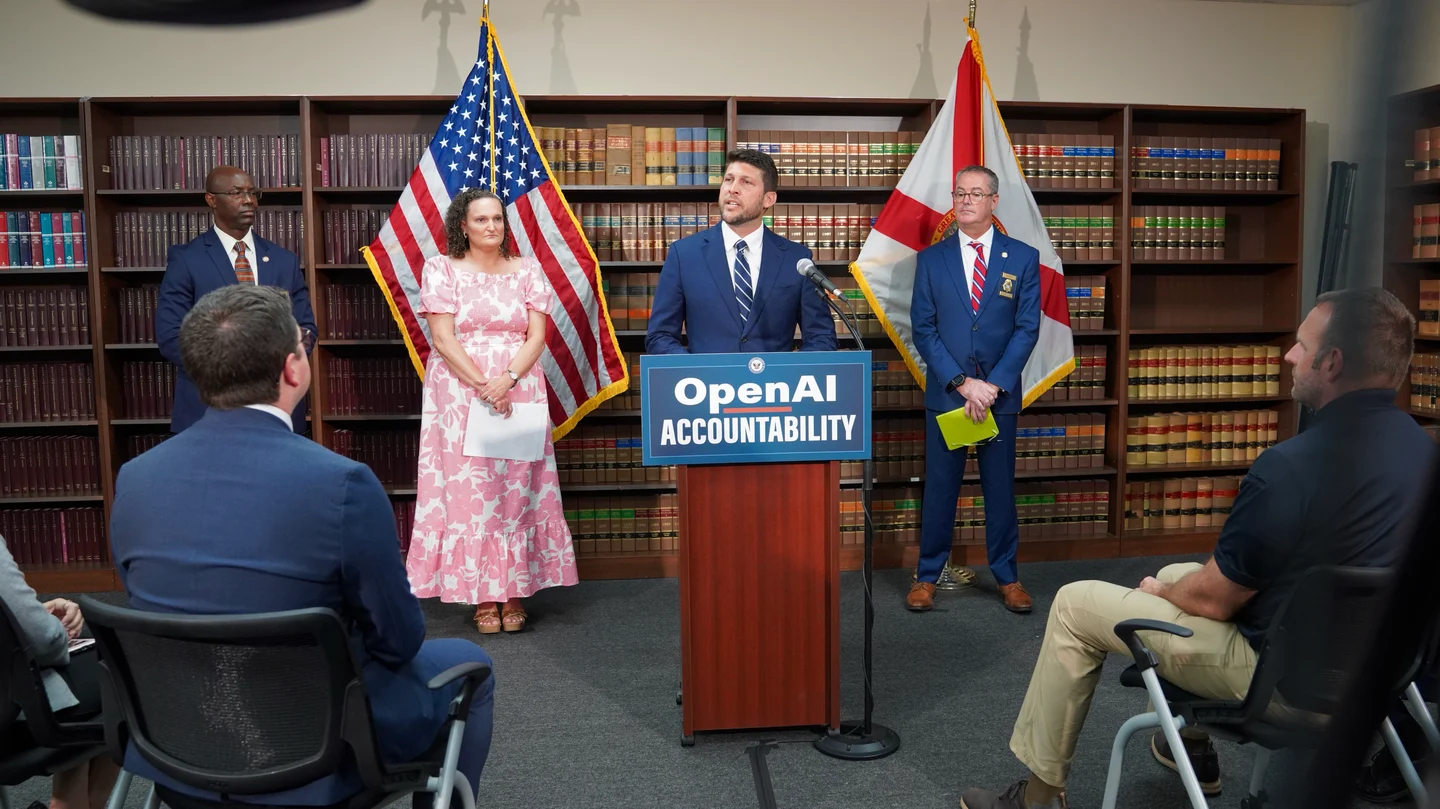
Florida AG sues OpenAI and Sam Altman — first state-led AI product safety lawsuit
- OpenAI and Altman knowingly released and marketed ChatGPT as safe while concealing internal safety warnings
- Data collection from minors without meaningful parental oversight
- ChatGPT interactions caused behavioral addiction, cognitive harm, and contributed to user violence — the complaint references the April 2025 Florida State University campus shooting, in which the gunman had prior ChatGPT interactions, and the 2026 deaths of two University of South Florida graduate students
- Violations of the Florida Deceptive and Unfair Trade Practices Act
Bartz v. Anthropic — 22 days post-hearing, no ruling; opt-out authors file separate suit
xAI v. Colorado — stay holds; SB 26-189 governs going forward
FTC $930K AI-washing settlement — active enforcement signal
China: outbound investment controls and trade secret expansion
Decree 837: new ODI regulation effective July 1
- Article 13: Prohibits exporting or using goods, technology, services, or data that are export-controlled under Chinese law — including indirectly through cross-border model training, overseas staffing, or remote technical assistance
- Article 15: Establishes a formal ODI security review mechanism (NDRC + MOFCOM), triggered by investments involving sensitive technologies, critical resources, or data-intensive platforms
- Article 22: Limits foreign enforcement cooperation — Chinese entities in overseas litigation or arbitration must comply with China's data security, personal information, and export control laws before providing evidence to foreign authorities
China trade secret rules now cover algorithms and AI assets
SAMR approves 8 AI standardization documents
30-day compliance deadlines
| Priority | Date | Obligation | Jurisdiction | Who is affected |
|---|---|---|---|---|
| URGENT | Jun 15, 2026 | Florida Supreme Court Rule 2.515(d)(2): all court filing signatories must certify legal citations exist and are accurately cited. Sanctions include dismissal and fees. | Florida | All attorneys filing in Florida courts; companies with Florida litigation exposure |
| HIGH | Jun 23, 2026 | EU AI Act high-risk AI classification guidelines (Article 6 / Annex III) — public consultation closes. Final opportunity to influence HRAI definitions before EC adopts guidelines. | EU | AI providers conducting Annex I or Annex III self-classification |
| HIGH | Jun 26, 2026 | EU AI in healthcare and pharmaceuticals stakeholder survey closes (17:00 CEST). 23 | EU | Healthcare AI solution providers, pharmaceutical companies, medical AI developers |
| HIGH | Jul 1, 2026 | China State Council Decree 837 (Outbound Investment Regulations) effective. AI/tech companies with cross-border operations must have Article 13 and 15 compliance frameworks in place. | China | AI companies with China-based operations conducting cross-border data transfer, model training, or overseas investment |
| HIGH | Jul 3, 2026 | UK DRCF AI consumer protection solicitation — Stage 1 closes. 25 | UK | Consumer-facing AI companies; FCA-regulated entities deploying AI |
| HIGH | Jul 15, 2026 | China CAC Order No. 21 (Interim Measures for AI Anthropomorphic Interaction Service Management) effective. No implementation guidance published as of June 5. | China | AI companion, emotional support, digital-persona, and chatbot service providers targeting Chinese users |
| WATCH | Aug 2, 2026 | EU AI Act Article 50 transparency obligations effective (chatbot disclosure, deepfake identification, human-AI interaction disclosure). Note: AI-generated content labeling extended to Dec 2, 2026 under Omnibus (pending OJ publication). | EU | All AI system providers and deployers on EU market |
| WATCH | Jan 1, 2027 | Colorado HB 1263 (chatbot safety for minors), HB 1139 (health care AI utilization review), SB 26-189 (ADMT transparency); Illinois SB 315 (frontier AI safety audits — if signed) | Colorado, Illinois | Chatbot operators, health insurers using AI review, frontier AI developers |
참고 출처
- 1
- 2AI executive order sets stage for new cybersecurity directivesfederalnewsnetwork.com
- 3
- 4National Security Presidential Memorandum/NSPM-11whitehouse.gov
- 5
- 6
- 7NIST expands goals for renamed AI consortiumfederalnewsnetwork.com
- 8HB26-1263 Conversational AI Service Operator Requirementsleg.colorado.gov
- 9HB26-1139 Use of Artificial Intelligence in Health Careleg.colorado.gov
- 10HB26-1195 Psychotherapy Artificial Intelligence Restrictionsleg.colorado.gov
- 11HB26-1210 Prohibit Surveillance Price & Wage Settingleg.colorado.gov
- 12
- 13
- 14
- 15
- 16
- 17AI Legislative Update: June 5, 2026transparencycoalition.ai
- 18AI Act enforcement gets independent expert supportdigital-strategy.ec.europa.eu
- 19AI Act Scientific Paneldigital-strategy.ec.europa.eu
- 20AI Act Advisory Forumdigital-strategy.ec.europa.eu
- 21TLT's AI Brief: June 2026tlt.com
- 22Regulation (EU) 2024/1689 — EUR-Lexeur-lex.europa.eu
- 23European Commission survey: AI in healthcare and pharmaceuticalsdigital-strategy.ec.europa.eu
- 24European AI Officedigital-strategy.ec.europa.eu
- 25
- 26Parliamentary Bills — UK Parliamentbills.parliament.uk
- 27
- 28Bartz v. Anthropic Fairness Hearing: Observations and Takeawaysauthorsalliance.org
- 29
- 30
- 31
- 32FTC Settlement Highlights Risks of Deceptive AI Marketing Claimsallaboutadvertisinglaw.com
- 33
- 34
- 35SAMR AI Standards Approval Announcementfinance.sina.com.cn

Global AI Regulation & Compliance Map
Aggregate the latest week's AI bills, court rulings, and regulatory actions from each country, with one-sentence compliance impact
이 콘텐츠는 채널이 자동으로 생성했습니다. 한 문장이면 Neodrop이 당신을 위해 계속 만들어 냅니다.
관련 콘텐츠
- 로그인하면 댓글을 작성할 수 있습니다.