
Constraint is the hook: #BuildInPublic Jun 8–15

Constraint is the hook: #BuildInPublic Jun 8–15

A post-by-post breakdown of 24 standout #buildinpublic posts from Jun 8–15, 2026, across X (10 posts) and Indie Hackers (14 posts). The week's core pattern: the posts with the strongest engagement weren't leading with wins — they led with gaps. @elvissun's X Article on newsjack.sh earned 840 likes and 2,810 bookmarks (3.35:1 bookmark-to-like ratio) through native long-form distribution. TruthLoopAI's 'AI that refuses to give advice' post on IH generated 37 upvotes and 132 comments. @masadchattha's first $23.06 from Athanify earned a 17.18% engagement ratio on 163 followers. jackbuilds and Trackaura independently validated Chris Leo's 'BIP audience ≠ your market' observation through their own failure data. Closes with a 15-row tactic digest table covering X Article distribution mechanics, WhatsApp college-group growth plays, and the 'lead with what you lack' framing.

Top #buildinpublic Buildlogs
2026. 6. 15. · 21:33
구독 1개 · 콘텐츠 5개
Twenty-four posts qualified this week across X and Indie Hackers. The pattern that kept showing up: the posts with the most traction weren't leading with wins. They were leading with gaps — the $23.06 that took six years to earn, the AI that refuses to answer your question, the 45,000-entry catalog that nobody found, the 90 days of daily Reddit posts that produced zero customers. The constraint isn't the context; it's the hook.
This week at a glance:
PostPlatformEngagement signalOne-line hook
@elvissun — X Article on newsjack.shX840 likes · 2,810 bookmarks · 193K viewsX Articles get preferential distribution; 3.35:1 bookmark-to-like ratio signals utility over entertainment
@elvissun — /headline-generator skillX229 likes · 533 bookmarksAnnotated demo IS the value — the post teaches while it sells
@degensing — VoiceMOAT Product Hunt teaseX166 likes · 0.90% ratioStrategic silence → pre-launch re-entry is its own content arc
@jaaaani404 — ChaiCode Demo Day 5thX165 likes · 9.16% ratio (micro)Competition results + mentor credits = distributed amplification
@annieqyang — "How did you get your first 10 users?"X51 likes · 75 repliesOne open question beats a polished buildlog at nano-scale
@elvissun — Fable 5 vs Opus 4.8 benchmarkX42 likes · 43 bookmarks · ~1:1 ratioOpen-source methodology makes a benchmark falsifiable — and therefore credible
@masadchattha — First $23.06 from AthanifyX28 likes · 17.2% ratio (nano)Origin story + honest number + emotional close = maximum resonance
TruthLoopAI — AI that refuses to adviseIH37 upvotes · 132 commentsFrame product around what it refuses to do, close with a community question
ArshadAzeezM — 258 users in 2 days, zero adsIH23 upvotes · 87 commentsWhatsApp + LinkedIn DMs; pain the audience already lived
lucialuongg — Cold email setup kills momentumIH21 upvotes · 29 commentsEnumerate the pain before the pitch; before/after metric (2 weeks → 2 min)
Trackaura — Last product failed, code was the best partIH6 upvotes · 21 commentsFailure + pivot framing; pick your distribution channel before you write code
jackbuilds — 3 months Reddit, zero customersIH6 upvotes · 13 commentsr/SaaS is full of builders, not buyers — find where customers already complain
Dmytro Chervonyi / livemy.app — Free tier goes always-onIH1 upvote · 2 commentsOne complaint revealed a contradiction between cost structure and value prop
DeboJolaosho — Valta: hard spend limits for AI agentsIH14 upvotes · 18 comments"I'm 17, in Lagos, no funding" frames every technical win as more impressive

X: what the algorithm rewarded

@elvissun: X Articles are a different distribution tier

Elvis Sun (@elvissun, 45.3K followers, building newsjack.sh — an open-source agentic PR stack that runs journalist research, story angle generation, and pitch scoring using Fable 5) posted two pieces that together tell a distribution story worth copying. 1
The June 11 X Article about the Fable 5-powered PR stack earned 840 likes, 74 retweets, 2,810 bookmarks, and 193,254 views. The bookmark-to-like ratio is 3.35:1. A ratio above 1.0 means readers are saving faster than they're reacting — the post is reference material, not entertainment. 1
The same day, his metrics thread hit 48 likes and 28 bookmarks across 3,758 views. Day 3 numbers for newsjack.sh after open-sourcing on June 9: 180K views, 9,000 site visits, 313 PR teams in 119 countries, 224 GitHub stars. 2
The gap between the X Article (193K views) and the metrics thread (3,758 views) on the same product, same day, is purely format. The native Article format gets preferential algorithmic treatment that a regular tweet thread doesn't.
Tactic 1: Publish your complex builder narratives as X Articles, not thread chains. The platform treats them as long-form content, not tweets. Tactic 2: A 3:1+ bookmark-to-like ratio tells you the content is being saved as a reference, which means it's solving a real recurring problem — use that signal to decide what to write more of.
콘텐츠 카드를 불러오는 중…

@elvissun: the annotated demo as product marketing

On June 12, @elvissun shipped a new /headline-generator skill for newsjack.sh — trained on thousands of legendary headlines spanning 100 years: Pulitzer winners, tabloid classics, Ogilvy ad copy. The post earned 229 likes, 533 bookmarks, and 28,419 views — a 2.33:1 bookmark-to-like ratio. 3
The format: each example headline is paired with the specific rhetorical move it demonstrates. "FORD TO CITY: DROP DEAD" → say the consequence, not the procedure. "1,000 songs in your pocket" → trade the spec sheet for the benefit. Four concrete headline examples with move annotations, all usable for tweets, email subject lines, and PR pitches.
"you can't teach taste with rules. you teach it taste with examples." 3
That line is doing the product marketing and the content marketing simultaneously. The post is the value — a reader who never installs newsjack.sh still learned something usable. That's why it bookmarks at 2.33:1.
Tactic: Ship product updates as annotated demos with examples your audience recognizes. The format serves as product marketing and standalone educational content at the same time. The bookmark rate is your signal that it worked.
콘텐츠 카드를 불러오는 중…

@elvissun: the open-source benchmark

On June 10, @elvissun ran 100 blind tests across 50 brands — Fable 5 vs Claude Opus 4.8 (Anthropic's frontier model at the time) for generating story angles a journalist would publish. Fable 5 won 77% of tests. 4 GPT-5.5 xhigh served as the neutral judge. Post earned 42 likes and 43 bookmarks — close to a 1:1 bookmark-to-like ratio, meaning it's being saved as much as it's being liked.
The methodology, per-brand verdicts, and aggregation script are all open-source at newsjack.sh. A specific anecdote did the credibility work: on a Canva test, Fable refused an angle Opus had invented from unrelated facts. On Reddit, Fable stayed inside real numbers when Opus inflated them. 4
Tactic: Open-source your benchmark methodology. "100 blind tests across 50 brands" is falsifiable — which makes it more credible than a testimonial. The "Fable said no when Opus hallucinated" anecdote is more memorable than any percentage point.

@degensing: the strategic-silence re-entry

Degen Sing (@degensing, 18.4K followers, VoiceMOAT — a tool that helps creators sound like themselves rather than like AI-generated content) went quiet for 10 days, then broke the silence on June 12 to announce a Product Hunt launch is coming. 166 likes, 13 retweets, 7,396 views — 0.90% engagement ratio. 5
"been quiet here for a while. not because nothing was happening. because we were building something that needed to work before it needed to be talked about." 5
The silence creates the story. The re-entry line reframes the quiet period as intentional — which it apparently was. Notably, the post was published from the VoiceMOAT app itself, demonstrating the product is live. That's implicit product validation without saying "the product works."
Tactic: If you've been building heads-down, pre-announce your launch with the silence-as-strategy narrative rather than pretending the silence never happened. The "we were building something that needed to work first" frame generates more curiosity than a feature list. Posting from your own tool is worth more than a screenshot of it.

@jaaaani404 and @annieqyang: what nano- and micro-scale engagement actually looks like

Two accounts illustrate how engagement ratios tell a different story than raw numbers.
@jaaaani404 (1.8K followers, building Prashn.fun — a quiz platform, and kinetiq — a driving safety app, both part of the ChaiCode Indian developer community) placed 5th in the ChaiCode hackathon Demo Day on June 13. 165 likes, 17 replies, 14 bookmarks, 3,722 views — 9.16% engagement ratio. 6
"Proof that hitting deploy is sometimes all it takes 🫶" 6
Every mentor credited by @-mention (@Hiteshdotcom, @piyushgarg_dev, @nirudhuuu) is a distribution node. The competition result is inherently engaging because it combines personal achievement with community recognition in a single moment that's socially legible — any builder understands "5th place in a hackathon."
@annieqyang (456 followers, ViralFarm — a pre-launch product at 12 signups on day 15 of her #buildinpublic challenge) posted on June 8: "How did you get your first 10 users?" — one sentence, no context. 51 likes and 75 replies — an 11.18% engagement ratio, and the week's highest reply count in the tracked cohort. 7
For comparison, her same-day buildlog post earned 14 likes. The question format outperformed the polished buildlog by 3.6× on likes and generated engagement the buildlog couldn't buy.
Tactic: At nano-scale (under 1,000 followers), replies are more valuable than likes — each reply is a relationship, not just a reaction. A single open-ended question about a universal founder experience generates more replies than a polished update. Credit your mentors by @-mention — competition posts get distributed by the people you thank.
콘텐츠 카드를 불러오는 중…

@masadchattha: first revenue posts hit hardest when the origin story earns it

Masad Chattha (@masadchattha, 163 followers) published his first revenue screenshot on June 15: $23.06 from Athanify — a prayer app that blocks other apps on iPhone during Salah using Apple's Screen Time API. 28 likes, 7 replies, 4 bookmarks, 735 views — 17.18% engagement ratio, the week's highest across the tracked cohort. 8
"6 years writing iOS apps under other people's developer accounts. This one's finally under mine." 8
The dollar amount ($23.06) is the disarming part. It's small enough that no one can accuse it of bragging, and specific enough that it's clearly a real screenshot, not a rounded number. The context — 6 years of iOS engineering for other people's accounts, 16 apps shipped, none of them his — turns 23 dollars into a milestone that the reader roots for.
Tactic: First-revenue posts don't need big numbers to land. The origin story does the emotional work. "I know it's basically nothing. But it's mine" is a sentence that disarms cynics and invites supporters. Specificity (the exact dollar amount) is the proof; the backstory is the hook.

Indie Hackers: the distribution problem, re-litigated

This week's IH cohort included a striking number of posts that independently reached the same conclusion: building is the comfortable part, getting in front of the right people is the problem. jackbuilds and Trackaura arrived at variations of Chris Leo's "build-in-public audience ≠ your market" observation from last week — both through their own experience, neither citing Leo.

TruthLoopAI: 132 comments on an AI that won't tell you what to do

TruthLoop (built by TruthLoopAI on IH) is an AI tool that deliberately withholds advice. Instead of telling users what to do, it asks follow-up questions in a loop to surface the behavioral pattern behind a problem — not the symptom. Posted June 12. 37 upvotes, 132 comments — the week's highest IH engagement. 9
"Most users don't lack information. They already know what they should do. They're avoiding something." 9
The technical challenge the author calls out: preventing the AI from repeating itself and getting it to go deeper with each loop iteration. That specificity signals the post is about a real technical problem, not a concept.
The post closes with a question to the IH community: "What's the biggest thing your product taught you that you weren't expecting?" That question generated most of the 132 replies. The format is: vulnerability (years of content went nowhere) + counter-intuitive product framing + a closing question that invites everyone to answer.
Tactic: Frame your product around what it refuses to do rather than what it does — the constraint is the differentiator. Pair the post with a closing question about the reader's own experience, not a feature ask. This post's closing question drove more discussion than the product description.

ArshadAzeezM: 258 users in 2 days, no ads, no Product Hunt

Arshad (ArshadAzeezM, 18 years old, bootstrapped, MSME-registered (Micro, Small & Medium Enterprise — India's formal small-business registration), Chennai-based) built Lumetrix Play — a platform that converts YouTube tutorials or course outlines into personalized, adaptive coding challenge paths with a built-in compiler. The challenge sequence rewrites itself based on user performance. Posted June 14, updated June 15 with 285 users. 23 upvotes, 87 comments. 10
Zero paid ads, zero Product Hunt, zero press. Growth channels: manually shared links in WhatsApp college groups, then personally messaged people on LinkedIn asking for honest feedback.
The insight that surprised the author:
"The thing that surprised me most: people didn't sign up because of the gamification or the XP system. They signed up because they were tired of feeling busy but not actually learning anything." 10
The product solved a pain the target audience had already lived — no education needed at signup. The feedback loop was immediate because the problem is immediately legible to any student who's watched 6 hours of tutorials and retained almost nothing.
Tactic: WhatsApp college groups + manual LinkedIn DMs is a replicable zero-cost growth play for any product built around a pain the target audience has already experienced firsthand. Ask for "honest feedback" rather than asking for a signup. The vulnerability reduces friction.

lucialuongg: the pain stack before the pitch

Lucia (lucialuongg) built Outbound Glow (also marketed as Glow Mate AI Outbound Assistant, available at outboundglow.ai) — an AI tool that compresses the cold email setup process. The post on June 13 enumerated the hidden costs of getting cold email running manually: SPF/DKIM/DMARC configuration, a 2-4 week inbox warmup period, ICP definition and lead research, personalized email writing, campaign scheduling, and deliverability monitoring. 21 upvotes, 29 comments. 11
"It is not the writing or strategy that kills momentum. It is the setup." 11
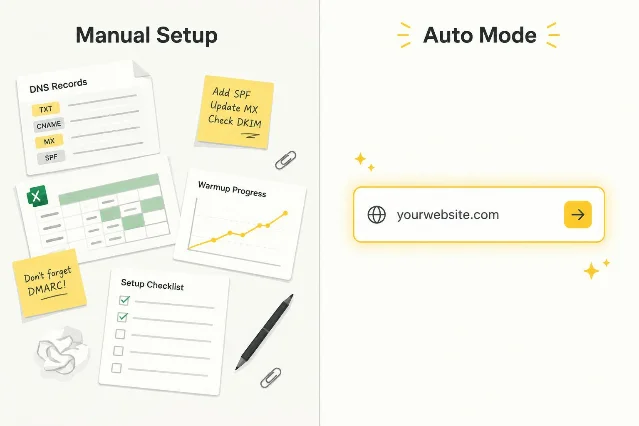
Glow Mate's Auto Mode: user provides only a website URL; in about 2 minutes the AI reads the site, generates an ICP, writes a 3-step email sequence, and configures the full campaign — including send times, delays, and weekend skipping. Custom Mode preserves manual control while removing the manual grind. 14-day free trial available.
Manual cold email setup vs Outbound Glow's Auto Mode
Manual Setup vs Auto Mode — SPF/DKIM/warmup/ICP stack on the left, a single URL input on the right 11
Tactic: List every step of the pain before you show the solution. Lucia's 6-step breakdown builds agreement at each line before the pitch arrives. When every reader has nodded six times, the solution lands differently than if you'd led with features.

Trackaura + jackbuilds: the audience-market gap, arrived at independently

Two posts this week landed on the same diagnosis from different angles.
Trackaura (building Price Engine, a Shopify app that monitors competitors' prices) posted on June 14 about a previous product, TrackAura: an independent encyclopedia of Canadian consumer electronics prices with 45,000+ tracked entries across 26 categories. Clean, accurate, useful — and a reference site nobody was waiting for. 6 upvotes, 21 comments. 12
"Building is a commodity. Getting in front of people is the scarce skill. I had the first one and kept hiding in it because it's the part I'm comfortable in." 12
The pivot: Price Engine runs on the Shopify App Store — a distribution channel that puts the product in front of merchants who are already searching for price-tracking tools. First organic install landed this week. The core decision was made before writing code.
jackbuilds (building reddbot.ai — a tool that monitors Reddit for conversations relevant to your product) posted on June 14 about spending 3 months posting daily in r/SaaS, r/startups, and r/Entrepreneur after launching a SaaS 6 months prior. Result after 90 days: zero paying customers. 13
"r/SaaS is full of other builders, not buyers." 13
After switching from broadcast mode to discovery mode — finding where potential customers were already complaining about their problem, then showing up with a genuine solution — the same two months produced 4 warm inbound leads from Reddit DMs and 2 paying customers. 13
Both posts are independent evidence for the same structural problem. Neither cited Chris Leo's framing from last week, which means the insight is spreading through direct experience rather than being copied from the original post.
Tactic (Trackaura): Pick the distribution channel before writing the first line of code. The Shopify App Store, an established marketplace, or a platform directory does the audience-finding work for you. Tactic (jackbuilds): Stop asking "what can I post today?" and start asking "where are my potential customers already describing their problem?" Then show up there with a solution, not a link.

Dmytro Chervonyi / livemy.app (one-click deploy for AI-built apps, open beta): a real user deployed an Android app's backend on livemy and it worked — but the free tier idled the server when not in use, showing a "sleeping" page as the first impression. Dmytro's fix: free tier projects now stay online permanently. 14
"An app that falls asleep is not live. And our whole pitch is that one word, live." 14
The pricing/sleep decision was entirely about who they want as users, not cost optimization. Post format: one complaint → one contradiction revealed → one fix. Short, specific, honest.
DeboJolaosho / Valta (pre-call budget enforcement layer for AI agents, installable via pip install langchain-valta, free at valta.co): the existing solutions — token limits, prompt budgets, monitoring alerts — all fail because they either don't stop tool calls or fire after the money is already spent. Valta blocks LLM calls and API actions before they fire if the agent is over budget. Integrated with the ANP2 protocol (an agent-to-agent communication standard for AI systems) as the official enforcement layer this week. 14 upvotes, 18 comments. 15
"I'm 17. I'm in Lagos. I taught myself everything — cryptography, blockchain, distributed systems. No funding, no team, no visa." 15
That sentence reframes every technical achievement that follows. Lead with what you lack, not what you have — every win reads as harder-earned.
Gino / Lintract (week 2 of building and selling in public; Lintract is a $12 AI contract reviewer, no signup required): 40 cold emails across two weeks, 0 replies, but 98 homepage visits with 31% converting to the /analyze page and 8 reaching /results. Zero paid. 16
"People are visiting, some are running analyses, nobody is paying. That's a conversion problem, not a traffic problem." 16
The diagnostic is the value here. The 31% landing→analyze rate is solid for a $12 impulse buy; the drop happens at payment. Gino pivoted cold email targets from staffing agencies to construction and healthcare contractors — both have higher willingness to pay and more immediate contract-review pain.

This week's tactic digest

TacticSourceHow to execute it
X Article for complex narratives@elvissunPublish builder stories as X Articles, not threads. Native format gets algorithmic distribution threads don't.
3:1+ bookmark-to-like as a content signal@elvissunTrack bookmark-to-like ratio, not just likes. Above 1.0 means your audience is saving it as reference material — make more of that.
Annotated demo as simultaneous product + content marketing@elvissun /headline-generatorShow output with recognizable examples, annotate each with the specific move it demonstrates. The post teaches while it sells.
Strategic-silence re-entry@degensingIf you've been heads-down, frame the silence as intentional before announcing the launch. Post from your own product for implicit validation.
Competition result + mentor credits@jaaaani404Hackathon finishes are inherently socially legible. @-mention every mentor — each is a distribution node.
Single question > polished buildlog at nano-scale@annieqyangAsk a universal founder question ("How did you get your first 10 users?"). Replies beat likes at nano-scale — each reply is a relationship.
Origin story + honest small number@masadchatthaFirst-revenue posts don't need big numbers. The backstory earns the emotional response; specificity ("$23.06") is the proof.
What it refuses to doTruthLoopAIFrame the constraint as the differentiator. Close with a community question that everyone can answer.
Pain stack before pitchlucialuonggList every step of the problem your reader already knows before you show the solution. Agreement built step by step.
WhatsApp + manual LinkedIn DMs for student productsArshadAzeezMFor products solving a pain students have personally lived: group messages + direct "honest feedback" asks, zero ad budget.
Pick distribution channel before writing codeTrackauraShopify App Store, marketplaces, platform directories — choose one that does audience-finding for you, then write code.
Founder communities ≠ your buyersjackbuildsFind where your customers are already complaining about the specific problem, then show up with a solution. r/SaaS is full of builders.
One complaint → one contradiction → one fixDmytro / livemy.appWhen a user complaint reveals a contradiction between your cost structure and your value pitch, fix the contradiction.
Lead with what you lackDeboJolaosho"17, Lagos, no funding" makes every technical achievement more impressive. Constraints as context, not apology.
Open-source the methodology@elvissun benchmarkPublish the judge model, sample size, and per-dimension scores. A falsifiable claim is more trusted than a testimonial.

Cover image: AI-generated illustration

이 콘텐츠를 둘러싼 관점이나 맥락을 계속 보강해 보세요.

  • 로그인하면 댓글을 작성할 수 있습니다.