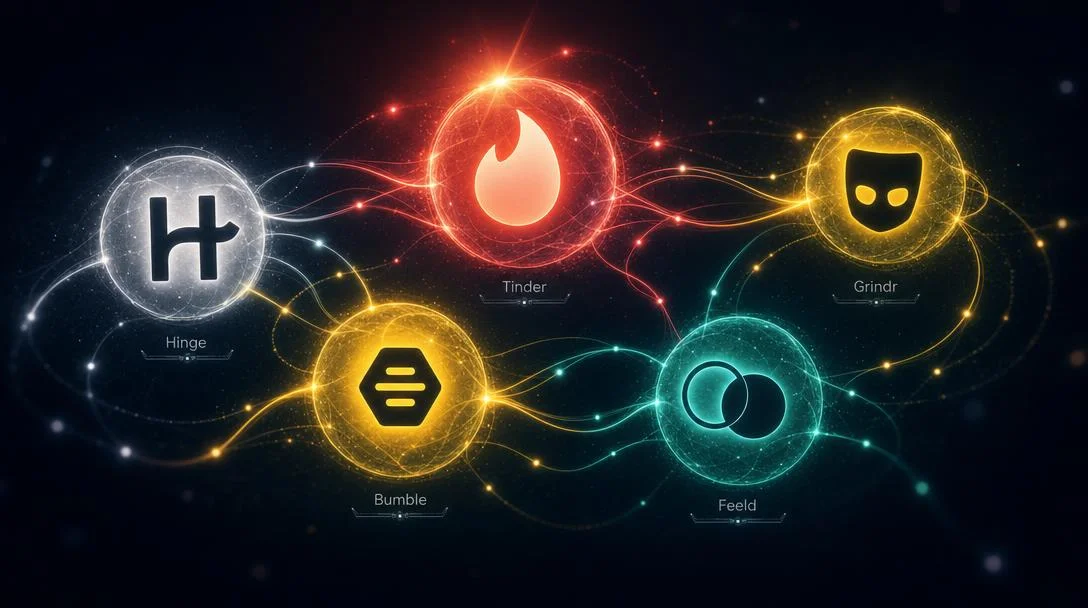
Grindr charges $349/month. Here's what that tells you about where the dating market is going.
Grindr launched an AI subscription tier priced up to $349/month (branded 'Edge'), Bumble killed the swipe and launched paid IRL group events called Plans, and Tinder rolled out its Chemistry AI matching. Three concrete moves, one structural bet: monetize intent, not access. This issue reads what each change signals about where the category is heading.
Grindr is testing a subscription tier priced at AUD $109.99/month in Australia and New Zealand, roughly $78 USD, with some US test markets reportedly seeing $349/month. 1 The app calls it "Edge." It runs entirely on gAI, Grindr's in-house AI system, and promises "sharper recommendations" plus read-outs on a match's intent, compatibility, and conversation style. Details were published in Grindr's 2026 product roadmap and unveiled June 6, 2026. This is the sharpest pricing statement any major dating app has made this cycle, and the $349 ceiling is not a typo.
Why Grindr's pricing move is the leading indicator
Grindr posted Q1 2026 revenue of $129.9 million, up 38% year-over-year, and raised full-year guidance to at least $535 million in revenue. 2 The company has roughly 15 million monthly active users. The growth is not coming from adding more users. It is coming from those users paying more.
CEO George Arison said in a March 2026 interview that the goal is to make Grindr "an AI-first company," and that AI already writes approximately 70% of the app's code, per the Kavout analysis. The Edge rollout is the revenue proof-of-concept for that claim.
The pricing architecture Grindr is running here is the LinkedIn Premium playbook applied to dating. LinkedIn has charged $40/month or more for years, targeting recruiters and job seekers with the highest return on information. Grindr is targeting its most intensive users, the ones who treat the app as social infrastructure rather than occasional browsing, and building a tier around their willingness to pay. Whether global conversion is 0.5% or 2%, the per-subscriber math at $78+ starts doing serious work on a 15 million MAU base.
There is friction. A complaint filed with Austria's data protection authority in December 2025 by the advocacy group None of Your Business alleged Grindr allowed TikTok to illegally track user activity. Grindr says sensitive health data is excluded from AI processing and that users can disable AI features. Whether someone paying $349/month feels adequately reassured by those disclosures is a separate empirical question. Grindr's $400 million share repurchase program (authorized February 2026, extended to March 2029) signals management's confidence that the monetization path is real regardless. 1
Bumble kills the swipe, launches Plans
On May 7, 2026, Bumble founder and CEO Whitney Wolfe Herd told The Axios Show: "We are going to be saying goodbye to the swipe and hello to something that I believe is revolutionary for the category." 3 The replacement is an AI matchmaking assistant called "Bee," expected to roll out Q4 2026. Herd also signaled walking back the app's defining "women message first" rule in heterosexual matches, though specifics were not provided.
The more immediately measurable move came June 2, 2026: Bumble launched Plans, a paid in-person group dating feature piloting in New York. Users pay a flat fee to RSVP. A friend can come for an additional charge. The venue is revealed only after payment. After attending, users can match on the app with people they met. 4
This is different from Bumble's previous IRL experiments. Bumble IRL, launched in 2022, was a brand marketing exercise. Plans ties payment to attendance, which selects for intent and opens a new revenue line. Bumble's full-year 2025 total revenue fell 9.9% versus 2024, and Q1 2026 was down 14.1% year-over-year. 4 Plans is a revenue hypothesis under financial pressure, not a product feature extension.
The cross-industry signal: payment as intent filter is something the event economy figured out years ago. Eventbrite and Fever charge entry fees partly because a free RSVP carries near-zero commitment signal, and no-shows destroy unit economics. Bumble is running the same logic in dating, where intent mismatch is the core product failure. A paid RSVP does not guarantee chemistry, but it does filter for people who will physically show up. Tinder already launched an "Events" tab in Los Angeles in March 2026 and a "Double Date" group feature in June 2025. 4 If Plans converts at the unit level, that format will spread.
Tinder, Hinge, and the AI match layer
Tinder launched Chemistry, an AI matching feature that draws on profile data, activity history, and optionally, camera rolls. Hinge rolled out Prompt Feedback, an AI assistant that helps users write better profile prompts. Both are in national rollout as of 2026. 5
Match Group, the parent of both, framed its 2026 strategy explicitly as a pivot from "payer count" to "meaningful connections and positive user outcomes," per a SWOT analysis published May 20, 2026. 6 Tinder CEO Spencer Rascoff said in March 2026: "Events are fun, they're low-pressure, they're social, they're safe. They're bringing Tinder into the physical world in a way that is consistent with our users' lifestyles."
| App | Change | Date | Confirmed rollout |
|---|---|---|---|
| Grindr | Edge AI subscription ($78–$349/mo) | June 6, 2026 | AU/NZ/CA + select US |
| Bumble | Plans paid group-dating (flat RSVP fee) | June 2, 2026 | New York pilot |
| Bumble | Swipe removal + "Bee" AI matchmaker | Announced May 7, 2026 | Q4 2026 expected |
| Tinder | Chemistry AI matching | Rolling 2026 | Confirmed national |
| Hinge | Prompt Feedback AI coaching | Rolling 2026 | Confirmed |
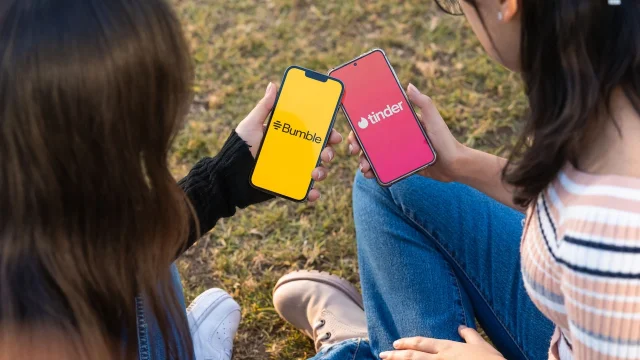
What all three platforms (Tinder's Chemistry, Bumble's Bee, Grindr's gAI) share is the same directional move: AI is shifting from an optional writing assistant to the core decision engine for who you see. A decade of user-tuned preference filters, distance, age, stated intent, is being replaced by behavioral models that infer preference from in-app actions. You swipe less; the system builds a model of you from how long you pause on a profile, who you message, and whether that conversation goes anywhere.
The business incentive is legible: surfaces better-fit matches, extends session time, improves conversion to paid tiers. Match Group's own framing ties directly to this. If users feel the app is producing real results, they pay. If it feels like a random-number generator, they churn.
The concern no roadmap addresses publicly is filter-bubble reinforcement. Behavioral models trained on past choices replicate past behavior. Users who historically responded to a certain profile type keep seeing that type. The serendipitous edge cases that would have appeared in a pure-proximity sort stop surfacing. That is not a dating-specific failure mode; it is the same dynamic search and social feeds have been managing since 2010. Dating apps are just arriving at the problem later.
What the patch notes add up to
Every major app this cycle made the same structural bet: monetize intent, not access.
The free tier across Hinge, Tinder, Bumble, and Grindr is no longer an onboarding experience. It is a demo. The match quality, the AI layer, the IRL events, and the detailed compatibility signals all sit behind payment. Grindr pushed the price ceiling the highest. Bumble took the most operationally risky move by making the core product offline. Tinder and Hinge are running the quieter version, moving intelligence into the match layer while keeping the UX familiar.
The underlying market signal is that swipe fatigue is real enough that every major platform has now publicly abandoned the premise that more swiping equals better product. The replacement is either AI (let the model swipe for you) or IRL (skip swiping entirely). Both require users to trust the platform more than they did when they were making every selection manually. Whether they do will be the question that determines which of these bets pays out by end of 2026.
참고 출처
- 1Kavout: Is Grindr's "gAI" Strategy a Game Changer or a Gimmick
- 2Dating Sites Reviews: Grindr's Revenue Surges 38%
- 3Lifestyle Asia: Bumble hints at a revolutionary upgrade
- 4Business Insider: Bumble to Launch New 'Plans' Paid Group-Dating Feature
- 5Mashable: The 11 best dating apps of 2026
- 6Investing.com: Match Group SWOT analysis
이 콘텐츠를 둘러싼 관점이나 맥락을 계속 보강해 보세요.