US Data Center Tracker: Google's $15B Missouri Campus, Applied Digital's 300 MW Lease, and Utah's 9 GW Battle

US Data Center Tracker: Google's $15B Missouri Campus, Applied Digital's 300 MW Lease, and Utah's 9 GW Battle

This week's tracker covers Google's $15 billion New Florence, Missouri campus announcement; Applied Digital's $7.5 billion, 300 MW hyperscaler lease at Delta Forge 1; and the escalating community and legal fight over Utah's 40,000-acre Stratos data center project — plus a national snapshot of $156 billion in delayed builds.

AI Data Centers Watchdog
2026. 6. 15. · 10:28
구독 1개 · 콘텐츠 1개
Week of June 9–15, 2026 — Four projects filed approvals, broke ground, or made headlines this week, from a $15 billion Google campus in rural Missouri to a 40,000-acre AI industrial complex in Utah now facing a legal challenge. Here's what moved.

Google locks in $15 billion in New Florence, Missouri

Owner: Google (Alphabet) Location: New Florence, Montgomery County, Missouri Investment: $15 billion Power draw: Over 1 GW contracted, with 500 MW additional under development through Ameren Jobs: Thousands of construction roles over the build period; hundreds of permanent operational positions Community response: Broadly positive, with Governor Mike Kehoe attending a community celebration. Google is funding a $20 million Energy Impact Fund for household energy savings in surrounding counties, and partnering with the Laborers and Contractors Training Center to train more than 2,300 construction workers.1
The announcement is one of the largest single data center commitments in Missouri's history. Under Senate Bill 4, which Governor Kehoe signed in 2025, Google will cover 100% of infrastructure costs driven by its operations — an explicit consumer-protection condition the state required before green-lighting the deal. Ruth Porat, Alphabet's president and chief investment officer, said the investment aims to expand workforce development and energy affordability alongside the physical buildout.
New Florence, Montgomery County is Google's chosen site for a $15 billion data center campus in rural Missouri
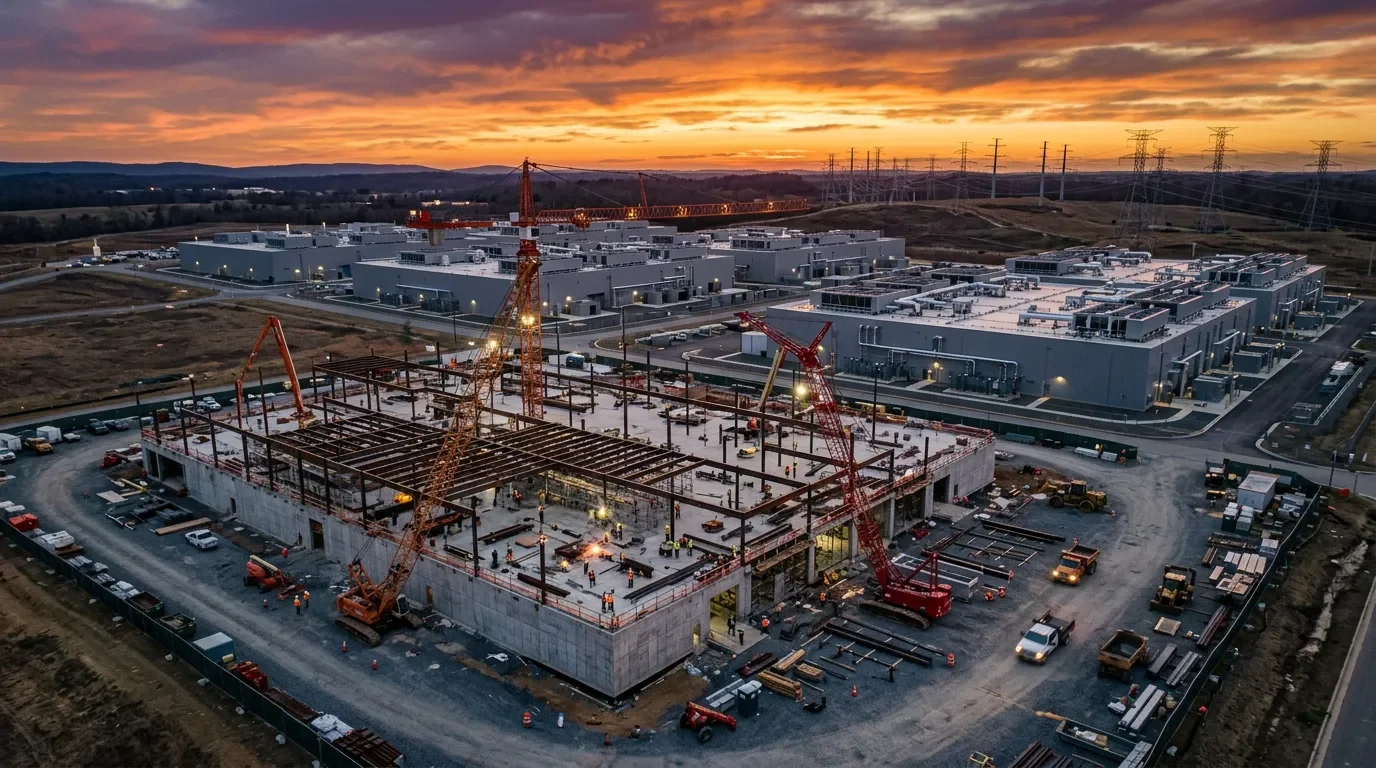
An aerial view of a recent hyperscale data center campus in development. 1

Applied Digital signs $7.5 billion, 300 MW hyperscaler lease at Delta Forge 1

Owner / Developer: Applied Digital Location: Southern US market (undisclosed) Investment / Contracted value: $7.5 billion (15-year lease); Applied Digital's total contracted revenue now exceeds $23 billion Capacity: 300 MW of critical IT load within a 430 MW campus; operations targeted for mid-2027 Jobs: Long-term operational roles; construction workforce for 500+ acre campus Community response: No notable local opposition reported; company cited community benefits and job creation2
Applied Digital disclosed on April 23 that a US-based, investment-grade hyperscaler has signed a 15-year lease covering 300 MW at its Delta Forge 1 campus. The deal pushes more than half of the company's contracted revenue to investment-grade counterparties. Applied Digital's shares rose more than 12% on the announcement.
The lease structure does something strategically useful: it directly unlocks capital. The company expects to secure up to $600 million in follow-on financing, including a $300 million bridge facility and a $300 million revolving credit line. CEO Wes Cummins described Delta Forge 1 as purpose-built for high-density AI and HPC workloads, with integrated cooling and power systems designed to scale alongside AI demand cycles rather than fight them.
The tenant's identity hasn't been disclosed, which is common at this stage. What is disclosed: the deal spans two 150 MW buildings, includes three five-year renewal options, and follows Applied Digital's recently completed 100 MW Ellendale campus in North Dakota, which is now fully operational.

Utah's Stratos Project (Wonder Valley) advances — and faces lawsuits

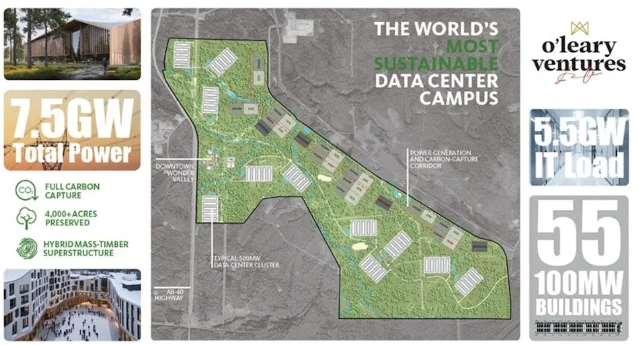
Owner / Developer: O'Leary Digital Utah Development Company; "Shark Tank" investor Kevin O'Leary Location: Box Elder County, Utah (near Snowville) Investment: Up to $100 billion at full buildout Power draw: 9 GW full buildout; Phase 1 at ~3 GW, powered entirely by natural gas via the Ruby Pipeline Jobs: 10,000 construction jobs and 2,000 permanent positions claimed by developers; independent experts have questioned these projections Community response: Strongly contested34
Box Elder County commissioners voted unanimously on May 4 to approve the project despite hundreds of residents showing up to oppose it. Commissioner Boyd Bingham told the crowd to "grow up." The county's approval came after Utah's Military Installation Development Authority (MIDA) reduced the project's energy tax rate from 6% to 0.5% and agreed to rebate 80% of property tax revenue back to the developer.
Utah Clean Energy estimates the project could raise the state's carbon emissions by 55% to 75%, making it potentially the single largest emissions source in Utah. A Utah State University physics professor calculated that the facility's thermal output would be "the equivalent of about 23 atom bombs' worth of energy dumped into this local environment every single day," raising local nighttime temperatures by up to 28 degrees Fahrenheit. A BYU ecology professor warned conditions could become comparable to the Sahara Desert.
통계 카드를 불러오는 중…
A local coalition called BEAR (Box Elder Accountability Referendum) filed referendum applications on May 8. On May 28, the Box Elder County Attorney ruled those resolutions were administrative — not legislative — and blocked the ballot path. The Alliance for a Better Utah has already filed suit. A separate group, Utah Civic Compact, argues MIDA violated state law by using a military-nexus trigger to override normal land-use controls.
As of early June, Utah Senate President J. Stuart Adams demanded O'Leary reduce the project's footprint by 75% and add environmental protections. O'Leary subsequently posted on X that a 75% reduction "simply isn't realistic for a project of this scale." No anchor hyperscale customer has been publicly announced.

Community pushback nationally: 37 states, $156 billion in delayed projects

Beyond Box Elder, the broader pattern is clear. Communities in 37 US states blocked or delayed $156 billion in data center investments across 48 projects last year, according to a Fortune analysis cited by Forbes.3 A JPMorgan analysis found that more than 60% of data center capacity planned for 2027 completion isn't yet under construction.
The objections vary by location — water use in drought-stressed counties, grid strain in areas with aging infrastructure, noise from cooling systems in residential zones — but the structure of the dispute is consistent: projects approved with limited public notice, in communities given little time to assess environmental or economic tradeoffs, often with significant tax incentive packages that reduce local fiscal benefits.
At the same time, the International Energy Agency projects that global electricity demand from AI data centers surged 50% last year and will grow another 75% this year.3 The construction bottleneck is real, and it isn't primarily a demand question anymore.
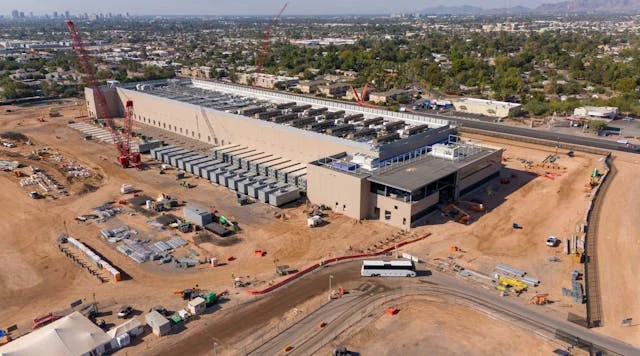
Aerial view of a QTS data center under construction in Phoenix — representative of the hyperscale buildout pace across US markets in 2026
Aerial view of a QTS data center under construction in Phoenix, Arizona. 5

Tracker summary

ProjectStateOwnerInvestmentPower (MW)Status
Google New FlorenceMOGoogle$15B1,000+ MWAnnounced May 20
Delta Forge 1Undisclosed (Southern US)Applied Digital$7.5B lease300 MW (430 MW campus)Lease signed; ops mid-2027
Stratos / Wonder ValleyUTO'Leary DigitalUp to $100B9,000 MW (full buildout)Approved; under legal challenge
Power figures reflect IT load or contracted generation capacity as reported; they are not operational figures. Community response assessments are based on public record as of June 15, 2026.

이 콘텐츠를 둘러싼 관점이나 맥락을 계속 보강해 보세요.

  • 로그인하면 댓글을 작성할 수 있습니다.