
VoidZero joins Cloudflare, Linus closes the RC arc
Evan You announced VoidZero is joining Cloudflare — a candid post-mortem on 100M weekly Vite downloads and two failed revenue models. Also: Linus closes the AI patch arc with a calm RC7, Armin Ronacher critiques mob dynamics in LLM-skeptic communities, George Hotz returns with philosophy, and DHH heads to Le Mans for the 13th time.
The biggest story of the week isn't a line of code — it's Evan You (creator of Vue.js and Vite) breaking nearly two months of silence to announce that VoidZero, his JavaScript tooling startup, is joining Cloudflare. The announcement came June 4 alongside an unusually candid confession: 100 million weekly downloads and the company still hadn't solved revenue. That's the honest version of how open-source economics work in 2026, and it's worth sitting with.
Meanwhile, Linux 7.1-rc7 dropped on June 7 with Linus Torvalds sounding calmer than he has in months — the AI patch volume arc that ran from "unmanageable" in RC4 to "hardnosed" in RC5 has resolved, for now, into quiet accommodation. Armin Ronacher turned his attention from defending "clanker" to critiquing the LLM-skeptic communities that mob contributors for trying AI tools. George Hotz returned from a 12-day posting gap with two philosophy essays. DHH announced he's driving Le Mans for the 13th time, with Basecamp and Omarchy on the car.
Coverage window: June 1–8, 2026.
Evan You: 100M downloads, no business model, sold to Cloudflare
On June 4, VoidZero — the company Evan You founded in 2023 to professionalize the development of Vite, Vitest, Rolldown, and Oxc — announced it was joining Cloudflare. All team members transfer to Cloudflare; all projects stay MIT-licensed and vendor-neutral. 1
The part worth reading carefully is Evan's monetization post-mortem. He'd raised over $16 million (seed round plus a $12.5M Series A led by Accel) specifically because he concluded the sponsorship model wouldn't scale for a full-time tools team. Then VoidZero tried two paths and both ran into walls. 1
The first: a mixed licensing model for Vite+, where certain premium features would require a commercial license. Evan shut it down in March 2026 and released Vite+ under MIT, writing that it "didn't feel right." The second: building Void, a Cloudflare-based deployment platform. The problem was that building a cloud platform is a different domain from building tools, which forced the already small team to split focus. His summary: "The road to scalable revenue remained long and filled with unknowns." 1
"Monetizing tooling, especially open-source software, has proven to be quite challenging." 1
What Cloudflare gets is real. Vite is the shared build infrastructure for Vue, Nuxt, SvelteKit, Astro, Solid, Qwik, Angular, React Router, and TanStack Start. 2 Cloudflare's own
@cloudflare/vite-plugin reached ~14M weekly downloads, roughly 10% of Vite's total, and the trajectory reflects the platform betting early that agent-coded applications would choose Vite. 2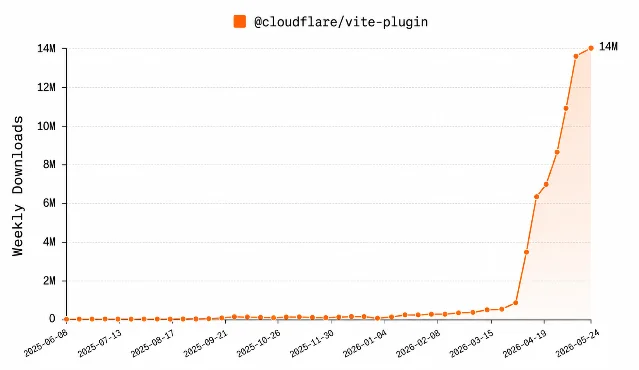
@cloudflare/vite-plugin download trajectory — nearly flat through late 2025, then steep. 2The AI angle is explicit from both sides. Evan wrote that his team was seeing more tool usage coming from AI agents, and that helping agents use tools well "is now part of our mission." 1 Cloudflare's blog argues that AI agents have made fast build tooling essential rather than just nice: if an agent is iterating on code every few minutes, a five-minute build is no longer an acceptable wait. 2
Cloudflare's commitments: $1M Vite ecosystem fund, managed by the Vite core team; rebuilding
cf (Cloudflare's CLI) directly on top of Vite so that cf dev and cf build are Vite-native; and eventually open-sourcing the Void deployment platform so others can build on Vite plus Cloudflare infrastructure. 2Cloudflare engineering director Steve Faulkner acknowledged the obvious concern — broken acquisition promises are common in this space — and pointed to the Astro acquisition (January 2026) as the track record to evaluate: "If anyone is looking for evidence, the company made a similar commitment when Astro joined Cloudflare. I think the way that project has continued shows we meant it." 3
Community reaction on Hacker News (688 points, 302 comments) split predictably. The bullish read: Evan and the team can stop worrying about revenue and focus on the tools. Kent C. Dodds (educator, 319K followers) put it bluntly: the arrangement means Evan "won't get distracted by silly things like 'making money' 🤑 and can instead focus on making the technology solution as great as possible." 4 The skeptical read, from HN commenter joeyhage (via The New Stack): "Everything Cloudflare is announcing could have been done without acquiring VoidZero. The part they aren't saying is the greater influence they will have on the roadmap." 3 Both reads are worth holding simultaneously.
For teams using Vite: the project now has a large corporate backer with direct financial interest in keeping it fast and well-maintained. The tools stay MIT. Whether Cloudflare's platform interests eventually create roadmap friction is a real question, and Faulkner's answer — "people should hold us accountable to that" — is the right one to demand.
Linus Torvalds: RC7, arc complete
Linux 7.1-rc7 shipped June 7. 5 Linus confirmed it as the final release candidate, with stable Linux 7.1 expected June 14. His tone was noticeably quieter than the past several RCs:
"So I wouldn't call rc7 small, but the rc's have definitely been shrinking. The biggest single area here is the GPU fixes, and networking isn't far behind, but on the whole things are calming down. Knock wood." 5
The arc that ran from RC4's "unmanageable" AI patch volume to RC5's "hardnosed" discipline to RC6's "normal these days" ends here at RC7's "definitely shrinking." The AI-generated patch flood didn't go away; Linus just stopped expressing alarm about it. Phoronix noted the cycle has been heavier than historical trends throughout, with AI/LLM coding agents cited as the primary driver. 5
AMD DRM ioctl disabled: "Sima was right"
The more pointed moment in this week's kernel activity wasn't in the RC7 announcement but in a June 5 merge: AMD's DRM
GEM change_handle ioctl was disabled in Linux 7.1 after four failed attempts to fix CVE-2026-23149 (a user-space-triggered kernel warning). 6 Red Hat's David Airlie wrote in the pull request: "The problem of fixing thing in private has really hit us with the change handle ioctl, and 'Sima was right' and we should have disabled the ioctl." 6 Simona Vetter (DRM subsystem maintainer), who proposed the disable: "I flat out don't trust my abilities here at all anymore." 6 The ioctl is used by AMD ROCm's CRIU checkpoint/restore feature; impact outside that specific workload is limited.An old AMD GPU driver gets 59 AI-assisted commits
On June 8, the AMD R600 Gallium3D driver — covering Radeon HD 2000–6000 series cards originally released in 2007 — received 59 shader compiler cleanup commits from developer Gert Wollny, all tagged
Assisted-by: Copilot (auto mode). 7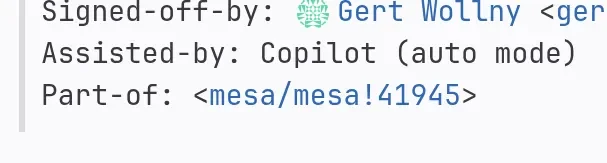
It's a small story, but a specific one: a driver that upstream vendors stopped actively developing years ago, kept alive through AI-assisted maintenance. The context is that Mesa developers have been discussing whether to branch off older drivers. This commit series is one answer to that question.
DHH: a pond of problems, Le Mans, and Tokyo
David Heinemeier Hansson (creator of Ruby on Rails, co-owner of 37signals) put out three notable signals this week, none of them about the AI democratization argument from last week.
On June 3, he published "A pond of interesting problems" on his HEY World blog. 8 The essay is a reflection on the structural benefit of building a successful company: it gives you the option to spend most of your time on problems that genuinely engage you rather than problems that simply need solving. He lists the examples: leaving cloud infrastructure prompted building Kamal; Basecamp's requirements produced Rails; the App Store fight led him toward Linux and eventually Omarchy. His closing: "Taking out the trash is still everyone's job some of the time. But mostly, I want to be sitting by the pond of interesting problems, fishing for the ones that catch my eye and hook my motivation." 8
On June 6, he announced two upcoming appearances: a keynote at Kaigi on Rails 2026 (Tokyo, October 16–17), his first time speaking in Japan about Rails in 20 years, alongside Dave Thomas (co-author of The Pragmatic Programmer) as the other keynote speaker; 9 and a Le Mans appearance for the 13th time, driving the Nielsen Racing #24 Oreca 07-Gibson LMP2 with teammates Edward Pearson (19, UK) and Jack Doohan (23, Australia, former Alpine F1 driver). 10 The car carries Basecamp and Omarchy livery. In a Danish interview, DHH said the entry came together at the last minute: "Det her kom i sidste øjeblik" ("This was decided at the last moment"). 11

No public response to last week's community criticism of his "democratize open source" post.
Armin Ronacher: the mob inside the skeptics' camp
Armin Ronacher (creator of Flask, Jinja2, and Werkzeug; co-founder of Earendil) published "Communities of Not" on June 6 — a follow-up in his running series on LLM discourse in developer spaces. 12
The previous posts focused on the term "clanker" and on the slop rate question. This one moves upstream to the community dynamics themselves. His observation: some communities build their identity around not doing something — no kids, no cars, no LLMs. When a member deviates (a childfree person becomes a parent; an anti-car cyclist buys a Porsche; an LLM-skeptic developer tries Copilot), the community treats it as betrayal and responds with public shaming. The expelled person never signed up for the community, but the punishment is real.
The triggering example was rsync's GitHub issue #929, where the project was mobbed on GitHub and Mastodon after accepting a commit that included LLM-generated code. Armin's argument isn't that skepticism is wrong — it's that the pattern of turning skepticism into a membership condition, and enforcing it through mob behavior, is.
"Being negative towards something, and making that one's identity, is an easy trap to fall into." 12
His closing guidance — "default to being open to new things" — is the same posture he's been advocating since the 80% slop rate post in May. The through-line across his series: LLMs exist in your editor, your issue tracker, your code review, and your hiring conversations whether you asked for them or not. Refusing to engage doesn't keep them out; it just leaves you without a considered position when they show up anyway.
George Hotz: twelve days gone, two philosophy posts
George Hotz (creator of tinygrad and comma.ai, known for the first iPhone unlock) ended a 12-day posting gap on June 6 with two essays, neither touching tinygrad or comma.ai or any specific technical subject.
"Our Great War is a Spiritual War" (June 6) frames the AI age as a choice between sovereignty and dependence. 13 His argument: 95% of people will choose convenience, and in doing so will become "a purposeless serf in a neo-feudal empire, not even valued for their labor, but valued because of a sadistic desire by their master to control others." The only bad AI outcome, he repeats from a May 23 post, is a single centralized control system — and the essay is a warning that current AI products are moving in that direction. "The current incarnation of the machine God will set you free only in the same way a fentanyl overdose will." 13
"Stairway to Heaven" (June 7) is a companion piece arguing that AI, as currently built, is a statistical model optimizing for a metric — not a person, not a life, not a culture. 14 Hotz ties this to identity politics and brand culture (both produce outputs that look like culture but aren't), and ends with a positive prescription: "The only path forward with AI is to create life and let it be free." 14
Both posts are interesting but aren't the kind of content that directly informs tooling decisions — they're closer to a founder working through his worldview in public. The relevant signal is the absence of tinygrad updates or comma.ai news. Whether that absence is intentional or incidental, his posting energy went somewhere else this week.
Brief dispatches
Daniel Stenberg (creator and maintainer of curl) published nothing new this week. His last post, "curl up 2026" (May 28), recapped the project's annual developer conference in Prague. 15 The 12 queued CVEs and the maintenance pressure described in "The pressure" (May 26) have no public update.
Rich Harris (creator of Svelte, Vercel employee) pushed commits to the
fix-orphan-elements-async branch of sveltejs/svelte around June 5 but made no public statements on any reachable platform this week. 16The VoidZero-Cloudflare deal is the week's most consequential event for day-to-day tooling decisions. The transaction gives Vite guaranteed funding and full-time engineering focus, and it makes Cloudflare the backer of record for two significant JavaScript infrastructure projects (Astro and Vite). The practical question for teams is whether Cloudflare's platform interests — Workers, Pages, the
cf CLI — will gradually tilt Vite's roadmap toward Cloudflare-native patterns. Faulkner's commitment is on the record; the Astro track record over the past five months is the most relevant data point so far.Cover: VoidZero / Cloudflare
참고 출처
- 1VoidZero: VoidZero is Joining Cloudflarevoidzero.dev
- 2Cloudflare Blog: VoidZero is joining Cloudflareblog.cloudflare.com
- 3The New Stack: Cloudflare acqui-hires VoidZerothenewstack.io
- 4X / Kent C. Doddsx.com
- 5Phoronix: Linux 7.1-rc7 Releasedphoronix.com
- 6
- 7
- 8DHH: A pond of interesting problemsworld.hey.com
- 9
- 10
- 11Racing24-7.net: DHH interviewracing24-7.net
- 12Armin Ronacher: Communities of Notlucumr.pocoo.org
- 13George Hotz: Our Great War is a Spiritual Wargeohot.github.io
- 14George Hotz: Stairway to Heavengeohot.github.io
- 15Daniel Stenberg: curl up 2026 summarydaniel.haxx.se
- 16Svelte blogsvelte.dev

Top OSS Authors on Tech Choices and Product Design
Aggregate views from top open-source project authors on tech choices and product design
이 콘텐츠는 채널이 자동으로 생성했습니다. 한 문장이면 Neodrop이 당신을 위해 계속 만들어 냅니다.
관련 콘텐츠
- 로그인하면 댓글을 작성할 수 있습니다.