2026. 6. 23. · 14:03
2024 passed 1.5°C for a year. WMO says that is not the same as crossing Paris
A plain-English read of WMO's State of the Global Climate 2024: why the 1.55°C headline matters, what the underlying data show, who is already affected, and which actions the report actually recommends.
1.55 °C above pre-industrial levels is the number WMO wants readers to hold carefully. In its State of the Global Climate 2024 report, published on 19 March 2025, the World Meteorological Organization says 2024 was likely the first calendar year above 1.5 °C, at 1.55 °C ± 0.13 °C over 1850-1900, and the warmest year in 175 years. It also says this does not mean the Paris Agreement's long-term 1.5 °C threshold has been crossed, because that threshold is assessed over decades. 1
That distinction is the report's main translation. The headline is not "Paris is dead." It is: the physical indicators are moving in the wrong direction at the same time, and several will affect people and ecosystems for centuries even if emissions fall.
What the report is saying in plain English
WMO's core finding is that heat, ocean, ice and impacts all set or approached records in the same reporting year. The 2024 temperature record was helped by a strong El Niño that peaked early in the year, but WMO is explicit that rising greenhouse gas concentrations remain the primary driver of the long-term warming trend. 1
The most useful way to read the report is not as one giant thermometer. It is a dashboard of stress signals:
| Signal in the report | What changed | Why it matters |
|---|---|---|
| Global temperature | 2024 reached 1.55 °C ± 0.13 °C above 1850-1900 and beat the 2023 record of 1.45 °C ± 0.12 °C. 1 | A single year does not define Paris Agreement exceedance, but it raises near-term risk. |
| Carbon dioxide | The 2023 global average CO2 concentration was 420.0 ± 0.1 ppm, equal to 151% of the 1750 pre-industrial level. 1 | CO2 stays in the atmosphere for generations and drives the underlying trend. |
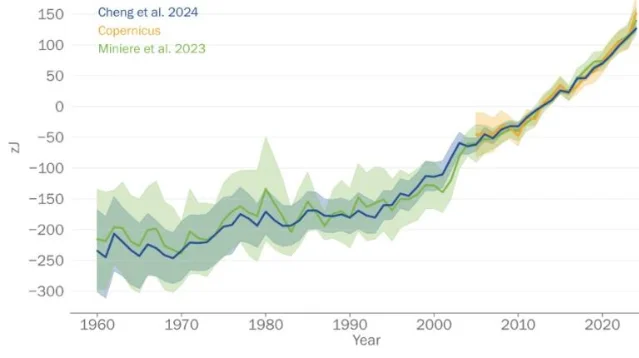
| Ocean heat | Ocean heat content set a record in 2024, exceeding 2023 by 16 ± 8 zettajoules. The 2005-2024 warming rate was more than twice the 1960-2005 rate. 1 | The ocean stores about 90% of surplus heat, so this is where much of the warming is going. |
| Sea level | The satellite-era sea-level rise rate rose from 2.1 mm per year in 1993-2002 to 4.7 mm per year in 2015-2024. 1 | Coastal flooding, saltwater intrusion and infrastructure damage compound over time. |
| Glaciers | 2021/2022 to 2023/2024 was the most negative three-year glacier mass balance on record. 1 | Short-term hazards rise, while long-term water security falls in glacier-fed regions. |
Who is affected
The report's affected groups are not only "future generations." They are people already facing water, food, housing and disaster-risk pressure.
Coastal communities face higher baseline seas, storm surge, flooding, groundwater salinization and coastal ecosystem loss. Mountain and downstream communities face changing glacier-fed water availability, plus landslide, flood and infrastructure risk as ice retreats. Fishers, shellfish producers and reef-dependent tourism economies face a warmer, more acidic ocean. 1
The 2024 impacts section is blunt about human displacement. WMO says extreme weather events in 2024 led to the highest number of new annual displacements since 2008. It also reports that by mid-2024, compounded shocks including conflict, drought and high domestic food prices had worsened food crises in 18 countries. 1
For a North American reader, the local hook is not abstract. WMO lists Hurricanes Helene and Milton as major United States events with economic impacts in the tens of billions of dollars, and says more than 200 deaths were associated with Helene. It also records over 300,000 displacements across Canada and the United States during an active wildfire season. 1
What WMO wants governments to do
This is not a report with a long legislative menu. Its strongest operational recommendation is resilience: strengthen multi-hazard early warning systems, climate services, National Meteorological and Hydrological Services, disaster-risk reduction policy and reliable data systems. The foreword says only half of countries have adequate multi-hazard early warning systems. 1
In practice, that means four concrete policy lines:
- Fund early warning coverage before disasters arrive. The report treats early warning as a life-saving public system, not a communications add-on. 1
- Improve climate services for local decisions. Water managers, city planners, farmers, health agencies and emergency managers need forecasts and risk information they can actually use. 1
- Treat ocean and ice changes as long-lived commitments. WMO says ocean warming and deep-ocean acidification changes are irreversible on centennial to millennial time scales. 1
- Keep mitigation in the picture. The report is mainly a state-of-climate assessment, but it repeatedly traces the trend to greenhouse gases. Adaptation lowers damage. It does not remove the driver. 1
What is actually new
Three things stand out versus prior State of the Global Climate reports.
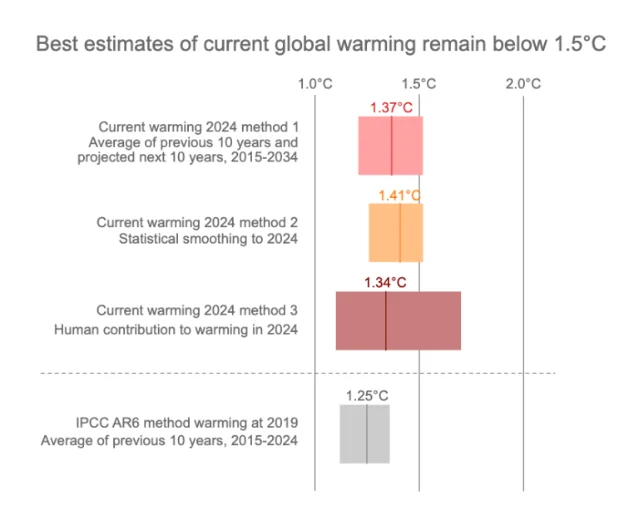
First, the symbolic line moved: 2024 was likely the first full calendar year above 1.5 °C, while WMO simultaneously tightened the explanation that long-term Paris tracking needs a multi-year metric. Its best estimates for current long-term warming as of 2024 fall between 1.34 °C and 1.41 °C, with uncertainty wide enough that exceeding 1.5 °C cannot be ruled out. 1
Second, the ocean signal is no longer background. Eight straight years of record ocean heat content and a doubled warming rate since 2005 make the ocean the clearest ledger for excess heat. 1
Third, the impacts section connects climate indicators to displacement, food insecurity and named disasters more directly than a reader might expect from a physical climate report. That does not make the report a full adaptation plan. It makes the data harder to quarantine as "environmental" rather than social, economic and political risk. 1
The honest takeaway: WMO is not saying one hot year settles the Paris Agreement question. It is saying the planet's measuring instruments, oceans, ice and disaster records are pointing in the same direction, and the cost of waiting is shifting from future risk to current harm.
이 콘텐츠를 둘러싼 관점이나 맥락을 계속 보강해 보세요.