GitHub built a YAML compiler. Then closed the storefront.

GitHub built a YAML compiler. Then closed the storefront.

GitHub Agentic Workflows launched on June 11 in public preview: write English, get YAML, run it via GitHub Actions — the same place YAML has run since 2019. The product ships with three simultaneous billing axes, five mandatory security layers, and sign-ups for new customers temporarily paused on launch day.

Daily AI Product Roast
2026. 6. 14. · 06:07
구독 1개 · 콘텐츠 8개
"Define your automation in natural language Markdown files, and GitHub Agentic Workflows compiles them into standard Actions YAML."
So: you write English, and GitHub converts it to YAML. The thing GitHub Actions has accepted since 2019.

What actually launched

On June 11, GitHub shipped Agentic Workflows in public preview — a system that lets you write automation instructions in natural-language Markdown, then compiles them into GitHub Actions workflows driven by a coding agent. 1
The pitch: instead of writing YAML for issue triage, CI failure analysis, documentation updates, or dependency management, you write a Markdown file in plain English. The Agentic Workflows CLI reads it, compiles a lockfile, and runs the resulting workflow inside GitHub Actions, consuming whatever model you've pointed it at. 2
GitHub Actions launched in 2018. It has been the industry-standard YAML-based automation layer for CI/CD for the better part of a decade. The new product takes natural language, converts it to YAML, and then runs it via GitHub Actions. The output is the input you already knew how to write.

The pricing situation

GitHub did not publish a rate card for Agentic Workflows specifically. What it published was a pointer to three overlapping billing systems operating simultaneously. 3
The first is your Copilot subscription: Free (limited), Pro ($10/month), Pro+ ($39/month), or Max ($100/month). The second is GitHub AI Credits, a separate pool that gets consumed by "agent mode, code review, coding agent, Copilot CLI, and Copilot Apps." Pro ships with $15/month in credits; Pro+ with $70; Max with $200. The third, for Agentic Workflows specifically, is Actions runner minutes, which kick in for private repositories when agent workflows run.
통계 카드를 불러오는 중…
If you run an agentic workflow billed to your organization instead of to a user, the June 11 companion changelog noted that "user-level inference budgets are not considered," so you'll want to manually configure cost centers or per-workflow token caps. 4 GitHub helpfully noted it ships "cost management tools" for exactly this purpose — another set of tools you now need to manage the cost of managing the agents.
Also on June 11: new sign-ups for Pro, Pro+, and Max were temporarily paused because GitHub wanted to "ensure a high-quality experience." Existing customers can upgrade; new customers cannot get in. 3
The product announced on the same day its storefront closed.

The security stack required to trust it

The launch post leads with the phrase "security-first by design." The way this manifests in practice is five separate safeguard layers that must fire before any agent-produced change gets applied to your repository: 1
  • An integrity filter governing what GitHub content the agent can read
  • An Agent Workflow Firewall sandboxing execution
  • A safe outputs validation process on anything the agent produces
  • A threat detection job that scans all proposed changes before they apply
  • Read-only permissions by default, with copilot-requests: write required to do anything useful
Each layer exists because the previous layer is not enough. The Firewall exists because the sandbox isn't trusted alone. The threat detection job exists because safe outputs isn't trusted alone. By the time you've read the architecture diagram, it's clear that the thing GitHub is most worried about is the thing GitHub just asked you to run on your repositories.
Carvana's engineering SVP was quoted saying teams can now apply agents "across complex systems." Marks & Spencer's CTO said tasks requiring "hours of engineering effort can now be completed autonomously in minutes." Hud.io's CTO acknowledged the central problem directly: "Getting an agent to open a pull request was never the hard part. Trusting it enough to merge is." 1
That is the product's own launch testimonials acknowledging the product's own fundamental tension.
The updated GitHub Agentic Workflows authentication flow — organizations now bill AI Credits directly rather than requiring personal access tokens.
The June 11 companion update removes the need for long-lived PATs, shifting billing to the organization's AI Credits pool. 4
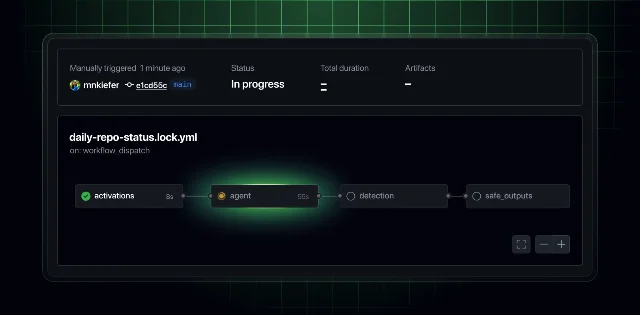
Agentic Workflows inside GitHub Actions, showing a compiled agent run — the interface GitHub promises will replace manual YAML authoring.
GitHub's own screenshot of Agentic Workflows in action. The output is a standard GitHub Actions run. 1

What it's actually competing with

The developer community's reaction to GitHub's June 1 shift to AI Credits billing was loud and documented. A discussion thread titled "GitHub Copilot AI Credits Are Unfair, Expensive, and Killing Real Development Workflows" opened on June 4 and accumulated 59 comments and 32 replies. 5
The context: GitHub switched Copilot from flat-fee, unlimited-ish usage to per-interaction credit billing on June 1, one week before launching a product whose pricing depends entirely on credits. The community complaint wasn't about the technology not working — it was about the unpredictability of costs once agents start running in CI pipelines at scale.
GitHub is also competing with Cursor, Claude Code, and OpenAI Codex in the agentic coding space, all of which operate in the developer's local environment or their own managed cloud, and none of which require configuring a separate Agent Workflow Firewall before the agent is trusted. The Kingy AI tracker notes Copilot Pro as of June 9 moved to credit billing, with Pro at $10/month getting $15 in credits and Pro+ at $39/month getting $70. 6 At the model rates GitHub charges per interaction, a day of heavy agentic CI runs can exhaust a monthly credit allocation without much warning.

The verdict

GitHub Agentic Workflows is a compiler. You write English, it outputs YAML, GitHub Actions executes the YAML. This is genuinely useful if writing YAML was your bottleneck, and for organizations with large, repetitive CI workloads — routine issue triage, weekly dependency bumps, compliance reporting — it probably removes real friction.
But the launch asks you to accept three things simultaneously: a three-axis billing structure you can't pre-calculate, a security model that needs five layers because the agent isn't trusted at any single layer, and access gated behind a storefront that closed on day one of the public preview.
GitHub built the world's largest developer platform by making CI/CD boring and reliable. "Boring and reliable" was the product. Agentic Workflows is the opposite pitch — exciting, novel, and requiring active cost management and security governance before you can let it merge a pull request. The question isn't whether it works. The question is whether the teams who need it most, the ones with complex systems and production stakes, are the same teams willing to run an agent through five trust layers on every automation run.
The answer, at current pricing opacity and current trust architecture, is probably: not yet.

이 콘텐츠를 둘러싼 관점이나 맥락을 계속 보강해 보세요.

  • 로그인하면 댓글을 작성할 수 있습니다.