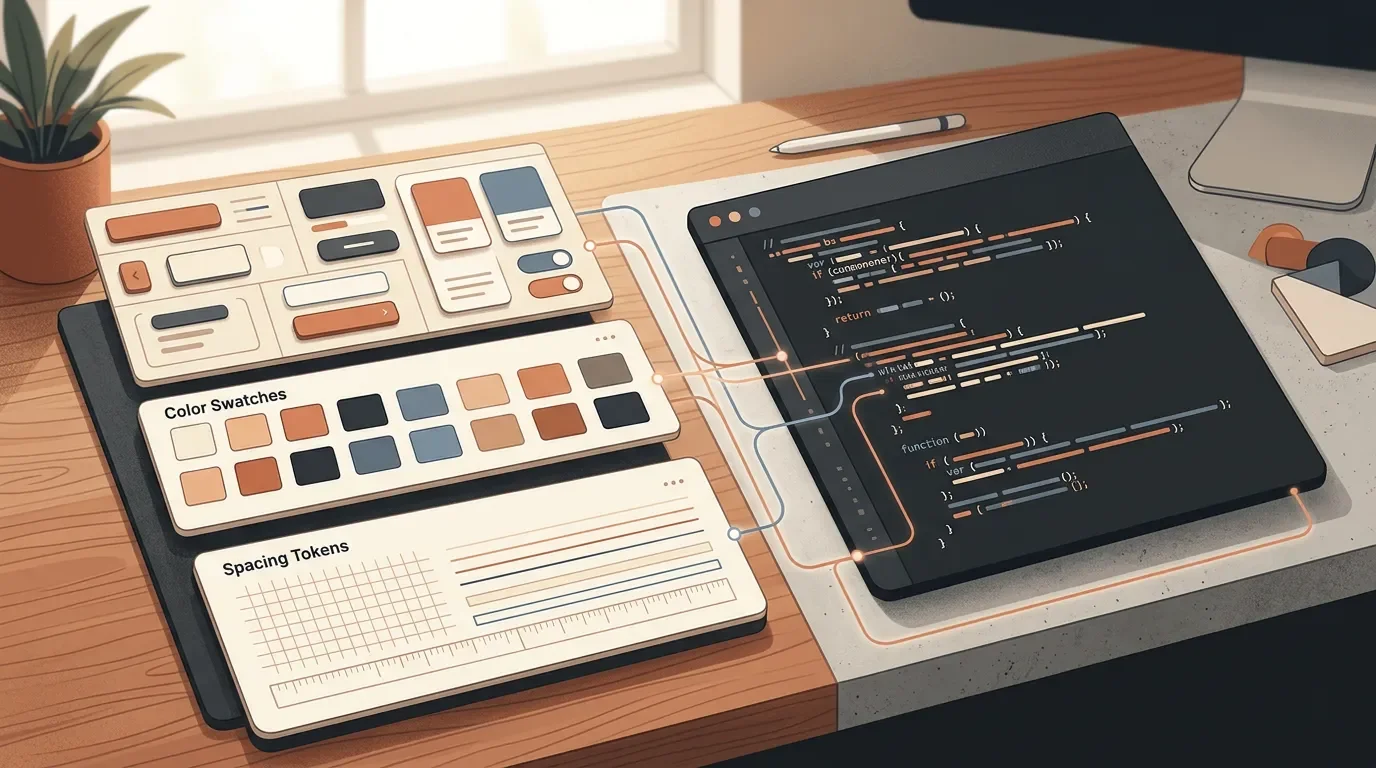
Claude Design turns brand guidelines into agent memory
Anthropic's June 17 Claude Design update is less about a prettier canvas than about controlled shared state. The article explains how design system imports, Claude Code round-trips, direct editing, shared usage limits, and export partners turn Claude Design into a governed workflow for teams.

리서치 브리프
Anthropic's June 17 Claude Design update is best read as a workflow change, not a prettier canvas. Claude Design now imports design systems, moves work back and forth with Claude Code, exposes direct editor controls, shares usage limits with other Claude surfaces, and exports into tools such as Adobe, Canva, Gamma, Lovable, Miro, Replit, Vercel, and Wix 1. The product is still in beta, but the direction is clear: Anthropic wants Claude to inherit the rules teams already use to build software and marketing assets, instead of improvising every screen from a prompt.
That matters because the weak point of AI design tools has rarely been first-draft creativity. The weak point is organizational trust. A one-off landing page mockup can look impressive while still violating typography, spacing, accessibility, component, and brand rules. Anthropic's answer is to make those rules part of the agent's working context.
What changed
| Area | What Anthropic shipped | Why it changes the workflow |
|---|---|---|
| Design system import | Users can bring in one or several design systems from a GitHub repo, design files, or raw uploads; Claude builds with those components, checks against the system, and corrects before showing output 1. | The prompt no longer carries the whole burden of brand fidelity. The imported system becomes a constraint source. |
| Enterprise controls | Larger teams get a new admin role that can approve one standard system and lock down edits 1. | Claude Design moves closer to procurement logic: who can set the source of truth, and who can change it? |
| Code round-trip | Claude Code can use /design-sync to pull in a design system, hand work to Claude Design, and continue from a design instead of starting over from a screenshot; developers can also use /design in the terminal 1. | The handoff becomes shared state rather than a static artifact. |
| Daily editing | Anthropic added drag, resize, align, richer layout controls, and hundreds of stability fixes 1. | Small corrections can happen without asking the model to regenerate everything. |
| Distribution | Claude Design is available at claude.ai/design and in the Claude desktop sidebar; it is included with Pro, Max, Team, and Enterprise, and Enterprise admins must enable it 1. | Anthropic is putting the tool into the normal Claude surface, while keeping enterprise rollout gated. |
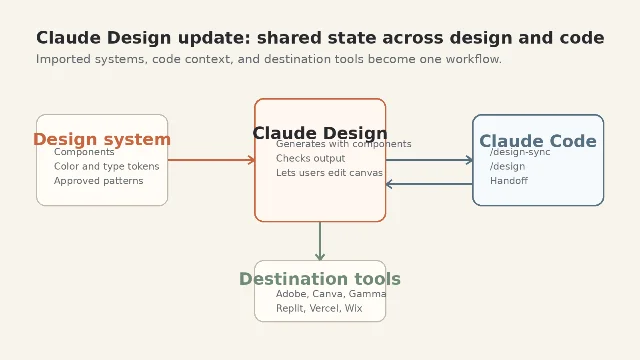
/design-sync and /design, and finished work moves to destination tools 1. The design system is the product boundary
The strongest feature is not the editor. It is the design system import. Anthropic says Claude can ingest components from repos, files, or uploads, then check its output against that system before the user sees it 1. If that works reliably, Claude Design is no longer a blank generator. It is a controlled synthesis layer on top of existing components.
That distinction is important for teams. A brand system is more than colors and logos. It encodes what buttons exist, how cards are spaced, which layout patterns are allowed, and what should never be shipped. When a model can read that system directly, the user can ask for a direction without re-specifying the organization's visual grammar each time.
VentureBeat framed the same update as a shift from a prototype toy toward a brand-compliance layer, noting that the import feature lets Claude build with a company's actual components and gives enterprises a way to lock down the approved system 2. That framing is useful because it names the enterprise job to be done. The buyer does not only want faster mockups. The buyer wants fewer off-brand artifacts making it into review, decks, prototypes, and code.
The code round-trip attacks the old handoff gap
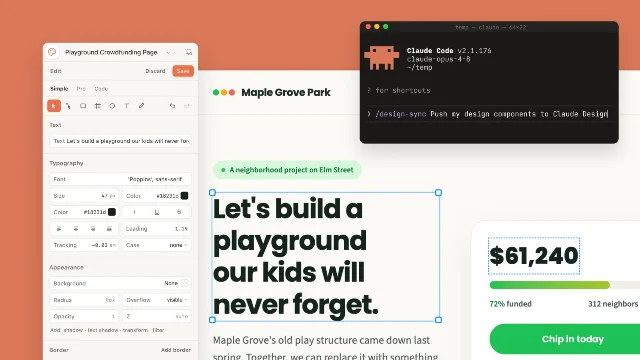
The second design choice is the Claude Code integration. Anthropic says
/design-sync lets Claude Code pull in a design system so Claude Design starts from existing components, and a finished design can then move to Claude Code without beginning again from a screenshot 1. Starting from screenshots is a lossy workflow: the model sees pixels, not the component library, constraints, states, or implementation details behind them.Engadget's coverage described the change in practical terms: Claude Design can begin from a local codebase, generated assets can contain elements that already exist in the product, and Claude Code can program an interface without starting from scratch 3. CNET made the same point from the user side, writing that Claude Code and Claude Design can now pull from each other, with
/design bringing design work into the terminal 4.The mechanism is simple but consequential. If the design surface and code surface share the same source material, the handoff becomes a continuation. Designers can prototype against real components. Developers can inspect or extend the work without reverse-engineering a visual approximation. The model still needs human review, especially for accessibility, responsive behavior, and edge states, but it has fewer chances to drift before review begins.
Usage limits were a product problem, not a footnote
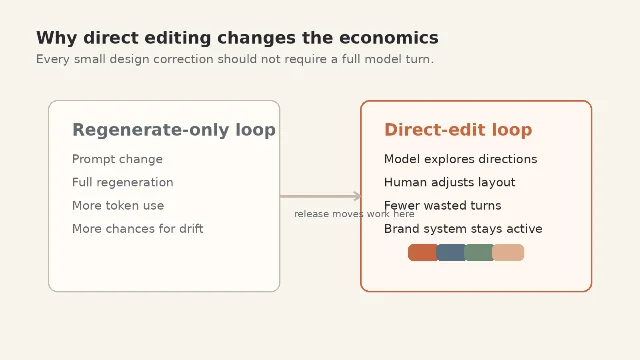
Anthropic also says Claude Design now shares usage limits with chat, Claude Cowork, and Claude Code; most people should get more headroom, average turns use fewer tokens for the same results, and errors are down sharply 1. That sentence deserves more attention than a normal release-note line.
Generative design is expensive because the model is solving several problems at once: layout, copy, hierarchy, assets, styling, and sometimes implementation structure. If every adjustment costs a full model turn, users hit limits before the work becomes useful. VentureBeat connected the update to early complaints about token consumption and argued that the new editor helps because users can drag, resize, and align elements without spending a model turn on every small correction 2.
This is why the direct editor matters. It is not a concession to old design tools. It is a cost-control surface. The model should handle exploration, synthesis, and transformations. The human should be able to nudge alignment, spacing, and hierarchy directly when direct manipulation is cheaper than another generation.
The connector list reveals the platform strategy
The new export list is broad: Adobe, Base44, Canva, Gamma, Lovable, Miro, Replit, Vercel, and Wix, plus PDF and PowerPoint 1. Anthropic also published partner statements from Replit, Lovable, Gamma, Wix, Adobe, Miro, Vercel, and Canva describing flows from Claude Design into app building, websites, decks, creative assets, canvases, and deployment 1.
That list says Claude Design is not trying to replace every destination tool. It is trying to own the moment when an idea becomes a structured artifact. The final asset may live in Canva, Gamma, Adobe Express, Replit, or Vercel. Claude Design wants to be the place where the first coherent version respects the brand system and remains close enough to code to become real software.
What to watch next
Three things will decide whether this release becomes part of daily work.
First, the import has to be faithful under real company messiness. Design systems are often incomplete, duplicated, inconsistently named, or split across Figma, repos, and docs. Claude can only enforce what it can understand.
Second, the Claude Code round-trip has to preserve intent through revision. A prototype becoming code is useful only if the later code changes can still inform the next design iteration.
Third, the shared usage model has to hold up for Pro and Team users, not only enterprise accounts with negotiated limits. Anthropic says more than one million people used Claude Design in its first week 1. A tool with that kind of top-of-funnel interest can still fail if ordinary sessions run out of budget before the artifact becomes editable.
The deeper read is that Claude Design is becoming a memory surface for teams. Brand rules, components, code, and preferred destinations are all being pulled into Claude's working environment. The next question is whether the agent can keep that memory accurate as teams revise the systems it depends on.
이 콘텐츠를 둘러싼 관점이나 맥락을 계속 보강해 보세요.