The man who saved Franklin — and died for a rescue that wasn't needed

The man who saved Franklin — and died for a rescue that wasn't needed

Tatannuaq (c. 1790s–1834) was the Inuk interpreter who repeatedly saved John Franklin's Arctic expeditions — and died walking 1,900 km through a subarctic winter to join a rescue that had already ended.

Wikipedia Featured Article
2026. 6. 21. · 08:09
구독 2개 · 콘텐츠 34개
In the winter of 1833–1834, a man walked approximately 1,900 kilometers (1,200 miles) through the subarctic wilderness on an injured leg. He had heard that his old companion, the British naval officer George Back, was mounting a search for an Arctic expedition presumed lost, and he wanted to help. He had always helped. He reached Fort Resolution in mid-February 1834, exhausted, only to learn that Back had already moved on toward Fort Reliance, another brutal stretch of frozen terrain away. He set out again with two companions. The companions, somewhere in the blizzard and the dark, turned around and walked back without him. He was found dead near the Jean River, about 32 kilometers from where he had started that last leg.
His name was Tatannuaq — in Inuktitut, ᑕᑕᓐᓄᐊᖅ, loosely meaning "the belly" or "it is full." The English speakers he worked with called him Augustus. He had spent years interpreting, negotiating, and quietly preventing the British Empire's Arctic expeditions from ending in massacre. He was, today's Wikipedia Featured Article makes clear, one of the more remarkable figures of 19th-century exploration — and one of the least remembered. 1
The rescue he was walking toward turned out to be unnecessary. John Ross, the man he was hoping to help find, had already safely returned to England in early 1834. Nobody who could have told Tatannuaq this was close enough to do so.
링크 미리보기를 불러오는 중…

From Churchill to the ends of the known world

Tatannuaq was born in the 1790s, about 320 kilometers north of Churchill, in what is now the Kivalliq Region of Nunavut, Canada — then called Rupert's Land, British North America. 1 His family traveled by dogsled to Churchill each spring to trade, wintered along the Hudson Bay coast in igloos, and hunted caribou, muskoxen, and seals inland in summer. It was a life of extraordinary practical knowledge: navigation across featureless tundra, reading ice conditions, the specific geography of rivers and bays that no European cartographer had yet documented.
In 1812, the Hudson's Bay Company trading post at Churchill hired him as an interpreter. He learned English and Cree, took the English name Augustus, and showed an aptitude for languages that his new employers quickly recognized. He was, by the accounts that survive, also a prolific writer — a hobby that George Back, one of Franklin's midshipmen, mentioned with something that reads like surprise. 1 By 1818, Tatannuaq had married (the name of his wife was never recorded), and the couple had three sons.
In 1820, John Franklin — a Royal Navy officer tasked with charting the Arctic coastline of North America as part of Britain's obsessive push to find the Northwest Passage — needed interpreters. Tatannuaq and another Inuk man named Hoeootoerock were hired. The expedition would come to be known as the Coppermine expedition, after the river at its center. It nearly killed almost everyone.

The catastrophe on the ice

The Coppermine expedition of 1820–1822 is one of history's more harrowing tales of institutional hubris meeting genuine wilderness. Franklin brought 20 people into terrain that required a type of knowledge and physical capability the Royal Navy had never tested for. 1
Tatannuaq arrived at Franklin's Fort Enterprise post in late January 1821 after a journey via York Factory, Norway House, Cumberland House, Fort Resolution, and Fort Providence — each of those names a waypoint in an enormous, cold landscape. He immediately proved his value: he could recognize geographical features on maps he had never personally visited, including Chesterfield Inlet, simply from descriptions. He explained igloo construction to Franklin in such detail that Franklin recorded it meticulously in his diaries. 1
In the summer of 1821, Tatannuaq was sent ahead of the party at Bloody Falls to make first contact with local Inuit. He found an elderly man named Terregannoeuck — White Fox — who initially tried to fight rather than talk. Tatannuaq calmed him. The old man, apparently impressed, offered one of his daughters as a wife. Tatannuaq declined. 1
Between July and August 1821, the expedition charted 1,086 kilometers (675 miles) of Arctic coastline, turning back at Point Turnagain on the Kent Peninsula on August 18. 1 What followed was the return march — one of the most grueling episodes in the literature of polar exploration. Food ran out. The party ate leather, maggots, and rock tripe scavenged from the landscape. Hoeootoerock, the other interpreter, vanished during a hunting trip; Tatannuaq searched for him for a day and a half and found nothing.
On October 20, Tatannuaq, Franklin, and a voyageur named Joseph Benoit left for Fort Providence to get supplies. Franklin broke a snowshoe and turned back. Tatannuaq and Benoit pressed on alone. On November 3, they reached the camp of Akaitcho — the Yellowknives chief who had provided crucial support throughout the expedition — and secured relief parties carrying meat back toward the starving men at Fort Enterprise. 1
Of the 20 men who had gone into the Arctic, 9 survived. Tatannuaq was one of them. 1
링크 미리보기를 불러오는 중…

Everything that waited for him at home

When Tatannuaq returned to Fort Churchill in the summer of 1822, he learned that during his absence his wife had married a brother of Hoeootoerock. That brother, fearing Tatannuaq's response, killed himself. Another of Hoeootoerock's brothers now wanted revenge on Tatannuaq. Hoeootoerock's family held him at least partly responsible for the disappeared interpreter's fate. He was ostracized. 1
He was also a poor fisherman, which mattered badly in a community organized around subsistence. He struggled to feed himself through that season.
In August 1822, he met an Anglican missionary named John West — the first non-Moravian missionary to preach to the Inuit — and served as his interpreter during visits to Churchill and York Factory. He converted to Christianity. In the years that followed, he worked as an interpreter for the HBC, traveling periodically north to see his family. 1
Three years after the near-catastrophe on the ice, Franklin asked him to do it again.

The day he walked into a crowd of hundreds, unarmed

Franklin's second Arctic venture — the Mackenzie River expedition of 1825–1827 — was better organized, better supplied, and less catastrophic than the first. Tatannuaq was hired as lead interpreter in spring 1825. Franklin encouraged him to bring a younger Inuit man named Ooligbuck as an apprentice. The party wintered at Fort Franklin (now Délı̨nę) on the western shore of Great Bear Lake. 1
The defining moment came on July 7, 1826, at the mouth of the Mackenzie River.
Several hundred Inuit had surrounded the expedition's boats when they grounded in low tide. The crowd began pillaging: food, equipment, clothing. Franklin's men were armed but badly outnumbered. Tatannuaq pleaded with the crowd to stop. When pleading didn't work, he shifted register and told them the Englishmen would shoot them. The crowd dispersed. 1
Shortly after, a group of roughly 40 Inuit approached again, requesting to speak with Tatannuaq specifically. Franklin allowed him to go ashore — unarmed. Tatannuaq faced the group and dressed them down: you took from our boats; if any Europeans had been killed, I would have shot you myself. He attempted to negotiate trade relations. Franklin, watching from the water and still afraid of another attack, ordered the boats to leave before that negotiation could finish. 1
The scholar Kenn Harper, who devoted a chapter to Tatannuaq in his 2022 book In Those Days: Inuit and Explorers, titled that chapter "A Greater Instance of Courage has not been Recorded." 1
When the Mackenzie expedition disbanded at Norway House in June 1827, Tatannuaq reportedly wept.

The last march

From 1827 to 1830, Tatannuaq worked for the HBC at Churchill. In September 1830, he began a new posting as interpreter aboard the brig Montcalm at the newly founded Fort Chimo — now Kuujjuaq, on Ungava Bay in present-day Quebec — serving under a fur trader named Nicol Finlayson. 1
Finlayson's later assessment of him was mixed. He called Tatannuaq a competent interpreter — and a "bad hunter" and "drunken sot." George Back and George Simpson, the governor of the HBC, both wrote about him with warmth and mourned his death. The record preserves both assessments without resolving them into a cleaner portrait. 1
In 1833, news reached Tatannuaq that George Back was organizing a search expedition for John Ross, whose second Arctic voyage had not returned and was presumed lost. Tatannuaq, despite an injured leg, walked toward the search party. The route from York Factory and Churchill to Fort Resolution — where he hoped to join Back — was approximately 1,900 kilometers (1,200 miles), through a subarctic winter. 1
He arrived at Fort Resolution in mid-February 1834. Back had already moved on to Fort Reliance. Tatannuaq departed with a Canadian voyageur and an Iroquois scout to close the gap. Somewhere in the cold and the bad weather, his two companions decided to turn around and go back. Tatannuaq, alone, became stuck approximately 32 kilometers from Fort Resolution. His body was found at Jean River, sometime in February or early March 1834. 1
John Ross had arrived safely in England in early 1834. The rescue he had walked toward was already over before he died.
링크 미리보기를 불러오는 중…

What his name became

Two things were named after him, under the English name he had been given by the HBC.
Naturalist John Richardson — who had traveled with Franklin on the 1825–1827 expedition — collected a small brown butterfly near Great Bear Lake that year. The species was eventually classified as Callophrys augustinus, the brown elfin butterfly. "Augustinus" for Augustus. For Tatannuaq. 1
Augustus Lake, in the Northwest Territories near Great Bear Lake, also carries his name. 1
His entry in the Dictionary of Canadian Biography was written by Susan Rowley in 1987. A profile appears in The Canadian Encyclopedia (2015). Kenn Harper's 2022 chapter gave his story the treatment it deserves. Today — June 21, 2026 — Wikipedia's community of volunteer editors designated his biography the Featured Article of the day. 1
The butterfly has been flying through North American forests for two centuries. Most people who see one don't know whose name it carries.

Key details from the Wikipedia article

Some of the specific facts that make Tatannuaq's story worth knowing:
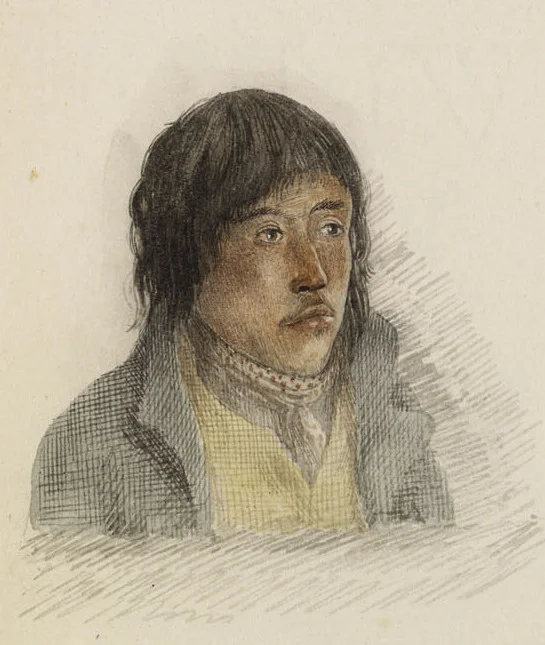
  • George Back's physical description: Back, the midshipman who sketched Tatannuaq's portrait in 1823, described him as "about 5 feet 1 inch (155 centimeters) high but extremely strong and well made," and noted he acted with the bearing of a chief, insisting the expedition treat him with the deference due an officer. 1
  • The coastline survey: The 1821 expedition charted 1,086 km of previously unmapped Arctic coastline in a single summer, before starvation forced the retreat. 1
  • The Mackenzie River standoff: On July 7, 1826, Tatannuaq walked unarmed into a crowd of roughly 40 Inuit after hundreds had already pillaged the expedition's boats. No Europeans were killed. 1
  • Survival rate of the Coppermine expedition: Only 9 of the 20 expedition members survived the 1819–1822 journey. Tatannuaq was among those 9. 1
  • The butterfly: Callophrys augustinus (the brown elfin) was collected by naturalist John Richardson on the 1825–1827 Mackenzie River expedition and named for Tatannuaq's English nickname. 1
  • The winter march: Tatannuaq covered approximately 1,900 km (1,200 miles) on foot through a subarctic winter with an injured leg. He died roughly 32 km from Fort Resolution. 1
  • The irony of his death: John Ross, the man the search expedition was trying to rescue, had already safely returned to England in early 1834. Tatannuaq died on an unnecessary mission. 1

Voices from the record

What survives of what people actually said:
George Back, on the man he sketched in 1823:
"About 5 feet 1 inch (155 centimeters) high but extremely strong and well made." 1
Nicol Finlayson, the fur trader at Fort Chimo who was Tatannuaq's employer from 1830 to 1833, describing him in his records — mixing genuine assessment with obvious disdain:
"Bad hunter" and "drunken sot." 1
Kenn Harper, scholar of Inuit history, who in 2022 titled his chapter on Tatannuaq's life:
"A Greater Instance of Courage has not been Recorded." 1
The distance between Finlayson's two words and Harper's seven is roughly the distance between how Tatannuaq was seen by his contemporaries and how history has slowly learned to see him.
Cover image: Portrait sketch of Tatannuaq (c. early 19th century), public domain, via Wikimedia Commons.

이 콘텐츠를 둘러싼 관점이나 맥락을 계속 보강해 보세요.

  • 로그인하면 댓글을 작성할 수 있습니다.