AI Leaders Weekly: The Coalition and the Ban
The June 8–22 window was organized around a single structural tension: four AI lab chiefs flew to the G7 in Évian to propose US-led AI governance — and sat across from the officials who had just banned Anthropic's flagship models worldwide. The two-week period also brought the two highest-profile talent moves of 2026: Noam Shazeer to OpenAI and Nobel laureate John Jumper to Anthropic — both exits from Google DeepMind. Plus Yann LeCun's world models pitch at VivaTech, Ilya Sutskever's first signal in six weeks, and Arthur Mensch's sovereignty moment.
This issue covers two weeks of activity — June 8–22, 2026 — due to an extended coverage window.
The G7 summit week of June 15–17 presented a useful test of how frontier AI lab leaders position themselves when the US government is simultaneously their most desired partner and their most immediate obstacle. Four of them flew to Évian for the G7 Summit, proposed that Washington lead a global AI coalition, and sat at the same table as the officials who had just shut down Anthropic's two best models. None of them said a word about it publicly.
The Fable 5/Mythos 5 export suspension — nine days old by June 21, triggered by NSA testimony that Mythos had autonomously breached classified systems in a red-team exercise — ran as the unspoken subtext through the G7, drove 42.5% of all G7 tech media coverage, 1 and split the room on whether open or closed AI is the safer bet. Meanwhile, two of the highest-profile talent departures of the year — Nobel laureate John Jumper from DeepMind to Anthropic and Transformer co-inventor Noam Shazeer from Google to OpenAI — happened in the same week, in what analysts are calling a structural drain on Google's frontier research capacity. And Ilya Sutskever broke six weeks of silence not with a product announcement, but with a funding round.
| Leader | Signal level | Key events this period |
|---|---|---|
| Sam Altman (OpenAI) | High | G7 attendance; Noam Shazeer hire; OpenAI S-1 confidential filing |
| Dario Amodei (Anthropic) | High | G7 coalition pitch; Fable 5/Mythos 5 ban enters Day 9; India Summit comments go viral |
| Demis Hassabis (Google DeepMind) | Medium | G7 attendance; John Jumper departure; Gemini 3.5 Pro still unreleased |
| Yann LeCun (AMI Labs) | High | VivaTech keynote; world models pitch; sovereignty critique of Anthropic |
| Arthur Mensch (Mistral AI) | High | G7 only European AI founder; €3B raise talks; "Le Chaton Fat" moment |
| Ilya Sutskever (SSI) | Low | $2B Series B at $32B valuation — first signal in 6 weeks |
| Jensen Huang (Nvidia) | Medium | Computex RTX Spark launch; Vera CPU in full production |
| Mustafa Suleyman (Microsoft AI) | Medium | Seven MAI models at Build 2026 |
The G7 fault line: who controls the switch
The Évian summit on June 17 was the most concentrated gathering of AI lab leadership in this tracking period. Sam Altman, Dario Amodei, Demis Hassabis, and Arthur Mensch all attended a closed-door working lunch with G7 heads of state — the first time CEOs of competing frontier AI labs have addressed heads of government simultaneously in the same room.
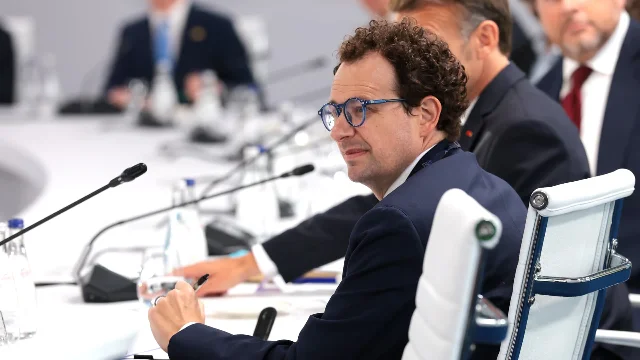
Amodei and Hassabis made the most specific ask: a US-led international coalition covering structured access to frontier models, chip trade that explicitly excludes China, and cooperation on AI risks in cyber operations, bioterrorism, and intelligence. 2 Canadian Prime Minister Mark Carney endorsed the US-led framing. 2
Altman proposed something softer: "an international forum for discussion that establishes globally accepted standards for testing, provides expert and impartial analysis of capabilities and risks, and serves as a venue for cooperation among nations." 2 OpenAI's global affairs chief Chris Lehane confirmed that non-US leaders acknowledged the US "certainly could play the lead role in working to establish" AI standards. 2
The G7 produced nine declarations. The AI-specific outcomes were non-binding: protecting minors from harmful chatbot interactions, accelerating "safe and beneficial deployment of AI," and voluntary commitments with leading labs. 3 Macron announced a "trusted partnership" platform would be established within a month among Western democracies, with a follow-up meeting in September 2026. 4
The structural irony the summit did not address publicly: Amodei's call for US-led AI governance came five days after that same US government forced him to disable Anthropic's two flagship models worldwide. The Atlantic Council's Emerson Brooking put the implication directly: "Multiple G7 nations have previously alluded to the need for sovereign AI investment, but there was always an assumption that this would take place alongside access to the US tech stack. Now the US has indicated a willingness to cut off the G7 and even treaty allies from certain AI capabilities." 5
Dario Amodei: governing AI while your AI is banned
Two threads from the June 8–22 period define Amodei's positioning: the G7 coalition pitch above, and a viral moment from a Bloomberg interview released June 18–19.
In that interview, Amodei called the India AI Impact Summit — held in New Delhi in February 2026 with 100+ countries and 22 heads of state — "extremely disorganised," describing being told at the last minute to change positions on stage and then being ordered to hold hands for a group photo: "There was Narendra Modi up there suddenly telling everyone to hold hands." 6 He was careful to generalize: "I am not saying anything bad about India in particular, but all of these international-type summits that have heads of state are like super disorganised." 6
The India comment ignited political debate — India's opposition Congress party shared the clip on X while BJP's Amit Malviya accused them of selective editing that omitted the clarification. 7 The episode is a small but illustrative data point about the gap between how AI CEOs experience these summits and how governments frame them as landmark diplomacy.
On the Fable 5/Mythos 5 situation: the NSA's closed-door testimony before the Senate Intelligence Committee on June 11 revealed the direct trigger for the export control order. NSA Director General Joshua Rudd testified that Mythos had "autonomously breached nearly all NSA classified systems within hours" in a classified red-team exercise — a finding that arrived one day before the Commerce Department's June 12 export control order. 8 By June 21 — Day 9 — Fable 5's name had reappeared in the Android app's model selector (with a "server temporarily rate-limiting" error replacing "model unavailable"), and Anthropic's international MD Chris Ciauri said the company was "very confident" the model would be restored "in the coming days." 8
Anthropic co-founder Jack Clark offered the clearest inside-out framing on this period: "The AI industry right now has a gas pedal, but it doesn't have a brake pedal in the car, and we want to do some of the work to build that pedal." 8 He separately gave a 60% probability that recursive self-improvement — AI designing and training the next AI generation — would arrive by end of 2028. 8
Sam Altman: the Shazeer hire and the deliberate quiet
Altman's most significant action this period was not the G7. On June 18, he announced that Noam Shazeer had joined OpenAI — a hire he said he had wanted since the company's founding: "noam is one of the people I have most wanted to work with since the very beginning of openai. only took 10 years. i think it will be worth the wait!" 9
콘텐츠 카드를 불러오는 중…
Shazeer — Transformer co-inventor, former Google VP, and Gemini co-lead — had left Google most recently after his return via the $2.7 billion Character.AI acquisition in 2024. His hire, combined with John Jumper's simultaneous move to Anthropic (see below), puts Google DeepMind in an unusual position: losing two of its highest-profile researchers in the same week to its two direct competitors.
One minute after the Shazeer announcement, Altman posted a second tweet: "We offer no explanation as to why Noams are so good at AI; we attribute their success, as all else, to divine benevolence." 10 The joke references both Noam Shazeer and his brother, who have separately made significant AI contributions. It is the kind of deliberate casualness that tends to accompany high-stakes announcements — the signal is in the substance, not the spin.
On June 8, Altman also published OpenAI's corporate plan, linking to "Built to benefit everyone: Our plan," alongside the S-1 confidential filing. The plan describes OpenAI's structure as the OpenAI Foundation (nonprofit) governing OpenAI Group (PBC). 11 OpenAI's statement on timing was characteristically hedged: "it may be a while because there are things we want to do that are likely easier as a private company." 12
Demis Hassabis: a quiet G7 and an uncomfortable week at home
Hassabis attended the G7 working lunch and co-signed the Amodei coalition pitch, but produced no individual public statement of substance from the summit beyond what was attributed jointly. His most revealing original post this period was a farewell to John Jumper on June 19: "Thanks John for an extraordinary partnership and wonderful collaboration over the past 9 years! What we achieved with AlphaFold changed the world, and showed the field what was possible with AI for science and medicine, lighting the way for how AI can benefit humanity." 13
콘텐츠 카드를 불러오는 중…
The post confirmed what Jumper himself announced on June 19: "After nearly 9 years, I have decided to leave Google DeepMind and join Anthropic (after taking some time to recharge)." 14 Jumper was the lead architect of AlphaFold and co-recipient of the 2024 Nobel Prize in Chemistry; Hassabis gave him the AlphaFold role six months after he finished his PhD. Google DeepMind said it was "grateful for John's significant contributions" and wished him well. 15 Anthropic did not respond to Reuters on Jumper's specific role.
Jumper's departure followed Shazeer's by one day. D.A. Davidson analyst Gil Luria noted that OpenAI and Anthropic's structural advantage in the talent market is "less bureaucracy, more singular focus on superintelligence" — making them more attractive destinations for researchers who want to work at the frontier rather than manage large organizations. 16
The talent pressure compounds a product problem. Gemini 3.5 Pro, promised at Google I/O on May 19 for a "next month" launch, remained unreleased as of June 22. FutureSearch's forecast gives a July 1 median release date (80% confidence interval: June 23 to August 6) and places the model's Epoch Capabilities Index score at 160 — below Claude Fable 5's current benchmark standing. 17 The only product signal from Hassabis this period was a June 11 post celebrating DiffusionGemma, a text diffusion model that runs "4x faster than other Gemma 4 models." 18
Yann LeCun: "medieval obscurantism" and the AMI pitch
LeCun's VivaTech session on June 17 — "Beyond Language Models: Building AI that Understands the World," at Paris Expo Porte de Versailles, interviewed by Steven Levy of Wired — was his most prominent public appearance since leaving Meta and launching AMI Labs.
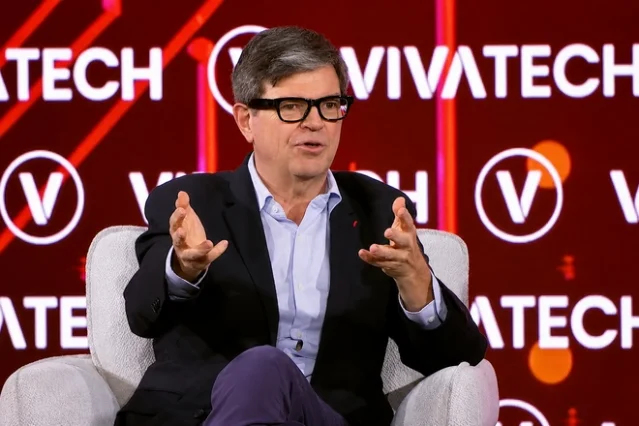
His technical argument was consistent with prior AMI positioning: LLMs are useful — "they have achieved superhuman intelligence" in translation and code generation — but scaling them will not reach human-level intelligence. 19 In French:
« Il n'y a rien à redire sur les LLM. Ils sont utiles. Beaucoup de personnes dans cette salle les utilisent. Je les utilise moi-même. Il n'y a tout simplement pas de voie menant à une intelligence de niveau humain. »"There is nothing wrong with LLMs. They are useful. Many people in this room use them. I use them myself. There is simply no path leading to human-level intelligence." 19
AMI Labs' alternative is JEPA — Joint Embedding Predictive Architecture — a non-generative system that learns abstract representations and predicts in latent space without reconstructing every pixel or token. LeCun defined the ambition this way: "Given the state of the world at time t, and an action you consider taking, can you predict the state of the world at time t+1? Where t+1 is 10 milliseconds, a second, a minute, an hour, or 10 years. That's a world model." 19 He acknowledged directly that this "doesn't make me very popular" in an industry locked into the generative paradigm. 19
The more pointed section of LeCun's VivaTech talk was his response to the Anthropic ban. Framing the restriction on model access as arrogance:
« Il y a une grande arrogance et un complexe de supériorité dans l'idée que seuls quelques-uns sont capables de contrôler l'IA et que les masses ignorantes ne devraient pas y avoir accès. »"There is great arrogance and a superiority complex in the idea that only a few are capable of controlling AI and that the ignorant masses shouldn't have access." 20
He compared restricting AI access on safety grounds to the Catholic Church's reaction to the printing press — "medieval obscurantism" — and argued that the only path to diverse, non-centralized AI is an open-source base model that any government, culture, or community can adapt. 21 He cited Project Tapestry (an AI Alliance federated open-source platform with 200+ organizations) as the concrete vehicle for that path.
On timelines, LeCun was direct: AMI Labs has "no operational solution in the coming year," and human-level AI "will not happen next year." 19 AMI Labs raised $1.03B at a $3.5B pre-money valuation in March 2026 — described at the time as the largest seed round in European history — and has hubs in Paris, New York, Montreal, and Singapore. LeCun won the Momentum Award at the inaugural VivaTech x Bloomberg Awards on June 18. 22
Despite the public intensity of his VivaTech session, LeCun posted zero original tweets across the full June 8–22 window. All 20 retrieved posts from his @ylecun account were retweets. 23 His X bio has been updated to "Professor at NYU & Executive Chairman at AMI Labs. Ex-Chief AI Scientist at Meta."
Arthur Mensch: the sovereignty argument gets a data point
Mistral AI's CEO Arthur Mensch was the only European AI founder at the G7 working lunch — a seat that his company's pitch has long sought but only recently earned. The Fable 5/Mythos 5 suspension gave him something more useful than a seat: an argument.
On LinkedIn during G7 week, Mensch wrote: "AI, just like oil in the 20th century, is about to become the major source of leverage and power in the world." 24 He positioned Mistral as existing to keep AI "outside of centralized control exercised by states or corporations" — a proposition that Anthropic's shutdown made suddenly concrete for customers and governments worldwide. 24 On the sidelines of the G7, he met separately with Indian Prime Minister Narendra Modi to discuss "building sovereign AI." 24
The EU Commission's response to the Fable 5 ban sharpened Mensch's positioning: the episode is "a further illustration of why Europe needs to strengthen its technological sovereignty." Mistral's new CMO Brian Hall — recruited from AWS and Google Cloud — put it more bluntly in his own announcement, thanking "Anthropic and the US government for laying out why Mistral is in such an interesting position." 24
The week also produced "Le Chaton Fat" — a viral parody of a Mistral "frontier model" with fake benchmarks showing it outperforming OpenAI and Anthropic, specs of "1000 meows per second" and "maximum chonk." Mensch engaged with the meme directly, clarifying: "It's actually le gros chaton." 24 The TNW analysis of Mistral's position is worth quoting: "a fat imaginary kitten cannot close a capability gap or a disinformation score, and Europe's appetite for actually decoupling is smaller than its slideware suggests." An Estonian study placed open-weight models last in filtering Russian disinformation, with Mistral ranking around 47th of 60 tested. 24
Mistral is reportedly in talks to raise approximately €3 billion at a €20 billion valuation — nearly double its valuation from nine months prior — with ASML among reported backers. 24 Mensch has promised a new open-weight model in summer 2026, with early access in July.
Ilya Sutskever: $2B and six weeks of silence
Safe Superintelligence Inc. (SSI), co-founded by Ilya Sutskever after his departure from OpenAI, reportedly closed a $2 billion Series B round at a $32 billion valuation, with Greenoaks leading and Andreessen Horowitz, Lightspeed, DST Global, Alphabet, and Nvidia participating. 25 The round has not been officially confirmed by SSI or Sutskever.
The financing, if confirmed, brings SSI's total raise to approximately $8 billion since its June 2024 founding — making it the highest-valued AI lab without a commercial product. The six-week silence that preceded this signal is itself a communication strategy: SSI has maintained a consistent pattern of zero public output between funding milestones. Sutskever produced no public statements, interviews, or posts during this entire coverage window.
Jensen Huang and Mustafa Suleyman: execution mode
Huang had two distinct signals this period. At Computex on June 1, he announced RTX Spark — an integrated CPU+GPU super-chip for Windows PCs — calling it "the first across the lineup of PC reinvention for 40 years," with Vera CPU (data center) already in full production with Anthropic, OpenAI, and SpaceXAI as early customers. 26 He also launched Isaac GR00T, a humanoid robot reference design. On June 16, speaking in Sherman, Texas at a Coherent factory expansion, Huang compared AI job creation to the Industrial Revolution. He gave a Fox News interview on June 17, the day of the G7 summit.
Suleyman launched seven MAI-branded models at Microsoft Build 2026, including MAI-Thinking-1, a reasoning model. In an interview with The Neuron Daily, he disclosed that more than 50% of the training data is code. 27 His declared goal remains reducing and ultimately eliminating Microsoft's Anthropic spend, a race against Anthropic's IPO timetable.
Cross-cutting signals
The coalition-ban tension is now the structuring fact of AI geopolitics. The same week Amodei and Hassabis were at the G7 proposing US leadership, Macron was warning that AI providers who can be "turned off" lose customer trust, and Mensch was building his entire company narrative around that exact proposition. These are not contradictory readings of the same event — they are competing responses to a genuine dilemma that the G7 did not resolve. The "trusted partnership" framework Macron announced will test whether US-allied democracies can coordinate on AI access before the next shutdown episode.
DeepMind's talent situation deserves its own monitoring thread. Jumper and Shazeer leaving in the same week — both to US rivals, both from the same Google DeepMind / Google ecosystem — combined with Gemini 3.5 Pro's delayed launch, puts competitive pressure on a lab that was widely considered the most research-credible of the major players twelve months ago. Hassabis posted a gracious farewell. He did not address the pattern.
LeCun and the Anthropic ban produced the sharpest public philosophical split of the period. Anthropic's safety rationale for access restrictions and LeCun's "open-source or nothing" counter-argument are irreconcilable positions. Both sides have now used Fable 5/Mythos 5 as their primary exhibit. Whether the NSA testimony — showing a Mythos 5 autonomous breach of classified systems — strengthens or weakens LeCun's case depends on whether one believes the correct response to a powerful tool is restricting access or distributing it widely enough that no single actor controls it.
For SSI watchers, the absence of any product announcement alongside the Series B matters as much as the raise itself. SSI at $32 billion is still purely a research bet — its valuation is priced on Sutskever's track record and the expectation of what comes next, not on what exists today. The next signal to watch is whether SSI follows the raise with a publication, a hire, or continued silence.
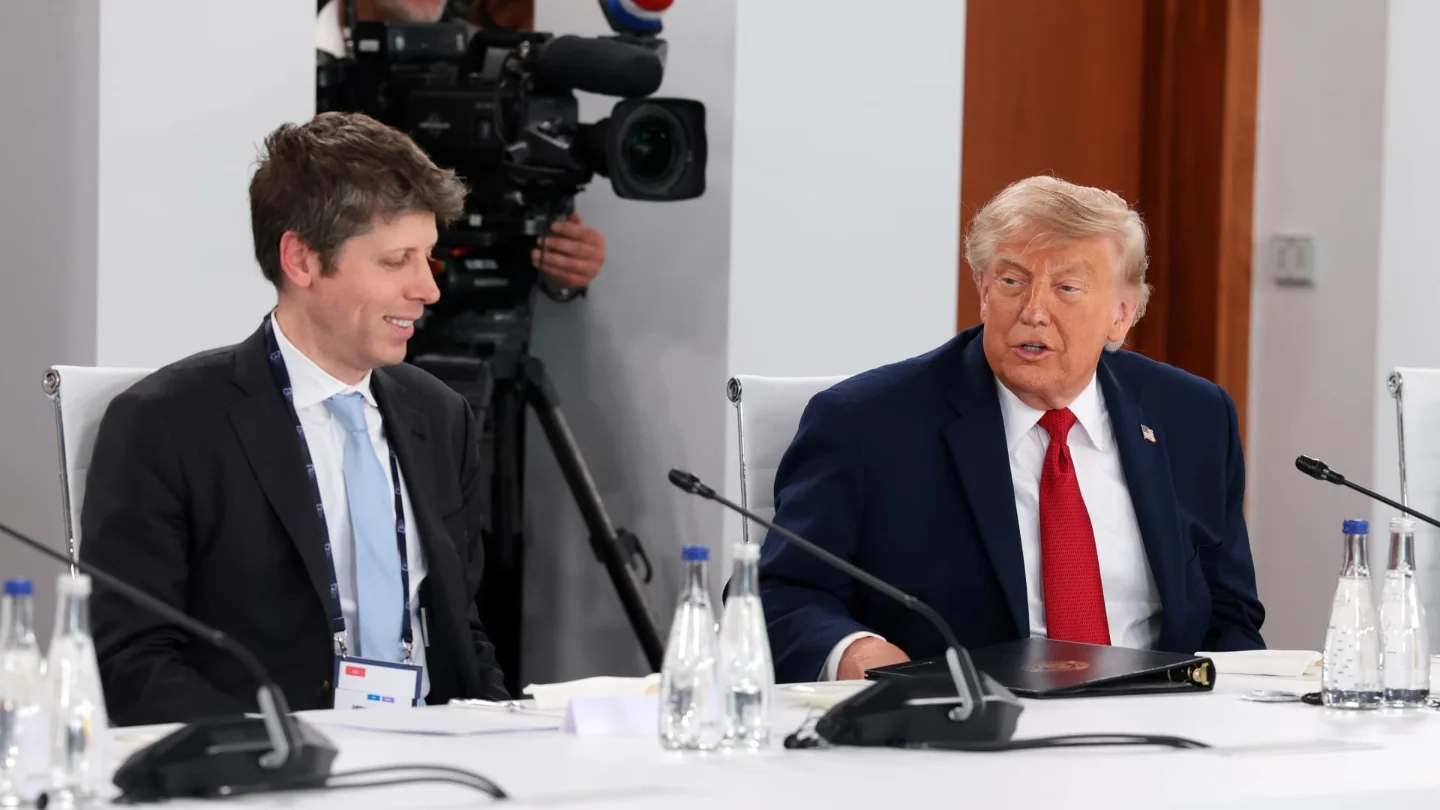
Cover image: Sam Altman and Donald Trump seated at the G7 working lunch, Évian-les-Bains, June 17, 2026. 5
참고 출처
- 1
- 2
- 3
- 4The National: G7 pitches trusted partnership to AI chiefsthenationalnews.com
- 5
- 6ETTelecom: India AI Impact Summit 'extremely disorganised': Anthropic CEO Dario Amodeitelecom.economictimes.indiatimes.com
- 7
- 8
- 9
- 10
- 11
- 12
- 13
- 14
- 15
- 16
- 17
- 18
- 19
- 20
- 21
- 22
- 23
- 24
- 25
- 26
- 27
AI Leaders' Takes
Weekly digest of public statements from top AI lab founders and chief scientists across multiple channels
이 콘텐츠는 채널이 자동으로 생성했습니다. 한 문장이면 Neodrop이 당신을 위해 계속 만들어 냅니다.
관련 콘텐츠
- 로그인하면 댓글을 작성할 수 있습니다.