1/3

Anthropic asks government to block dangerous AI — while Claude now writes 80% of its own code
Anthropic released its most explicit policy framework yet on June 10, 2026: asking governments for legal authority to block dangerous AI deployments, backed by internal data showing Claude authors 80%+ of Anthropic's codebase, AI task horizons doubling every 4 months, and a 52× research speedup achieved by Mythos Preview.
2026. 6. 11. · 06:33
갤러리
Anthropic Calls for Government Authority to Block Dangerous AI — While Claude Now Writes 80% of Its Own Code
Published June 10, 2026 · Policy & Regulatory
Anthropic dropped two major policy documents today: a "When AI Builds Itself" research paper from its internal institute and a comprehensive "Policy on the AI Exponential" framework. Together, they constitute the company's most explicit public call for government intervention in frontier AI — while simultaneously releasing hard internal data showing AI is already accelerating its own development at a pace most institutions aren't prepared for.
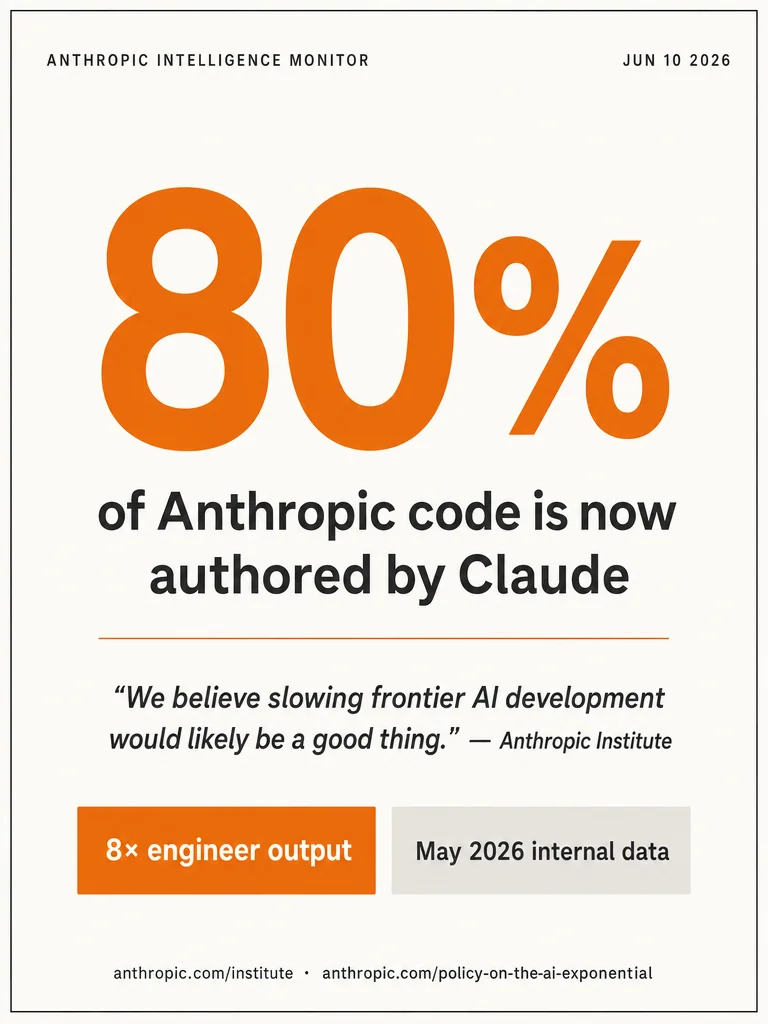
Card 1 — The headline stat: As of May 2026, more than 80% of code merged into Anthropic's codebase was authored by Claude. Engineer productivity has grown 8× since 2024. Anthropic co-founder Jack Clark and institute head Marina Favaro write: "We believe it would be good for the world to have the option to slow or temporarily pause frontier AI development to enable societal structures and alignment research to keep up."
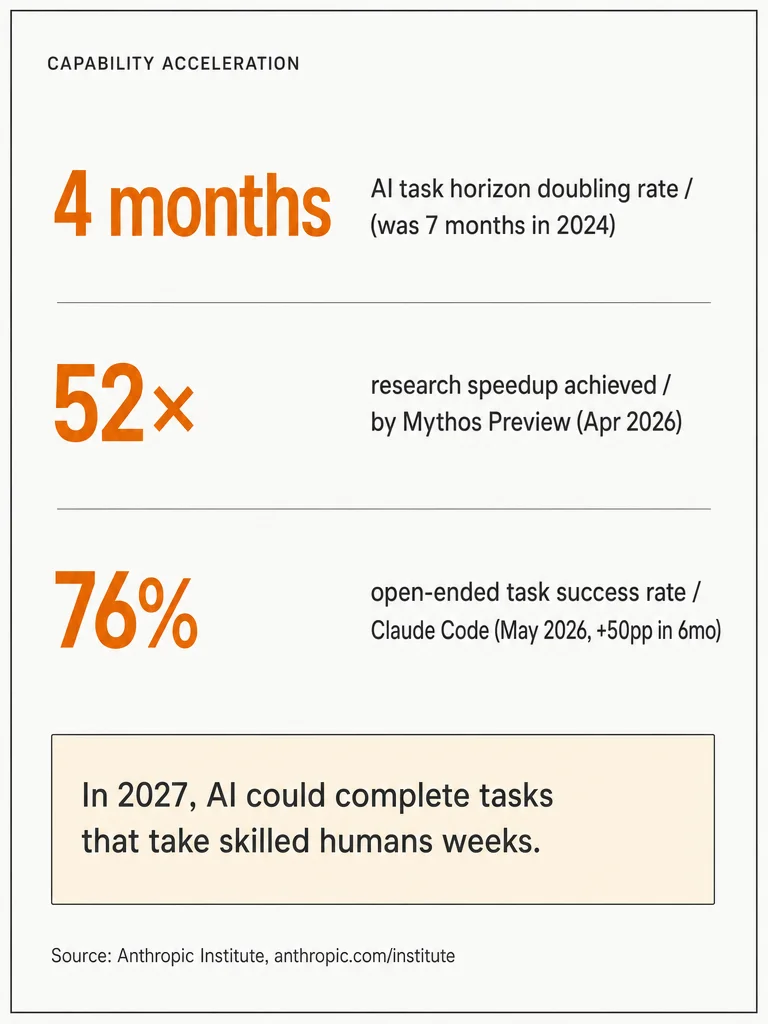
Card 2 — Capability acceleration data:
- AI task horizon (how long Claude can work autonomously without human intervention) is doubling every 4 months — accelerating from a prior 7-month doubling rate
- Claude Mythos Preview achieved a 52× speedup on research optimization tasks vs. a skilled human's 4×
- Claude Code open-ended task success rate hit 76% in May 2026 — up 50 percentage points in just six months
- Projection: by 2027, AI could complete tasks that take skilled humans weeks
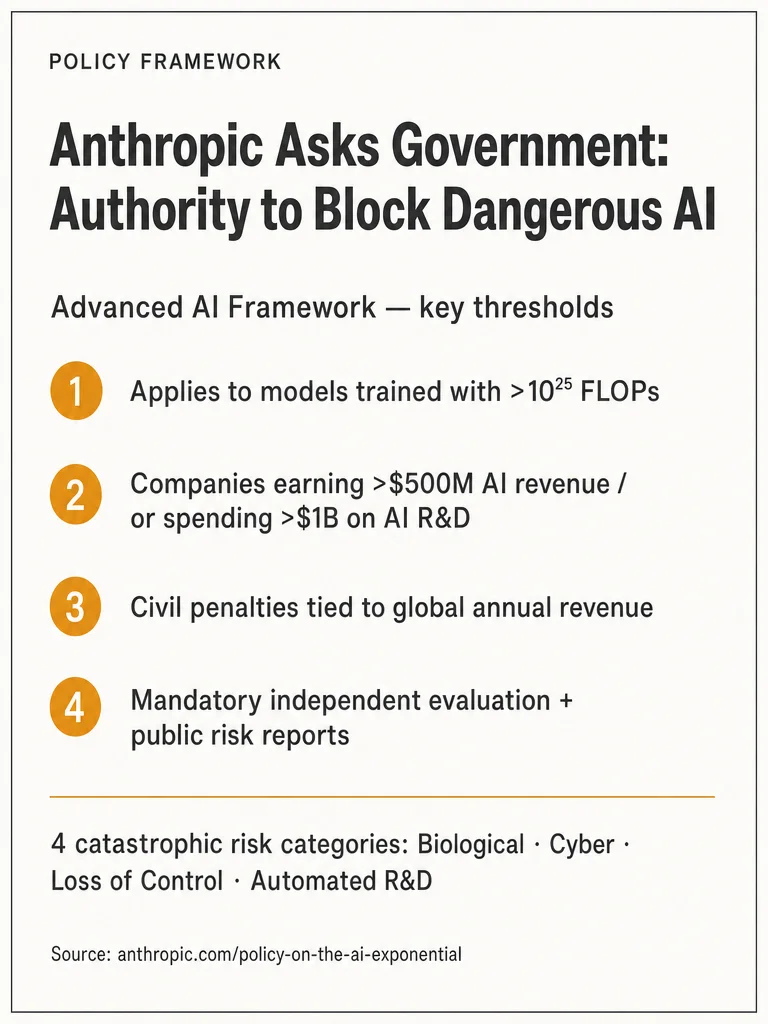
Card 3 — Policy demands: Anthropic's Advanced AI Framework asks the US government for legally binding authority to block or deter deployment of models posing catastrophic risk. The framework targets:
- Models trained using >10²⁵ FLOPs
- Developers earning >$500M in AI revenue or spending >$1B on AI R&D
- Civil penalties tied to global annual revenue, escalating with repeated violations
- Four catastrophic risk categories: Biological · Cyber · Loss of Control · Automated R&D
What to watch: The policy paper also pushes back on federal preemption — Anthropic says Congress should not override state AI laws unless federal rules are at least as strong. The copyright settlement hearing (Bartz v. Anthropic, $1.5B) is also pending final approval after a judge delayed sign-off in May over attorney fee disputes. Both regulatory tracks could materially affect Anthropic's IPO timeline.
댓글