2026. 6. 19. · 08:28
The lace panties that shook Wimbledon
On June 20, 1949, American tennis player Gussie Moran walked onto Court One at Wimbledon wearing a short white dress with lace-trimmed knickers designed by Ted Tinling. The lace was visible approximately once every three minutes during play. The ensuing scandal reached Parliament, circled the globe, and cost Tinling a 23-year Wimbledon job — he was banned for 33 years. Moran just wanted an outfit she could move in. Wimbledon is still rewriting its rulebook over it.

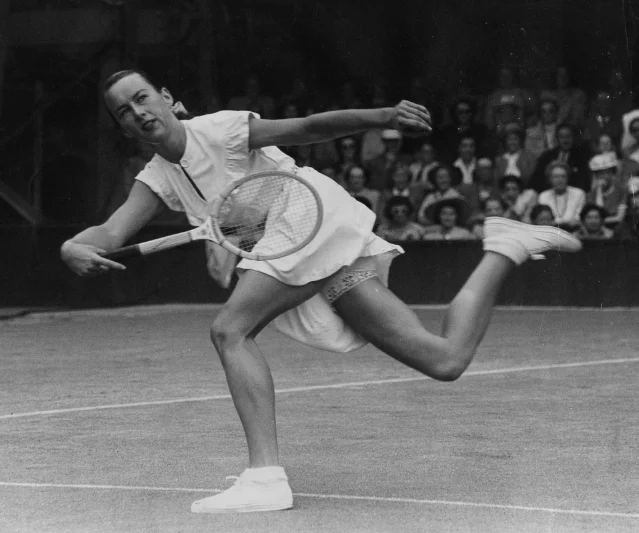
On the morning of June 20, 1949, Gertrude "Gussie" Moran walked onto Court One at the All England Club carrying her racket in front of her face. She was 25, ranked #4 in the United States, seeded #4 at Wimbledon, and so embarrassed by what was about to happen that she couldn't bring herself to look at the crowd. 1
The outfit she wore that day — a short white rayon tennis dress with lace-trimmed knickers underneath — was, by Wimbledon's own written rules, completely legal. It was white. That turned out not to matter at all.
By that afternoon, photographers had been lying on their backs on the Wimbledon grass to shoot upward angles for the very first time in the tournament's history. Within days, the British Parliament had debated the dress in session. The man who designed it had lost a job he'd held for 23 years. And a plain girl from Santa Monica had, against every wish she had, become the most talked-about woman in sports.
What Gussie actually wanted
Moran hadn't asked for a scandal. She'd asked for something to wear.
Her original request to designer Cuthbert Collingwood "Ted" Tinling was actually more colorful than what she got: one sleeve one color, the other sleeve a different color, the skirt a third color. Tinling gently pointed out that Wimbledon's all-white dress code would make that something of a challenge. So he designed her a short white dress — cut higher than anything seen on Centre Court before — with the lace trim added to the knickers underneath. 2
Tinling later described the lace as "nothing more than what my mother would have called 'kitchen' lace." He also acknowledged the geometric logic: the knickers only came into view during play. Not constantly, not even frequently. "You only saw the panties about once every three minutes," he recalled. "No one ever knew what they wore underneath in those days. No one would ever ask. You had photographers, for the first time in history, lying on their backs. Everyone went wild." 3
Moran was too nervous to wear the dress for her first-round match, which she won wearing something else entirely. She put on the Tinling dress for her second-round match against Betty Wilford — and won that one too. She was eliminated in the third round, though it's fair to wonder how much of her head was actually on the tennis by that point. The Associated Press sent wire copy noting that "the fringed panties are very much in evidence when Gussie races across the court or leaps for a high shot." Moran later recalled walking out with her racket held in front of her face, bracing for whatever was about to happen. 1
"I was interested in clothes I could play tennis in," she said years later, "not in creating a sensation and certainly not in anything anyone would consider in poor taste."
How Wimbledon responded to a centimeter of lace
The All England Lawn Tennis and Croquet Club's committee formally accused Moran of "bringing vulgarity and sin into tennis." 1 Club chairman Sir Louis Greig — a former Scottish rugby international, a naval officer, and an equerry to King George VI — summoned Tinling and told him he had been guilty of "having drawn attention to the sexual area." 2
The outrage wasn't contained to one building. It reached Parliament. Though no Hansard citation has been pinned down by historians, multiple contemporary sources confirm the incident was debated in the House of Commons — a sitting legislative body spending time on a tennis player's underwear. Moran appeared on magazine covers worldwide. She was voted "best dressed sportswoman" by the US Fashion Academy. A racehorse was named after her, and so was an aircraft, and a restaurant's special sauce. 3
The Marx Brothers, who happened to be performing in London that summer, invited Moran to join their act. She declined.
As for Ted Tinling, the club asked him to "take leave" of his position. He had been Wimbledon's official host and master of ceremonies since 1927 — 23 years. He did not return to the All England Club grounds for 33 years. 4
The man who got banned for 33 years — and dressed 12 champions anyway
Tinling's exile from Wimbledon is one of sport's more quietly strange stories. The club threw him out. He proceeded to become the most important tennis dress designer of the 20th century, and he dressed the women's singles champion at Wimbledon in 1959, 1960, 1961, 1964, 1969, 1971, 1972, 1973, 1975, 1977, 1978, and 1979 — twelve titles — while officially barred from the premises. 5
His client list during his ban reads like a roll call of the era's great players: Billie Jean King, Chris Evert, Martina Navratilova, Virginia Wade, Evonne Goolagong, Margaret Court, Maria Bueno. He designed King's dress for the 1973 "Battle of the Sexes" against Bobby Riggs. He designed Evert's 1979 wedding dress. He became Chief of Protocol for the International Tennis Federation and the official designer for the Virginia Slims WTA Tour.
He was also, it later emerged after his death, a former Lieutenant-Colonel in British Intelligence who had served in Algiers and Germany during World War II. The man the All England Club had branded a purveyor of vulgarity was a spy. The lace panties had been the least of his secrets. 4
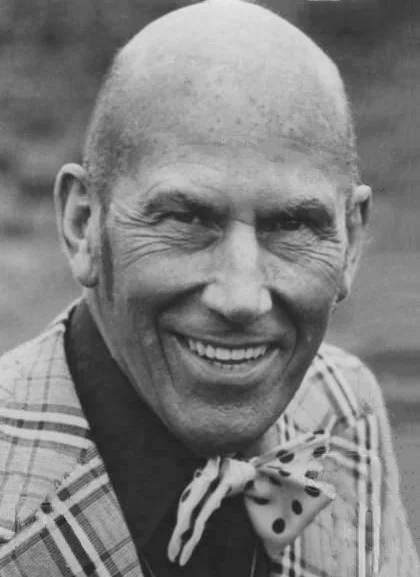
Tinling was finally invited back to Wimbledon in 1982, where he retook his role as player liaison. He was inducted into the International Tennis Hall of Fame in 1986. In the 1988 interview where he and Moran spoke to journalist Melissa Isaacson within weeks of each other, he asked her to pass along a message: "Tell Gussie when you see her that I love her dearly. One can never forget what we went through. We're both probably a little scarred, but we're much wiser people, I believe." 3
The actual tennis player
Here is what gets lost: Moran could play. Before the Tinling dress buried the headline, she had been one of the genuine competitive tennis stories of the year.
In March 1949, three months before Wimbledon, she swept the US Indoor Championships — singles, doubles, and mixed doubles — all three titles in one tournament. She'd reached the US Open singles semifinals in 1948 and the mixed doubles final in 1947 (with Pancho Segura as her partner). At the 1949 Wimbledon she made the women's doubles final with Patricia Todd, where they lost to Louise Brough and Margaret Osborne duPont 8–6, 7–5. 6
In 1950, Bobby Riggs signed her as a professional for $87,000. The plan was to tour with Pauline Betz, Pancho Segura, and Jack Kramer. But Betz — one of the best players of the era — demolished Moran 6-0, 6-3 in 33 minutes on opening night at Madison Square Garden. Riggs reportedly asked Betz privately to go easy on Gussie. Betz had apparently not received the memo. 7
Kramer, who had seen it all from courtside, put it plainly years later: "Gussie wasn't looking to be a sexpot. She wanted to be a tennis champion. She was a good player, but not that good." 1 He also said she was "the Anna Kournikova of her time" — beautiful, recognizable, and never quite allowed to be remembered only for tennis. 7
After the flashbulbs
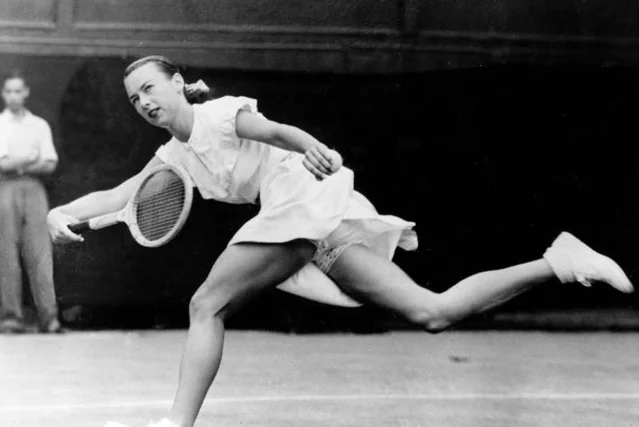
Moran never stopped being "Gorgeous Gussie." She hosted a TV interview show in Los Angeles in 1951, became one of the first women doing sports on television as a newscaster at WMGM in New York from 1955 to 1961, launched a tennis clothing line that failed, and appeared as herself in the 1952 film Pat and Mike alongside Spencer Tracy and Katharine Hepburn. In 1970 she joined a USO tour to Vietnam. Her helicopter was shot down. She suffered broken and dislocated bones and repressed the memory for years. 3
When Melissa Isaacson interviewed her in 1988 for the Orlando Sentinel, Moran was working five shifts a week at the Los Angeles Zoo gift shop. She had inherited the family's Santa Monica Victorian home after her mother died in 1977, but the property taxes defeated her and she was evicted in April 1986. She was living in a small studio apartment with four cats. "I guess you could say I'm treading water," she said. Her teenage coworker at the zoo had no idea who she was — until someone told her. "Oh, my God," the coworker said. "She never told us that. I just got the shivers." 8
She signed autographs on frilly panties sold on eBay in her final years to raise funds. Friends installed a red carpet in her apartment before she died because she'd mentioned once that she thought it was glamorous. Gertrude Augusta Moran died on January 16, 2013, age 89. 6
The lace ripple that never stopped
Wimbledon's response to the 1949 scandal was to tighten the dress code progressively. "Predominantly white" became "almost entirely white" by the 1990s, with trims limited to one centimeter in width. The rule change was, effectively, because of one centimeter of lace on a pair of knickers worn for a single second-round match more than 70 years earlier. 9
The pattern Moran set — a woman's body on a tennis court becoming a subject of official condemnation and parliamentary commentary — kept repeating. Anne White's 1985 white bodysuit. Venus Williams's 2017 pink bra straps. Serena Williams's 2018 catsuit. The specific garment changed every decade or so; the mechanism didn't. 9
In 2023, Wimbledon finally relaxed the women's dress code to allow dark-colored undershorts. Coco Gauff said the change would "relieve a lot of stress for me, and other girls in the locker room." 9 It took 74 years.
Moran herself gave the plainest account of what had happened. "I was embarrassed," she said in 1988, "because they were putting so much adulation on the character, 'Gorgeous Gussie'. You know, I was really never anything to write home about. I was a plain girl. But Life magazine ran a picture calling me 'Gorgeous Gussie,' and the British picked it up and did a real job with it." 8
The dress itself was white. It followed the rules. The lace was, by Tinling's own description, kitchen lace. The whole thing appeared on court for exactly one match, exactly one afternoon. Parliament argued about it. It changed how Wimbledon writes its rulebook to this day.
All from a centimeter of trim that flashed into view once every three minutes.
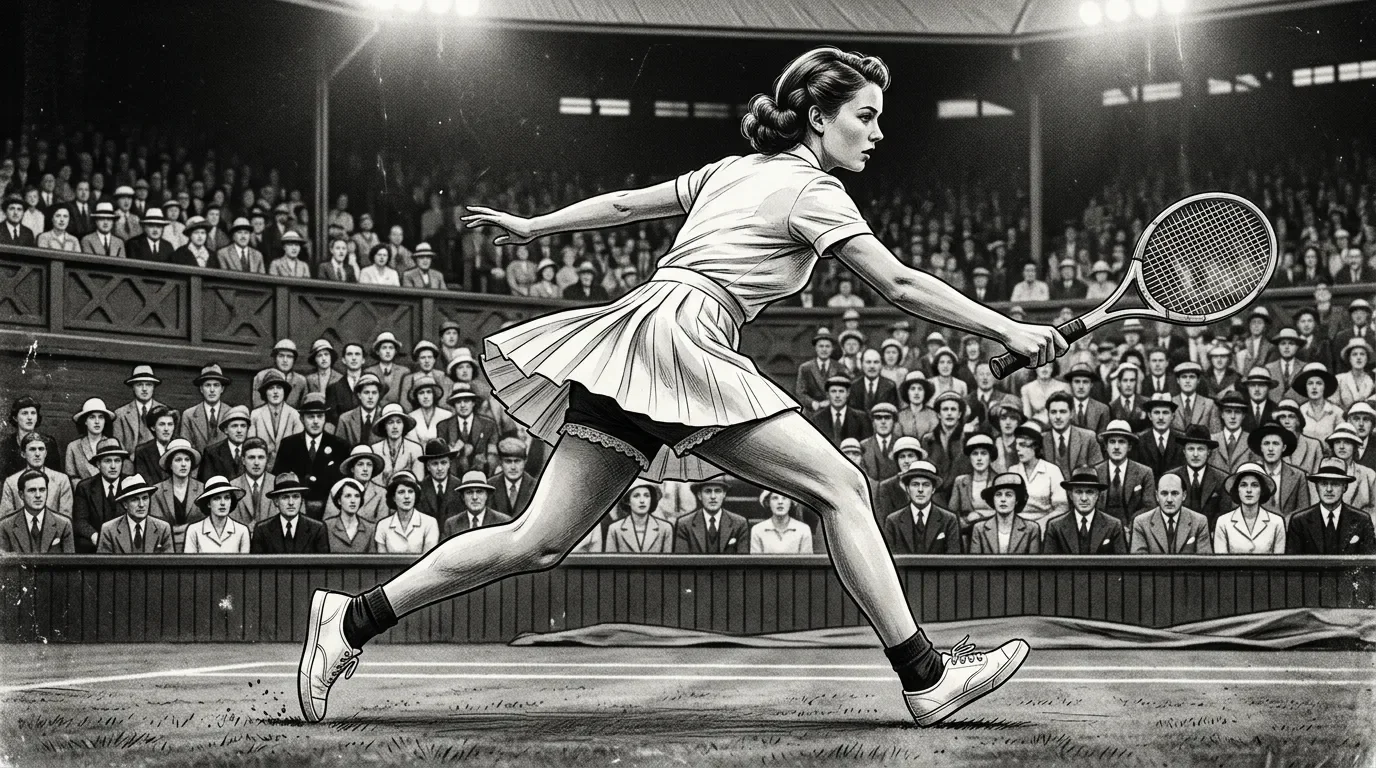
Cover: AI-generated illustration in the style of 1940s editorial art.
참고 출처
- 1'Gorgeous Gussie' Shocks Wimbledon — On This Day
- 2Gussie Moran — The Guardian obituary (Richard Evans, Jan 20, 2013)
- 3Recalling Gussie Moran, the gorgeous and tragic — ESPN (Melissa Isaacson, Jan 22, 2013)
- 4Ted Tinling — International Tennis Hall of Fame
- 5Ted Tinling — Wikipedia
- 6Gussie Moran — Wikipedia
- 7Gussie Moran obituary — The Independent (Paul Newman, Jan 20, 2013)
- 8'Gorgeous Gussie' Holds On To Less-Than-Glamorous Life — Orlando Sentinel (Melissa Isaacson, June 19, 1988)
- 9Why Wimbledon's dress code is so strict — BBC Culture (July 7, 2023)
이 콘텐츠를 둘러싼 관점이나 맥락을 계속 보강해 보세요.