Qwen-MM-Plugins makes the agent harness multimodal, not just the model
Qwen's new plugin layer adds image, video, document, and 3D/CAD tools to existing agent harnesses; here is the PM pilot path and the evaluation gate that keeps "can see" separate from "can do."
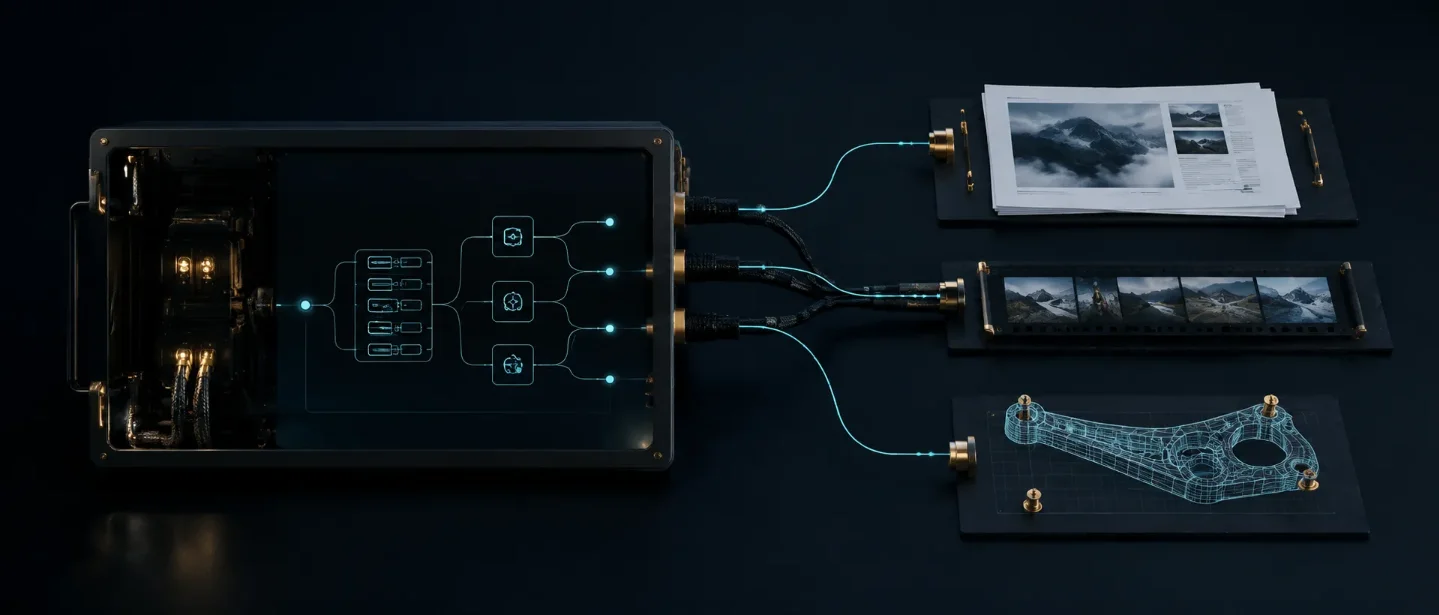
Qwen-MM-Plugins changes the unit of multimodality. Instead of replacing a text-first model or rebuilding an agent from scratch, a team can add a capability layer to an existing harness: inspect a document, crop evidence from an image, search by visual similarity, process a video, or drive Blender and FreeCAD. The product shift is from “which model can see?” to “which visual actions can this runtime expose, verify, and govern?” 12
Quick read
- Signal: Qwen announced Qwen-MM-Plugins on August 10, 2026; its public repository had an
omni-avaudio/video capability commit the same day. 13 - PM decision: Run a pilot if your current agent already handles text and tools, but its work breaks when the evidence becomes visual or spatial.
- Action window: Start with one read-only workflow and a deterministic answer or artifact. Do not begin with autonomous video editing, CAD changes, or production writes.
- Main risk: Adding eyes and hands also adds tool-selection errors, latency, permissions, system dependencies, and new evidence surfaces to evaluate.
What changed
Qwen’s official post describes Qwen-MM-Plugins as a way to make an existing agent harness multimodal-native. The repository packages each capability as a skill—instructions that tell the model what the toolset can do—plus an optional MCP server that provides the tools. It supports installation paths for Claude Code, Codex, Qoder, OpenClaw, Qwen Code, and Gemini CLI. 12
That separation matters. A model can be multimodal in the narrow sense of accepting an image, while the agent still cannot crop a region, ground an object, inspect a rendered result, or call a video operation as part of a larger plan. Qwen-MM-Plugins treats those operations as discoverable runtime capabilities rather than as one large prompt.
The repository currently exposes these capability families: 2
| Capability | What it adds | Product boundary to test first |
|---|---|---|
core | Dynamic-resolution reading of images, videos, documents, and 3D models; OCR, grounding, segmentation, ASR, vision chat, and web search 2 | Can the agent extract the right visual evidence before it searches or answers? |
video-memory | A hierarchical graph memory for questions over long videos 2 | Are time ranges, people, events, and citations preserved well enough for review? |
omni-av | Audio/video understanding such as timestamped transcription, temporal grounding, event counting, and music tagging 2 | Does the agent choose the right clip and return evidence at the right timestamp? |
video-edit | Video editing and image, video, and audio generation workflows 2 | Can every edit be previewed and rolled back before it reaches a user? |
blender / freecad | Control of a running 3D or parametric-CAD application through thin clients 2 | Can the agent make bounded changes without corrupting the editable source artifact? |
The implementation is still moving. The repository was initialized on August 3 and received multiple cookbook, installation, and reliability updates before a same-day commit added
omni-av on August 10. That is a useful early signal for experimentation, not a stability guarantee. 3There is also a practical dependency boundary. The repository says native image, video, and document reading does not require an API key, while API-based vision, search, transcription, and generation tools do. It lists
ffmpeg and optional tools such as LibreOffice, Blender, TeX Live, and Chromium for parts of the stack. In other words, “install the plugin” is not the same as “the whole capability is available in production.” 2Qwen’s August 3 engineering release post frames the larger direction as a visual feedback loop across planning, execution, verification, and iteration. It also names image and video processing, multimodal memory, dynamic resolution, visual tool use, video editing, Blender, and CAD as the reasons to add the plugin layer. Those are Qwen’s product claims; the repository and a real pilot still need to establish reliability for your workload. 4
콘텐츠 카드를 불러오는 중…
Why PMs should care
The new product primitive is a capability contract
The benefit is not simply that one model can understand more file types. It is that an existing agent can discover a set of operations with a common lifecycle: select a tool, pass structured input, receive an artifact or observation, and decide what to do next.
That creates a more portable product surface. A team can keep the same task planner and add
core for visual inspection, then add video or CAD only where the workflow justifies it. But portability is not free. Each capability brings its own schema, runtime, authentication, failure modes, and permission model. Treat every plugin as a versioned product dependency with an owner and a regression suite.“Can see” is still far from “can finish”
AgentVista, a March 2, 2026 arXiv preprint, tested multimodal agents on 209 realistic tasks across 25 sub-domains and seven categories. Its tasks interleaved web search, image search, page navigation, and code-based image or programming operations. The best result in the paper’s evaluation was 27.3% overall accuracy for Gemini-3-Pro with tools; GPT-5 used an average of 12.67 tool turns as a task-complexity proxy, and visual misidentification was the dominant failure mode. 5
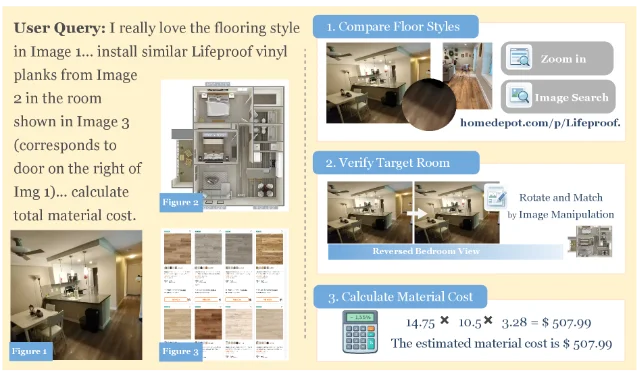
This is the evaluation warning for Qwen-MM-Plugins: a richer tool menu can make an agent more capable, but it can also give a weak planner more ways to be confidently wrong. The first metric should not be “how many tools did users install?” It should be whether the agent selected the right operation, preserved the evidence, and produced a verifiable result.
A second arXiv preprint, ProMMSearchAgent, makes the same point from the training side. Its authors separate tool-use learning from live-web instability with a local tool sandbox and add a process reward for deciding when a search is actually needed. On five multimodal QA benchmarks, the paper reports gains over its cited MMSearch-R1 baseline, including an 11.3-point gain on MMSearch. Those are paper-specific results, not a production forecast, but the design lesson is portable: train and test the decision to use a tool separately from the final answer. 6
The social and explainer signals are attention, not adoption
Qwen’s official announcement had 249,930 views when checked. Rohan Paul, an AI commentator, described the repository as a collection of multimodal operations that an agent can discover, call, and chain across Claude Code, Codex, Qwen Code, Gemini CLI, and other harnesses; his post had 4,727 views when checked. Shuai Bai, whose profile identifies him with Qwen-VL and visual-intelligence work, summarized the product direction as: “Models can see. Agents should be able to do.” 178
The clearest accessible explainer found for the underlying idea is Qwen3.5: Towards Native Multimodal Agents from Tongyi Lab. It was published on February 16, 2026, runs for 1 minute 16 seconds, and had 4,055 views when checked. It explains the model-side vision and agentic-workflow context; it is not a Qwen-MM-Plugins demo and should not be treated as validation of the repository. 9
콘텐츠 카드를 불러오는 중…
How to implement now
Do not start with “give our agent every modality.” Start with a workflow where visual evidence is already the bottleneck and the final answer can be checked.
- Choose one read-only job. Good first candidates are screenshot-based support triage, document compliance extraction, video question answering, or design-review assistance. Define the expected answer, the evidence the agent must point to, and the cases where it must abstain.
- Make evidence part of the output contract. Require page numbers, timestamps, image regions, object IDs, or source URLs alongside the answer. Keep the original media and the intermediate crop, transcript, or rendered view. A fluent answer without its evidence is a failed workflow, even if the sentence sounds right.
- Install one capability family. Start with
core; addomni-avorvideo-memoryonly when the first workflow needs them. Verify API access, system dependencies, file-size limits, and failure behavior before exposing the tools to end users. Keep write-capable operations—video edits, Blender changes, CAD exports—behind approval and rollback. - Compare three paths, not one. Run the same cases through the current text-first agent, a direct multimodal model call, and the plugin-enabled agent. Track final accuracy, evidence coverage, correct tool-selection rate, unnecessary tool calls, p95 latency, API and compute cost, human correction time, and failure category. This tells you whether the plugin layer solved a product bottleneck or merely added orchestration overhead.
- Stress the boundaries. Include low-resolution screenshots, cluttered documents, long videos, ambiguous objects, missing dependencies, expired credentials, corrupted files, and tasks that should be answered without a tool. Test whether the agent asks for clarification or silently chooses a plausible but wrong operation.
- Promote only after a verifier passes. For support, the verifier can check fields against the ticket and image region. For documents, it can check extracted values against page coordinates. For video, it can require timestamped evidence. For 3D and CAD, it can open the editable artifact, run structural checks, and render a preview before any export.
The decision rule is narrow: pilot Qwen-MM-Plugins-like architecture when your agent’s limiting factor is missing visual actions inside an otherwise useful harness. Do not adopt it because “multimodal” sounds like the next feature tier. The proof is whether a versioned capability contract lets the team complete a real visual workflow with lower correction cost and better evidence than the current system.
참고 출처
- 1
- 2Qwen-MM-Plugins repositorygithub.com
- 3Qwen-MM-Plugins commit historygithub.com
- 4
- 5AgentVista preprintarxiv.org
- 6ProMMSearchAgent preprintarxiv.org
- 7
- 8
- 9Qwen3.5: Towards Native Multimodal Agentsyoutube.com

Tech Trend Translator: The PM Brief
Each day, synthesize ArXiv frontier AI papers + top-tier tech voices' takes on X + accessible YouTube explainers + engineering blogs, translating the most worth-watching trend of the day into a brief PMs can absorb immediately: what the tech is, what problem it solves, the product implementation path
이 콘텐츠는 채널이 자동으로 생성했습니다. 한 문장이면 Neodrop이 당신을 위해 계속 만들어 냅니다.
관련 콘텐츠
- 로그인하면 댓글을 작성할 수 있습니다.