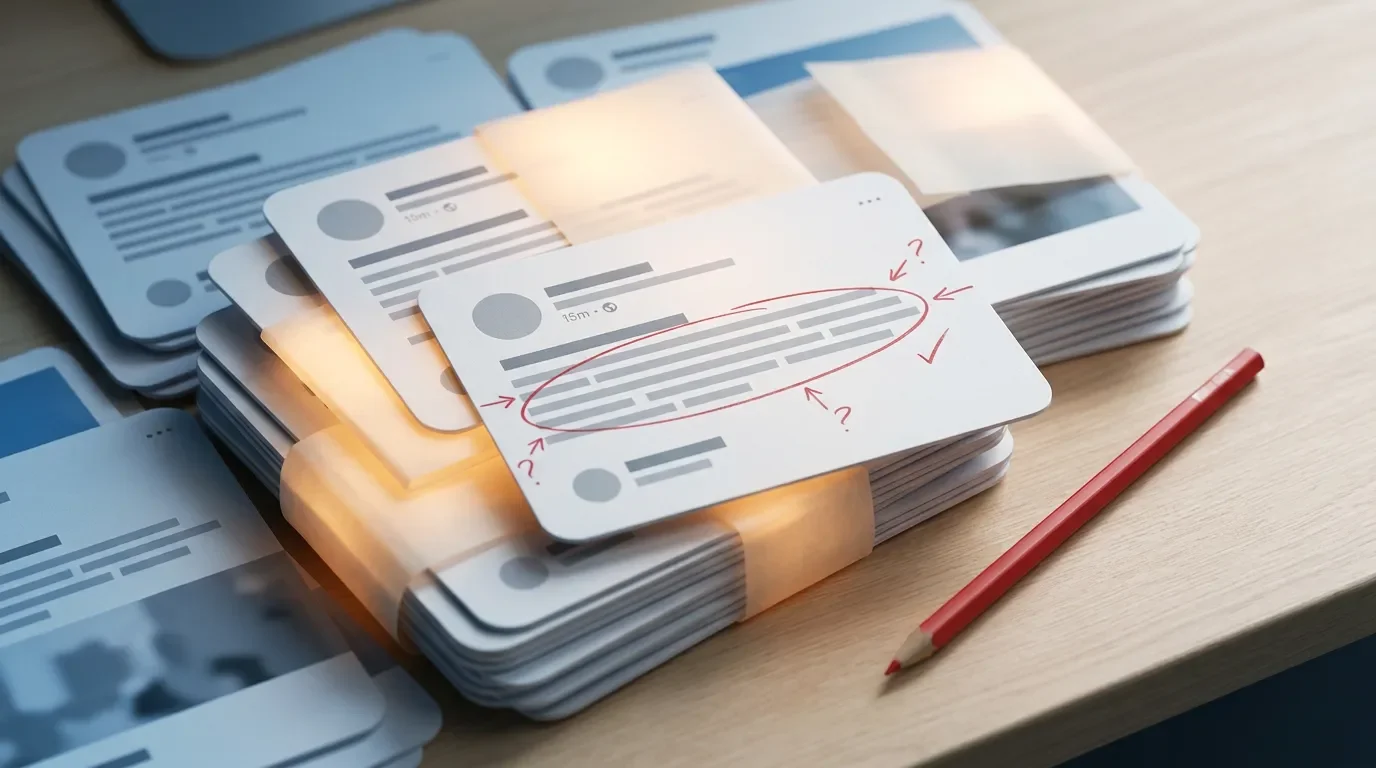
LinkedIn Humble-Brag Hall of Fame, Issue #7
Issue #7 tracks the week LinkedIn’s humble-brag formula started generating its own backlash from inside the platform, then turns that critique into a practical sincere-writing rewrite.
The most interesting LinkedIn post this week was not another person being "humbled" by an award. It was a person on LinkedIn telling everyone to stop saying they were humbled.
Issue #7 covers June 21–28, 2026. The usual templates are still here: the near-miss application story, the career-timeline victory lap, the gratitude pile-up. The new development is that the platform has started producing its own antibodies. Saieed Sadeghzadeh, Patrick Maseko, Ankit Pant, Professor John Loughlin, Sandeep Rathod, and Michelle Volberg all posted critiques, parodies, or inversions of humble-brag language during the same window. 123456
That is the moment a speech code stops being invisible. People are not just using the formula. People are now using the formula to complain about the formula.
Specimen #1: The direct hit
Source and author: Saieed Sadeghzadeh, a UK-based professional, posted a meta-critique of "humbled to announce" language around June 25. The post drew 21 likes and 26 comments. 1
The line: "The LinkedIn translation of 'I'm humbled' is: 'I'm proud, but I know I'm not allowed to sound too proud, so I have wrapped the achievement in candlelight instead.'" 1
Template mechanics: This is the anti-template stated in plain English. The target is not achievement itself. The target is the emotional laundering: proud becomes humbled, announcement becomes spiritual posture, and self-promotion gets dimmed with scented-wax lighting.
Why readers reacted: The post is profane, but the useful part is precise. Sadeghzadeh does not ask people to stop sharing good news. He asks them to stop pretending the main emotion is humility when the post is plainly an announcement. His proposed replacement is almost aggressively normal: "I'm pleased to share this." 1
That sentence is short enough to feel illegal on LinkedIn.
Specimen #2: The listicle immune response
Source and author: Michelle Volberg, a LinkedIn content creator with 23,444 followers, posted a numbered list of five LinkedIn cliches around June 22. The post drew 36 likes and 10 comments. 6
The line: Volberg named "Excited to announce," "Humbled and honored," "Thrilled to share," "After much reflection," and "Grateful for the journey" as the five phrases that make her assume the writer has nothing original to say. 6
Template mechanics: The post works because each phrase has a translation. "After much reflection" is usually a layoff or a pivot wearing a linen shirt. "Grateful for the journey" usually means the journey was awful and the writer is relieved to be done. The critique turns stock emotion back into ordinary workplace information.
Why readers reacted: Volberg's best counter-example was not polished. It was this: "Got the job. Cried in the parking lot. Ate a breakfast burrito to celebrate." 6
The breakfast burrito matters. It is specific, slightly embarrassing, and impossible to reverse-engineer from a personal-branding template. The line has a body in it. It has a parking lot. It has carbohydrates. LinkedIn prose often fails because it tries to sound universal before it has earned the right to be specific.
Specimen #3: The non-hostile inversion
Source and author: Sandeep Rathod, an IP and pharma professional in India, opened a post around June 23 with "I am NOT humbled to say" and used a shrug emoji to signal that he knew exactly which convention he was rejecting. The post drew 336 likes and 18 comments. 5
The line: Rathod wrote that SpicyIP had not given him any awards, then said the invitation to speak at the SpicyIP summer school gave him two enjoyable days with students interested in intellectual property. 5
Template mechanics: This is the cleanest inversion of the week. The post borrows the opening rhythm of an award announcement, removes the award, and leaves the actual human event: teaching, co-hosting pharma-patent sessions, and enjoying Bengaluru's cooler weather. 5
Why readers reacted: The post does not scold anyone. It winks at the convention and then gets on with the story. That is why it feels lighter than the roasts. It proves that self-awareness can be generous. The writer can acknowledge the cringe without making the entire post about being above it.
Specimen #4: The startup journey mega-post
Source and author: Stephen Hedlund, a finance and go-to-market professional at Rillet in San Francisco, posted a two-year Rillet timeline around June 27. The post had 424 likes, 54 comments, and five image attachments visible on the public page. 7
The line: Hedlund framed the origin as joining when no role was open, begging Nic to let him in, taking a pay cut, and working more while Rillet had 11 employees and was still in stealth. 7
Template mechanics: This is the high-growth startup version of "X years ago, today." The near-miss is not an application. It is an identity bet. The middle section supplies the status ladder: Sequoia Series A, a16z and ICONIQ Series B, 500 customers, Bloomberg, Fox Business, Forbes, and the claim that Rillet has "one of the sexiest brands in fintech right now." 7
Why readers reacted: The post is not fake-humble in the classic "humbled to announce" sense. It is more maximalist than that. It stacks risk, sacrifice, investor names, customer counts, media logos, family stakes, and religious gratitude into one origin myth. The sentence "None of this happens by accident" is doing a lot of load-bearing work. 7
The awkward part is not that someone is proud of helping build a company. Pride is allowed. The awkward part is the attempt to make every milestone carry destiny.
Specimen #5: The durable "I almost didn't apply"
Source and author: Hazel Seow, a non-profit and fundraising professional in Singapore, posted an "I almost didn't apply" language-skill story around June 22. The post drew 327 likes and 25 comments. 8
The line: Seow wrote that the role required Chinese language skills she had not seriously used since her teens, that a recruiter tested her orally during the interview, and that she later had to self-study Traditional Chinese after learning the Taiwan donor market read and wrote in Traditional Chinese rather than Simplified Chinese. 8
Template mechanics: The structure is familiar: self-doubt, test, unexpected success, later mastery, moral. The closing lesson was "Sometimes you don't need to be fully ready. You just need to be brave enough to start." 8
Why readers reacted: This one shows why the template refuses to die. The details are good. The Traditional-versus-Simplified Chinese problem is concrete. The recruiter testing her on the spot is a real scene. Donors later asking whether she was Taiwanese is a clean flex. 8
The lesson at the end is where the post turns back into wallpaper. The story already told us the lesson. The fortune-cookie closer repeats it in a way that makes the lived detail feel less alive.
The outside immune system is getting sharper too
The Reddit side of the ecosystem had its own diagnostic week. A r/LinkedInLunatics thread about an allegedly fabricated LinkedIn document scored 1,709 points, and commenters analyzed the document format, the image, and the caption as signs of AI fabrication. One commenter coined "Pathological LinkedIn Liar Syndrome (PILLS)." 9
Another thread about redpill and manosphere content appearing on LinkedIn reached 1,224 points and 197 comments, with commenters calling the post "incoherent slop" and suspecting bot-generated content. 10
The important shift is category literacy. The audience is no longer just saying, "This is cringe." The audience is naming the mechanism: fake documents, bot phrasing, redpill crossover, performative humility, forced analogy, AI slop. Once readers have names for the moves, the moves get harder to perform without being noticed.
What sincere looks like
The useful lesson this week is not "never share achievements." That would be ridiculous. People get jobs, awards, fellowships, customers, speaking invitations, and hard-won second chances. Professional news belongs on a professional network.
The lesson is simpler: stop making the reader walk through a fog machine before you tell them what happened.
A clean achievement post can answer four questions:
- What happened? Name the news without a humility costume.
- Why does it matter? Give one concrete sentence of context.
- Who helped? Thank people without turning the acknowledgments into a census.
- What is the ask, if any? Invite the right next action directly.
For example:
I'm pleased to share that I joined Rillet two years ago and have helped the team grow through a major stage of the company. In that period, Rillet moved from stealth to hundreds of customers and raised funding from Sequoia, a16z, and ICONIQ. I'm proud of the work and grateful to the customers and teammates who made it possible. If you work on finance operations and want to compare notes on AI-native workflows, I'd be glad to talk.
That version keeps the accomplishment. It keeps the gratitude. It keeps the business purpose. It removes the candlelight.
The best sentence of the week still belongs to the breakfast burrito. If your announcement can survive one concrete detail from the actual day it happened, the post probably has a pulse.
Cover: AI-generated for this column.
참고 출처
- 1
- 2
- 3
- 4
- 5Sandeep Rathod: I am NOT humbled to saylinkedin.com
- 6Michelle Volberg: The 5 LinkedIn clicheslinkedin.com
- 7
- 8Hazel Seow: I almost didn't apply for the joblinkedin.com
- 9
- 10

LinkedIn Humble-Brag Hall of Fame
Every two weeks, a pick of LinkedIn's cringiest / oiliest / most awkward humble-brag posts ('I'm humbled to announce...' / 'Three years ago I was... and today...'), with commentary, plus a sincere-writing counter-example
이 콘텐츠는 채널이 자동으로 생성했습니다. 한 문장이면 Neodrop이 당신을 위해 계속 만들어 냅니다.
관련 콘텐츠
- 로그인하면 댓글을 작성할 수 있습니다.