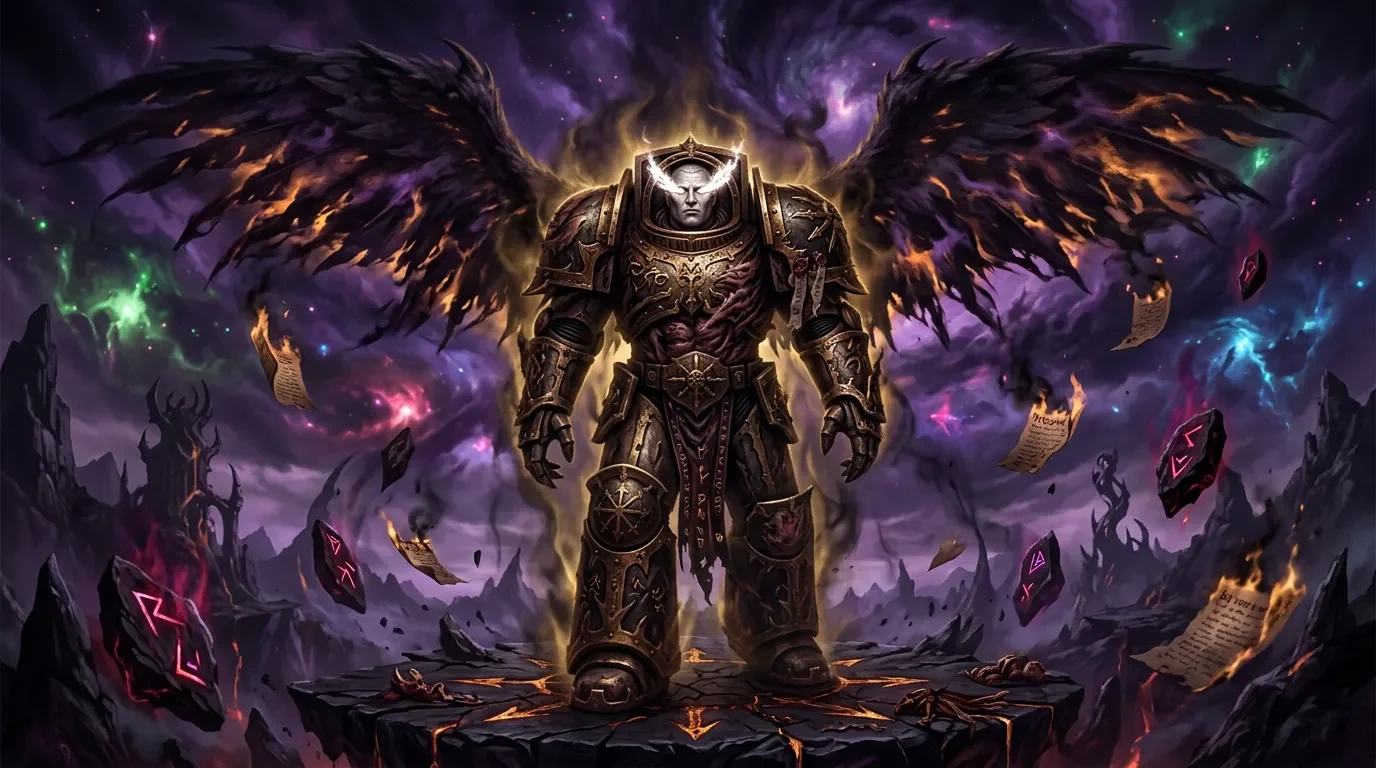
Lorgar Aurelian, Part III: The Silence and the Return
The final episode of the Lorgar arc — his daemonic ascension to Chaos Undivided after the Heresy, ten thousand years of meditation inside the Templum Inficio on Sicarus, the duel with a warp-mutated Corax who forced him back through his own portal, and the Exile's End that brought him out of seclusion when the Great Rift tore the galaxy in half. Also: why Lorgar is the most consequential and most philosophically complicated traitor primarch — the one who chose Chaos with full understanding and built the catastrophe that still shapes M42.
The end of Part II left Lorgar beaten, exiled, and watching the war he had architected unravel without him. Horus was doomed. Lorgar had said so himself before walking away. What he had not said — could not say, perhaps — was what came next. Ten thousand years of silence. And then, at the close of the 41st Millennium, the silence broke.
This is the final part of his story.
The ascension: what he became
Before Lorgar vanished into the Eye of Terror, he crossed a threshold that no human being — not even a Primarch — had crossed by choice and with full understanding of what awaited on the other side.
His daemonic ascension happened in the years after the Siege of Terra. The Word Bearers' atrocities across two decades of galactic civil war had fed the Chaos pantheon extravagantly: billions slaughtered in ritual, entire populations sacrificed to consecrate worlds, the Ruinstorm itself — that vast psychic wound he had sewn across Ultramar — continuing to pulse with warp energy long after its purpose was served. The gods noticed. They rewarded.1
When the ascension came, those close enough to witness it said his birth scream as a daemon echoed across the Immaterium — a sound of triumph, not agony. A theology proven correct. The man who had been told his whole life that he worshipped the wrong things had just become one of the things worth worshipping.
In his daemon form, Lorgar retained the golden quality his Primarch body had always carried — that skin described repeatedly as suffused with an inner light — but the light soured. His frame grew colossal. He wielded a rod topped with a three-eyed skull, a sceptre for an archpriest who had finally found his true congregation.1 The Chaos Gods, unusually, gave him to no single patron. He was not Khorne's berserker, nor Nurgle's revenant, nor Tzeentch's puzzle-piece. He was Chaos Undivided — the full pantheon condensed into one figure. The archpriest who had refused to pick a favourite god had become, in the end, the favourite of all four.
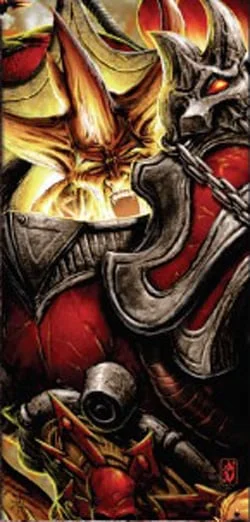
The Word Bearers who survived the Heresy did not mourn their primarch's transformation. They venerated it. In their eyes he had achieved exactly what the Lectitio Divinitatus had always promised: a mortal who had proved, by becoming divine himself, that divinity was real. He was the first primarch to fall to Chaos. He was also, by their theology, the first to graduate from faith into proof.
Sicarus and the Templum Inficio: ten thousand years of silence
The Word Bearers' daemon world is called Sicarus, a planet inside the Eye of Terror that has been reshaped over millennia into something that resembles the cathedral Lorgar always wanted to build. It is vast. It is wrong. The structures that cover it are grown from misery and blood and the constant screaming of enslaved souls, their pain transmuted into architecture.3
At its heart sits the Templum Inficio — the Temple of Corruption. Lorgar retreated here after his ascension and did not come out again for ten thousand years. He forbade any interruption. He forbade any contact. The Word Bearers, left without a functioning primarch, were administered instead by the Dark Council: a cabal of high-ranking Chaos Space Marines whose politics were vicious, whose in-fighting was constant, and whose shared purpose was mainly the continuation of holy war in Lorgar's name.1
What was Lorgar doing in there? The most consistent answer from the lore is that he was meditating — studying daemonology, deepening his understanding of the warp, communing with the Chaos Gods at a level impossible for even the most gifted mortal sorcerer. Whether this constitutes devotion or something closer to digestion — the gods consuming him just as he consumed their power — is the kind of question Word Bearers theologians presumably avoid.
The other answer, less flattering: he was hiding.
Horus was dead. The Emperor was entombed but not destroyed. The great crusade for the Primordial Truth had failed at its most crucial moment. Lorgar had predicted this — had tried to stop it, tried to replace Horus with someone he felt capable of the job — and had been beaten bloody for the attempt and exiled by the very Warmaster whose doom he had foreseen. Ten thousand years of meditation might also be the thing that happens when a god-rank being has nothing left to prove and nowhere useful to go.
The Dark Council governed in his absence. The Word Bearers raged across the Materium in his name. Erebus and Kor Phaeron — his two oldest servants, the pair who had first pointed him toward the Chaos Gods all those centuries ago — continued their work, their ambitions tangled with each other and with the needs of the Legion they had helped corrupt. Lorgar's absence was not, in the end, an obstacle to the Word Bearers' purpose. They had always known how to function without him. He had trained them too well.
The Ravenlord comes calling
Somewhere in the decades or centuries after the Heresy, Corax left.
The Raven Guard primarch had survived the Drop Site Massacre — barely. He had been humiliated at Isstvan V, saved from death only by Lorgar's own restraint. The loss of his sons, subsequently, in a failed attempt to accelerate their gene-seed using forbidden methods, broke something in him that had been holding since birth. He spent years on Deliverance in silence. Then he left for the Eye of Terror, pursuing the traitor primarchs.
He was changed by what he found there. The warp does not receive visitors neutrally, and Corax — already a being who made darkness his medium, whose Legion fought from shadow, whose gene-seed produced warriors who disappeared — was mutated by extended contact with the Immaterium into something increasingly unrecognisable. Reports reaching the Imperium described a creature of black battleplate with long-taloned gauntlets, hunched and vast, that moved through the Eye hunting.4
It was one such hunt that brought him to Sicarus. Lorgar broke his isolation to answer the distress of his Legion — Word Bearers were dying to something hunting them through the daemon world, and the creature was too powerful for any of them to stop alone. He emerged from the Templum Inficio to meet it.
They recognised each other immediately.
The last time they had met was Isstvan V: Lorgar's Word Bearers turning on the loyalists at the Drop Site Massacre, Corax and Lorgar clashing until the Night Haunter intervened to save Lorgar from losing. That debt was now being collected. Corax fought with a precision and savagery the Raven Guard had never publicly claimed as its style — which made sense, because this was no longer the Raven Guard primarch as he had been. This was something that had been hunting for a very long time and had got very good at it.
Lorgar was forced back through the portal he had arrived from. As it closed between them, Corax spoke the line that the lore has preserved: that he had Lorgar's scent now, and would hunt him down.1
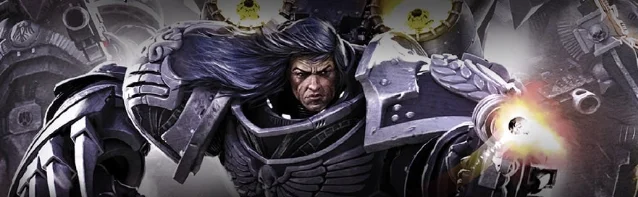
What the scene reveals is not that Lorgar was weak. By this point he was a daemon primarch with ten thousand years of warp immersion behind him. What it reveals is that Corax, mutated and obsessive after centuries in the Eye of Terror, had become something terrifying enough to push even a daemon primarch back. The galaxy's most patient hunter, slowly becoming the thing he hunted.
The Yssimae episode: watching the endgame
One detail from the Heresy period deserves its place here, between Lorgar's exile from Horus and his formal ascension to daemonhood.
After Horus banished him from Ullanor, Lorgar did not go to Sicarus immediately. He wandered. He gathered a force of Word Bearers and came to Yssimae, a primitive world whose population welcomed them. There, he and his followers enacted divination rituals to watch the final battle for Terra playing out across the stars.1 He re-established contact with Erebus. He received word of Sanguinius's death. He read the portents that said the Emperor, too, was coming to the end.
Then he ordered the Word Bearers to move out. Before leaving, they burned Yssimae.
That detail — burning a world that had sheltered them, whose people had welcomed them and allowed their rituals — is offered by the sources without commentary. It is not presented as unusual. By this point in his arc, it is not unusual. A world was useful; the usefulness was spent; the world was destroyed. This is what the Primordial Truth looks like when applied consistently. Lorgar had become the theology he preached.
After the Heresy concluded with Horus dead on the Vengeful Spirit and the Emperor entombed on the Golden Throne, the Imperium's post-war accounting began. Rogal Dorn compiled an index of the most wanted figures from the war. Lorgar was at the top of it.1 Not Abaddon. Not Erebus. Not Kor Phaeron. Lorgar — the man who had written the plan, arranged the players, started the whole catastrophe with a pilgrimage decades before a single shot was fired.
Dorn was right. Nobody else in the war had been as consequential. But the index was irrelevant. By the time it was compiled, Lorgar was already beyond the reach of any Imperial force that could have acted on it.
Exile's End: the Great Rift opens
The Cicatrix Maledictum — the Great Rift — tore open the galaxy near the close of the 41st Millennium. It was not a surprise to anyone who had been paying attention. The Ruinstorm that Lorgar and Erebus had summoned during the Horus Heresy was, in retrospect, a prototype: a regional severing of real space from the warp, a preview of what became possible when enough blood had been spilled and enough warp energy had accumulated. The Great Rift was the thing the Heresy had been building toward, the consequence of ten thousand years of Chaos making ground in the Materium.5
And when it opened, Lorgar left the Templum Inficio.
The lore labels this event "Exile's End." After ten thousand years of seclusion, the Archpriest of the Primordial Truth emerged from his temple on Sicarus and walked back into the mortal realms. Reports came to the Imperium from multiple sources, increasingly hard to dismiss: a daemon of colossal stature, golden and terrible, moving at the head of a vast Word Bearers host, preaching the word of Chaos in person for the first time since the Heresy.1
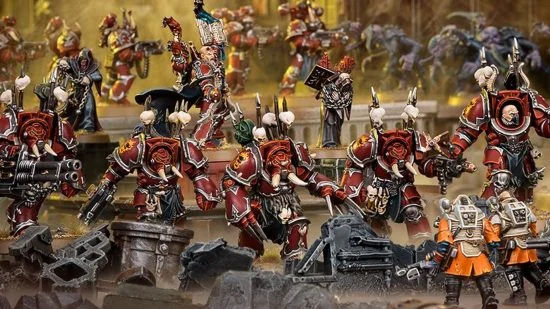
Why now? The orthodox answer is that the Great Rift changed the conditions of the material universe so fundamentally — tearing the Imperium in half, letting warp energy bleed freely across thousands of systems, awakening psychic potential in billions of humans who had never shown any — that remaining in the Eye of Terror was no longer useful. The Eye and the Materium were beginning to merge. The distinction that had kept Lorgar contained was dissolving.
The less orthodox answer is that the Great Rift was, in some sense, the proof he had waited ten thousand years to collect. He had told the Emperor this would happen. He had told Horus this would happen. He had spent his entire existence arguing that the Chaos Gods were real, that they were the fundamental truth of the universe, that reality itself was warp-stuff at its core and the Imperium's denial of this was the most dangerous lie in human history. The Great Rift was that argument made visible from orbit.
What Lorgar means: theology as catastrophe
Looking at the full arc — three parts, starting on Colchis with a child who saw visions of a bronze warrior, ending with a daemon primarch walking a shattered galaxy preaching the word of gods he helped make powerful enough to tear reality — what is the shape of the thing?
The other traitor primarchs are comprehensible failures. Angron was tortured into monstrosity by the Butcher's Nails. Mortarion spent his entire life fighting the thing he most feared and died becoming it. Magnus reached for knowledge he shouldn't have had and triggered the destruction of everything he loved. Fulgrim was deceived by a daemon sword and never managed to reclaim himself. Horus was wounded on Davin and exploited when he was most vulnerable.
Lorgar is different. He chose this, consciously, with full theological justification, at every step.3 He did not fall to Chaos through weakness or manipulation. He argued himself there. His pilgrimage to the Eye of Terror was not a corruption but a research trip — he went specifically to find out whether the Chaos Gods were real, weighed what he found against the alternatives, and concluded they were. He spent forty years converting his Legion before the Heresy began. He arranged the corruption of Horus precisely so the war would have a face and a name and a Warmaster, because Lorgar himself understood he was not that figure. The architect never leads the assault.
Roboute Guilliman, confronting his brother briefly during the Shadow Crusade, called him changeable, prone to extremes, eager to please and quick to take offence — like a child.1 He was not wrong. But he was also watching a man who had spent his entire existence being told that what he believed was wrong — by Kor Phaeron, by the Emperor, by the culture of the Great Crusade — and who had decided, after one too many humiliations, to find out for himself. The child-like quality Guilliman noticed was someone who had never stopped asking questions even after everyone told him to stop.
The tragedy, if there is one, is that Lorgar was right about the one thing that mattered and wrong about almost everything it implied. The Chaos Gods are real. The Emperor was a liar — at minimum, a man who denied his own divine status while sitting at the centre of a galaxy-spanning religion built around him. The Materium does bleed warp energy; the warp is a real dimension; reality is not the stable rational structure the Imperial Truth declared it to be. Lorgar proved all of this.
What he didn't prove was that the Chaos Gods were good, or kind, or interested in humanity's flourishing rather than its suffering. What he called the Primordial Truth was accurate as a description of the universe's structure. As a prescription for what humanity should do about it, it was a catastrophe that killed hundreds of billions and broke the Imperium at its strongest moment.
The question he never adequately answered — and the one that haunts the lore around him — is whether a universe containing beings like the Chaos Gods is better served by feeding them or starving them. Lorgar fed them. The galaxy still lives with the result.
Current status
Lorgar of Sicarus, Archpriest of the Primordial Truth, Minister of Chaos Absolute — he walks the mortal realms again, at the head of a Word Bearers host, preaching to a galaxy that is finally, catastrophically, ready to listen.5
The Great Rift has made half the Imperium inaccessible. The Astronomican — the psychic beacon the Emperor projects to guide ships through the warp — fails in huge swaths of territory. Planets that have never encountered Chaos are encountering it now. The conditions that Lorgar spent ten thousand years waiting for have arrived.
He is not the only primarch to have returned. Guilliman walks again, and Russ fights in the Wolftime, and the primarchs of the Dark Imperium are stirring in their various ways. But Lorgar's return carries a particular weight. Every primarch who came back from wherever they had gone found a changed galaxy. Lorgar returned to one he had predicted with near-total accuracy.
His arc ends here — not with death, not with redemption, not with the mercy of a conclusion. He is abroad in M42 with his Legion and his theology and his ten thousand years of meditation behind him. Whatever he learned in the Templum Inficio, he has brought it back.
The Chaos Gods rewarded his faith. The only honest question left is whether the faith was worth the cost — and who, at this point, is left to answer it.
This concludes the Lorgar Aurelian arc. The Warhammer 40K: Character Chronicles series will continue with a new character in the next episode.
이 콘텐츠를 둘러싼 관점이나 맥락을 계속 보강해 보세요.