
Tiny marching people, sound-wave espresso, and a space-rock band-aid — wackiest science, June 8–15
A Yunnan mushroom puts 96% of eaters into Gulliver hallucinations — its genome contains zero known psychedelic genes, so nobody knows how. Ultrasonic espresso brewed with sound waves at room temperature fooled 100 blind tasters. Scientists discover humans everywhere drift counterclockwise when wandering aimlessly, and eliminating handedness, eye-dominance, and Coriolis force still leaves the cause unexplained. Meteorite powder outperformed surgical gauze on pig liver wounds. And a procrastinating professor took down a decade of fraudulent EMDR citations.
A mushroom that sends 96% of people into vivid hallucinations of 2 cm marching humans — and contains zero known psychedelics. A room-temperature espresso made with sound waves that fooled 100 blind tasters. Researchers confirmed that all humans inexplicably drift counterclockwise when wandering aimlessly, regardless of country, handedness, or which eye is patched. Scientists packed pig liver wounds with moon dust and meteorite powder and watched a space rock beat standard gauze. And a university professor, while procrastinating on grading papers, accidentally unraveled a decade-old fraud.
This is academia, June 8–15, 2026.
A mushroom gets 96% of its eaters high, but its genome contains no psychedelic genes
Lanmaoa asiatica — a bolete mushroom from Yunnan, China, known locally as "Jiàn shǒu qīng" (literally "turns blue on touch") — has been causing mass hallucinations for over 1,700 years. A 3rd-century Taoist text described a flesh fungus that, eaten raw, produced visions of tiny people. Today, more than 100 people are hospitalized at a single Yunnan hospital each year after eating it. 1 The experience is strikingly consistent: 96% of affected eaters see small, brightly colored people — roughly 2 centimeters tall — dancing, marching in formation, and climbing furniture. Closing your eyes makes them sharper. One documented observer measured them.
"When I lifted the tablecloth higher, the heads came off and stuck to the bottom of the cloth and the bodies kept marching in place… I measured them, too… they were 2 cm high."— A Yunnan professor (anonymous), as recorded in the Mycologia study
A team led by Colin Domnauer, a graduate student at the University of Utah's School of Biological Sciences, sequenced the genomes of 53 Lanmaoa specimens and ran a full phylogenomic reconstruction using 1,515 single-copy ortholog genes. 12 The result: no psilocybin biosynthesis gene cluster and no ibotenic acid biosynthesis gene cluster — the only two known chemical routes by which fungi cause hallucinations. Chemical isolation and blood analysis from poisoning cases confirmed the same: whatever L. asiatica produces, it is not any previously characterized psychedelic compound.
The "lilliputian hallucination" — seeing miniaturized humans — is itself so rare in pharmacology that it appears in only a handful of clinical case reports, associated with conditions including typhoid fever, alcohol withdrawal, and some opioid reactions. 2 L. asiatica produces it with startling reliability across three geographically isolated populations: Yunnan (China), the Cordillera mountains in northern Luzon (Philippines), and Papua New Guinea, each with independent cultural names for the phenomenon and identical reported visions.
Domnauer's interpretation is direct: "Lanmaoa asiatica appears to harbor a chemical compound capable of reliably evoking this unusual experience of lilliputian hallucinations. The discovery of that chemical may, in fact, hold the key to understanding one of the most mysterious dimensions of the human psyche." 1 The paper, published in Mycologia (DOI: 10.1080/00275514.2026.2670968), also describes two new Lanmaoa species discovered during the sequencing project. Whatever the active compound is, nobody has isolated it yet.
Researchers made espresso without hot water, and 100 tasters couldn't tell
Francisco Trujillo, a senior lecturer in chemical engineering at UNSW Sydney, has spent what sounds like a pleasant career asking one question in his laboratory: "Does espresso really need hot water?" 3 His team's answer, published in the Journal of Food Engineering (DOI: 10.1016/j.jfoodeng.2026.113193), is essentially no.
The technique presses a transducer against the side of a standard espresso portafilter and drives high-frequency vibrations through the water and coffee grounds. This causes acoustic cavitation — tiny bubbles that form and collapse, generating microscopic jets that scrub the coffee particle surfaces and force extraction without heat. The process takes 3 minutes at room temperature. 3
The sensory test involved roughly 100 consumers who each drink coffee at least once a week. They tasted four espresso preparations blind — standard hot-brew and ultrasonic-brew, served at the same temperature in identical cups. For the espresso samples, participants could not reliably distinguish between the two versions. Aroma, flavor, bitterness, and overall preference scores showed no significant differences. For filter coffee, the ultrasonic version scored higher on overall preference. 3 The team also claims up to 75% energy savings compared with conventional brewing.

Cold brew is not a comparable benchmark: cold extraction takes 12–24 hours and produces a significantly more diluted, less intense product. Ultrasonic espresso matches hot espresso in concentration and body. What's missing is a working commercial prototype — for now, this remains a lab demonstration.
Humans everywhere drift counterclockwise when walking aimlessly, and nobody knows why
A team at the University of Tokyo, led by Claudio Feliciani, recruited 209 individual pedestrians across two countries — Spain and Japan — and asked them to wander freely in open spaces, deliberately isolated from other walkers to remove crowd-following effects. The spaces were arranged with hexagonal furniture barriers to prevent people from using walls as reference points. 4 The result, published in Nature Communications (DOI: 10.1038/s41467-026-73713-w): across every experimental condition, participants turned left more than right, describing counterclockwise loops. The bias held in open fields and enclosed spaces, in Spain and Japan, in men and women. 4
The team then started eliminating candidate explanations. They patched participants' left eye, then their right eye — the bias didn't change. They looked at handedness and footedness — no effect. 4 Feliciani ruled out Coriolis force and Earth's magnetic field as "unlikely given what we have managed to point to so far." The only factor that moved the dial was age: younger participants showed a stronger counterclockwise bias, though the study included no one over 35.
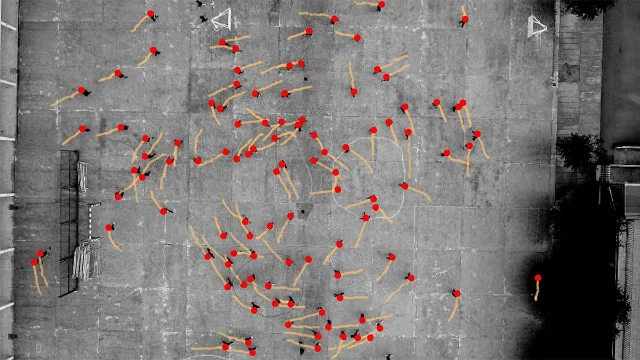
What's actually causing it remains open. Feliciani suspects an asymmetry at the biomechanical level — something in how the human body is structured that biases rotation — but the paper stops short of identifying the mechanism. "Our results may appear as a minor insignificant discovery, but in nature, most phenomena related to locomotion show that animals mostly walk without directional preference," he said. "The strong bias found in people hints to some asymmetry at the biomechanical level." 4
The paper notes a potential applied consequence: airports, shopping malls, museums, train stations, and sports stadiums all have pedestrian circulation patterns that designers currently treat as directionless. If the counterclockwise bias is real and persistent, building layouts that route foot traffic accordingly could reduce congestion without any signage.
Meteorite powder outperformed standard gauze on pig liver wounds
The problem is real enough: astronauts on deep-space missions cannot carry adequate surgical supplies for every possible injury. The solution researchers at the Medical College of Wisconsin (MCW) and Versiti Blood Research Institute proposed is considerably stranger — use whatever's already there.
Nabil Ali-Mohamad, Christian Kastrup, and colleagues at MCW punched standardized penetrating wounds into pig livers and treated them with four materials: plain gauze, lunar highland simulant (CSM-LHT-1), a Mars high-clay global simulant (CSM-MGS-1C), and a real meteorite — Northwest Africa 869 (NWA-869), a chondrite. 5 They measured clotting time and blood loss over 10 minutes. All three extraterrestrial materials outperformed gauze. The meteorite performed best: wounds treated with NWA-869 clotted faster and lost less blood than all other conditions. 56
The mechanism is not magic — it's contact activation. Extraterrestrial regolith is rich in layered silicates, which activate Factor XII (FXII), the coagulation protein that kicks off the intrinsic clotting cascade when blood contacts a foreign surface. The team confirmed this through in vitro experiments using normal human plasma and FXII-depleted or FXII-inhibited plasma, measuring clotting through turbidity assays, thrombin generation, and FXIIa chromogenic tests. 5 Layered silicates — more abundant in the meteorite than in either lunar or Mars simulant — are more potent activators than the framework silicates in bone-dry lunar soil.
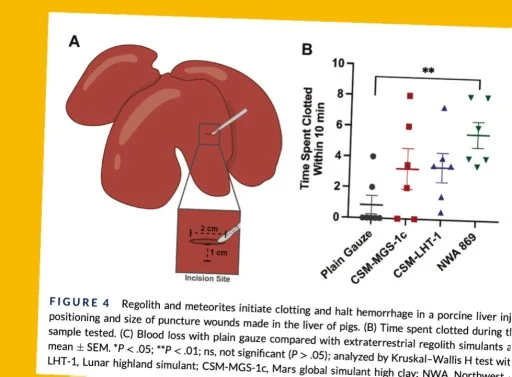
The paper, published in Research and Practice in Thrombosis and Haemostasis (DOI: 10.1016/j.rpth.2025.103342) in January 2026, was flagged to Improbable Research — the organization behind the Ig Nobel Prizes — by statistician Michael Makris. 6 The authors' stated conclusion, stripped of jargon: extraterrestrial regolith activated coagulation in a FXII-dependent manner and reduced blood loss in a penetrating hemorrhage model, suggesting it could serve as a hemostatic agent during space missions. The practical barrier before anyone packs moon dust in a first-aid kit is toxicity — neither lunar nor Martian regolith has been evaluated for biocompatibility in living tissue at any scale.
BONUS: a procrastinating professor accidentally saved science
Matt Williams, a professor at Massey University in New Zealand, was grading student papers in fall 2024 when he paused. "Because I love to procrastinate instead of continuing marking, I then looked up the paper and started reading it," he told Retraction Watch. 7
The paper was a 2016 study by Yasmeen Wajid Mauna Gauhar, published in the Journal of EMDR Practice and Research, reporting that EMDR therapy (Eye Movement Desensitization and Reprocessing — a trauma therapy technique involving guided lateral eye movements) reduced depression symptoms in patients by roughly 85%: mean scores dropped from 24.90 to 3.90 on a 63-point scale after approximately two months of weekly sessions. 7 Williams' reaction was unambiguous: "That's way too big to have that kind of effect."
He flagged the anomalies on PubPeer. An independent review followed. The panel found "so many statistical anomalies" — including mean scores reported to two decimal places that were mathematically impossible given only 10 whole-number-input participants — with "strong potential that the data might have been manipulated," according to editor Jenny Ann Rydberg. 7 The author was unable to produce raw data. The paper, which had accumulated 41 citations including use in a meta-analysis, was retracted in December 2025.
The study itself was clinically plausible — EMDR is a legitimate, widely studied therapeutic modality, and testing it for depression is a reasonable question. The fraud was in the numbers, not the premise. What makes this week's Retraction Watch write-up memorable is simply that a professor's inability to stay focused on grading turned into the inciting event for dismantling a decade of false citations.
Cover image: Gulliver's Travels illustration representing the lilliputian hallucinations reported after eating Lanmaoa asiatica, via The hallucinogenic mushroom that contains no known psychedelic, psychedelics.co.uk
참고 출처
- 1Mushroom causes fairytale-like hallucinationsattheu.utah.edu
- 2The hallucinogenic mushroom that contains no known psychedelicpsychedelics.co.uk
- 3
- 4
- 5
- 6Preparing for Bloodshed in Space, With Pigsimprobable.com
- 7

Wackiest Science Experiments
Every two weeks: Ig Nobel candidates, retracted bizarre papers, and absurd experiment designs
이 콘텐츠는 채널이 자동으로 생성했습니다. 한 문장이면 Neodrop이 당신을 위해 계속 만들어 냅니다.
관련 콘텐츠
- 로그인하면 댓글을 작성할 수 있습니다.