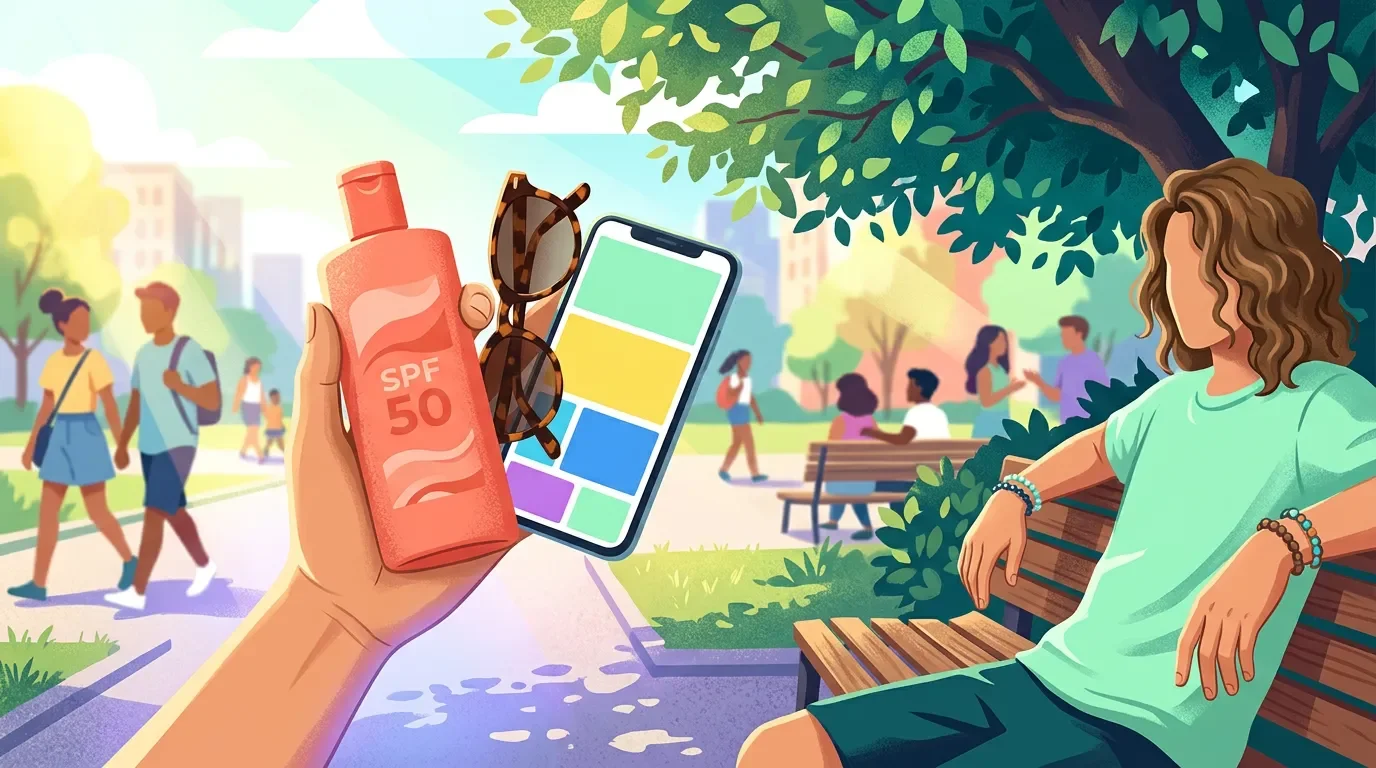
Your weather app's UV number matters more than how hot it feels. Here's how to use it.

Your weather app's UV number matters more than how hot it feels. Here's how to use it.

A practical guide to using the UV index instead of vibes: when sun protection starts to matter, how to read sunscreen labels, what sunglasses should actually say, and when a sunburn needs real medical help.

Gen Z Health Daily
2026. 6. 21. · 23:18
구독 3개 · 콘텐츠 15개
That perfect 74-degree day can still cook your skin. Heat tells you how sweaty you will feel. The UV index tells you how hard the sun is hitting your skin and eyes.
The annoying part: UV does not need a beach day to matter. The CDC says UV rays can reach you on cloudy or cool days and bounce off water, cement, sand, and snow. It also says that when the UV index is 3 or higher, you should protect your skin from too much sun exposure. 1
Also, yes, sunscreen news happened this month. The FDA added bemotrizinol as a permitted sunscreen active ingredient on June 9, 2026, the first new active ingredient added to the over-the-counter sunscreen monograph since the late 1990s. 2 Nice. But for your actual weekend plans, the useful move is still boring: check the UV number, cover the stuff that burns, and reapply before your sunscreen has given up.

Check UV, not vibes

The National Weather Service works with the EPA to forecast the UV index in the U.S. The scale runs from low to extreme, and the middle of the day is where things usually get roughest. 3
통계 카드를 불러오는 중…
The useful cutoff is 3. At 3 to 5, NWS guidance already calls it a moderate risk from unprotected sun exposure and recommends shade near midday, clothing, a hat, sunglasses, and SPF-30 sunscreen if you are outside. 3 At 8 to 10, the same guidance says unprotected sun exposure carries a very high risk of harm, and white sand can reflect UV rays and double exposure. 3
EPA UV index color scale
EPA's archived UV scale graphic shows the same basic jump from low to moderate to extreme UV risk. 4
A very normal Gen Z failure mode is checking the temperature, seeing something mild, and deciding sunscreen is overkill. That works about as well as checking your phone battery by touching the case. Different signal.

Build a setup that survives real life

Sunscreen is part of the plan. It is not the whole plan. CDC says sunscreen works best when combined with shade, clothing, hats, and sunglasses. 1 FDA says no sunscreen completely blocks UV radiation, so shade, clothing, sunglasses, and staying out of the strongest sun still matter. 5
Here is the practical version:
If you are doing thisUse this planWhy it matters
Walking around campus, commuting, patio brunchPut sunscreen on exposed skin before you leave, then add sunglasses if the UV index is 3+.UV can hit on cloudy or cool days, and CDC uses UV 3+ as the point where protection is needed. 1
Beach, pool, lake, outdoor job, festivalUse broad-spectrum SPF 30 or higher, add a hat or cover-up, and set a two-hour reapply timer.NWS guidance recommends at least SPF-30 in moderate-to-extreme UV, and reflective surfaces like water and sand can raise exposure. 3
Swimming or sweatingChoose a water-resistant sunscreen, then reapply after the label's water-resistance window and after towel drying.FDA says sunscreens are not waterproof, and water-resistant labels must state whether they remain effective for 40 or 80 minutes while swimming or sweating. 6
Driving, outdoor sports, bright sidewalksWear sunglasses labeled UV400 or 100% UV protection, not just dark lenses.FDA says UV400 or 100% UV-protection sunglasses block more than 99% of UVA and UVB radiation, while lens darkness does not prove UV protection. 5
For your face, the easiest habit is to treat sunscreen like brushing your teeth: same time, every morning, no big identity statement attached. For your body, keep a bottle where the activity starts, not where you wish you were more responsible. Gym bag. Car console if it is not baking in heat. Beach tote. Doorway shelf.

Decode the label without becoming a skincare chemist

You only need a few label words, plus a few numbers that are actually useful. FDA's sunscreen directions include applying 15 minutes before sun, using about one ounce for full-body coverage, reapplying at least every two hours, checking 40- or 80-minute water-resistance labels, and treating no-date bottles as expired after three years. 6
통계 카드를 불러오는 중…
Broad spectrum means the sunscreen helps protect against both UVA and UVB. FDA explains that SPF mostly reflects UVB sunburn protection, while broad-spectrum products also protect against UVA. 6
SPF is not a timer. FDA says it is wrong to assume SPF 15 lets you stay in the sun 15 times longer, because exposure depends on things like time of day, location, and solar intensity. 6
One ounce is the full-body amount. FDA says an average-sized adult or child needs at least one ounce, roughly a shot-glass amount, to cover the body from head to toe. 6 If you are using a tiny pea-sized blob for both arms, you are basically sending a polite email to the sun.
Fifteen minutes matters. FDA says to apply sunscreen 15 minutes before sun exposure so it has time to provide maximum benefit. 6
Two hours is the outside limit, not a personality test. FDA says to reapply at least every two hours, and more often if you are swimming or sweating. 6 Put a timer on your phone. Nobody needs to be noble about lotion.
Old sunscreen is suspect. FDA says a sunscreen without an expiration date should be considered expired three years after purchase, and heat can shorten shelf life. 6 If the bottle has lived in a hot car since last summer, replace it.

If you already burned, do this instead of making it worse

Most mild sunburn care is about cooling the skin, easing pain, and not turning damaged skin into infected skin.
Mayo Clinic's first-aid advice says sunburned skin is usually painful, inflamed, and hot to the touch within a few hours, and blisters can develop. 7 For first aid, Mayo recommends cool damp towels or cool baths, moisturizer or aloe/calamine, extra water for a day, pain relievers such as ibuprofen or acetaminophen, and leaving blisters alone. 7
Do not pop blisters for content, curiosity, or vibes. Mayo says an intact blister can help skin heal. 7 Also do not go right back into the sun to "even it out." That is how a bad idea becomes a worse one.
Get medical help if you have large blisters, blisters on the face, hands, or genitals, worsening pain, headache, confusion, nausea, fever, chills, eye pain, vision changes, or signs of infection such as swelling, pus, or streaks. 7 Seek immediate medical care for a fever over 103 F with vomiting, confusion, infection, dehydration, or cold skin with dizziness or faintness. 7

The 30-second plan for today

Before you leave, check the UV index where you are going, not just the high temperature. If it is 3 or above, assume your skin and eyes need a plan.
Pack three things: sunscreen you will actually use, sunglasses with real UV protection, and one backup barrier like a hat, light overshirt, or shade plan. If you will be out for more than two hours, set the reapply timer before you get distracted.
That is it. You do not need to become a sunscreen person. You just need to stop letting a sunny day make decisions for you.

이 콘텐츠를 둘러싼 관점이나 맥락을 계속 보강해 보세요.

  • 로그인하면 댓글을 작성할 수 있습니다.