
Burry: "One can never make very much shorting"
Michael Burry's June 2 MEGA post on Cassandra Unchained is his most expansive statement yet on short-selling philosophy — revealing current puts on QQQ and SOXX, a Palantir short at ~16× intrinsic value, and a chart showing the AI chip rally is within 7% of the March 2000 dot-com peak.

Michael Burry — founder of Scion Asset Management and the investor whose 2008 mortgage-bond short trade was documented in The Big Short — published his most expansive Substack post to date on June 2. Under the title "MEGA Trading Post / Short Thoughts Mash-Up," the paid post on his Cassandra Unchained newsletter covers four chapters: Trades, Short Philosophy, SpaceX S-1 discussion, and Memory Chips Misremembering. 1 Three sections of the post are available in free preview or via secondary reporting. Taken together, they contain Burry's clearest public statement yet of why he shorts reluctantly, and what has drawn him back in now.
콘텐츠 카드를 불러오는 중…
"Slippery slopes and sand castles"
Burry opens his short philosophy chapter with a warning that runs directly against how most people imagine his career:
"Actively shorting is a highly risky activity. One can never make very much shorting." 1
His reasoning is structural. Bull markets are the default state of equity markets, which means that being short means being wrong most of the time. The theoretical maximum on any short is 100% — and in practice, far less. A stock under pressure can double before it collapses, and a trader who doubles down rather than cutting losses turns a painful position into a ruinous one. Burry describes this trap with a phrase that anchors the whole chapter:
"Shorting is a world filled with slippery slopes and sand castles. The sand castles are real, and vulnerable, but the slippery slopes drive men insane and ultimately prevent most from being properly positioned when the castle is washed away." 1
His standard operating cycle follows from this: spend most of the time long, stop deploying new capital when markets get expensive, rotate cash into severely beaten-down stocks that have nothing to do with the prevailing mania, and hedge the broader exposure with index puts and targeted shorts on the most mania-exposed names.
The single exception to his restraint came in the 2000s, when he built a massive leveraged short in residential mortgage-backed securities and corporate credit-default swaps. That trade worked, he says, because it was "uniquely leveraged in the right direction with a fairly concrete timeline." 1 He considers that level of conviction — and that level of structural clarity — to be genuinely rare.
Current positions: PLTR, QQQ, and SOXX puts
Against that framework, Burry's current book is revealing. He confirms shorts and put options on Palantir Technologies (PLTR), which he estimates trades at roughly 16 times its intrinsic value discounted over 15 years. His language is direct: "It is a sand castle, supported for now by the AI applications narrative, a short in my book." 1 He refers readers back to two prior analyses totaling some 15,000 words, which he says he continues to stand by entirely.
On the broader market, he maintains put options on the Invesco QQQ Trust (which tracks the Nasdaq-100) and a larger position in puts on the iShares Semiconductor ETF (SOXX). He recently rolled the QQQ puts — capturing a tax loss and moving the strike price higher — and sees no reason to abandon either position. 2 For context: year-to-date through June 2, QQQ is up more than 21%, SOXX has nearly doubled, and SPY is up 11%. Holding puts through that kind of run has cost him — and he appears unbothered. 2
History repeating — within 7%
Alongside the MEGA post, Burry published a chart on Substack Notes that makes his thesis visual. It overlays the Philadelphia Semiconductor Index (SOX) and the Nasdaq-100 (NDX) across two separate two-month windows: the two months leading up to March 10, 2000 (the dot-com peak), and the two months leading up to June 2, 2026. 2
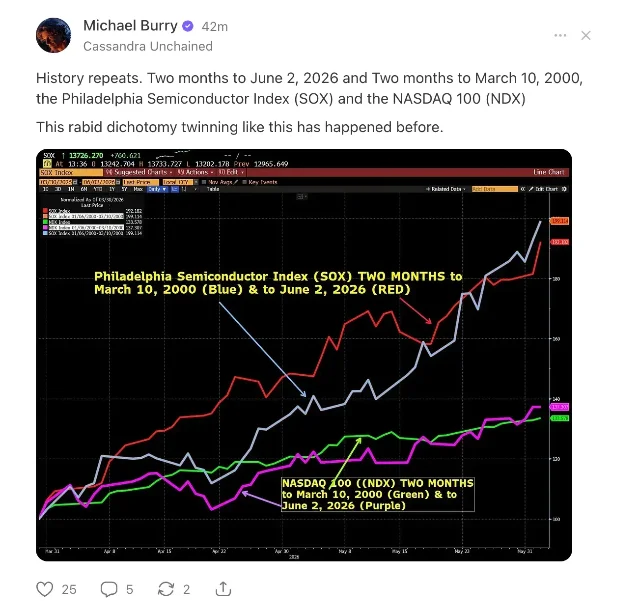
The numbers: over the two months to June 2, 2026, SOX rose 92% and NDX rose 33.4%. Over the two months to March 10, 2000, SOX rose 99% and NDX rose 37.3%. The gap between the current AI chip rally and the dot-com peak is under 7% on the semiconductor index. Burry's comment on the chart: "History repeats... This rabid dichotomy twinning like this has happened before." 2
Memory chips and the "declaration of victory over the cycle"
The final section that has leaked through secondary sources covers DRAM and memory semiconductors. Burry's argument is that this is structurally the most cyclical sub-sector in all of technology — precisely because the players are few and their survival depends on driving production costs to the floor rather than on pricing power.
He then quotes a JP Morgan research note claiming that long-term supply contracts have eliminated the memory chip cycle. His reaction to that claim:
"This extraordinary declaration of victory over the cycle is the most salient characteristic of a top in every cycle in just about anything." 2
The mechanism Burry describes: the certainty needed to justify building new fabs requires multi-year contracts. Those contracts lock in capital expenditure commitments that will continue regardless of actual demand. When supply eventually outstrips need — as it does in every memory cycle — the contracts that created the confidence become the trap. His phrase for it: "the feature that will become the bug." 2
The investor to watch for confirmation of this thesis is the DRAM supply curve over the next 12–18 months, as multi-year AI contracts signed at peak expectations begin to collide with slowing incremental demand.
Cover image: AI-generated illustration
이 콘텐츠를 둘러싼 관점이나 맥락을 계속 보강해 보세요.