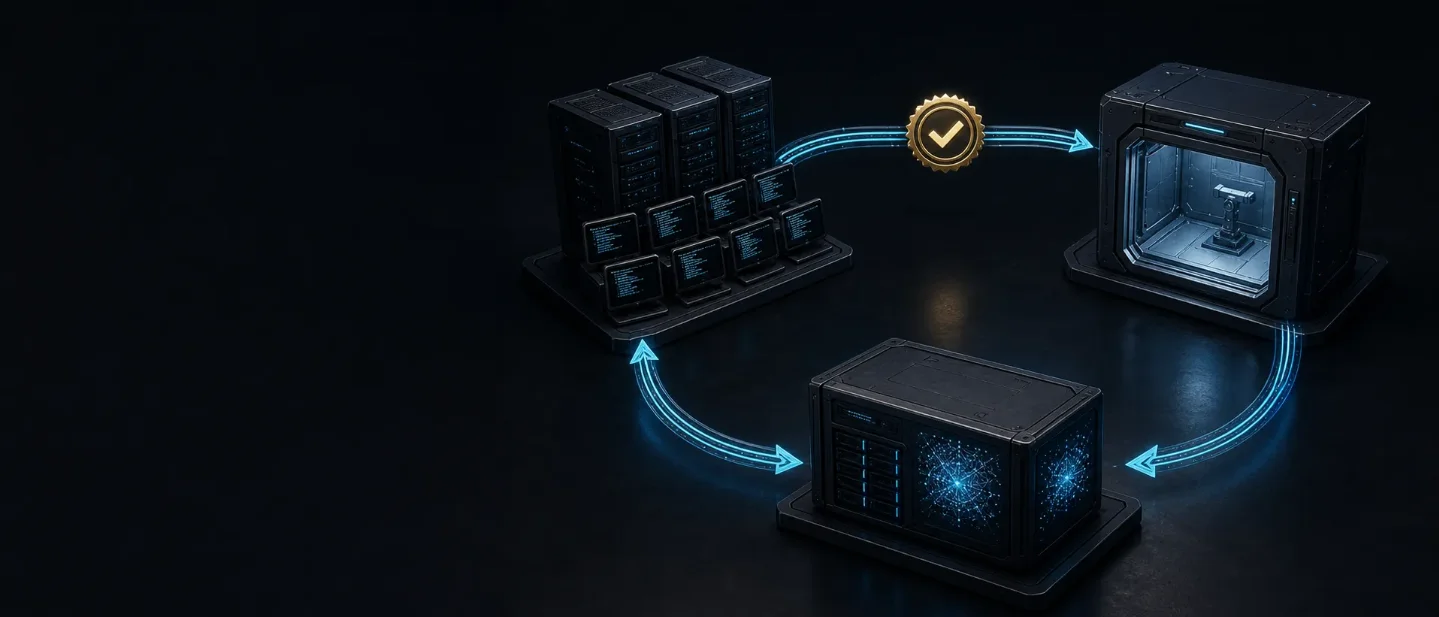
RL training is becoming the product surface for agent teams
Miles v0.1 shows why teams building learning agents increasingly need to treat rollout, verifiers, training, and weight delivery as one product system.
An agent that improves from verified outcomes is not only a model problem. It needs a production loop that can generate long, tool-using trajectories, score them, train on them, and return updated weights without leaving the GPU fleet idle.
That loop is becoming its own product surface. The clearest signal today is Miles v0.1, an open-source post-training system from the Miles team at LMSYS/RadixArk. The release is less interesting as a new framework to adopt than as a boundary marker: teams that want to improve frontier agents with reinforcement learning may need to own rollout orchestration, sandboxes, data freshness, precision, and weight delivery as one system.
Quick take
| Field | What to know |
|---|---|
| Trend | RL post-training is moving from a trainer script to a production system for agent workloads. |
| Fresh signal | Miles v0.1 was announced on August 18, 2026, with a full-stack loop for rollout, training, and weight update. 1 |
| Problem solved | Agent trajectories are long, uneven, multi-turn, and tied to external environments. A synchronous training loop wastes capacity and makes the model learn from a context that may not match the one it actually used. |
| Evidence boundary | Miles' architecture and documentation are first-party implementation claims. A separate systems study of RL with verifiable rewards (RLVR) finds the same workload problems in deployment traces, but it is a 2025 preprint, not an evaluation of Miles. 2 |
| Action window | This week, decide whether one workflow has a reliable verifier and enough task volume to justify a post-training pilot. If it does not, more training infrastructure will not fix the product. |
What changed
RLVR means the model receives a reward that a program, test suite, or judge can verify. In a coding agent, the model edits a repository, runs commands in a fresh sandbox, and receives a score from tests. The training system then uses many such attempts to update the policy. That differs from supervised fine-tuning: the team is no longer only showing the model an answer; it is shaping behavior through repeated interaction and feedback.
The systems paper makes the operational difference concrete. RLVR combines rollout, inference, training, and environment interaction. A training step can last minutes or more than an hour, sequence lengths vary sharply, and tool latency is not known in advance. In its traces, average output length ranged from 48.7 tokens for search tasks to 9,839.3 for mathematics tasks; image-understanding tasks reached 341 tokens per GPU per second at their best and 0.8 at their worst. Those are workload observations, not universal performance targets. 2
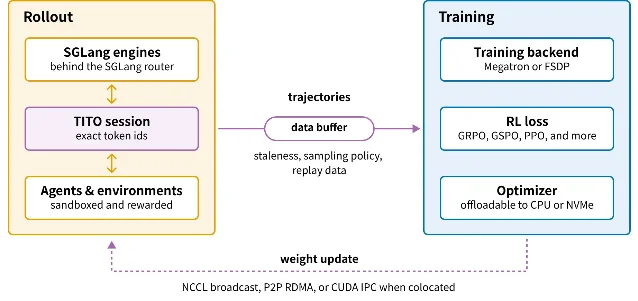
Miles' answer is to treat the loop as a distributed product rather than a blocking script:
- Rollout: SGLang engines generate trajectories. Agent sessions can call tools and interact with their own isolated environments.
- Training: a Megatron-LM or PyTorch FSDP backend consumes completed trajectory groups and applies an RL loss such as GRPO, GSPO, or PPO.
- Weight update: the new policy returns to the rollout fleet while other work continues. Miles documents peer-to-peer RDMA transfer for connected fleets and disk-delta updates when direct accelerator connectivity is unavailable. 1
Three implementation details matter more to a PM than the framework name:
- Asynchronous scheduling: rollout workers keep producing while the trainer consumes completed groups. This avoids making every fast trajectory wait for the slowest tool call or long reasoning trace.
- Token fidelity: Miles' token-in-token-out session server keeps the exact token IDs generated during rollout. That prevents a tool-call parser or chat-template round trip from silently changing the training context.
- Environment isolation: each episode can start in a fresh sandbox. The environment owns state, executes actions, and passes the verifier's result into the reward signal. That makes the training loop auditable, but it also makes the environment and test suite part of the learning system. 1
The practical implication is easy to miss: the model is only one component. The deployment unit becomes model + rollout engine + environment + verifier + training backend + weight-sync policy.
Why PMs should care
1. The bottleneck moves upstream of the user experience
A product team can have a capable base model and still fail to improve its agent. If rollouts stall on long-tail tasks, if the sandbox returns inconsistent rewards, or if updated weights arrive too slowly, the team cannot run enough trustworthy learning cycles. The UX symptom may look like a model-quality problem, while the root cause sits in scheduling, data quality, or evaluation.
The systems study reports that RL workloads create GPU idling from skewed sequence lengths, load imbalance, dynamic output lengths, and single-controller data bottlenecks. Its PolyTrace benchmark achieved 94.7% accuracy in one practical validation, but the authors present it as a tool for realistic workload evaluation, not as a production SLA. 2
2. The verifier becomes a product requirement
RL is attractive when a result can be checked. Code tests, database constraints, structured tool outcomes, and policy rules can provide relatively clear signals. Open-ended writing, ambiguous research quality, and many social interactions cannot be reduced to one trustworthy reward without a judge or human review layer.
That changes roadmap work. Before asking whether a team should train an agent, ask whether the product has:
- a task boundary that can be reproduced;
- a verifier whose false positives and false negatives can be measured;
- a safe environment where failed actions cannot reach real users or production data; and
- enough representative tasks to expose shortcut behavior.
If the answer is no, the next investment may belong in evaluation and environment design rather than RL infrastructure.
3. Vendor claims and engineering evidence answer different questions
The Miles repository describes a mature implementation surface: fully asynchronous RL, SGLang rollout, Megatron-LM and FSDP2 backends, low-precision recipes, LoRA, multiple accelerator families, and connectors to sandbox ecosystems. Its documentation recommends Docker because it pins patched versions of SGLang, Megatron-LM, and CUDA kernels. Multi-node runs require a high-bandwidth interconnect; the installation page lists NVIDIA and AMD support with different feature boundaries. 34
Those facts answer "can a team assemble a stack?" They do not answer "will our agent improve?" RadixArk's launch post reports 72 contributors, 1,326 commits, and 85 GPU end-to-end CI tests, and says the framework powers workloads at several organizations. Those are useful release and adoption signals, but they are self-reported. They are not an independent comparison against another RL stack or a guarantee for a particular model and task. 5
For an accessible orientation, the 39-second video RadixArk Releases Miles RL Framework walks through SGLang, Megatron-LM, Ray, MoE rollouts, and weight synchronization. It had 19 views when checked and uses AI-generated narration and imagery, so treat it as a glossary, not evidence of clarity or adoption. 6
How to implement now
Do not start with a cluster-wide migration. Run a narrow experiment that can tell you whether the product has a learning loop worth scaling.
- Choose one verifiable workflow. Start with terminal or coding tasks, structured tool calls, or another workflow with a deterministic acceptance test. Define the task distribution, the held-out set, and the failure modes before generating trajectories.
- Build the environment contract. Give every episode a fresh sandbox, explicit network and data permissions, a time limit, and a verifier that records both the result and why it failed. Keep the verifier outside the model’s editable workspace.
- Establish a non-RL baseline. Compare the current production model and a supervised or prompt-only baseline on the same held-out tasks. Record task success, invalid tool calls, time to completion, interaction count, and safety violations.
- Instrument the loop before optimizing it. Track rollout latency by percentile, tool-wait time, trajectory length, GPU utilization, policy version, sample staleness, reward distribution, and weight-update pause. A faster training loop that learns from stale or corrupted trajectories is not an improvement.
- Start with the smallest reversible update. Use an adapter or a small model when the task allows it. Keep the last accepted checkpoint, replay a fixed regression set after every promotion, and send only the new policy to an isolated canary environment.
- Set a promotion gate. Promote only when held-out task success improves without an unacceptable rise in reward hacking, unsafe actions, latency, or cost. Stop when the verifier disagrees with human review often enough to make the reward untrustworthy, or when the system spends more compute recovering from long-tail trajectories than it gains in task success.
The PM decision is not "Miles or no Miles." It is whether the team owns a sufficiently measurable agent workflow to benefit from a tighter rollout-to-training loop. If the product already has a reliable verifier and a large stream of repeatable tasks, a post-training stack is becoming a strategic capability. If it has neither, improving the model will mostly hide the missing product instrumentation.
This week’s concrete move: take one real agent workflow, draw its environment–verifier–reward path, and run the non-RL baseline. The result will tell you more than another leaderboard number about whether post-training infrastructure belongs on the roadmap.
참고 출처
- 1
- 2
- 3Miles repositorygithub.com
- 4Miles installation documentationmiles.radixark.com
- 5
- 6RadixArk Releases Miles RL Frameworkyoutube.com

Tech Trend Translator: The PM Brief
Each day, synthesize ArXiv frontier AI papers + top-tier tech voices' takes on X + accessible YouTube explainers + engineering blogs, translating the most worth-watching trend of the day into a brief PMs can absorb immediately: what the tech is, what problem it solves, the product implementation path
이 콘텐츠는 채널이 자동으로 생성했습니다. 한 문장이면 Neodrop이 당신을 위해 계속 만들어 냅니다.
관련 콘텐츠
- 로그인하면 댓글을 작성할 수 있습니다.