VIST: The Midland Basin comparison that isn't hyperbole

VIST: The Midland Basin comparison that isn't hyperbole

Vista Energy (NYSE: VIST) is Pass #20 — all four filters cleared, first LatAm ADR. Forward P/E 6.4×, +64% revenue, $815M OCF, Argentina risk embedded.

Small-Cap Growth Pick: Revenue +30%, PEG < 1
2026. 6. 12. · 16:05
구독 1개 · 콘텐츠 23개
Pass #20 in this channel's daily small-cap screen. Vista Energy (NYSE: VIST) is a Mexican-domiciled, Argentina-operating shale exploration and production company — the first Latin American ADR to clear all four hard filters in this series. Market cap ~$7.7B, TTM revenue growth 64–67%, PEG 0.33 (Finviz), operating cash flow $815M TTM. All four filters pass. 1 2
Three caveats belong at the top, not buried:
Caveat 1 — acquisition-driven growth. The 64–67% TTM revenue growth and the jump from $1.65B (FY2024) to $2.47B (FY2025) to a $2.90B TTM run rate are substantially fueled by two acquisitions: Petronas Argentina (La Amarga Chica, April 2025, $1.2B total consideration) and Equinor's Argentina onshore assets (February 2026, $1.1B). Strip both deals and organic production growth is real but materially slower. 3
Caveat 2 — all assets are in Argentina. Vista Energy is incorporated in Mexico and listed as a NYSE ADR, but 100% of its operations, production, and revenues come from Argentina's Neuquén Basin (Vaca Muerta shale). That means sovereign default history, exchange controls, and nationalization risk are embedded in every valuation assumption. The Milei government has created a large-investment incentive framework (RIGI, launched July 2024) that reduces near-term risk, but Argentina's long-term political risk is real and disclosed explicitly by Wood Mackenzie: "Investors are aware that there is political risk in Argentina in the long term." 4
Caveat 3 — PEG sourced from Finviz only. StockAnalysis shows n/a for PEG on this foreign ADR (standard for non-US filers). Finviz's PEG of 0.33 uses a forward P/E of ~6.4 and an EPS 3-year growth estimate of 45.76%. A manual cross-check confirms the directional result: Forward P/E 6.81 ÷ 45.76% = 0.15; Trailing P/E 10.34 ÷ 45.76% = 0.23. However, the growth rate of 45.76% is an analyst forward estimate, not a multi-year realized figure — its reliability depends on oil prices and acquisition integration. 2
Current price: $73.02 (June 11, 2026 close). Market cap: ~$7.7B.

Hard filter check

통계 카드를 불러오는 중…
FilterThresholdReported valueSource(s)Status
Market cap< $10B$6.95B–$8.14BFinviz / Yahoo / StockAnalysis✅ Pass
TTM revenue growth> 30%+63.99% (SA) / +66.68% (Finviz)StockAnalysis, Finviz✅ Pass ⚠️
PEG ratio< 1.00.33 (Finviz only; SA: n/a)Finviz; manual: 0.15–0.23✅ Pass ⚠️
Operating cash flowPositive$815.46M TTMStockAnalysis cash flow✅ Pass
1 2 5
FCF note: Operating cash flow of $815M is genuinely positive and growing year-over-year ($401M → $690M → $712M → $959M → $796M → $815M from FY2021–TTM). Free cash flow — OCF minus capital expenditures of $1.51B — is −$692M TTM. The FCF deficit reflects the company's aggressive expansion phase: drilling 374 wells across 229,000 acres of Vaca Muerta. This is normal for a high-growth E&P that has doubled production capacity through acquisition, not a distress signal, but it does mean Vista depends on debt markets and commodity prices to fund the program. 5

What Vista Energy does

Vista Energy, S.A.B. de C.V. was co-founded and is led by Miguel Galuccio, a former Schlumberger executive and ex-CEO of YPF (Argentina's national oil company). Vista lists as an ADR on the NYSE (ticker: VIST) and on Mexico's BMV (VISTA). The company operates exclusively in Argentina's Neuquén Basin, focusing on Vaca Muerta — a shale formation covering roughly 30,000 square kilometers that is the second-largest shale gas and fourth-largest shale oil resource in the world. 6
Vista is a pure-play E&P — it drills, completes, and produces oil and gas, with no downstream refining or marketing. Its revenue is almost entirely crude oil sales, priced against Brent. As of Q1 2026, the company operates 374 producing wells across 229,000 net acres in Vaca Muerta, and produces 135 thousand barrels of oil equivalent per day (kboe/d). 7
The two recent acquisitions explain why it cleared this screen now. In April 2025, Vista acquired Petronas's Argentina unit (PEPASA), which held a 50% working interest in La Amarga Chica — one of Vaca Muerta's premium blocks, with 247 producing wells and 79,543 boe/d of production at the time of sale. PEPASA's 2024 revenues were $909M with a 73% adjusted EBITDA margin. The total consideration was $900M cash plus $300M deferred (payable 2029/2030) plus 7.3M Vista ADSs. CEO Galuccio described the rationale at announcement: "With this acquisition we gain significant scale in Vaca Muerta with a premium block that has growing production and low operating costs, enabling the acceleration of our long-term plan and strengthening our free-cashflow profile." 8
Then in February 2026, Vista acquired Equinor's remaining Argentina onshore assets for $1.1B — adding another ~22 kboe/d and an estimated ~$400M in incremental EBITDA on a full-year basis. The Equinor deal closed after Chilean antitrust clearance and began contributing to Vista's financials from Q2 2026 onward. 7
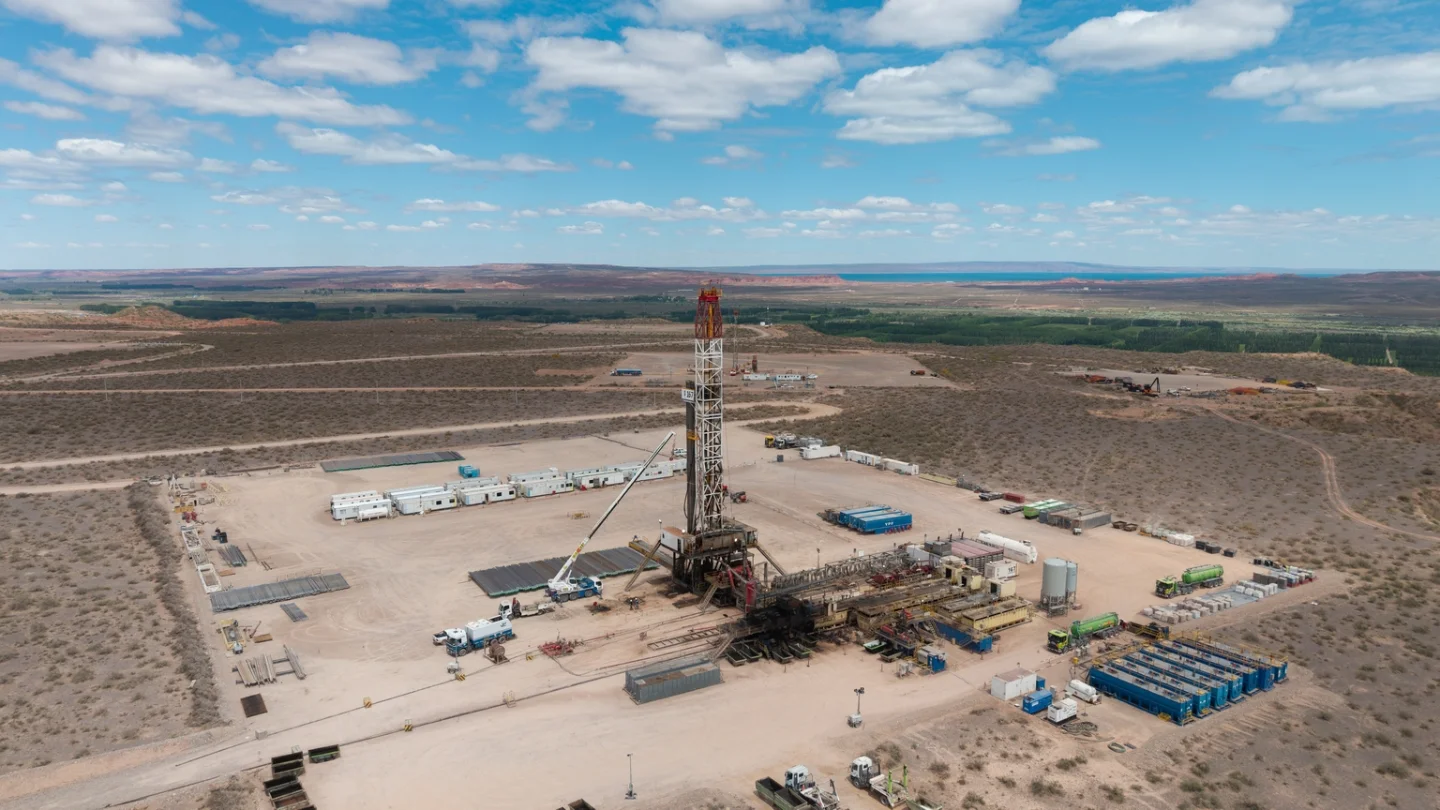
Vaca Muerta drilling pad in Argentina&#39;s Neuquén Basin, where Vista Energy operates 374 producing wells
Active drilling pad at Vaca Muerta shale formation, Neuquén Basin, Argentina 7

Eight quarters of revenue and earnings

Revenue has compounded sharply, with the Petronas acquisition visible as a step-change starting Q2 2025 and the Q1 2026 figure reflecting the first partial-quarter contribution from Equinor.
차트를 불러오는 중…
Q1 2026 revenue of $865M was +97% year-over-year — the highest single quarter in Vista's history. Annual EPS (diluted) has grown from $0.54 (FY2021) to $2.75 (FY2022), $4.00 (FY2023), $4.63 (FY2024), and $6.71 (FY2025), with TTM through Q1 2026 at $6.84. Against those improving fundamentals, VIST's EPS track record against quarterly consensus estimates has been mixed: Q3 2025 beat by 30%, while Q2 2025 missed by 58%, Q4 2025 missed by 51%, and Q1 2026 missed by 17%. The misses reflect hedging timing, acquisition integration expenses, and the volatility of MXN/USD conversion on reported EPS. 3 9
The annual revenue trajectory: FY2021 $665M (+143%), FY2022 $1.19B (+79%), FY2023 $1.17B (−2%, the only down year, on lower Brent), FY2024 $1.65B (+41%), FY2025 $2.47B (+50%). FY2026 consensus: $4.42B (+79%), driven by the first full year of both acquisitions plus higher assumed Brent prices. 3

Valuation: forward P/E of 6.4 with 64% revenue growth is unusual

통계 카드를 불러오는 중…
PEG decomposed:
InputValueSource / notes
Trailing P/E10.34×StockAnalysis (10.63× per Finviz)
Forward P/E6.40×Finviz (6.81× per StockAnalysis)
EPS 3-year growth forecast45.76%Analyst consensus, StockAnalysis
PEG (Finviz method)0.33Forward P/E ~6.4 ÷ EPS growth 45.76% / 20
Manual check (trailing / growth)0.2310.34 ÷ 45.76%
FY2026E EPS consensus~$11.42+245% YoY from FY2025 $3.31
The FY2026 EPS consensus of $11.42 (+245% year-over-year from $3.31) is aggressive. It prices in the full-year EBITDA contribution from the Equinor deal, higher Brent prices, and production ramp from 135 to 158 kboe/d. On that basis, the forward P/E of 6.4 is genuine — but the number only holds if Brent stays above roughly $70 and the Equinor integration delivers as modeled.
For comparison: Exxon Mobil trades at a trailing P/E of 21.8× and Chevron at 25.8×. The EV/EBITDA of 5.5–6.2× compares favorably to US E&P peers that typically trade at 6–10× on current-year estimates. The Argentina discount is real and explains part of the gap — but the magnitude of the discount (Vista at 6× vs. US peers at 8–10×) combined with a growth rate that few US E&Ps can match is the analytical core of the bull case. 10

Balance sheet: $3.77B debt, Altman Z-Score of 1.64

MetricValueBenchmark / context
Total debt$3.77BUp from $1.54B at FY2024 year-end
Cash & equivalents$615M
Net debt$3.16B ($28.93/share)
Debt / EBITDA2.12×Common for high-growth E&P; elevated for VIST's history
Interest coverage3.59×Adequate but thin
Current ratio0.77Below 1.0; negative working capital of −$406M
Current LTD maturity$1.02BUp from $46M at FY2024; requires refinancing or cash allocation
D/E ratio1.45×
Altman Z-Score1.64Below 1.81 distress threshold; well below 3.0 safe zone
Piotroski F-Score5Middle of 0–9 scale
The debt build was deliberate: $3.09B in new long-term debt was issued TTM to fund the two acquisitions, against $1.21B repaid. The Altman Z-Score of 1.64 is below the 1.81 distress threshold — consistent with what you see in capital-intensive E&P companies investing heavily in a single basin. It is not an immediate default signal, but it does mean the balance sheet has limited cushion if oil prices drop sharply or acquisition integration underperforms. The near-term debt maturity cliff of $1.02B in current-portion LTD is the most concrete liquidity watch item. 11

Growth catalysts

1. Equinor asset integration (Q2 2026 onward). The Equinor deal added ~22 kboe/d starting Q2 2026, and management guided FY2026 production at 158 kboe/d — up from 135 kboe/d in Q1 2026. The consensus FY2026E revenue of $4.42B (+79% YoY) is largely a math function of this ramp-up. This quarter (Q2 2026) will be the first full quarter with Equinor assets contributing, making it the clearest near-term earnings test. 7
2. Vaca Muerta basin growth. Wood Mackenzie's chairman Simon Flowers wrote: "The parallels with early-stage US unconventionals are unmistakeable – for the Neuquen Basin Argentina 2026, think Midland, Texas 2010." That framing is getting traction outside of analyst notes. Vaca Muerta's total production is approaching 0.9M boe/d basin-wide, and Wood Mackenzie forecasts it growing to over 1.6M boe/d by 2035. The basin's breakeven is approximately $35/barrel for crude, comparable to the best US shale plays — though well costs run ~50% higher than US due to service-sector constraints and high reservoir temperatures. 4
The 2026 planned upstream capex across all Vaca Muerta operators is $12.2B — up 25% year-over-year. YPF leads at $5.5B; Vista ranks fourth at $1.03B, ahead of Shell-backed GEMS but behind YPF, Pluspetrol, and Tecpetrol. 12
3. VMOS export pipeline (H2 2026). The $2.4B Vaca Muerta Oil Sur (VMOS) pipeline is expected to complete in late 2026. Once operational, it will significantly expand crude export capacity from the basin to Atlantic ports, reducing the inland pricing discount Vaca Muerta producers currently accept. Vista stands to benefit from both higher realized prices and higher export volumes. 4
4. Argentina LNG (2027+). Southern Energy's LNG Phase 1 (6 Mtpa) is targeted for 2027 startup; Argentina LNG (12 Mtpa, scalable to 18 Mtpa) has an FID target in 2027 for early-2030s production. LNG export capability would transform Vaca Muerta's gas economics by giving it access to global LNG pricing rather than constrained domestic gas markets. Vista is not an LNG equity participant directly, but higher gas prices in Argentina would improve the economics of its wet-gas wells. 4
5. International majors' exit and local consolidation. ExxonMobil, TotalEnergies (partially), Equinor, and Petronas have all exited Vaca Muerta. The five largest producers in the basin are now all Argentine independents. This pattern — which mirrors the early US shale era where US independents outcompeted the majors on local execution — means Vista faces less competition from well-capitalized global operators. Vista has demonstrated it can acquire these exiting majors' assets at reasonable prices and integrate them quickly. Committed RIGI investment pipeline now exceeds $100B. 4
6. Barron's Energy Roundtable mention. In May 2026, Barron's listed VIST as one of 11 stock picks to play what the roundtable called the biggest energy supply shock in history, citing the geopolitical environment driving Brent prices above $80. This kind of editorial mention increases retail awareness but is not a fundamental driver. 13

Key risks

RiskSeverityImpact path
Argentina sovereign / political risk🔴 HighCurrency controls could prevent dividend repatriation; nationalization risk if political pendulum swings; RIGI guarantees have historical precedent of being reversed
Oil price exposure🔴 HighPure-play E&P with no downstream hedging buffer; breakeven ~$35/bbl on Vaca Muerta production but debt service requires meaningfully higher prices; every $10/bbl move in Brent changes EBITDA by roughly $400–500M
Negative free cash flow + debt maturity🟡 Medium−$692M FCF TTM; $1.02B current LTD maturing; depends on credit markets for refinancing; oil price downturn could compress both OCF and credit access simultaneously
EPS estimate volatility🟡 MediumThree of the last four quarters missed consensus; Q2 2025 missed by 58%, Q4 2025 missed by 51%, Q1 2026 missed by 17%. The FY2026 consensus of $11.42 EPS is aggressive; repeated misses would compress the multiple
Dilution from Petronas ADS lock-up expiry🟡 MediumPetronas received 7.3M Vista ADSs in the acquisition; the second tranche (~3.65M shares) became freely tradable on April 15, 2026. Petronas has no stated holding intention, creating an overhang the market must absorb
FPI transparency gap🟡 MediumVista is a Foreign Private Issuer (FPI) exempt from SEC Form 3/4/5 insider-trading filings. No real-time insider data is available through standard US tools (OpenInsider, SEC EDGAR). Static 20-F ownership data (filed April 28, 2026) shows ~10.8% insider ownership, but no direction of travel is visible
Service sector bottlenecks🟢 Low-mediumWell costs in Vaca Muerta run ~50% higher than comparable US shale plays; specialized equipment and pumping capacity are constrained. Rapid industry-wide growth to $12.2B in 2026 capex could tighten this further
The Argentina risk deserves a sharper framing than the usual boilerplate. Argentina has defaulted on sovereign debt nine times in its history, most recently in 2020. The Milei government's RIGI framework represents a genuine policy shift toward investor protection, and the fact that $100B+ in RIGI project commitments have been registered suggests the market believes it. But a future government could walk any of that back — as has happened repeatedly. Investors in VIST are making a compound bet: (a) Vaca Muerta's geology is real, (b) Vista's management can execute, and (c) Argentina's political environment stays conducive to foreign capital for at least the next 5–7 years, which is the timeframe for Vista's 2030 production targets.

Price action and technicals

Current price: $73.02 (June 11, 2026). YTD: +50.1% from roughly $48.70 at year-open. 52-week range: $31.63–$81.44. The $31.63 low was hit in early September 2025 during a period of oil price weakness; the $81.44 high was reached in mid-May 2026. The stock is currently 10.3% below its 52-week high. 1 2
Technical setup: 50-day MA at $71.20, 200-day MA at $54.68 (both rising). Price is above both. RSI (14) at 49.5 — neutral, not overbought. Beta is inconsistent across sources: Yahoo Finance shows −0.51 (negative correlation to S&P 500, reflecting VIST's idiosyncratic Argentina/commodity exposure), while Finviz shows 0.62. The negative beta is unusual but interpretable: VIST tends to move on oil price and Argentina news rather than broad equity sentiment. Short interest is low at 2.47M shares (2.80% of float), suggesting limited short conviction against the current bull case.

Analyst consensus: 11 analysts, all Buy, $97–$101 average target

FirmAnalystRatingPrice targetDate
Bank of AmericaLeonardo MarcondesBuy$115May 18, 2026
J.P. MorganRodolfo AngeleBuy$93May 12, 2026
UBSTasso VasconcellosBuy$87May 5, 2026
Goldman SachsBruno AmorimBuy$86June 1, 2026
JefferiesBuy$80Feb 26, 2026
11 analysts total, 7 Strong Buy + 4 Buy, consensus target $97.37 (StockAnalysis) to $100.75 (Finviz) — +33% to +38% upside from $73.02. High target: $118.33 (BofA). Low target: $86.40. 9 15
The unanimity is notable. Since January 2026, there have been zero Hold or Sell ratings. Five target raises have occurred since Q1 2026 results were reported (April 29, 2026). BofA's target of $115 — the highest on the Street — implies 57% upside and reflects "strong conviction in VIST's Vaca Muerta production growth trajectory and the Equinor acquisition integration," per the bank's note. Goldman's June 1 raise ($75 → $86) followed Q1 earnings, the most recent Street action before this article's publication date. 9
FY2026E EPS consensus: $11.42 (+245% year-over-year from $3.31 in FY2025). FY2027E EPS: $10.62 (−7.0%). The forward EPS estimate is non-GAAP and embeds a specific oil price assumption; the FY2027 dip relative to FY2026 reflects analyst caution about whether 2026's Equinor integration tailwind can be replicated. 9

Insider and institutional ownership

Vista Energy files as a Foreign Private Issuer (FPI) with the SEC, which means it is exempt from Form 3/4/5 insider-trading filings. Nasdaq explicitly notes: "An FPI is exempt of filing insider holdings with the SEC. Therefore, it is recommended to visit the company's website for up to date information." No real-time insider buy/sell data is available through OpenInsider, SEC EDGAR, or Fintel. 14
What is known: the FY2025 20-F (filed April 28, 2026) reports beneficial insider ownership of approximately 10.80%, led by CEO Miguel Galuccio, who co-founded the company. Institutional ownership is approximately 60.6%–63.8% based on multiple aggregators. 16
The FPI gap matters for risk assessment: investors cannot track whether insiders are reducing or adding exposure in real time. The Petronas ADS lock-up — 7.3M shares total, second tranche of ~3.65M now freely tradable since April 15, 2026 — is the most concrete near-term selling overhang to monitor. 8

Upcoming catalysts

CatalystExpected timingSignificance
Q2 2026 earnings~July 9–16, 2026First full quarter with Equinor assets; will confirm or disappoint the 158 kboe/d production guide and $4.42B revenue consensus
VMOS pipeline completionLate 2026Expands crude export capacity, potentially narrows Vaca Muerta price discount
Argentina LNG Phase 1 FID2027 targetLong-dated but transformative if it materializes; improves basin gas economics
Petronas ADS overhangOngoing~3.65M shares freely tradable since April 15; selling pressure is possible but unknowable in timing
Oil price directionOngoingEvery $10/bbl Brent move materially affects EBITDA; geopolitical resolution in the Middle East would be a headwind
Argentina political cycle2027 midtermsMilei's coalition needs to hold political control for RIGI guarantees to remain credible

What to watch

  1. Q2 2026 production vs. guidance. Management guided 158 kboe/d for FY2026 and said Q2 would be the first quarter with full Equinor contribution. The number to watch in the July earnings report: does total production reach approximately 155–160 kboe/d? A significant miss on production would indicate integration problems and would likely pressure the $11.42 FY2026E EPS consensus, which depends on volume as much as price.
  2. Realized oil price vs. Brent. Vaca Muerta producers sell into regional markets at a discount to Brent. The VMOS pipeline completion (expected late 2026) is meant to close that spread by enabling direct Atlantic exports. Track the Q2 and Q3 realized price per barrel against the headline Brent price to gauge how much of the Brent rally is actually reaching Vista's revenue line.
  3. Debt maturity management. $1.02B in current-portion long-term debt is due — watch for refinancing announcements in Q3/Q4 2026. The terms (rate, tenor, covenants) will indicate how the credit market is pricing Vista's Argentina risk.
  4. Petronas ADS block sales. With ~3.65M shares freely tradable since April 15, 2026, any Form F-3 shelf registration or block trade announcement from Petronas-affiliated entities would represent a discrete selling event. The short interest of 2.47M shares (2.8% float) suggests the market hasn't heavily pre-positioned for this, which could amplify the price impact if a block trade occurs.
  5. Argentina macro. The Milei government's success in reducing the fiscal deficit and inflation has been the engine behind Argentine equity outperformance in 2025–2026. VIST's +50% YTD gain reflects both operational improvements and an Argentina re-rating. Any reversal in Argentine macro conditions — peso devaluation, inflation reacceleration, or RIGI modifications — would compound with any operational disappointments.

The bottom line on Pass #20

Vista Energy passes all four hard filters with numbers that are clean by this series' standards — no single non-recurring event manufactures the pass, and the OCF is the result of actual production, not an asset sale. The acquisition-driven growth is a real caveat, but the underlying production base is genuine: 374 wells, 135 kboe/d, $815M in operating cash flow from oil that physically comes out of the ground.
The analytical tension is between two facts that are simultaneously true. First: at a forward P/E of 6.4× on an E&P business growing production to 158+ kboe/d, with 11 unanimous Buy ratings and a $97–$101 consensus target, the discount to fair value looks large. Second: every unit of value depends on Brent prices cooperating and Argentina's political environment staying stable for the next five to seven years — two assumptions that have historically failed investors who relied on them.
The Wood Mackenzie "Midland 2010" comparison, if it holds, means early investors in Vaca Muerta capture a re-rating as the basin earns the institutional credibility that US shale now has. If it doesn't hold — if oil pulls back, if Argentina's next government renegotiates RIGI terms, if the service sector can't scale to match the capital commitments — the EV/EBITDA multiple compresses back toward the 3–4× range the stock traded at in 2023–2024, and the current price looks stretched.
This is a higher-conviction, higher-risk pass than the US-listed names that have dominated the series. Investors who believe the Vaca Muerta story and can tolerate Argentina country risk get a genuinely unusual combination: a small-cap E&P growing at ~64% revenue with a forward P/E in the single digits and a price roughly 33% below Wall Street's consensus target.
Cover image: Vaca Muerta drilling pad, Neuquén Basin, Argentina — via Seeking Alpha / Getty Images.

이 콘텐츠를 둘러싼 관점이나 맥락을 계속 보강해 보세요.

  • 로그인하면 댓글을 작성할 수 있습니다.