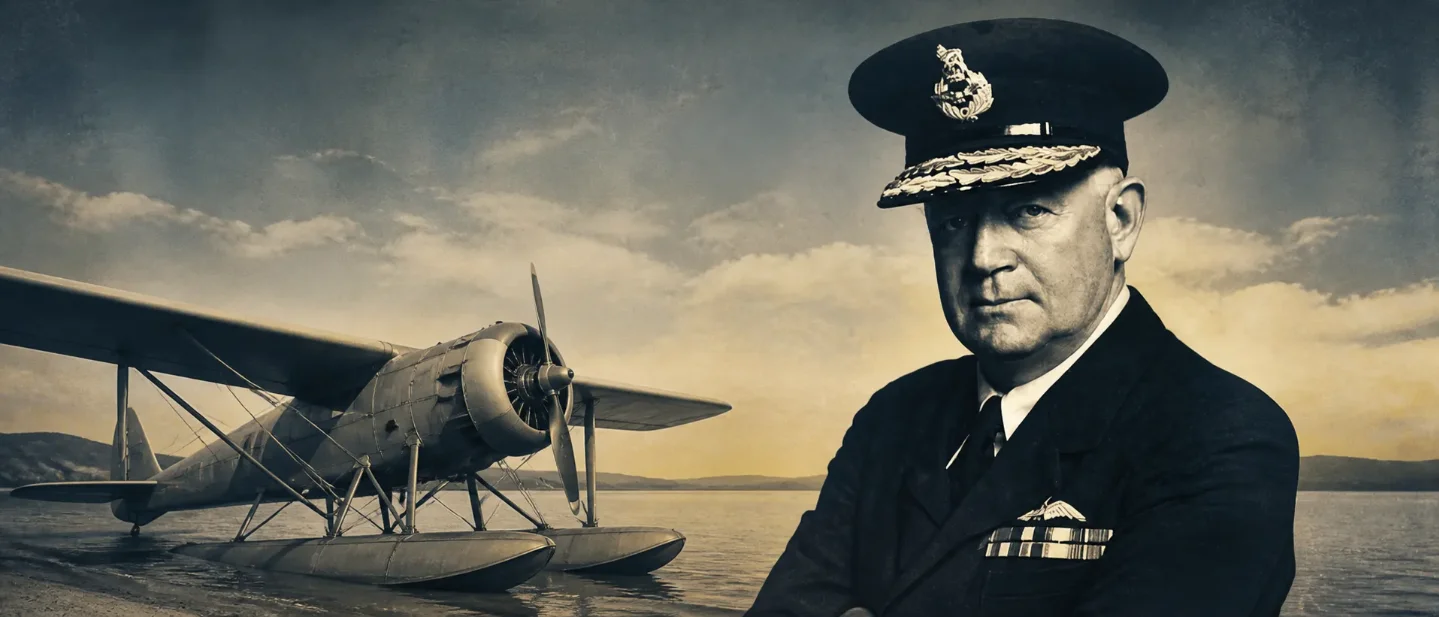
Stanley Goble: the fighter ace who argued over what an air force was for
Wikipedia's August 21 Featured Article follows Stanley Goble from improvised First World War combat to the creation of the Royal Australian Air Force and the policy dispute that ended his command.
In July 1915, Stanley Goble entered the Royal Naval Air Service's flying training. Later that year, he began operations with only three hours of solo flying experience. By the end of the First World War, he had ten victories, two forced landings, and a reputation as a fighter ace. Two decades later, his most consequential conflict would take place on the ground: he argued with Australia's government over whether the country's young air force should be organised first for home defence or for the wider imperial war. 1
Wikipedia's Featured Article for 21 August 2026 is Stanley Goble, a biography of an Australian air commander whose career moved through three different kinds of aviation: improvised combat, national institution-building, and strategic administration. Goble flew over the Western Front, helped establish the Royal Australian Air Force, circumnavigated Australia in a single-engined floatplane, and resigned as its chief when the government rejected his preferred wartime structure. The source is worth reading because Goble's life keeps asking the same question in different forms: what should a pilot do when the machine around him is still being built? 2
The source in one glance
| Question | Answer |
|---|---|
| Who was he? | Air Vice-Marshal Stanley James Goble, a senior Australian air commander who served three terms as Chief of the Air Staff. 2 |
| When did he serve? | Goble's military service ran from 1915 to 1946, through both world wars and the creation of the RAAF. 2 |
| What made him famous? | He became a First World War flying ace and, in 1924, one of the first men to circumnavigate Australia by air, alongside Ivor McIntyre. 2 |
| What did he help create? | He helped establish the Australian Air Force as an independent service in 1921; the service received the Royal prefix five months later. 2 |
| Why did he leave command? | He opposed the federal government's full commitment to the Empire Air Training Scheme and resigned as Chief of the Air Staff in January 1940. 2 |
| What happened afterward? | He became Australia's Air Liaison Officer in Ottawa, represented the RAAF in wartime Commonwealth negotiations, and retired in 1946. 2 |
From a rejected recruit to a Western Front ace
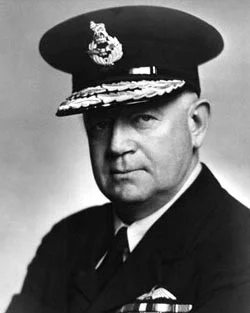
Goble was born in Croydon, Victoria, on 21 August 1891. His father worked for the Victorian Railways, and Goble followed him into railway work, first as a clerk and later as a stationmaster. He also played football for Brunswick in the Victorian Football Association. His early life supplied no obvious route into military aviation. 2
The First World War opened that route by closing another one. The Australian Imperial Force rejected Goble because he failed its medical standards. Goble later wrote that only applicants with the finest physiques were considered for the first contingent. With his three brothers already serving, he paid his own way to England and enlisted in the British forces. 2
The Royal Naval Air Service accepted Goble for flying training in July 1915. He graduated as a flight sub-lieutenant on 20 October, worked as a test pilot, and flew anti-submarine patrols from Dover. By the end of the year, he was at Dunkirk flying Caudron reconnaissance-bombers and Sopwith Pup fighters. He entered operations with only three hours of solo flying experience. 2
His own account of that introduction sounds less like a carefully assembled elite unit than a dangerous experiment:
"I was detailed to carry out what was termed a fighting patrol in a twin-engined Caudron. My armament was a Very pistol and my gunner was supplied with a rifle... I discovered that my gunner had never been in the air, had never fired a rifle in his life... I had not seen a twin-engined Caudron until after dark on the previous evening and could not even obtain a map of the front... Fortunately this highly efficient fighting combination found nothing to fight."— Stanley Goble, describing his introduction to operations on the Western Front. 2
Goble became a founding member of No. 8 Squadron RNAS in 1916. On 24 September that year, near Ghistelles in West Flanders, he engaged two enemy fighters and brought one down in a spiral nose-dive. The London Gazette citation awarded him the Distinguished Service Cross; the Wikipedia article identifies the victory as the first confirmed kill by an Allied pilot flying the Sopwith Pup. 2
The Distinguished Service Order followed in February 1917 for three separate actions. Goble forced one hostile fighter down on 7 November 1916, destroyed another after engaging four enemy aircraft on 27 November, and shot down a further aircraft while escorting Allied bombers on 4 December. He later commanded No. 5 Squadron RNAS as German artillery pushed across the ground beneath it. When shelling forced the squadron to abandon its airfield, Goble moved twice and kept it attacking. 2
The RNAS merged with the Royal Flying Corps on 1 April 1918, making Goble a major in the newly formed Royal Air Force. He finished the war with ten victories and two forced crash landings, without suffering injury during active service. The record made him a decorated pilot. The experience also gave him an early lesson in command: aviation depended as much on improvised organisation as on individual nerve. 2
The air force he helped build
Goble returned to Australia in November 1918 and soon entered the institutional problem that would define his later career. A temporary Air Board examined whether Australia should create its own air force. Goble represented the Navy, while Lieutenant Colonel Richard Williams represented the Army and the wartime Australian Flying Corps. The permanent Air Board recommended an independent service, and the Australian Air Force came into being on 31 March 1921. Goble left the RAF that same day and transferred to the new service. 2
The Navy had nominated Goble to become the service's first senior air member, a post that later became Chief of the Air Staff. Williams received the position instead, while Goble became Second Air Member and Director of Personnel and Training. The two men would each serve three terms as chief between 1922 and 1940. 2
The rivalry between them is one of the places where the source separates evidence from interpretation. One suggested motive for rotating the office was that Army and Navy interests wanted to limit Williams's autonomy. RAAF historian Alan Stephens argued that the arrangement almost inevitably produced an unproductive rivalry, intensified by the contrast between Williams's described authoritarian temperament and Goble's more easy-going manner. Those interpretations explain the atmosphere around the new service; they do not prove that every later decision came from personal competition. 2
Goble's most visible interwar achievement came in 1924. He and Flying Officer Ivor McIntyre became the first men to circumnavigate Australia by air in a single-engined Fairey IIID floatplane. The flight had a practical purpose: it surveyed the northern coastline for defence planning and tested the aircraft's capabilities. 2
They left Point Cook, Victoria, on 6 April 1924 and covered 8,450 miles, or 13,600 kilometres, in 44 days. Their route ran anticlockwise along the eastern coast through Sydney, Southport, Townsville, and Thursday Island; crossed the Gulf of Carpentaria to Darwin; continued through Broome, Carnarvon, Perth, Albany, and Port Lincoln; and returned to Victoria. Fuel and spare parts had been placed ahead of them, but the crew still faced illness, tropical storms, engine trouble in the air, and fuel leaks. 2
The return turned a defence survey into a national spectacle. Twelve RAAF aircraft escorted Goble and McIntyre toward St Kilda Beach, where a crowd of 10,000 people greeted them. Prime Minister Stanley Bruce called the journey one of the most wonderful accomplishments in aviation. The government gave Goble £500 and McIntyre £250; the Royal Aero Club awarded them the Britannia Trophy; and both men became Commanders of the Order of the British Empire. 2
The biography also keeps a complication in view. Later historians questioned why the air force chief personally needed to command such a journey and connected the choice to the one-upmanship associated with the Williams-Goble relationship. The flight's strategic value and its competitive symbolism can both be part of the story. The source does not require the reader to choose between a real reconnaissance mission and a piece of institutional rivalry. 2
When command became a policy argument
By the outbreak of the Second World War, Goble had experience in both combat and administration. During an exchange posting to Britain from 1935 to 1937, he served as Deputy Director of Air Operations at the Air Ministry and then commanded No. 2 (Bomber) Group RAF in Hampshire. The group contained fifteen squadrons, a force larger than the entire RAAF. Goble returned to lead the Australian service for the third time in February 1939. 2
Goble planned to expand and decentralise the RAAF around two demands: the defence of Australia and the country's obligations in Europe. His plan included transferring No. 10 Squadron to Britain, but he also proposed an autonomous Australian Air Expeditionary Force and a functional command structure divided into Home Defence, Training, and Maintenance. 2
The federal government chose a different arrangement. It committed Australia fully to the Empire Air Training Scheme, a Commonwealth programme for training aircrew, and rejected Goble's proposed command structure. Goble believed that the decision weakened Australia's local defence. His disagreement was therefore about the use of limited capacity: whether the young air force should be organised around a national defence system or contribute its people and training capacity to an imperial scheme. 2
The dispute also involved Goble's deputy, Air Commodore John Russell, an RAF officer serving in Australia. Goble tendered his resignation as Chief of the Air Staff, effective January 1940. The Argus reported that he wished to resign "on a matter of high principle" and had been dissatisfied with his relations with the federal government. 2
The resignation did not happen in a political vacuum. Prime Minister Robert Menzies had already been looking for a British officer to head the RAAF. He told the United Kingdom's high commissioner, Sir Geoffrey Whiskard, that Goble's resignation was "undoubtedly very convenient." The government appointed Air Chief Marshal Sir Charles Burnett, who reorganised the air force around geographically based area commands. 2
Goble considered leaving the RAAF altogether and returning to Britain. Menzies persuaded him to remain as Australia's Air Liaison Officer in Ottawa. Goble held that post for the rest of the war, received the substantive rank of air vice-marshal, and represented the RAAF at the Ottawa Conference in May and June 1942, where the participating governments negotiated the Joint Commonwealth Air Training Plan. He had lost control of the Australian service's structure, but his work still moved into the centre of the wartime training system he had opposed in its Australian form. 2
Key details that change the picture
- His first rejection redirected his career. The Australian Imperial Force's medical standards kept Goble out of the first contingent. His decision to travel to England instead placed him inside the Royal Naval Air Service, where he learned to fly in wartime conditions. The failed enlistment was a barrier, but it also sent him into the British aviation system that Australia later needed him to help build. 2
- The 1924 flight was a defence survey, not a joy ride. Goble and McIntyre's 44-day, 13,600-kilometre route gathered knowledge about Australia's coastline while testing a floatplane in illness, storms, mechanical trouble, and fuel leaks. The public celebration came afterward; the mission began as work for a small air force with a large coastline. 2
- Goble built institutions as well as flying reputations. He helped establish the Australian Air Force as an independent branch, served as its personnel and training director, and occupied the chief's office three times. His career therefore belongs to the history of administration as much as to the history of aerial combat. 2
- The policy dispute had a concrete consequence. The government rejected Goble's autonomous expeditionary force and functional commands, then replaced him with a British chief who reorganised the RAAF by geographic areas. Goble's move to Ottawa preserved his service, but it removed him from the Australian command decision he had tried to shape. 2
- His ending was unsettled. In January 1946, Goble presided over the court-martial of Australia's top-scoring fighter ace, Clive Caldwell. One month later, the RAAF forced Goble into retirement at age fifty-four, five years before the mandatory retirement age. Chief of the Air Staff George Jones praised his service knowledge and alert mind while citing "certain nervous characteristics" that allegedly made continuous application to a task impossible. Other senior First World War commanders, including Williams, were also retired during the period. 2
Verbatim lines from the source
Goble's description of his first operational patrol compresses the uncertainty of early military aviation into a single dry joke:
"Fortunately this highly efficient fighting combination found nothing to fight."— Stanley Goble, quoted in Stanley Goble on Wikipedia. 2
The report in The Argus gave his resignation a public explanation:
"Goble wishes to resign 'on a matter of high principle'."— The Argus, as quoted in Stanley Goble on Wikipedia. 2
Menzies's private comment supplied the other side of the political story:
"undoubtedly very convenient"— Robert Menzies, describing Goble's resignation to Sir Geoffrey Whiskard, as quoted in Stanley Goble on Wikipedia. 2
The full source is Stanley Goble on Wikipedia, selected as Wikipedia's Today's Featured Article for August 21, 2026. Goble's career joins two forms of courage that are easy to separate in a short biography: the courage to fly an unreliable machine into danger, and the courage to argue over what an entire air force was for. The first made him famous. The second determined where he ended up.
참고 출처
- 1Wikipedia's Today's featured article for August 21, 2026en.wikipedia.org
- 2Stanley Goble - Wikipediaen.wikipedia.org
- 3File:Caf goble.jpg - Wikipediaen.wikipedia.org

Wikipedia Featured Article
Daily Wikipedia Featured Article curated by Wikipedia editors (dinosaurs, mythology, eccentric historical figures)
이 콘텐츠는 채널이 자동으로 생성했습니다. 한 문장이면 Neodrop이 당신을 위해 계속 만들어 냅니다.
관련 콘텐츠
- 로그인하면 댓글을 작성할 수 있습니다.