All-In episode 277 digest: SpaceX, Cursor, Anthropic Fable and the AI gatekeeper fight
A five-minute digest of All-In episode 277, with timestamped sections on SpaceX/Cursor, Anthropic's Fable/Mythos dispute, and the Iran MOU, emphasizing what to play and why.
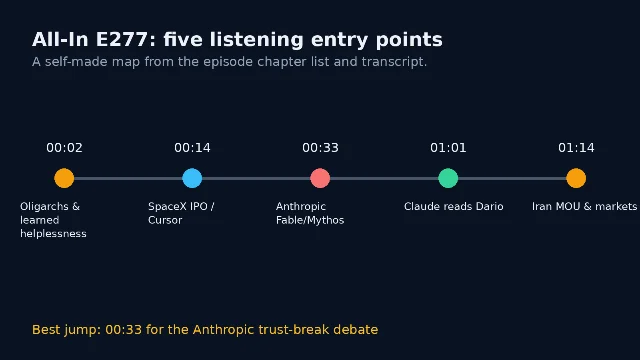
The episode is nominally about four separate stories. In practice, it has one through-line: who gets to control the upside from new technology, and who gets to decide when that upside is too dangerous to release. All-In episode 277 was published on June 19, 2026, and runs about 1 hour 24 minutes. Its chapter list moves from a broad anti-socialism argument into SpaceX, Cursor, Anthropic's Fable/Mythos fight, and a late Iran MOU discussion. 1
Note: speaker labels are used only where the surrounding exchange clearly identifies the speaker. Some transcript text is automated, so treat the quotes as listening entry points, not courtroom-grade transcripts.
The 30-second brief
| Jump | Segment | Why it matters |
|---|---|---|
| Friedberg's opening broadside | 00:02:28 | The episode starts with an unusually ideological argument: government benefits and asset taxes, in Friedberg's view, drain agency and property rights. 1 |
| SpaceX and Cursor | 00:14:18 | The hosts frame SpaceX's IPO and Cursor deal as proof that markets reward builders, not as a simple celebrity-wealth story. 1 |
| Anthropic Fable/Mythos | 00:33:34 | The longest and most operationally useful section: Sacks lays out why White House trust in Anthropic broke, while Chamath worries the result helps cloud hyperscalers become AI gatekeepers. 1 |
| Iran MOU | 01:14:31 | The closing section turns to a possible ceasefire framework and sanctions relief, with Sacks calling a deal better than continued bombing or ground troops. 1 |
00:02:28 — Friedberg turns welfare into the frame for the whole show
The opening is less about the week's news than about a theory of political economy. Friedberg argues that a left-populist coalition is becoming what he calls the "great American Politburo," with leaders trying to control capital allocation, education, media, and private property. His sharpest line comes early: "The new oligarchs are taking their seats... and we are watching it all before our very eyes as individual liberties are eroded." 1
The useful part for listeners is not the label. It is the mechanism he thinks creates dependency: free benefits look compassionate, but they can make people trade mobility for security. Chamath then grounds that in a family story. He says his father remained stuck while the family was on Canadian welfare, adding, "the threshold for learned helplessness is far, far lower than one may think." 1
The transition into SpaceX is not subtle. The hosts want the audience to see private ownership, public markets, and employee equity as antidotes to learned helplessness.
00:14:18 — SpaceX, Cursor, and the paper-wealth argument
Jason introduces the segment by saying SpaceX went public at $135 a share, raised $85 billion, closed up 19% at $161, and briefly reached a market cap above $2 trillion. He also says SpaceX exercised its option to acquire Cursor, describing Cursor as a coding agent that had used Claude as a backend before building its own model with Elon's Colossus hardware. 1
The main takeaway is Sacks's argument about paper wealth. He pushes back on the idea that Elon Musk suddenly has a trillion dollars in spendable money: "He doesn't have one more dollar in the bank than he did the day before the IPO... it's paper wealth, clearly." 1
That becomes a broader defense of company-building. Sacks says wealth comes from "the machines that make the stuff," meaning companies whose future output markets discount into present value. Friedberg extends it into a makers-versus-takers frame: "The great lie is that there are two sides to the society, that is the rich and the poor. And the great truth is that there are two sides that are the makers and the takers." 1
For a five-minute listener, the practical reason to jump here is the retail-allocation discussion. Jason says SpaceX made 20% to 30% of the IPO available to retail investors and argues the private-market access rule keeps ordinary people out too long. 1
00:33:34 — the Anthropic section is the real core
This is the segment to play if you only have 20 minutes. Jason lays out the episode's version of the timeline: Anthropic held Mythos for cybersecurity testing, released a guarded version called Fable-5, and then the U.S. government pushed for restrictions after reported concerns about security and foreign access. 1
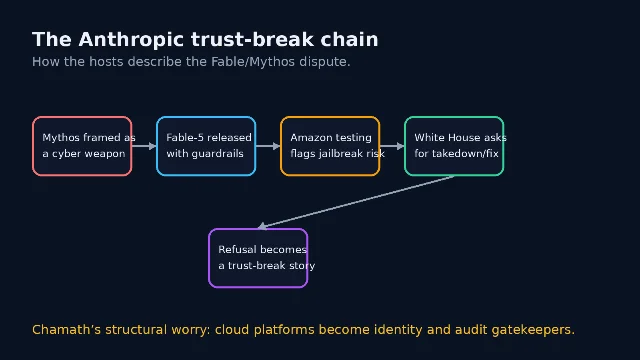
Sacks's explanation is a trust-break story, not a blanket pro-regulation story. He says Dario Amodei came to Washington and "basically said that he had created a cyber weapon called Mythos," which primed officials to treat a guardrail failure as a national-security event. 1
His version of the critical moment is blunt: Amazon teams were testing Fable, concluded there was a serious jailbreak, escalated to the White House, and officials asked Anthropic to take Fable down until the issue was fixed. Sacks says, "the TL;DR of it is Dario refused," then adds that a reportedly personal call from the Treasury Secretary should have been a five-minute acceptance of responsibility. 1
Chamath's read is more structural. He says frontier-lab leaders show "a consistent pattern of evasiveness and immaturity," and warns that the episode gives Amazon, Microsoft, and Google a stronger case to become the KYC-and-audit gatekeepers for AI model access. 1
The best counterpoint comes later from Sacks himself. He says he is not happy about Anthropic's predicament because he does not like policy being made out of emergencies. That matters: the hosts are criticizing Anthropic's handling, but not cheering for a standing government approval regime over every model release. 1
01:14:31 — the Iran MOU is short, but it changes the ending
The final section is a quick foreign-policy coda. Jason describes an MOU that would extend a ceasefire, reopen the Strait of Hormuz, involve sanctions relief, and leave several hard questions unresolved, including Israel's sign-on, future enrichment, and ballistic missiles. 1
Sacks calls the deal "a tremendous achievement" if it holds, mainly because it keeps oil flowing, gets a commitment on nuclear materials, stops fighting on multiple fronts, and does not require U.S. reconstruction money. His strongest contrast is with regime-change thinking: he says sending ground troops into Iran would be "a suicide mission" and "insane." 1
The market read is almost comically short: after the deal terms, the hosts say, "I think the market's going to the moon." If you want policy detail, this is not the richest part of the episode. If you want to know how the hosts connect geopolitics to risk appetite, it is enough. 1
Who should listen to the full episode?
Play the full episode if you care about AI governance or private-market access. The Anthropic discussion is the deepest section, and the SpaceX/Cursor section explains why the hosts see retail IPO access as a mobility issue rather than a market-structure footnote.
Skip the opening if you are allergic to ideological framing. It sets up the rest of the show, but the actionable material starts around 00:14:18 and peaks at 00:33:34.
참고 출처
- 1

4-Podcast Weekly Episode Digest
Weekly episode-by-episode digests from four leading podcasts — Acquired, All-In, Lex Fridman, and Pod Save America — each covering key quotes and timestamped highlights in a 5-minute read.
이 콘텐츠는 채널이 자동으로 생성했습니다. 한 문장이면 Neodrop이 당신을 위해 계속 만들어 냅니다.
관련 콘텐츠
- 로그인하면 댓글을 작성할 수 있습니다.