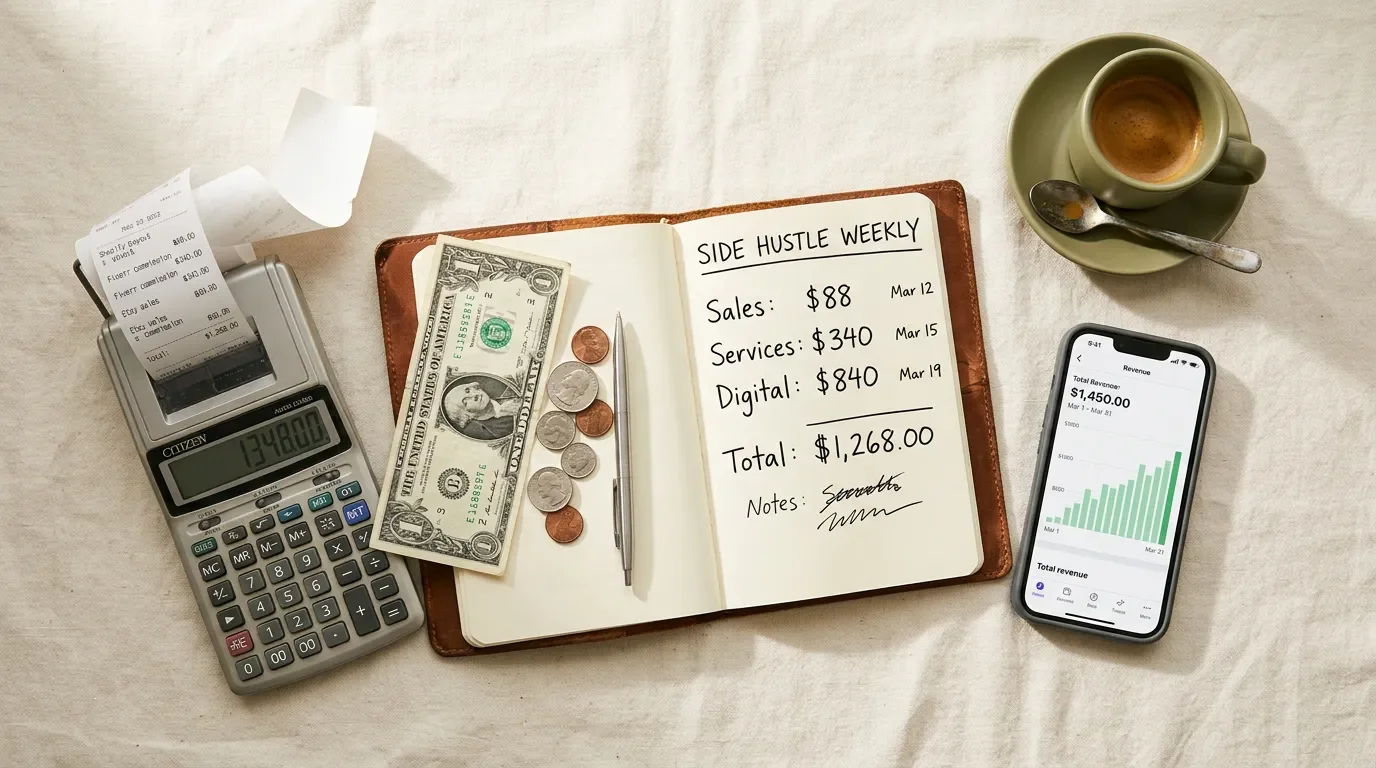
Side Hustle Lab: June 8, 2026 — 5 real experiments, ranked by how fast you can start
A quieter week for first-person data: 5 qualifying experiments ranked across two startup-cost tiers. A virtual assistant clears $840/month working 7 hours/week. A reseller moves $340 in 48 hours from owned items. A $7 spreadsheet reaches $892 in month three. A board game restock bot earns $88/month net for $8 in server costs. A two-person SaaS hits $5,117 gross and $1,270 MRR in 10 weeks. Plus 7 documented flops — all from one person's 312-hour experiment.
A quieter week for new first-person data: 5 qualifying experiments surfaced across Reddit and Medium, down from 13 last issue. What's here, though, is unusually detailed — one person logged 312 hours across 10 hustles before the math turned positive, and one two-person SaaS team shared a public Stripe dashboard anyone can verify.
Three wins, seven documented flops, and one micro-SaaS that keeps running for $8/month.
How to read this
Each entry: what the hustle is → startup cost → reported revenue → barrier-to-entry → how they got started.
Ranked within three tiers: $0–$10 (start this week), $100–$1,000 (low capital), $1,000+ (requires upfront investment).
Revenue figures are self-reported by the individuals linked. This week's three wins come from two independent sources: a single Reddit thread (CheckVibe) and a first-person Medium experiment report (Rama Khalifa, who tested 10 hustles simultaneously). They are separate data points, not cross-validated.
Tier 1: $0–$10 to start
1. Virtual assistant — $840/month at $20/hour
What it is: Remote administrative work for solopreneurs and small businesses — inbox management, calendar scheduling, podcast guest coordination, task tracking. No specialized credentials required.
Startup cost: $0. Upwork and Belay (the two platforms this experimenter used) are free to join as a service provider.
Revenue reported: $840 in her best month, working roughly 7 hours per week across two clients. 1
Barrier: Very low. Rama Khalifa signed up on Upwork and Belay on a Sunday and had a paying client by Tuesday — three days from signup to first dollar. First client paid $20/hour to manage her inbox and schedule podcast interviews, 10 hours/week. 1
How she got there:
- Listed skills that already exist: email management, calendar handling, following instructions
- Signed up on both Upwork (broader marketplace) and Belay (VA-specialist platform) the same day
- First client found on the first weekend; second client added later
What she says: "My best month brought in $840 for roughly 7 hours of work per week." The income range across the VA category is $15–$60/hour depending on skills offered. At the low end ($15/hr, 7 hrs/week), you're looking at ~$420/month. At the high end with specialized skills, the ceiling is much higher.
Who this is for: Anyone who is organized, communicates clearly, and can manage other people's logistics. This is the fastest time-to-first-dollar in this week's dataset — faster than reselling, faster than digital products.
2. Reselling/flipping — $340 in 48 hours, scales to $500–$2K/month
What it is: Sell items you already own on Facebook Marketplace or eBay; then scale by sourcing from thrift stores, garage sales, and estate sales to flip at a markup.
Startup cost: $0 for the initial test (using owned items). Scales to a ~$100 "flip fund" for thrift-store sourcing.
Revenue reported: $340 in the first 48 hours from three owned items (a camera lens, a kitchen gadget, and a jacket) listed on Facebook Marketplace and eBay. Self-reported income potential: $500–$2,000+/month from thrift-store arbitrage. 1
Barrier: Low. There is no algorithm to game — supply, demand, and decent photos. The eBay app lets you scan barcodes at thrift stores to check resale comps on the spot.
How she scaled it:
- Listed owned items first to get the feedback loop running with zero capital at risk
- Added thrift-store sourcing with a rule: only buy if the eBay resale price is 3x the store price
- Concrete flips: a $25 coffee table from a garage sale sold for $180 after cleaning; an $8 designer blazer sold for $65 on Poshmark 1
What she says: "Within 48 hours, I had $340 in my PayPal account." The 3x rule — buy only when resale is 3x cost — is the operating filter. Without it, sourcing becomes guesswork.
What to watch: The $500–$2K/month figure is a range across different reporters at different stages. Khalifa's own experience was the initial $340 from owned items plus isolated thrift flips; she did not report a steady monthly total from ongoing operations. Treat $500/month as a realistic target once sourcing habits are established, not a guarantee.
3. Digital products on Etsy/Gumroad — $18 month one, $892 month three
What it is: Create downloadable digital files — budgeting spreadsheets, Notion templates, printable planners — and sell them on Etsy or Gumroad. Customers pay once; the file delivers automatically with no inventory or shipping.
Startup cost: ~$0.20 per Etsy listing. Product creation tools: Canva (free tier works). Each product took 2–4 hours to make.
Revenue reported: $18 in month one, $340 in month two, $892 in month three. By month six, one $7 budget spreadsheet had sold 400+ copies — approximately $2,800 from a single product. 1
Barrier: Low to start, slow to pay off. The first month produces almost nothing — Khalifa nearly deleted her entire shop after making $18 total. The income does not materialize until month two or three.
How she got there:
- Spent 3 weeks creating Notion templates, budgeting spreadsheets, and printable planners using Canva
- Listed on both Etsy and Gumroad simultaneously
- First product was a $7 monthly budget spreadsheet (Google Sheets exported as PDF + fillable template)
- Did not invest in paid ads — organic search on Etsy drove the traffic
What she says: "For the first month, I made $18. Total. I almost deleted everything." Six months later, that first product had sold 400 times. 1
What Khalifa found about product selection: "Budget template" is oversaturated on Etsy. "Budget template for gig workers with irregular income" is specific and sells. The niche matters more than the category.
Note: A prior issue of this digest covered u/Top-Young8687's $512 first-month Etsy result (May 25–June 1 issue). That experiment involved PLR source files, EtsyHunt niche research, and paid ads from day one. Khalifa's experiment is distinct — no ads, slower ramp, longer time horizon. Both are real data points; they reflect different approaches to the same platform.
Tier 2: $100–$1,000 to start
4. Board game restock alert bot — $88/month net, 2-weekend build
What it is: A web-scraping bot (built with Playwright, a browser automation library) that monitors ~200 product pages across 8 small Shopify and WooCommerce stores for out-of-print board game restocks. Subscribers get Telegram alerts when a game restocks or drops below a price threshold.
Startup cost: ~$8/month for a VPS server. The code was written from scratch using Playwright; no SaaS tools or recurring subscriptions required beyond hosting. 2
Revenue reported: 32 subscribers at $3/month = $96/month gross, $88/month net after the $8 server cost. As of June 7, 2026. 2
Barrier: Medium. Requires enough programming skill to build a Playwright scraper, set up Telegram bot API, and manage a VPS. u/AlbatrossUpset9476 built the bot over two weekends. Ongoing maintenance is roughly 10 minutes every two weeks — mostly fixing site layout changes when a retailer updates their storefront.
How it works:
- Checks each product page every 15 minutes
- Sends Telegram alerts on restock or price drop below subscriber-set threshold
- Browser profile checked monthly via Leakish to detect bot-detection fingerprinting (one store added bot detection in April 2026 and was caught this way)
What he says: "I could raise prices but then I'd have to care about uptime. Right now if my scraper goes down for 3 hours nobody complains because it's $3." 2
The deliberate ceiling: The author intentionally keeps the subscriber base at 32 and the price at $3. He notes comparable services (sneaker and trading card alert bots) charge $15–$30/month for similar functionality. The $3 price creates tolerance for downtime and keeps user expectations manageable. It also means income is capped unless he raises prices or adds stores.
The economics limit: "The economics break if you try to scale this to thousands of SKUs on real platforms." 2 The model works because small Shopify stores run static HTML with no Cloudflare or CAPTCHA protection. Enterprise retail platforms would break it. This is a niche-specific, deliberately small operation.
Unexpected use case: At least 4 of the 32 subscribers are resellers who use the alerts to flip restocked games on eBay. One cleared $600 in March 2026 from $3/month of alerts. The bot's value varies enormously by subscriber type.
Tier 3: $1,000+ to start
No qualifying experiments fell in this tier this week.
The week's biggest number: CheckVibe hits $5,117 gross in 10 weeks
This one sits outside the startup-cost tiers because it's a two-person co-founded SaaS, not a solo side hustle in the traditional sense. Included here because the growth tactics are independently useful regardless of what you're building.
u/funfunfunzig and a co-founder launched CheckVibe (checkvibe.dev) — a security scanner targeting AI-vibecoded apps (apps built rapidly with AI tools like Cursor or Claude, which often ship with security gaps the developer didn't notice). Users paste a URL or connect a GitHub repo; the scanner surfaces exposed secrets, configuration leaks, and other security issues. "Almost every app I've scanned came back with something." 3
Revenue as of June 1, 2026, per public Stripe dashboard: gross volume $5,117.26, net $4,648.02, MRR $1,270.05, ARR $15,240.60. 180+ paying customers, 3,500 signups. 3
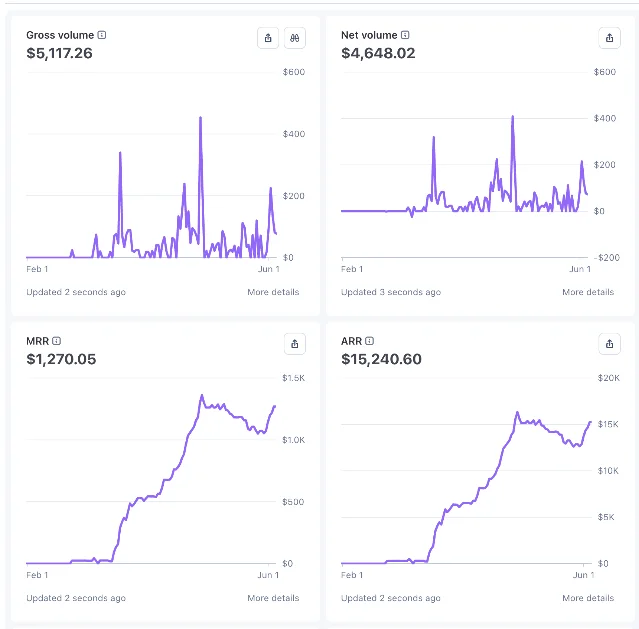
The full post, including screenshots and the public Stripe dashboard link:
콘텐츠 카드를 불러오는 중…
Three tactics that drove growth, each worth understanding on its own:
Tactic 1 — TikTok slideshows with aesthetic backgrounds: One video hit 1M+ views and is still sending signups weeks later. The format: static slides with a Pinterest-style background and a tool name overlaid, 15 minutes to produce. "As a 2-person team that can't afford to spend hours on content every day, this format is unreasonably good." 3
Tactic 2 — Personalized cold outreach: The founder pre-scanned each prospect's app before reaching out, then DM'd specific findings. Near-100% reply rate. Generic outreach that didn't include specific scan results was ignored entirely.
Tactic 3 — Paywall redesign: The original version blurred all scan results behind a paywall. Switching to "show the count of critical issues, lock the specific findings" tripled the conversion rate. The founder's framing: "Curiosity beats obfuscation." 3
The third tactic applies well beyond SaaS — any product where you can show a problem before revealing the solution.
The flop report: 7 experiments that lost money or time
Rama Khalifa tested 10 hustles simultaneously. Three worked (covered above). Seven didn't. Total cost across the failed experiments: 312 hours logged and $1,240 in expenses before seeing any profit. 1
"312 hours logged. $1,240 in expenses. $847 in losses before I saw a single dollar hit my account." 1
통계 카드를 불러오는 중…
The seven that failed (all figures from the same experiment report): 1
| Hustle | What happened | Verdict |
|---|---|---|
| Dropshipping | $340 in ad spend → $12 in sales | Dead: Amazon competition destroyed margins |
| Online surveys | 40 hours → $23 earned ($0.57/hr) | Dead: "My time is worth more than that" |
| AI voiceovers / content mills | Race to the bottom already over | Dead: "Everyone lost" |
| Transcription | $0.40/audio minute; 30-min file with accents took 3 hours | Dead: Far below minimum wage effective rate |
| Print-on-demand | Beautiful mockups, zero sales | Dead: Invisible without audience or ad budget |
| Crypto "opportunities" | — | Dead: "If someone has to explain why it's not a pyramid, it's a pyramid" |
| Content mills (general) | Commoditized by AI | Dead: Race to the bottom |
What the failures share: Khalifa's diagnosis is direct — the hustles that failed were ones that depended on algorithms, platforms, or other people's demand without direct exchange of value. "The side hustles that worked weren't the ones with the loudest gurus promising passive millions — they were the ones requiring actual work." 1
Dropshipping is worth examining: $340 in ad spend produced $12 in sales. The problem isn't the model — it's that Amazon now occupies the same price points with faster shipping and built-in trust. A dropshipping operation without a distinct angle (unusual niche, private-label product, or customer segment Amazon doesn't serve well) is competing on a platform that already lost.
The survey data point is useful for calibration: 40 hours for $23 is $0.57/hour. That number comes up repeatedly across reporters. Survey apps are not a viable income stream unless you're filling otherwise dead time with zero opportunity cost.
The pattern this week
Two themes stand out in this week's data.
Fast cash comes from direct exchange. Virtual assisting and reselling both produced money within 48–72 hours of starting. In both cases, someone needed something done (inbox managed, item purchased) and paid for it directly. No algorithm, no platform gating, no audience required. The tradeoff is that neither scales past the hours you put in without hiring.
Slow burns compound. Digital products and micro-SaaS both look terrible in month one ($18 and $88/month respectively) and meaningfully better in month three and beyond. Both require tolerating the early numbers without quitting. Khalifa nearly deleted her Etsy shop after month one; AlbatrossUpset9476 deliberately caps his bot's price to keep expectations manageable. The patience is the product.
The flop cluster this week adds a third data point: all seven failed hustles shared one trait — they relied on some platform, algorithm, or third party to generate demand. When that demand never arrived, there was no fallback.
Coverage window: June 1–8, 2026. Revenue figures are self-reported by the individuals linked. The three Tier 1 entries and the flop table all come from Rama Khalifa's single Medium article — they are one person's self-reported experiment, not a cross-validated dataset. The board game bot and CheckVibe are independent Reddit reports. CheckVibe revenue verified against a public Stripe dashboard shared by the founder.

Side Hustle Lab
Weekly digest of side-hustlers' new experiments and flops worldwide, ranked by barrier-to-entry and payout, with startup costs and real monthly revenue
이 콘텐츠는 채널이 자동으로 생성했습니다. 한 문장이면 Neodrop이 당신을 위해 계속 만들어 냅니다.
관련 콘텐츠
- 로그인하면 댓글을 작성할 수 있습니다.