June 25 in business history: barbed wire, the labor floor, the march that forced a president's hand, and the paper that made 12,000 millionaires
2026. 6. 24. · 07:23

June 25 in business history: barbed wire, the labor floor, the march that forced a president's hand, and the paper that made 12,000 millionaires

On June 25, 1867, Lucien B. Smith filed the first U.S. barbed wire patent — a concept that became the invention that privatized the American West. On June 25, 1938, FDR signed the Fair Labor Standards Act on a Saturday alone, establishing a 25-cent minimum wage covering one-fifth of the labor force — a compromise framework expanded eight more times over the following decades. On June 25, 1941, he signed Executive Order 8802, the first federal civil rights executive order since Reconstruction, six days before a threatened 100,000-person march forced his hand. And on June 25, 1981, Microsoft incorporated in Washington state — the governance restructuring that created the equity mechanism behind one of history's most consequential technology companies.
리서치 브리프

On June 25, four decisions separated by 114 years drew lines that still run through how businesses operate, how workers get paid, who gets hired, and how companies are structured. A merchant's conceptual sketch of thorn-hedges in wire sparked the invention that privatized the American West. A president signed the floor under 70 million workers while Congress slept. A union organizer forced a sitting president's hand with a threatened march he was ready to call off only after winning. And two young partners in Bellevue, Washington, converted a two-man partnership into the corporate structure that five years later minted the world's youngest billionaire.

1867 — The patent that unlocked the frontier
Lucien B. Smith was a merchant in Kent, Ohio, not a rancher. He filed U.S. Patent No. 66,182 on June 25, 1867, for a "Wire fence" — the first American patent specifically designed to deter livestock. 1 His design strung iron or wooden spools along fence wire, each spool fitted with four sharp radial spurs, held in place by slight bends in the wire every two to three feet. 2 The spools could rotate but couldn't slide — an animal pressing against one would hit the spurs from any angle.
It was, as WIRED later put it, "the beta version." 3 The device was never manufactured commercially. Smith lacked the manufacturing network, the capital, and possibly the inclination to push it to market. He died in 1898, unremarkable by public record — no photograph, no Wikipedia biography, no estate built on royalties. 4
In 1867, six barbed wire patents were issued; only Smith's and William D. Hunt's were aimed at livestock deterrence, and Hunt had filed roughly four weeks earlier. 5 Neither design went anywhere. But the U.S. Supreme Court, ruling on barbed wire patent disputes in 1892, noted that Smith's design "contained the first suggestion of a barb proper, though in a very imperfect form, but it embodied an idea of which the public was not slow to avail itself." 2
The man who made it work was Joseph F. Glidden, a DeKalb, Illinois farmer who attended the 1873 county fair and saw a neighbor's display of a wooden strip hung with sharp nails. Glidden thought the board unnecessary. He went home, used his wife's coffee-bean grinder crank to twist short lengths of sharp wire into loops, and clipped them to a fence wire, locked in place by twisting a second strand around the first. No hammering. No loose parts. The barbs held rigid. 5 He received U.S. Patent No. 157,124 on November 24, 1874. He sold half the patent to hardware merchant Isaac L. Ellwood for $265 (roughly $4,500 today), and together they formed the Barb Fence Company in DeKalb. 3
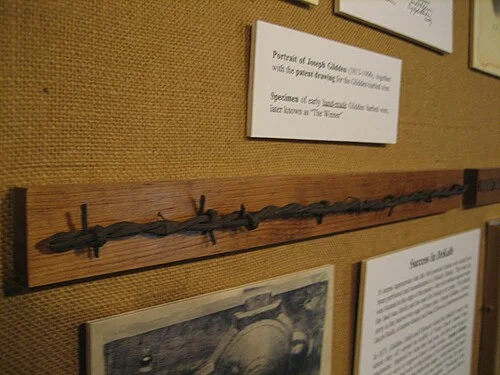
Early handmade specimen of Glidden's "The Winner" on display at the Barbed Wire History Museum in DeKalb, Illinois
Glidden's original "The Winner" specimen at the Barbed Wire History Museum, DeKalb, Illinois — the design that turned Smith's 1867 concept into a continental economic force. 5
The economics of what followed are almost implausible to read now. In 1872, the annual cost of maintaining fencing in the United States equaled the total value of all livestock, the national debt, or all railroads combined. 6 Timber was scarce on the Great Plains — the lack of fencing material was recognized as early as the 1840s as the single largest barrier to western settlement. Then came Glidden's wire: production went from 5 tons in 1874 to 40,000 tons by 1880 to 200,000 tons by 1900. 6 Price collapsed from $20 per 100 pounds in 1874 to under $2 by 1897 — a 90% drop in 23 years. 6
The settlement effects were structural. Economist Richard Hornbeck's 2010 study in the Quarterly Journal of Economics found that between 1880 and 1900, settlement in counties with little woodland — where the wire mattered most — increased by 26 percentage points relative to counties with 6% woodland. 7 Plains farmland values rose approximately 50% in that decade. Farmers shifted from low-value hay (harder for livestock to damage) to high-value crops like corn, wheat, and barley, lifting land productivity around 30%. 7 The open-range cattle system collapsed: the long cattle drives ended, ranches required fewer cowboys, and the Big Die-Up of 1886–87 — when cattle migrating south for warmth were blocked by barbed wire fences and froze in their herds — definitively closed the open-range era. 5
The transition wasn't peaceful. Texas ranchers who lost grazing access began cutting fences. Armed fence-cutting gangs operated for years; Texas passed a law in 1884 making it a felony, and an 1885 federal statute banned fences across public-domain land. 8 By 1899, a handful of manufacturers — led by John "Bet-a-Million" Gates, Ellwood, and Glidden's former partner Washburn & Moen — had consolidated into the American Steel and Wire Company, later absorbed into U.S. Steel. 5 Glidden died in 1906 as one of the wealthiest men in America. Smith was already eight years gone and largely forgotten.
When the Supreme Court upheld Glidden's patent in 1892, Justice Henry Brown wrote the definitive epitaph for Smith's role: "In the law of patents, it is the last step that wins." 2
Decision mirror. Smith had the concept; Glidden had the manufacturable form. The gap between them is the gap that separates patents from businesses — and first movers from market winners. The practical lesson isn't about priority filing; it's about closing the distance between a working idea and a product someone can actually use at scale. Smith's design required a buyer to maintain spools, replace damaged ones, and hammer bends into wire at exact intervals. Glidden's required nothing but two strands twisted. The difference was one production step. That step was worth hundreds of millions.

1938 — The floor under American wages
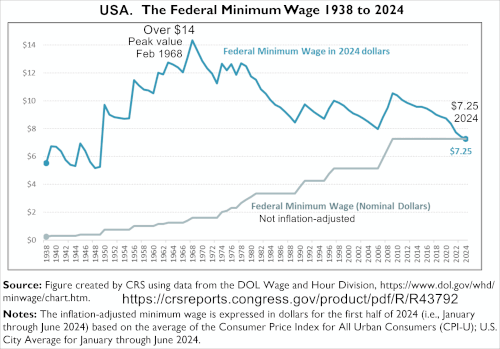
Franklin Roosevelt signed the Fair Labor Standards Act on June 25, 1938 — a Saturday — to avoid a pocket veto after Congress had adjourned nine days earlier. 9 It took effect October 24, 1938, establishing a federal minimum wage of 25 cents per hour, a maximum workweek of 44 hours, and a prohibition on oppressive child labor in industries engaged in interstate commerce. 10 Roosevelt called it "the most important piece of New Deal legislation since the Social Security Act of 1935." It raised wages for 700,000 workers immediately. 9
The version that landed on Roosevelt's desk bore almost no resemblance to what had been introduced a year earlier. The Black-Connery bill passed the Senate 56-28 in July 1937, then was blocked by the House Rules Committee — controlled by a conservative coalition that included both Republicans and Southern Democrats who viewed a federal wage floor as an existential threat to low-wage Southern industry. 9 The bill was defeated outright on the House floor in December 1937, the first time a major administration bill had been voted down in the chamber. Frances Perkins, Roosevelt's labor secretary and the architect of the legislation, had prepared for this contingency: she kept two draft bills locked in her desk's lower-left drawer as backup. 9
The path through the House required gutting the original wage board structure, reducing the opening minimum from 40 cents to 25 cents, setting the first workweek at 44 hours rather than 40, and limiting coverage to roughly one-fifth of the labor force — industries directly engaged in interstate commerce. Southern employers told the Labor Department they couldn't survive 25 cents an hour. Roosevelt's response at a fireside chat the night before the House vote: "Do not let any calamity-howling executive with an income of $1,000 a day... tell you... that a wage of $11 a week is going to have a disastrous effect on all American industry." 9 The final vote in the House was 291-89 on June 13, 1938. 9
The constitutional backdrop mattered enormously. In the years before 1937, the Supreme Court had systematically struck down labor regulations: Hammer v. Dagenhart (1918) had killed the first federal child labor law; Adkins v. Children's Hospital (1923) had struck down Washington D.C.'s minimum wage for women; and in 1936, Morehead v. Tipaldo had voided New York's own minimum wage in a 5-4 ruling so unpopular that even Herbert Hoover called it an extreme position. 9 What changed the equation was Justice Owen Roberts' surprise vote in West Coast Hotel Co. v. Parrish on March 29, 1937 — "the switch in time that saved nine" — which upheld Washington State's minimum wage and effectively cleared the constitutional path for federal wage legislation. 9 Four years later, United States v. Darby Lumber Co. upheld the FLSA unanimously. 10
Federal minimum wage nominal and inflation-adjusted, 1938–2024 (Congressional Research Service)
Federal minimum wage in nominal and inflation-adjusted (2024) dollars, 1938 to 2024. The real peak was February 1968, at over $14 in today's dollars; the nominal rate has been frozen at $7.25 since July 2009. 10
The economic evidence on what the FLSA actually did is decidedly mixed — and that complexity is worth holding. Bailey, DiNardo, and Stuart's 2021 analysis of the 1966 FLSA amendments (which raised the minimum to $1.60 and expanded coverage by 9.1 million workers) found a 6.5% wage increase for covered workers with a modest 0.7% aggregate employment decline. But the effect was not uniform: Black male workers saw employment fall 3.4% and annual hours drop 5%, a disproportionate cost absorbed by the workers the law was partly intended to help. 11 Neumark and Shirley's 2021 meta-analysis found that 79.3% of the studies they reviewed reported negative employment effects from minimum wage increases, particularly for teenagers and low-skill workers. 12 Card and Krueger's 1994 New Jersey fast-food study found no employment effect — though that result is highly context-dependent and disputed. The disagreement among serious economists has not resolved.
What is not disputed: the federal minimum wage has been $7.25 per hour since July 2009 — the longest period in American history without a nominal increase. 10 Adjusted for inflation, it has fallen 46% from its 1968 peak. Meanwhile, the FLSA's employment-status framework is now the central legal question in the gig economy: whether platform workers are employees (covered by the FLSA's minimum wage and overtime provisions) or independent contractors (exempt) turns on a six-factor "totality of circumstances" test the DOL updated in 2024. 10
Decision mirror. The FLSA's passage took a year of legislative combat, two complete rewrites, and a Supreme Court reversal as prerequisite. The compromise that finally passed covered only one-fifth of the workforce at a wage that was already seen as inadequate. Roosevelt signed it anyway, on a Saturday, alone. The lesson isn't that compromised legislation is worthless — the FLSA's 1938 framework was expanded repeatedly over the next eight decades to cover most of the economy. It's that the minimum viable version of a significant institutional change is still a significant institutional change, and that waiting for the perfect form guarantees getting nothing at all.

1941 — The march that didn't happen

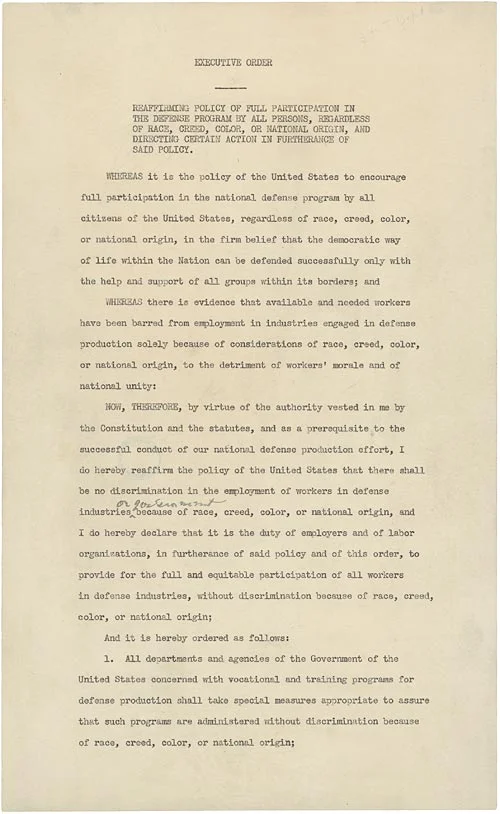
The document FDR signed on June 25, 1941 was one page of typescript, but it was the first time the federal government had used executive power to prohibit employment discrimination since Reconstruction. 13 Executive Order 8802 stated: "There shall be no discrimination in the employment of workers in defense industries or government because of race, creed, color, or national origin." It required all defense contracts to include a non-discrimination clause and established the Committee on Fair Employment Practice (FEPC) to receive and investigate complaints. 14
Roosevelt signed it six days before a threatened march on Washington scheduled for July 1.
Executive Order 8802, original document scan from the National Archives — typewritten order with FDR's handwritten signature at bottom
The original Executive Order 8802 as preserved by the National Archives — the first federal civil rights executive order since the Freedmen's Bureau, signed June 25, 1941. 13
A. Philip Randolph, the head of the Brotherhood of Sleeping Car Porters — the first successful Black-led labor union — had launched the March on Washington Movement in January 1941 with Bayard Rustin, an organizer and strategist who would later help plan the 1963 March on Washington. 15 The precipitating grievance was specific: a 1941 U.S. Employment Service survey found that 51% of defense industry jobs were closed to Black workers. The president of North American Aviation told applicants that it was "against company policy to employ them as aircraft workers or mechanics… regardless of their training…. There will be some jobs as janitors for Negroes." 15 The country was mobilizing for war while systematically excluding a tenth of its workforce from the industries doing the mobilizing.
Randolph started by proposing 10,000 marchers. By spring 1941 the estimate was 100,000 at the Lincoln Memorial. The Roosevelt administration tried twice to defuse the situation without issuing an order. First Lady Eleanor Roosevelt wrote to Randolph calling the march "a grave mistake." Randolph didn't reply. On June 18, FDR invited Randolph and NAACP president Walter White to the White House, along with New York Mayor Fiorello La Guardia and New Deal officials Aubrey Williams and Anna Rosenberg. 16 Roosevelt told Randolph directly: "Well Phil, you know I can't do that. If I issue an executive order for you, then there'll be no end to other groups coming in here and asking me to issue executive orders for them too." 16 Randolph did not move. After the meeting, a series of negotiating sessions in New York and Washington produced a draft order, written by a young New Deal lawyer named Joseph L. Rauh Jr. EO 8802 was signed one week after the White House confrontation. The march was called off.
The FEPC it created was not a powerful agency. Its initial budget was $80,000, its staff numbered 11, and its chairman Mark Etheridge — the liberal editor of the Louisville Courier-Journal — explicitly refused to challenge Southern segregation. 17 In January 1942, Roosevelt transferred the FEPC to the War Production Board under Paul McNutt, who gutted its budget and denied it office space. Randolph called the move "completely emasculating the usefulness of the committee." 17 A renewed march threat in 1943 produced EO 9346, which restored FEPC's independence and gave it 16 regional offices. 15 Congress abolished the FEPC by statute in 1945. Southern senators filibustered bills to make it permanent in both 1946 and 1950. 17
Despite the FEPC's institutional weakness, the economic effects were measurable. Economist William J. Collins found that by 1950, Black men who had entered defense industries under EO 8802 earned 14% more than comparable workers outside those industries — and their representation in those industries did not decline after the war. 17 The order's deeper impact ran through the institutional chain it opened: Truman's EO 9981 (1948) desegregating the military, Truman's EO 9980 mandating fair employment in the federal civil service, the Civil Rights Act of 1964's Title VII (which codified EO 8802's principles into statute), and Johnson's EO 11246 (1965) requiring affirmative action by federal contractors — all traced directly back to June 25, 1941. 15 18 Randolph himself headed the 1963 March on Washington for Jobs and Freedom, at age 74, where Martin Luther King Jr. delivered "I Have a Dream."
Decision mirror. Randolph's negotiating position in June 1941 has a clarity that's worth studying: he had one ask, he refused substitutes, and he maintained the credible threat of action throughout. The Roosevelt administration offered moral support, voluntary measures, and a presidential meeting — and got no concessions. The order came only when it became clear that the march would happen on schedule without one. For any stakeholder negotiation where the counterparty has a structural interest in delay, the lesson is about the difference between having leverage and being willing to use it. Randolph was willing. The order was signed in a week.

1981 — The paper that made 12,000 millionaires possible
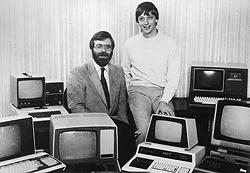
On June 25, 1981, Microsoft restructured from a two-man partnership into a privately held Washington state corporation, renamed Microsoft, Inc. Bill Gates (age 25) became president and chairman of the board. Paul Allen (age 28) became executive vice president. 19 The company had approximately 129 employees and had closed fiscal 1981 with revenue of $17.3 million. 19
The trigger for incorporation was a compensation crisis with a new hire. Steve Ballmer had joined Microsoft on June 11, 1980, as the company's 30th employee, dropping out of Stanford Business School at Gates' invitation. His deal included a base salary of roughly $50,000 and a clause giving him 10% of all profit growth he generated — a structure that had seemed reasonable for a small partnership but became untenable as Microsoft's revenues accelerated. 20 The profit-sharing clause needed to be bought out. The only currency that wouldn't immediately drain cash was equity.
Dave Marquardt, Microsoft's first venture capital investor, had already been pushing for incorporation: operating as a private partnership with two owners was unsustainable for a company growing at Microsoft's pace. 20 The incorporation converted the Gates-Allen partnership (Gates held 64%, Allen 36%, a split they had negotiated away from 50/50 in prior years) into a corporate structure. Gates and Allen retained roughly 84% combined. Ballmer received approximately 8% in exchange for the profit-sharing cancellation. The remaining 8% was distributed among other employees. 20 Allen objected to Ballmer receiving more than 5%. Gates resolved the deadlock by funding the excess out of his own stake. 20
Forty-eight days later — on August 12, 1981 — IBM shipped the PC with MS-DOS 1.0, the operating system licensing deal that was already in place before incorporation. 21 The corporate structure that was created on June 25 made the equity distribution from that deal — and every subsequent hire, investor conversation, and acquisition — possible. On March 13, 1986, Microsoft went public on Nasdaq at $21 per share, raising $61 million. 21 Gates became the world's youngest billionaire at 31. An estimated 12,000 Microsoft employees became millionaires from the stock options the corporate structure had made available to give them. 21
Bill Gates (left) and Paul Allen (right) on October 19, 1981, four months after Microsoft's incorporation and after signing a pivotal IBM contract
Gates and Allen in October 1981 — four months after the June 25 incorporation that converted their partnership into the equity structure behind one of the most consequential technology companies ever built. 21
Decision mirror. The Microsoft incorporation is a case of governance structure as a strategic asset, not administrative overhead. The partnership that Gates and Allen ran from 1975 to 1981 had no mechanism to compensate key hires in equity, no formal governance for investor relationships, and an individual profit-share clause that could have consumed the company's cash as revenues grew. The June 25 restructuring solved all three problems at once — and created the precondition for the 1986 IPO that multiplied everyone's stake by roughly 15x on the first day of trading. The decision to incorporate early, before it is operationally urgent, is almost always worth more than the legal and administrative friction it creates.

June 25 runs a structural thread across 114 years: in every case, the document signed on that date was not the final form of the thing it created. Smith's patent became Glidden's business became U.S. Steel. Roosevelt's FLSA covered one-fifth of the workforce at 25 cents per hour and was expanded eight times in the following decades. FDR's EO 8802 created an underfunded, deliberately weakened agency that nonetheless opened a chain of institutional precedents running to the Civil Rights Act of 1964. And Microsoft's June 25 incorporation was a legal technicality at the time — Gates was 25, the company had 129 employees — that became the structural prerequisite for the wealth created by the 1986 IPO. None of these decisions were complete on the day they were signed. All of them compounded.

이 콘텐츠를 둘러싼 관점이나 맥락을 계속 보강해 보세요.

  • 로그인하면 댓글을 작성할 수 있습니다.