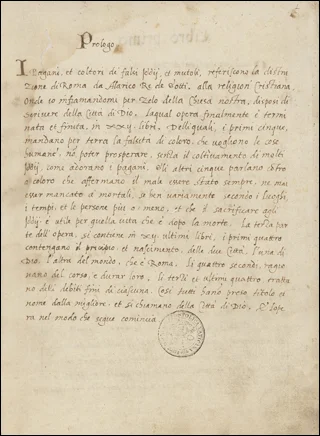
Augustine's City of God in Italian: a 16th-century reading copy opens at the Vatican
Vatican manuscript Ott.lat.2912 is a 16th-century Italian translation of Augustine's De Civitate Dei — 66 paper folios in plain humanistic cursive, with no illumination but with visible corrections and a scribe's marginal nota. The translation descends from the only known medieval Italian version, by Dominican friar Jacopo Passavanti (c. 1302–1357). The manuscript passed through Queen Christina of Sweden's Roman library before the Ottoboni family transferred it to the Vatican in 1748. Now freely readable on DigiVatLib as part of the Week 23 batch.

In the summer of AD 410, Alaric and his Visigoths sacked Rome. For the Roman world, it was the kind of event that demanded an explanation. The city that had stood for over a millennium, the city that had absorbed Christianity as its official religion a century earlier — it had fallen to a barbarian army. Pagans said the old gods had been abandoned in favor of an impotent new one. Someone needed to answer that charge.
Augustine of Hippo (354–430) spent thirteen years answering it. De Civitate Dei — The City of God — runs to twenty-two books and roughly 1,100 manuscript pages in Latin. 1 It dismantles the pagan argument methodically: the old gods had not protected Rome before Christianity either, and the true city worth protecting was not Rome but the civitas Dei, the community of those who live for God rather than for earthly power. The text finished around 426. It became one of the most copied works in the Latin West. 1
Now a 16th-century Italian translation — Vatican manuscript Ott.lat.2912 — is freely readable on DigiVatLib, released as part of the library's Week 23 batch around June 10, 2026. 2 It is 66 paper folios: plain, unilluminated, written in a flowing humanistic cursive. No gold. No miniatures. This was a reading copy, not a showpiece — and its journey to the Vatican shelves runs through one of the most famous private libraries in 17th-century Europe.
A thousand years of translation
Augustine wrote in Latin. For most of the medieval West, that was fine — Latin was the language of the church, the university, and the educated layman. But the 14th century changed things. Dante, Petrarch, and Boccaccio had demonstrated that Italian could carry weight. Vernacular piety grew. Readers who could not manage Augustine's dense Latin wanted access to his ideas.
The only medieval Italian translation known to survive is the one made by Jacopo Passavanti (c. 1302–1357), a Dominican friar in Florence. 3 Passavanti is better remembered today for his Specchio della vera penitenza (Mirror of True Penance), a vernacular penitential manual — but he also turned De Civitate Dei into Tuscan Italian, producing the translation that Ott.lat.2912 almost certainly copies. One earlier witness to Passavanti's version, a 319-folio codex now in the Bodmer Foundation in Cologny, survives from the early 15th century. 3 The Vatican copy, written a century later, shows the translation still circulating in humanist-era Italy. At 66 folios, it may represent a selection or condensed version rather than the complete twenty-two books — the full text fills many more pages.
What the prologue says
The scribe begins where Augustine began: with the sack of Rome.
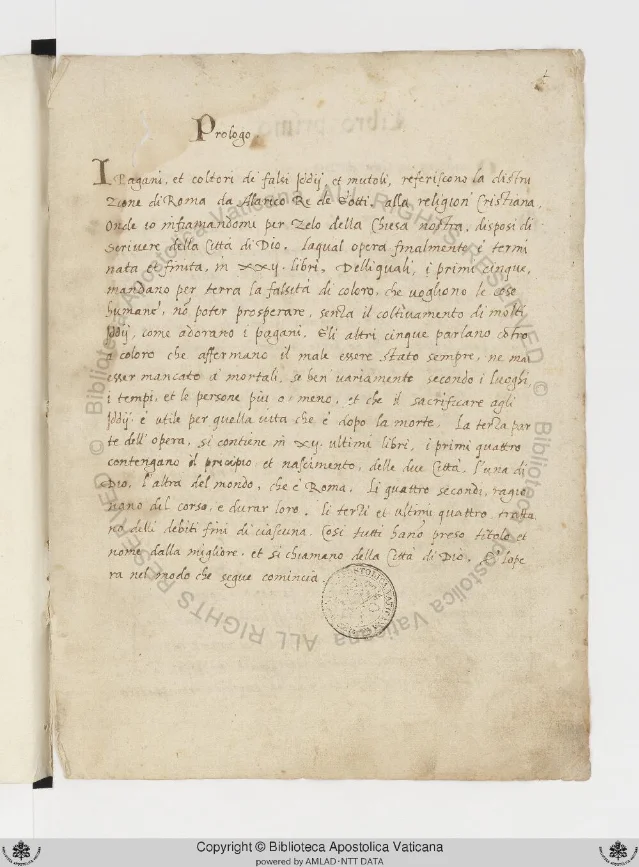
The incipit reads: "Prologo. I Pagani, et coltori de falsi Iddij, et mutoli, referiscono la distri-zione di Roma da Alarico Re de Gotti, alla religion Cristiana." 4 In plain English: The Pagans, and worshippers of false and mute gods, attribute the destruction of Rome by Alaric, King of the Goths, to the Christian religion.
The folio continues with the familiar Augustinian response: the work is divided into twenty-two books ("in xxij libri"), the first twelve attacking the pagan position, the final ten building the positive case for the City of God. The scribe's humanistic cursive is confident and readable — this is not a rough draft but a fair copy, produced with care even if without ornament.
The mid-book: demons, theater, and chapter headings
By folio 32v, the manuscript has moved deep into Book I's argument against Roman religion. Chapter 10 carries a centered heading: I Demonij accioche sia creduto loro, uogliono che le loro sceleratezze sièno recitate — "The demons, so that they may be believed, wish their wickednesses to be performed." A decorated initial L opens the chapter text.
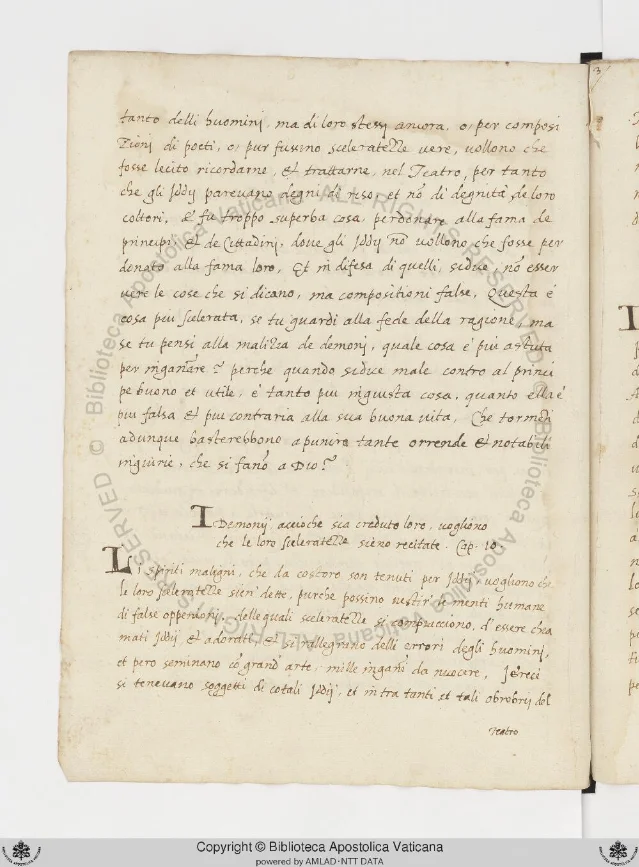
The marginal word Teatro at the bottom right is a reader's — or the scribe's own — nota, flagging the passage on theatrical performance. Augustine argues that Rome tolerated stage plays in which the gods were mocked and degraded; the theater itself was a symptom of religious corruption. The small annotation shows someone was reading actively, not just copying.
From a queen's library to the Vatican shelf
The DigiVatLib catalog lists a single bibliographic reference for Ott.lat.2912: Susanna Åkerman's Queen Christina of Sweden and her Circle (Brill, 1991). 2 That citation points to a specific provenance chain.
Queen Christina of Sweden (1626–1689) abdicated her throne in 1654, converted to Catholicism, and settled in Rome, bringing a vast manuscript collection with her. 5 She had studied the Church Fathers — Augustine among them — and her library reflected a systematic interest in patristic theology alongside classical texts and diplomatic intelligence. When she died in 1689, the collection passed to Cardinal Decio Azzolino, her close companion. Azzolino died shortly after and the books went to the Ottoboni family. In 1748, Pope Benedict XIV purchased the Ottoboni holdings for the Vatican; the roughly 3,000 manuscripts now carry the "Ott.lat." shelfmark. 6
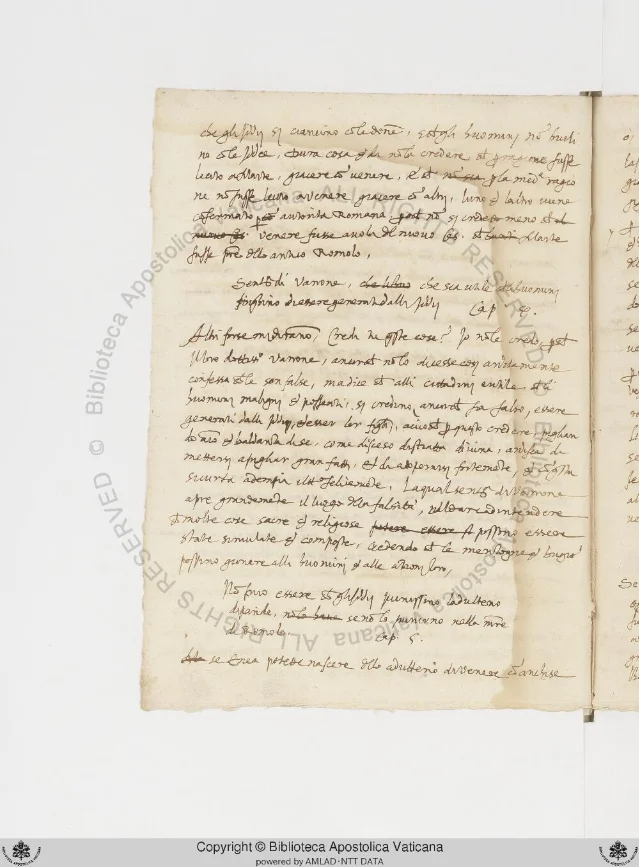
The folio 66v shown above — the manuscript's last page — carries the same compact, confident hand throughout. Corrections are visible in the text: a word crossed out, a replacement written above. Someone proofread this.
Now open on DigiVatLib
The full digitization runs to 150 canvases, covering 66 content folios plus binding images, three-edge views, a color checker, and a millimeter scale. 2 The manuscript is freely accessible as part of the Biblioteca Apostolica Vaticana's Week 23 batch.
The prologue begins on canvas 5 (folio 1r). The chapter headings in centered italic appear throughout — a consistent navigational feature the scribe maintained from beginning to end. There are no illustrations to hunt for, no illuminated borders to admire. What the manuscript offers instead is something rarer for a text this important: the experience of reading Augustine as a 16th-century Italian reader would have, in the vernacular, on paper, in an unadorned hand that trusted the words to carry the weight.
Cover image: manuscript cover of Vatican Ott.lat.2912, © Biblioteca Apostolica Vaticana — all rights reserved.
이 콘텐츠를 둘러싼 관점이나 맥락을 계속 보강해 보세요.