Cursor's playbook: $2B ARR with zero marketing

Cursor's playbook: $2B ARR with zero marketing

A deep-dive case study on Cursor (Anysphere), the AI-native code editor that grew from $4M to $2B ARR in 18 months — the fastest B2B SaaS scaling on record — with zero paid marketing and ~20 employees at the $100M ARR milestone. Breaks down its three-part growth engine: VS Code fork on-ramp + word-of-mouth acquisition, codebase RAG retention, and a 36% free-to-paid conversion rate. Closes with 5 concrete mechanics you can apply today.

Daily AI Product Growth Teardown
2026. 5. 28. · 01:11
구독 1개 · 콘텐츠 1개
One developer told r/cursor: "My code volume went up roughly 4×. My review queue went up 4×." 1 That tension — more output, more scrutiny, still can't stop using it — captures Cursor in a sentence.
Cursor (Anysphere Inc.), the AI-native code editor built by four MIT graduates, hit $2 billion in annual recurring revenue in February 2026. 2 It did this in roughly 18 months from a $4M baseline, with zero paid marketing and only about 20 employees when it crossed $100M ARR. No B2B software company has scaled this fast on record — ahead of Slack (7 years to $1B ARR), Zoom (5 years), Snowflake. 2
This piece tears open the three-part growth engine: how Cursor gets users, keeps them, and makes money — plus the real risks that complicate the story.

The scoreboard

차트를 불러오는 중…
Cursor's ARR growth, confirmed by official blog posts and Bloomberg reporting. Sacra estimates $3B ARR as of April 2026. 3
The valuation followed the same trajectory: $400M Series A (August 2024) → $2.6B Series B (January 2025) → $9.9B Series C (June 2025) → $29.3B Series D (November 2025) → ~$50B in the current round. 4 A SpaceX acquisition option at $60B, announced April 2026, sets a possible ceiling. 5
As of early 2026: 1M+ paying customers, 50,000+ engineering teams, and 70% of Fortune 1000 as customers — including NVIDIA, Uber, Adobe, Salesforce, OpenAI, Shopify, and Spotify. 6

Acquisition: the VS Code on-ramp and the word-of-mouth machine

Cursor is a fork of VS Code, the editor used by most of the world's professional developers. That single architectural decision did more for acquisition than any marketing budget could.
When a new user installs Cursor, it offers to import all existing VS Code extensions, themes, and key bindings automatically. The friction of switching from VS Code to Cursor is close to zero — developers describe it not as moving to a new tool but as "opening a smarter version of what I already use." 7
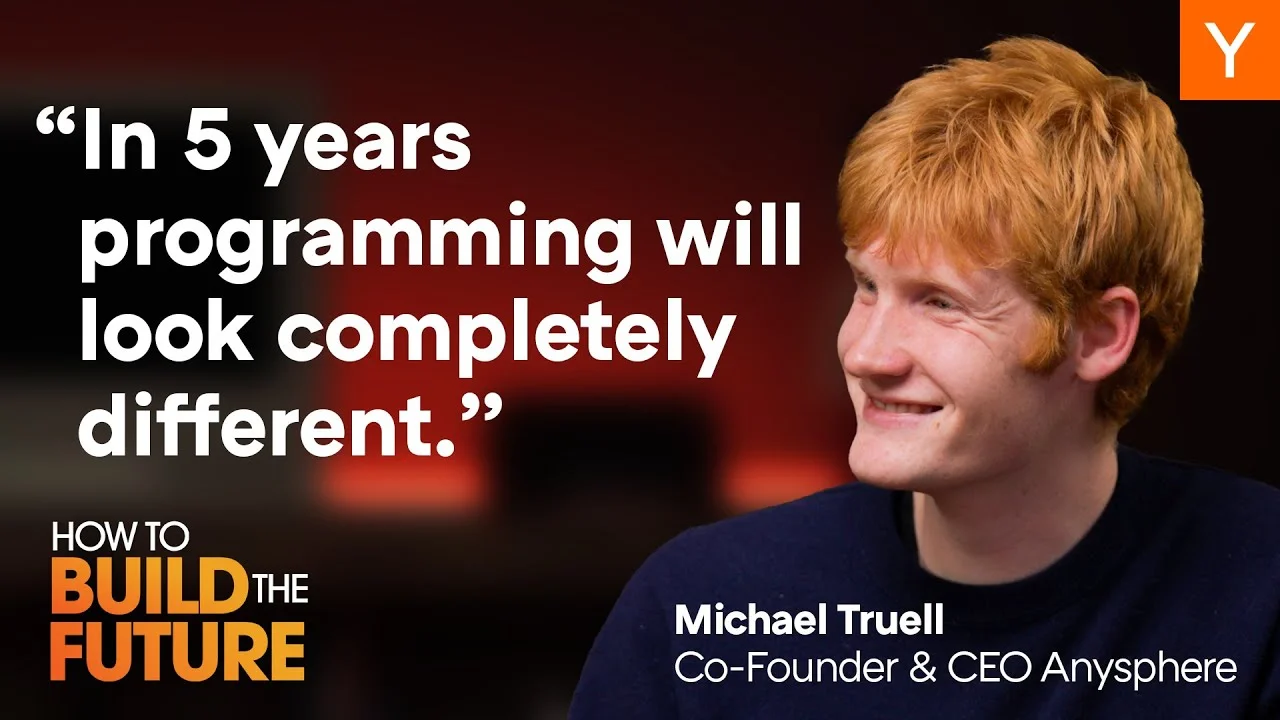
That matters because the typical alternative — building as a VS Code plugin — would have constrained what the product could do. As co-founder Michael Truell explained on the Lex Fridman Podcast: "You're very limited in the control you have over a code editor if you're a plugin to an existing coding environment and we didn't want to get locked in by those limitations. We wanted to be able to just build the most useful stuff." 8
The acquisition engine then ran on three overlapping layers:
Word of mouth from day one. In 2023, the team "lived like monks" — Truell's phrase — focused entirely on the product with almost no marketing. 9 A 2024 Bloomberg headline captured the result: "Despite not having spent a single dollar on marketing, it's become one of the fastest-growing startups of all time." Developers at OpenAI adopted it, then colleagues at Stripe, Instacart, and Shopify did the same. By April 2025, Cursor had a million total users with zero marketing spend, and Cursor President Oskar Schulz could say simply: "It just makes a thing that you do every day better and faster." 6
Community as a distribution channel. Cursor's official forum has 28,000+ registered users. The r/cursor subreddit — user-created, not company-managed — has 28,000 members, with dozens of new posts daily covering everything from project showcases to troubleshooting to comparisons with competing tools. 10 Cursor's X (Twitter) account has 382,000 followers; the single-platform strategy — X only, no Instagram, no LinkedIn — is deliberate. Product announcement posts routinely reach hundreds of thousands of views; the May 2026 SpaceXAI training announcement hit 1.16 million views.
Beyond official channels: third-party YouTube tutorials for Cursor have reached tens of millions of views cumulatively, and the Lex Fridman Podcast episode featuring all four co-founders drew approximately 1 million views. These are acquisition channels Cursor never paid for.
Viral loops from unexpected moments. A tweet showing an 8-year-old using Cursor to build a game generated significant attention in 2024. 10 Amazon CEO Andy Jassy named Cursor as a key driver of the "coding agents explosion" in an earnings call. Google CEO Sundar Pichai was publicly noted as using it for vibe coding. These organic endorsements — each from a different segment of the developer and executive world — amplified reach without spend.

Retention: why developers say they "can't go back"

SaaStr's Jason Lemkin put it bluntly: "Developers who try it can't go back to regular VS Code. That's the bar now." 11
Cursor's retention mechanics aren't mysterious — they're deliberate design choices that compound over time.
60-second time-to-value. The onboarding is engineered to deliver a "wow" moment within the first minute: users can immediately use Tab autocomplete or the Agent without any setup or configuration. There is no learning curve because Cursor inherits VS Code's muscle memory. 11
Four habit-forming features. Cursor's stickiness comes from a layered feature stack, each engaging different frequencies of a developer's workflow:
  • Tab autocomplete: Predicts what you're about to type, including multi-line edits, at under 150ms. After a Fusion update in January 2025, difficult edit prediction accuracy improved by 25%+. Cursor generates over a billion edit characters per day. 12
  • Inline Edit (Cmd+K): Select any block of code and transform it with a natural language instruction, in place.
  • Agent Mode: An autonomous workflow where Cursor breaks a task into subtasks, executes them sequentially, auto-fixes lint errors, and creates checkpoints for rollback.
  • Composer: Cursor's proprietary model, released October 2025, trained on over a billion lines of daily code data. It runs 4× faster than frontier models for typical coding tasks. 13 Developers who adopted Composer 2.5 Fast report flipping their usage from "90% Claude, 10% Composer" to the reverse. 14
Codebase context as a switching cost. Cursor indexes the entire repository using a Merkle-tree change tracker (a file-difference system that only re-uploads what changed) and vector search. The more a team uses it, the better it understands project structure, naming conventions, and dependencies. That understanding is not portable — switching to another tool means starting that accumulation over. Shane Chang, a full-stack engineer who reviewed both Cursor and Windsurf, described it as: "It's like having a colleague who's memorized your entire codebase." 15
Model freedom as a moat. Cursor doesn't lock users to a single AI provider. At last count, it offered 33 model choices, including Claude, GPT-4o, Gemini, and its own Composer. For developers worried about vendor lock-in — a growing concern as AI model providers enter the coding tool market directly — this is a meaningful differentiator.
The churn signals are real, too. The top complaints on r/cursor in May 2026: pricing opacity (users unsure what a session will cost), "quietly wrong" AI errors that erode confidence, and a 2025 security incident where an AI support bot hallucinated a "new single-device policy" to explain a login bug, which was reported by Ars Technica and discussed on Hacker News. 13 These are retention liabilities, not peripheral noise.

Monetization: the model that built $2B ARR — and its hidden cost

통계 카드를 불러오는 중…
Cursor runs a six-tier pricing model: 16
PlanPriceBest for
HobbyFreeTrial / occasional use
Pro$20/monthIndividual developers
Business$40/seat/monthTeams with admin controls
Ultra$200/monthHeavy power users
Enterprise~$61K median ACVFormal IT procurement
API (Composer SDK)Pay-per-useBuilders on Cursor's stack
The standout number: 36% of free users convert to paid, compared to a 2–5% industry average for developer tools. 11 That conversion rate is downstream of the 60-second time-to-value — if the product delivers a real "aha moment" immediately, free-to-paid friction drops.
The enterprise path is equally distinctive. Cursor initially resisted enterprise sales — at one point removing all contact information from the website. The enterprise tier came not from an outbound push but from inbound demand: between 4,000 and 5,000 companies reached out to request enterprise access in February 2025 alone. 13 Digital Applied describes the adoption pattern as a three-phase sequence: individual developers adopt on personal subscriptions → team-wide usage grows organically → IT procurement formalizes the contract. Net Dollar Retention (NDR — how much revenue expands from existing customers, where >100% means expansion outpaces churn) above 160% means teams consistently expand usage after their first enterprise contract.
Revenue structure shifted rapidly: enterprise revenue was roughly 25% of ARR at end of 2024, around 45% by November 2025, and approximately 60% by March 2026 — though Forbes, citing an internal document it reviewed, noted that as of November 2025, only 13.6% of ARR came from formal enterprise contracts (vs. the broader "businesses" category that includes Teams subscriptions). 17 The two numbers measure different things and are not in conflict — they point to a large middle tier of business users not yet on formal enterprise agreements.
The economics problem. Cursor's growth numbers are real. Its profitability is not. AI inference — paying Anthropic and OpenAI per API token to power features — consumes an estimated 100% of revenue, producing a net loss of approximately $150 million per year. 18 That figure is unconfirmed (Cursor does not publicly disclose financials), but it is consistent with the scale of Cursor's API usage and Anthropic's known pricing.
The path to margin is Composer — Cursor's proprietary model. If Cursor can serve most requests through its own model rather than paying Anthropic or OpenAI, gross margin improves substantially. The company's January 2026 "War Time" all-hands meeting — convened after employees noticed Claude's coding quality had surpassed Cursor's native experience — named "build the best coding model" as P0 priority #1. 17

The competitive picture: what "war time" actually means

Cursor fundraising at ~$50B valuation — the fastest-growing AI developer tool
Cursor at ~$50B: from zero marketing to the most-contested position in developer tooling. 2
Cursor's strongest competitor is not GitHub Copilot (Copilot has 4.7 million paid subscribers and 42% market share by user count 19 but only 9% developer satisfaction vs Cursor's 19% 3). The real threat is Claude Code — a terminal-native coding agent from Anthropic (the AI safety company behind the Claude model family), launched May 2025 — which by April 2026 had reportedly reached $2.5 billion in annualized revenue, surpassing Cursor's $2 billion. 17
Claude Code operates differently from Cursor: it runs in the terminal, not in an IDE, which means it competes for a different moment in the workflow. But at $200/month, Anthropic is reportedly spending up to $5,000 in compute per subscriber — a level of subsidy that lets Claude Code undercut on raw capability at an unsustainable cost. 17 That's not a durable competitive dynamic; it's a land-grab.
The more structural signal: in February 2026, Valon, a mortgage startup, had its 90+ engineers collectively cancel Cursor subscriptions and move to Claude Code. Ramp's transaction data showed a small but real decline in enterprise adoption of Cursor in the same period. Insight Partners co-founder Jerry Murdock, speaking on the 20VC podcast, said his portfolio companies' view was that "Cursor is obsolete today."
IdeaPlan offered the counter-argument: "the assumption that one tool wins the developer is dead." 19 Seventy percent of engineers already use 2–4 AI tools simultaneously. The dominant pattern in the market is Cursor for editing + Claude Code for complex autonomous tasks — not either/or.
The SpaceX $60B acquisition option, announced April 21, 2026, sits in this context. SpaceX gains a coding tool for its xAI division; Cursor gains compute from the Colossus supercomputer (already used for Composer training) and a strategic narrative heading into SpaceX's planned Nasdaq IPO. 5 Whether the option is exercised matters less than the signal: the market values Cursor's developer distribution, not just its current revenue.

5 mechanics builders can actually steal

These are operational-level observations from Cursor's growth, with clear trigger conditions and expected outcomes. They are not universal — Cursor's context (VS Code ecosystem, developer audience, AI tailwind) made these particularly effective. Where evidence is thin, that's noted.
1. Use an existing tool's install base as your distribution channel.
What: Build your product as a fork or migration path from the category leader rather than starting from scratch. How: Identify the one-click import that lets users bring their existing setup. Make the first experience look and feel identical to what they already know. Trigger: You have a meaningfully better product in a category where the incumbent has high user familiarity (settings, extensions, shortcuts). Indicator: Day-1 retention above 40% within the first week (users don't need to re-learn anything, so churn from friction disappears).
2. Design for a 60-second "aha moment" before any gate.
What: The free experience must deliver the core value proposition before asking for signup, email, or payment. How: Map the product's single strongest moment (Cursor's: seeing Tab autocomplete predict exactly what you were about to write) and remove every step between new user and that moment. Trigger: Your free-to-paid conversion is below 5% in a developer tool category — almost always a sign that users leave before experiencing the product's best feature. Indicator: If conversion rate moves from 2–5% toward 20%+, the product is reaching users before friction erodes intent.
3. Let community do the support and distribution work.
What: Invest in a forum or Discord that becomes the primary place users go with questions — not your support team. How: Seed it with responsive founders early. Structure it to reward contributions (upvotes, featured posts). Accept that some discussions will be critical; suppress nothing. Trigger: Your support ticket volume is growing faster than your team can absorb. Indicator: Forum-driven referrals; users citing community as a reason they stay in NPS surveys.
4. Let individual users pre-sell your enterprise deals.
What: Don't build a sales team until inbound demand forces you to. How: Make the individual and team tiers work well enough that developers adopt personally, bring colleagues in, and eventually ask IT to formalize the contract. Trigger: Noticing that enterprise inquiries are coming from companies whose individual employees are already paying users — the bottom-up signal has fired. Indicator: Net Dollar Retention above 120% (teams expand usage after initial contract). Cursor's reported NDR is above 160%.
5. Own a specific model architecture bet, even if it's risky.
What: Don't just route user queries to the best available LLM. Build proprietary components for the specific tasks your product does most often. How: Identify the one inference task that dominates your token spend and is poorly served by general-purpose models (for Cursor: generating accurate code diffs). Train a smaller, faster, domain-specific model for that task. Trigger: Your gross margin is deeply negative because of inference costs, and a large fraction of those costs serve repetitive, formulaic tasks. Indicator: Margin improvement and latency reduction. Cursor's Composer model runs 4× faster than frontier alternatives on comparable tasks.

Cursor's growth from $4M to $2B ARR is genuinely remarkable. Its economic model — inference costs that consume all revenue — is not yet resolved. Both things are true. For builders, the honest lesson is that Cursor's acquisition and retention mechanics are replicable; its "grow first, figure out margin later" bet requires either a Composer-style model ownership path or a strategic exit. The SpaceX option suggests at least one buyer agrees the distribution is worth more than the P&L.

이 콘텐츠를 둘러싼 관점이나 맥락을 계속 보강해 보세요.

  • 로그인하면 댓글을 작성할 수 있습니다.