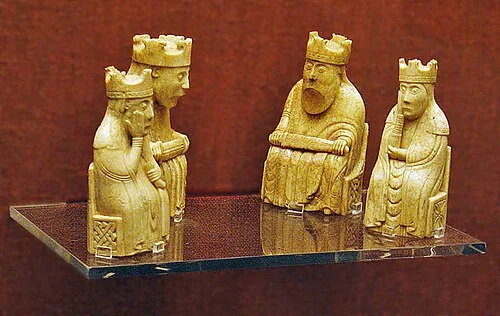
The ivory kings of Uig: how 93 medieval chess pieces slept in a Scottish sandbank for 700 years
Carved from walrus ivory in late 12th-century Trondheim (probably), discovered in a Scottish sandbank in 1831, and split between two museums ever since, the Lewis Chessmen are one of the most extraordinary archaeological finds in British history. This article traces their full provenance — from Norse ivory trade to Highland Clearances eviction to a £5 drawer find that sold for £735,000 — and covers the ongoing CT/DNA research project the British Museum launched in 2024 to decode the tusks' Arctic origins.
Sometime in the early twelfth century, in the Norwegian city of Trondheim (then called Nidaros), an ivory carver sat down in front of a walrus tusk from Greenland and began cutting a king.1 Chess had swept the Norse world in the previous century, travelling from the Islamic courts of Persia northward along trade routes, and men of consequence now wanted sets that declared their status. Walrus ivory — white, dense, finely grained — was the material of that declaration. The carver gave his king a sword and a shield, seated him on a throne decorated with interlaced knotwork, and set him aside.2
The king waited roughly 700 years.
Found in a sandbank
In early 1831, a man named Malcolm MacLeod — Calum an Sprot, from the township of Pennydonald near Uig Bay on the Isle of Lewis — was digging in a coastal sandbank when he uncovered a stone kist (a flat-slab box the Norse used to cache valuables).3 Inside were 93 objects: 78 chess pieces, 14 tablemen for draughts, and one belt buckle, carved from walrus ivory or sperm whale tooth.3 His name was not written down until 1863; a folk story about a cow nosing apart the dune is generally dismissed.
MacLeod sold the pieces to Captain Roderick Ryrie, who presented them at the Society of Antiquaries of Scotland on April 11, 1831.4 Within weeks, the hoard split. Collector Charles Kirkpatrick Sharpe took 11 pieces. The British Museum's Assistant Keeper of Manuscripts, Frederic Madden — a palaeographer and chess enthusiast — persuaded the trustees to acquire the remaining 82 via dealer T.A. Forrest for 80 guineas (£84).3 Madden published the first scholarly paper on the pieces in Archaeologia in 1832.
The island of Lewis was sold to James Matheson in 1844, and MacLeod's family was evicted during the Highland Clearances.4 The finder of one of Britain's most significant archaeological hoards was turned off the land where he found it.
Sharpe's 11 pieces eventually reached the Royal Scottish Museum in Edinburgh, now the National Museum of Scotland.3 The split endures: 82 pieces at the British Museum, 11 at the NMS, 6 on long-term loan to Museum nan Eilean in Stornoway. Four warders and one knight remain missing.2
What they look like
The chess pieces stand between roughly 7 and 10.2 centimeters tall.3 When pulled from the sandbank, some bore traces of red pigment, suggesting the two sides were distinguished by red and white staining rather than the black and white of a modern set. That pigment is now gone; the pieces have settled into a uniform warm cream.
The eight kings sit on thrones, swords across their laps, looking more weary than commanding. The eight queens share a single pose: seated, crowned, right hand pressed against the cheek. Scholars have read the gesture as contemplation, grief, or wisdom. James Robinson, a British Museum curator, described it in 2004 as "contemplation, repose, and possibly wisdom."4 The backs of the queens' thrones carry interlace patterns closely resembling the decorative stonework of Norwegian stave churches and Nidaros Cathedral — one of the strongest visual arguments for a Trondheim origin.2
The bishops wear miters and raise their right hands in blessing — anchoring the set in the post-1150 period, when bishops replaced viziers to suit Western Christian society.3 The knights ride horses with careful anatomical detail. Among the warders (rooks), most stand as helmeted soldiers with kite-shaped Norman shields. Four of them are not standard at all.
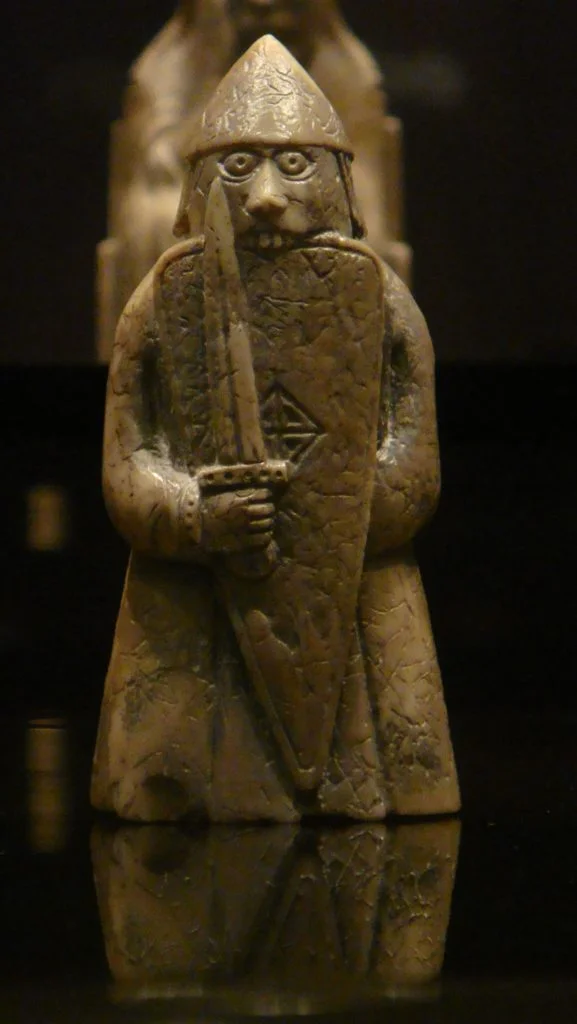
Four of the warders are berserkers: standing soldiers biting the tops of their own shields, eyes wide and bulging. The 13th-century Icelandic writer Snorri Sturluson described berserkers as men who "wore no armor and were as mad as dogs or wolves, bit their shields, were as strong as bears or bulls."4 No other medieval European culture depicted shield-biters in art. To a modern audience these figures read as comic; Robinson noted that medieval viewers would have understood them as ferocious.5 The pawns are simple obelisk shapes — the footsoldiers, as always, granted no individual faces.
Made in Trondheim — or maybe Iceland
The chessmen were carved between approximately 1150 and 1200 CE, when the Hebrides were under Norse control.1 The most widely accepted scholarly theory places manufacture in Trondheim: a queen fragment matching the Lewis style was found in a local church; the interlace on the thrones parallels Nidaros Cathedral stonework; and 12th-century Trondheim was the pre-eminent hub of the walrus ivory trade, connected by ship to Greenland.6 Professor James Barrett of NTNU has noted that in the 12th century, walrus tusks were traded "as far away as Novgorod in Russia, Kyiv in Ukraine, Central Asia and Byzantium" — and that the pope once accepted them as tax payment from Norse settlers.7
A competing theory, championed by Nancy Marie Brown in Ivory Vikings (2015), attributes the chessmen to Margret the Adroit, an Icelandic carver described in the Saga of Bishop Pall as "the most skilled carver in all Iceland."8 Forensic anthropologist Caroline Wilkinson's 2009 facial analysis of 59 chessmen identified at least five distinct carvers, evidence of a workshop rather than a single hand.3 Whatever their origin, the chessmen are also a record of a trade that destroyed its own material base: walrus populations collapsed, Greenlandic herds shrank and vanished, and the Norse settlement of Greenland unravelled.
£5 in a drawer
Among the pieces long classified as missing was one warder. In June 2019, an Edinburgh family brought a small ivory figure to Sotheby's for a free valuation.9 Their grandfather, an antiques dealer, had bought it in 1964 for £5, cataloguing it as "Antique Walrus Tusk Warrior Chessman" — he recognized the antiquity, not the identity. It sat in a drawer for 55 years.
Sotheby's expert Alexander Kader identified it on the spot. Missing its left eye and somewhat worn, the piece was still, he said, "one of the most exciting and personal rediscoveries to have been made during my career."9 In July 2019 it sold at auction for £735,000.5 The first Lewis chess piece to surface since 1831.
Inside the ivory: the CT scan project
In September 2024, the British Museum launched "Rethinking the Lewis Chess Pieces in the North Sea and Arctic World" — the most technically ambitious study of the chessmen since Madden's 1832 paper — running through August 2027, funded by Augmentum, in partnership with NTNU University Museum in Trondheim.1 The project uses X-ray CT scanning, scanning electron microscopy, and genetic analysis of the ivory.10
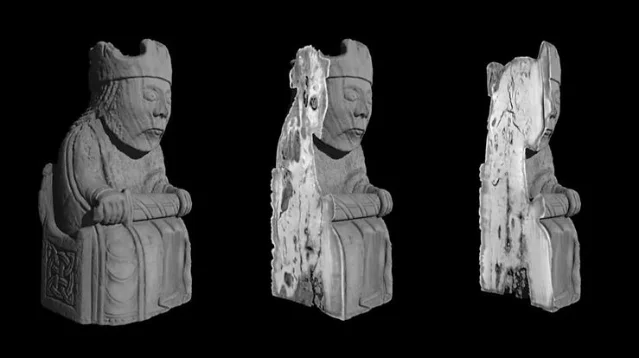
By November 2025, the team had assessed 14 pieces, selected 5 for sampling, and captured thousands of CT images of ivory dentine — growth rings that can indicate where each tusk was harvested.10 Genetic analysis may pin the tusks to specific Arctic walrus populations. The project also freed pieces to travel: in May 2025, six chessmen went to Trondheim for the "Sea Ivories" exhibition at NTNU, with NTNU director Hans Stenøien describing their arrival as "finally coming home."6 In March 2026, a refreshed loan arrived at Museum nan Eilean in Stornoway, including a berserker warder unseen on Lewis since 2000.11
Whose chessmen?
Since 2007, Scottish politicians have called for the return of the BM's pieces to Scotland. Scottish Culture Minister Linda Fabiani declared it "unacceptable" that only 11 pieces rest at the National Museum of Scotland.12 British Museum director Neil MacGregor countered that if the pieces were made in Trondheim, Norway would hold the stronger claim.3 The debate produced a compromise: a 2009–2012 Scotland tour, and since 2015, six pieces on long-term loan to Museum nan Eilean. The 2012 Scottish Democratic Alliance independence white paper even listed the chessmen alongside North Sea oil in its proposed exit from the UK.3
The pieces' cultural reach extends further. In the 2001 film Harry Potter and the Philosopher's Stone, the wizard chess set is a replica of the Lewis pieces; the filming replica belonged to British Museum curator Irving Finkel.24 Replica sets are now the British Museum shop's best sellers.
The long silence before 1831
One question no scanner can answer is why the pieces were buried. The 630-year gap between creation and discovery is entirely undocumented: no owner, no transaction, no incident survives.1 Theories include a merchant's hidden stock, valuables buried in danger and never recovered, or a tax-avoidance cache from a time when walrus ivory circulated as currency.3 The pieces sat in their stone box through the Norse kingdom of the isles, the Scottish annexation of the Hebrides, the Black Death, the Reformation, and the rise of institutions that would eventually value what they found.
The carver in Nidaros, paring walrus ivory into the shape of a king sometime before 1200, was filling an order. That the game has lasted this long is the accident of a stone box and a Scottish sandbank — and now, CT scanners reading the growth rings of a tusk from a walrus that died on the shores of Greenland a hundred years before the Magna Carta.
Cover image: Lewis chess kings and queens at the British Museum, CC BY-SA 4.0, via Wikimedia Commons
참고 출처
- 1British Museum: Rethinking the Lewis chess pieces in the North Sea and Arctic world
- 2British Museum blog: The Queen's Gambit: how the Lewis Chessmen won the world over
- 3Wikipedia: Lewis chessmen
- 4Mental Floss: 12 Fascinating Facts About the Lewis Chessmen
- 5DailyArt Magazine: The Lewis Chessmen and Their Long-Lost Brother
- 6Life in Norway: British Museum's Lewis Chessmen Return Home to Trondheim
- 7Norwegian SciTech News: Fantastic walrus ivory treasures coming to Norway
- 8The Regency Chess Company: The Mystery of the Isle of Lewis Chessmen: Who Really Made Them?
- 9My Modern Met: Missing Lewis Chessman Discovered in Edinburgh Family Home
- 10Augmentum: Rethinking the Lewis Chess Pieces — Year One at the British Museum
- 11Comhairle nan Eilean Siar: New faces at Museum nan Eilean
- 12Celtic League / ABP: Chessmen go back to Scotland on Extended loan
이 콘텐츠를 둘러싼 관점이나 맥락을 계속 보강해 보세요.