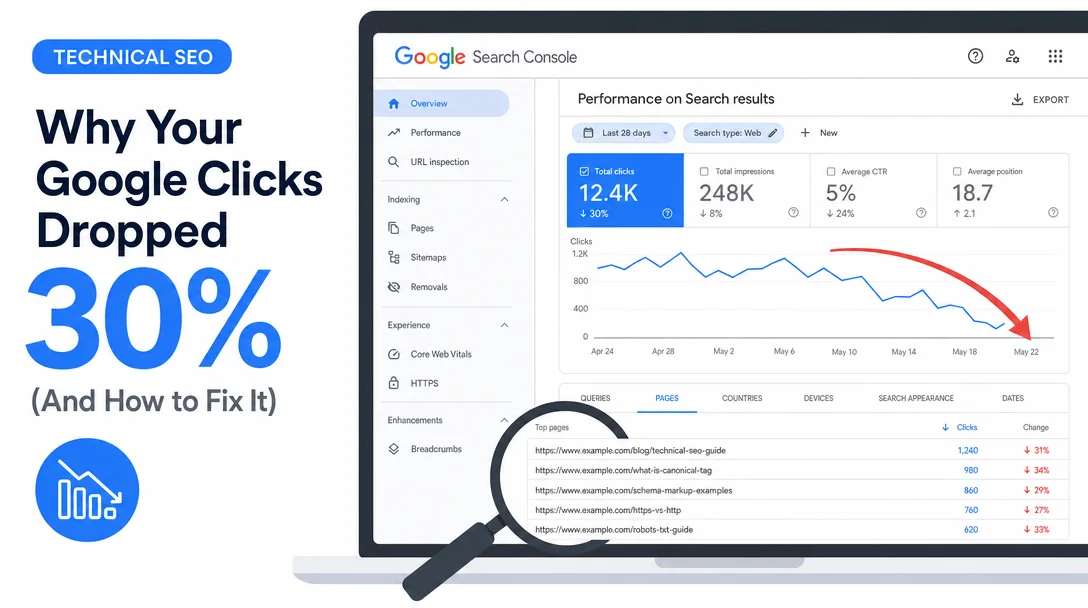
Week 1: Pull your GSC drop list before rankings stabilize
The May 2026 Google core update is mid-rollout. The single most actionable step for indie devs right now: build a drop list in Search Console using the 30% click-decline threshold — before the pre/post baseline becomes impossible to reconstruct.

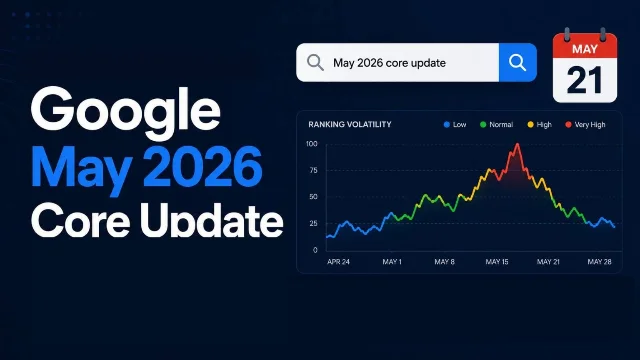
Google's May 2026 core update started rolling out on May 21 and is expected to run for up to two weeks. 1 If you saw a traffic dip this week — even a small one — the single most actionable thing you can do right now takes about 20 minutes in Search Console and costs nothing.
The pitfall: waiting until rankings "settle" before diagnosing
The instinct to wait makes sense. Rankings oscillate during a rollout, so why act on noisy data? The problem is that the window for meaningful corrective action is actually during the rollout, not after. Google's systems are still reweighting signals while the update propagates — improvements made now may be factored in before the rollout completes, rather than waiting for the next named update (which may arrive as few as six weeks later). 2
The other problem with waiting: pre-rollout volatility for this update spiked on May 13–14, a full eight days before the official May 21 start date. If you only look at post-announcement data, you'll miss pages that were already demoted in the pre-rollout test wave. 2
콘텐츠 카드를 불러오는 중…
The fix: build your drop list in Search Console today
Here's the exact workflow. It's blunt, fast, and gives you a ranked repair queue.
Step 1: Set your baseline date range. Open Search Console → Performance → Search results. Set the date range to the 7 days before May 14 (the pre-rollout spike). Export it. This is your clean pre-update reference — GSC data lags 48–72 hours, so taking this snapshot now before further drift is important. 2
Step 2: Switch to the post-update window. Set the comparison window to May 14–21. In the Pages tab, sort by clicks, toggle the comparison view, and export every URL showing greater than 30% click decline. That 30% threshold is the standard recovery-priority cutoff — below it, you're likely looking at normal rollout noise. Aim for a list of 50–150 URLs; if you're an indie dev with a smaller site, even 10–20 URLs is a useful queue.
Step 3: Tag each URL by issue type before you write a single word of new content. Assign one primary tag to each page:
| Tag | What it means |
|---|---|
| Thin content | Under 500 words, low information gain |
| Duplicate / near-duplicate | Canonicalization issue, overlapping topics |
| Outdated | Data or guidance more than 18 months old |
| Scaled content | Programmatically generated, no editorial review |
| Weak E-E-A-T | No named author, no primary-source citations, no first-hand evidence |
This tagging step is what most people skip. Without it, you end up rewriting whichever page feels most important rather than addressing the highest-concentration issue type. Data from the March 2026 core update analysis — covering 2,076 domains — showed that E-E-A-T issues drove the highest proportion of drops, followed by thin and outdated content. Fix E-E-A-T pages first. 2
One important caveat
Don't start rewriting pages during active rollout. The drop list you build today tells you what to fix — but if you're running a solo project, stagger the rewrites to start after the rollout completes around June 4. Rankings are unstable until then, and making structural changes to pages mid-volatility makes it harder to read whether a change helped or hurt. 1
The 20 minutes you spend pulling this list today is the only window you have to capture a clean pre/post snapshot. Once the rollout completes and you want to diagnose which pages recovered and which didn't, you'll need exactly this baseline. Building it now takes five minutes. Rebuilding it from scratch after the fact is impossible.
Next week: once your drop list is tagged, the highest-ROI fix for weak E-E-A-T pages — and it's not adding a byline to a thin post.
이 콘텐츠를 둘러싼 관점이나 맥락을 계속 보강해 보세요.