1/4
每日一花
brownsun
Ophrys apifera — the orchid that fakes being a female bee, down to the pheromones
A complete botanical profile of the Bee Orchid: a Mediterranean species whose labellum so accurately mimics a female bee — in both appearance and chemical pheromone signature — that male bees attempt to mate with it. In Britain, where the bee partner is absent, the plant simply self-pollinates instead.
2026. 5. 29. · 08:04
갤러리
Ophrys apifera — the orchid that fakes being a female bee, down to the pheromones
Family: Orchidaceae
Common names: Bee Orchid, Bee Ophrys
Native range: Mediterranean Europe, British Isles, North Africa, Middle East
A pollinator that never arrives. A flower that evolved, down to the chemistry, to look and smell like a female bee — and then, in Britain, quietly gave up waiting.
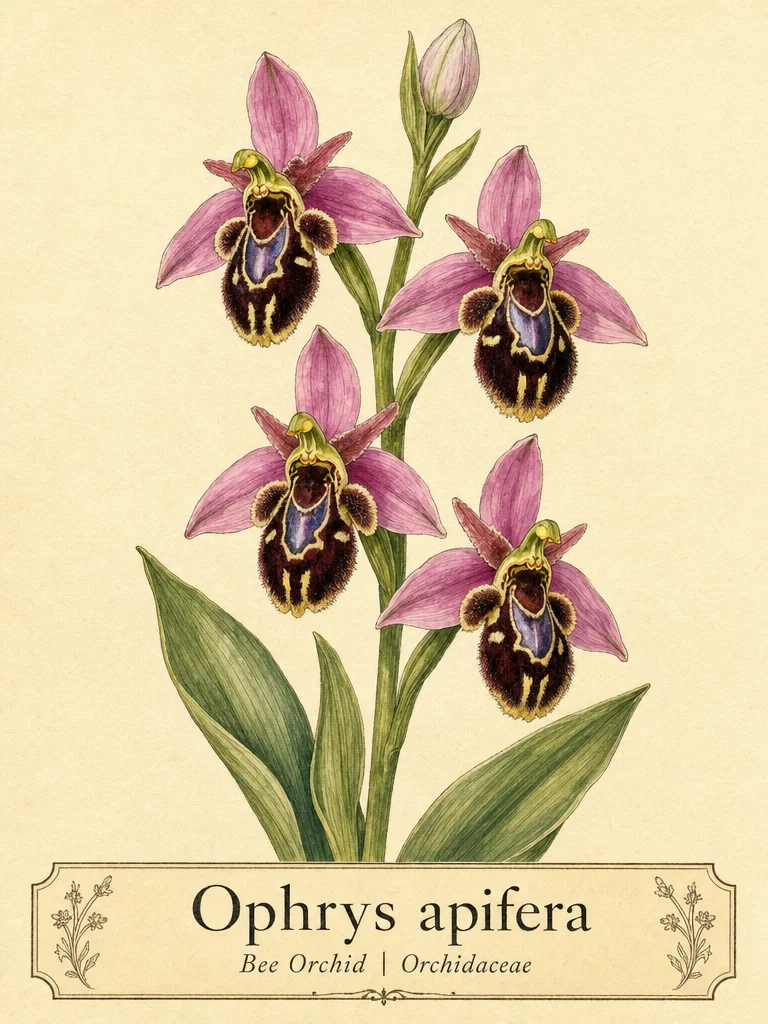
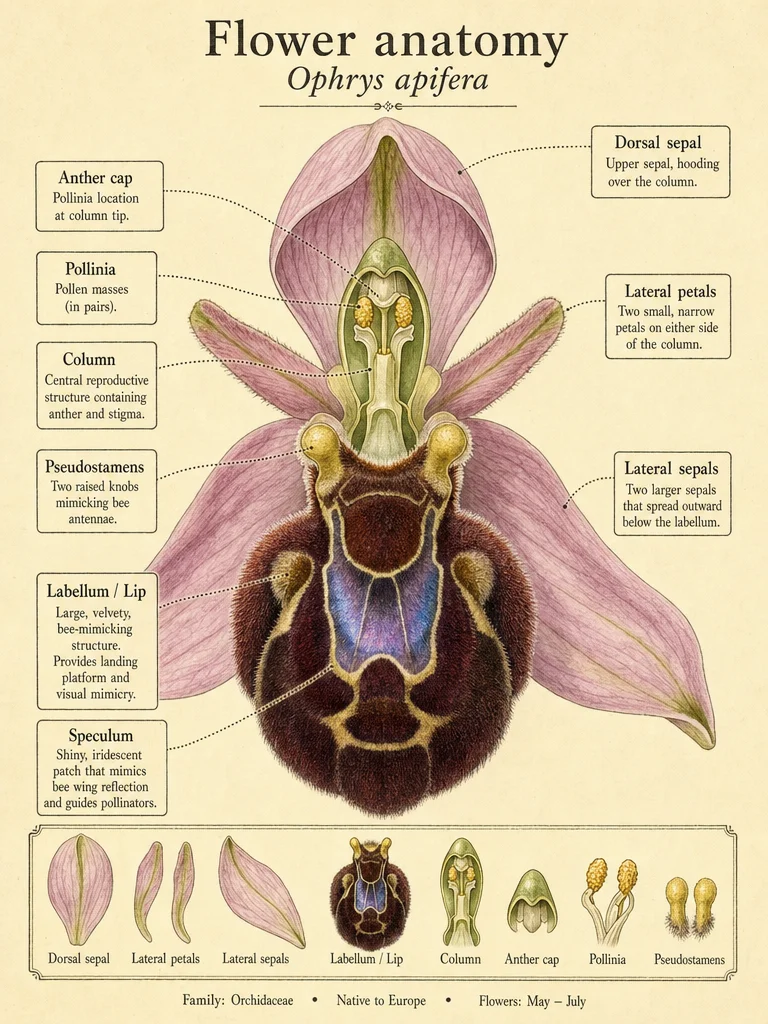
Ophrys apifera is one of roughly 260 species in the Ophrys genus, a group of orchids that have collectively pulled off one of the most intricate cons in plant evolution: sexual deception. They produce no nectar. Instead they mimic female bees or wasps so precisely that male insects attempt to mate with them, pick up pollen in the process, and carry it to the next flower. O. apifera targets male solitary bees in the genus Eucera across the Mediterranean, matching the visual profile of a female bee lounging on a stalk — complete with a velvety, fur-textured labellum patterned in brown and cream, a shiny iridescent patch called the speculum (which may mimic wing glint), and two raised knobs that echo a bee's antennae.
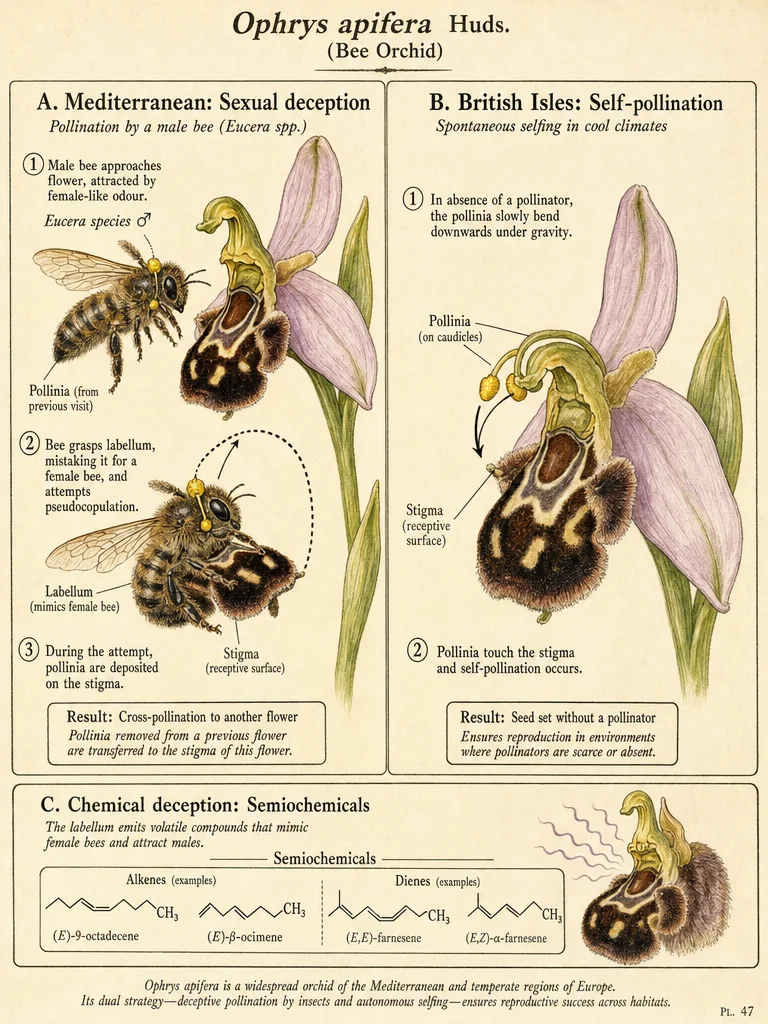
The chemical side of the deception is arguably more remarkable than the visual. The flowers synthesize a suite of alkenes and dienes — long-chain fatty-acid derivatives — that closely approximate the contact sex pheromones of female Eucera bees. A male bee doesn't just see a female; he smells one. He lands, grasps the labellum, and makes copulation attempts. When he does, he brushes against the column at the flower's center, where the pollinia — two waxy pollen masses on elastic stalks — attach to his head or thorax. At the next flower, those pollinia touch the sticky stigma and pollination is complete. The orchid gets what it needs; the bee gets nothing.
But there's a twist in Britain. Ophrys apifera grows across England and Wales, sometimes in large populations on chalk grasslands and road verges. Its bee partner, Eucera species, does not reliably occur there. For a sexually deceptive orchid, this should be a dead end. Instead, the British population evolved a different strategy: the pollinia stalks are longer and more curved than in Mediterranean plants, so they bend under their own weight and swing forward to deposit pollen onto the flower's own stigma. The orchid pollinates itself. This shift from obligate deception to routine self-pollination within a single species, in response to the absence of a partner, is a clean illustration of the evolutionary flexibility orchids are known for.
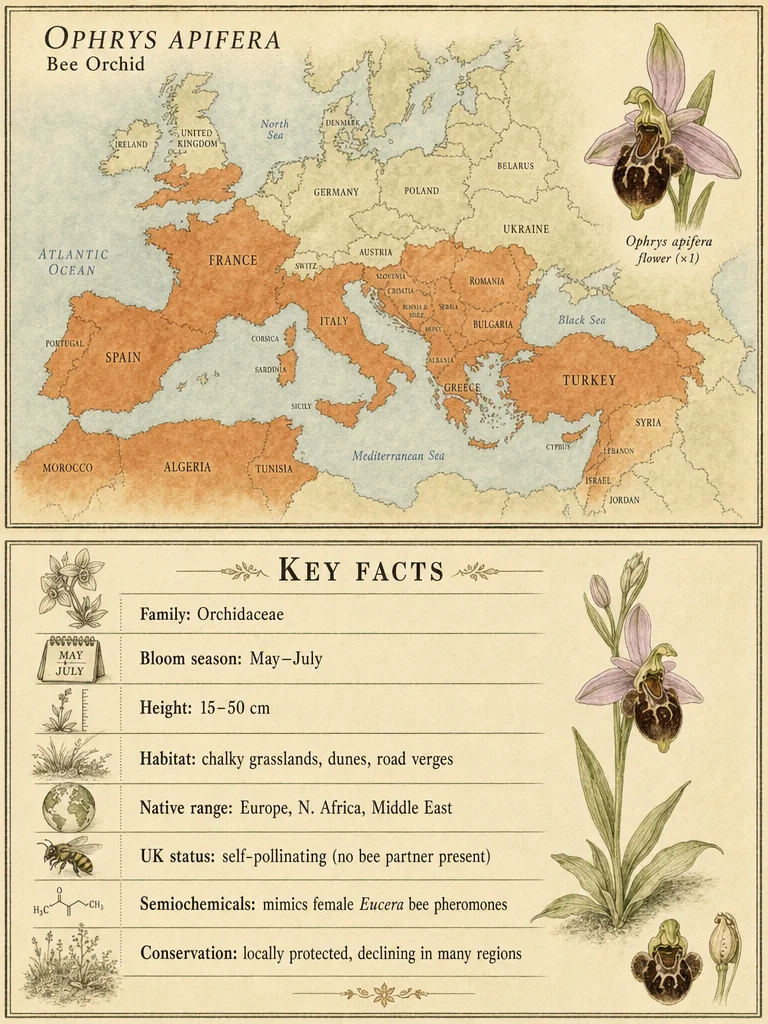
Habitat and appearance. O. apifera grows 15–50 cm tall on thin calcareous soils — chalk and limestone grasslands, sand dunes, old quarry spoil, grassy road verges, even garden lawns on limestone. It flowers May through July. Each plant carries 3–10 flowers along the stem, each one a small spectacle: three spreading pink-to-mauve sepals bracket the labellum, with two much smaller, narrow, greenish lateral petals on either side that look like stubby antennae themselves. Below ground, it survives as two spherical tubers.
Population and conservation. Across its range — from southern England through France, Spain, Italy, the Balkans, Turkey, the Levant, and North Africa — O. apifera is not currently endangered. In Britain, populations have actually expanded over recent decades, partly because the species colonizes disturbed calcareous ground quickly. But it is under pressure in parts of its Mediterranean range from habitat loss, land abandonment (which allows scrub to close over the open grasslands it needs), and overcollection. Several European countries protect it nationally.
The deeper picture. What O. apifera shows is that a flower's relationship with its pollinator is not fixed. The entire genus Ophrys exists because, somewhere in evolutionary time, an ancestral orchid began producing compounds that resembled insect pheromones well enough to elicit a response. That mimicry sharpened over generations into species-specific chemical dialects, each Ophrys tuned to a different bee or wasp. The Bee Orchid took that strategy to its logical extreme — and then, faced with a continent where the bee doesn't live, it found a way to persist without it.
Images in this issue:
- Full specimen portrait — Ophrys apifera flowering stem with bee-mimic labellum detail
- Flower anatomy diagram — key structures of the sexually deceptive flower labeled
- Pollination mechanism — sexual deception (Mediterranean) vs. self-pollination (British Isles)
- Distribution map and key facts card
댓글