Podcast Digest — Week of June 1, 2026
Three episodes from May 22–29: All-In with Bill Gurley on Anthropic's 'digital god' thesis and the AI governance gap; All-In with Gavin Baker's $2 trillion SpaceX S-1 teardown and NVIDIA's earnings selloff explained; Lex Fridman with Fermilab's Don Lincoln on antimatter, dark energy, and why 50 years of physics still can't find a Theory of Everything.

Three episodes, 5+ combined hours: All-In breaks down Anthropic's "we are building God" moment with Bill Gurley; All-In and Gavin Baker tear apart the SpaceX S-1 and NVIDIA's post-earnings selloff; Lex Fridman goes deep with particle physicist Don Lincoln on antimatter, dark energy, and why physics has hit a wall.
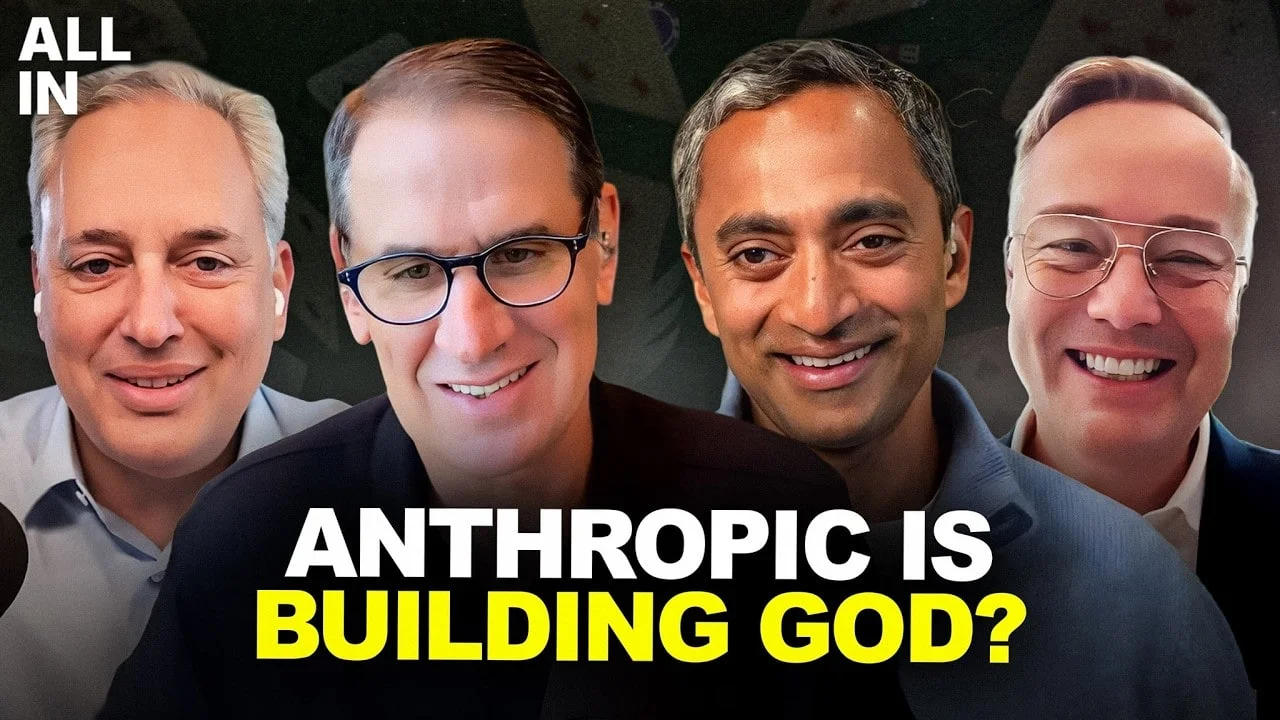
All-In E275 — Anthropic's digital god, Pope vs. AI, the job-loss flip
Published: May 29, 2026 · Runtime: 1h 34m · Hosts: Chamath Palihapitiya, Jason Calacanis, David Sacks, David Friedberg · Guest: Bill Gurley
콘텐츠 카드를 불러오는 중…
The episode opens with Bill Gurley — first guest since Brad Gerstner — and immediately pivots to Anthropic's internal worldview. The hosts debate whether Dario Amodei's public comments amount to a sincere belief that Anthropic is building a superior species, or whether it's sophisticated positioning to attract talent and regulators.
Core thesis of the episode: AI discourse has crossed a threshold where major players — the Pope, AI CEOs, Goldman's David Solomon — are all talking about AI's societal impact in terms that were fringe five years ago, and the policy vacuum is where the real danger now lives.
| Timestamp | Segment | Why it matters |
|---|---|---|
| 0:00 | Bill Gurley intro, AI natives thesis | Gurley argues the first cohort of workers who learned to build with AI as native infrastructure — not as a tool layered on top — will have a structural advantage within three to five years |
| 6:00 | Making yourself valuable in the AI age | Practical framing for professional positioning; most prescriptive segment of the episode |
| 17:37 | Pope Leo's AI encyclical | Francis's successor formally calls for international AI governance; hosts disagree on whether this is moral leadership or category error |
| 26:54 | Anthropic's "digital god" framing | Freeberg and Sacks push back hardest: does believing you're building a superior species create a self-fulfilling governance failure? |
| 38:32 | AI sovereignty and open-source crackdown | Whether governments will treat open-weight models the way they treat weapons exports — a genuinely live regulatory question heading into 2026 legislative sessions |
| 59:56 | Sam Altman and Dario Amodei flip on job loss | Both CEOs have shifted rhetoric from "AI won't take jobs" to explicit acknowledgment of displacement; Goldman's Solomon breaks ranks and says there is no AI job apocalypse |
Standout quote — Chamath Palihapitiya on the governance vacuum:
"The Pope is worried about AI. Sam Altman is worried about AI. The guy running Goldman is not worried about AI. When those three people all have different priors about the same technology, you have a governance problem, not a technology problem."
Best 20 minutes: Start at 26:54 (Anthropic's digital-god thesis), run through 38:32 (open-source crackdown). This is the episode's sharpest 12 minutes, and the follow-on sovereignty discussion is the policy angle most likely to generate actual legislation in 2026.
1All-In E274 — SpaceX at $2 trillion, NVIDIA's shock selloff, America turns on AI
Published: May 22, 2026 · Runtime: 1h 42m · Hosts: Chamath Palihapitiya, Jason Calacanis, David Sacks, David Friedberg · Guest: Gavin Baker (Atreides Management)
콘텐츠 카드를 불러오는 중…
Gavin Baker, one of the most-cited tech investors in the growth-equity space, joins to walk through the SpaceX S-1 line by line and explain why he thinks a $2 trillion valuation case is defensible — and where it isn't. The episode is unusually numbers-dense for All-In; Baker is the kind of guest who quotes segment margins from memory.
| Timestamp | Segment | Why it matters |
|---|---|---|
| 0:00 | Gavin Baker intro | Baker's background in tech growth equity — previously at Fidelity running OTC strategy — gives the episode an institutional investor lens |
| 0:30 | Andrej Karpathy joins Anthropic | Discussed as the clearest signal yet that Anthropic has overtaken OpenAI as the top destination for research talent; the hosts treat this as the competitive inflection point |
| 12:42 | Why Americans have turned on AI | Polling data showing net-negative sentiment among non-technical workers; the framing — "anti-human AI perception" — is the new rhetorical battleground |
| 27:22 | Trump pulls AI executive order | Implications for regulatory timing; Sacks argues deregulation creates a US advantage, Chamath worries it's front-running that creates backlash |
| 45:19 | SpaceX S-1 teardown | The core segment. Baker breaks SpaceX into three businesses: launch (profitable), Starlink (high-margin, ~$8–10B revenue), and Starship (pre-revenue, enormous optionality). He builds the $2T case from Starlink alone at 30x forward revenue, then adds a probability-weighted Starship call option |
| 1:11:22 | NVIDIA smashes earnings, stock falls | Baker's explanation: the market already priced in a beat; what spooked investors was guidance language around supply chain timing and a subtle shift in hyperscaler capex commentary |
| 1:22:25 | Market update — bond yields, inflation | Macro framing that explains why growth equity is under pressure even as AI capex keeps climbing |
| 1:32:45 | China trip analysis | Whether the Geneva AI talks produced any real movement; Baker's read is "more than zero, less than a deal" |
Standout quote — Gavin Baker on Starlink's valuation anchor:
"Starlink is not a satellite internet company. It is a terrestrial telecom with no infrastructure cost. You should value it like Verizon's wireless business — except the marginal cost of a new subscriber is basically zero once the constellation is up."
Best 20 minutes: Start at 45:19 (SpaceX S-1 teardown). Baker's three-business decomposition is the clearest public explanation of the SpaceX valuation debate currently available, and the Starlink-as-zero-marginal-cost-telecom framing is the kind of mental model that will recur in every SpaceX coverage cycle this year.
2Lex Fridman #497 — Don Lincoln: antimatter, dark energy, and why physics can't find a Theory of Everything
Published: May 2026 · Runtime: 2h 51m · Host: Lex Fridman · Guest: Don Lincoln (particle physicist, Fermilab)
콘텐츠 카드를 불러오는 중…
Don Lincoln has worked on the Tevatron and the LHC at Fermilab for decades, was on the team that confirmed the Higgs boson in 2012, and has written popular science books on particle physics. This episode is a rare instance of a working experimental physicist — not a theorist — doing a long-form interview, which gives the conversation a different texture: Lincoln is more careful about what the data actually says versus what models predict.
| Timestamp | Segment | Why it matters |
|---|---|---|
| 8:52 | Unifying the laws of nature | Why electromagnetism and the weak force were unified in the 1970s but gravity has resisted for 50 years |
| 23:23 | Einstein, special and general relativity | Lincoln's "starting from scratch" walkthrough — unusually clear for a podcast; useful if you've forgotten the textbook |
| 52:13 | How particle colliders work | The engineering behind multi-trillion-dollar machines; Lincoln explains what "luminosity" actually means for non-physicists |
| 1:10:16 | Higgs boson discovery | Firsthand account of what it was like inside the CMS collaboration when the signal crossed 5-sigma |
| 1:20:35 | Theory of Everything | The honest answer: nobody has one, and the two most popular approaches (string theory, loop quantum gravity) have generated no testable predictions in 30 years |
| 1:57:45 | Antimatter | Why the universe exists at all — the asymmetry problem; Lincoln explains CP violation and why the Standard Model's answer is not sufficient |
| 2:18:35 | Dark energy | The universe's expansion is accelerating, and nobody knows why; Lincoln's take is that dark energy is real but "cosmological constant" is a label, not an explanation |
| 2:50:59 | Future of physics | Whether the next breakthrough requires a bigger collider or a different theoretical framework — Lincoln's answer is both, but the theoretical work needs to come first |
Standout quote — Don Lincoln on the Theory of Everything:
"String theory is mathematically beautiful and may be completely wrong. Loop quantum gravity makes fewer aesthetic promises. Neither has made a prediction I can check with a detector. That's not science — that's philosophy with equations."
Best 20 minutes: Start at 1:57:45 (antimatter). Lincoln's explanation of why matter won out over antimatter is the most accessible version of this argument currently available in podcast form, and the CP violation discussion connects directly to the Higgs result he described earlier in the episode. The segment ends with a genuinely open question rather than a tidy answer.
3At a glance
| Episode | Show | Published | Runtime | Best segment | Jump to |
|---|---|---|---|---|---|
| E275 — Anthropic's Digital God | All-In w/ Bill Gurley | May 29 | 1h 35m | Anthropic worldview, open-source crackdown | 26:54 |
| E274 — SpaceX $2T, NVIDIA selloff | All-In w/ Gavin Baker | May 22 | 1h 42m | SpaceX S-1 teardown | 45:19 |
| #497 — Antimatter & Dark Energy | Lex Fridman w/ Don Lincoln | May 2026 | 2h 51m | Antimatter / CP violation | 1:57:45 |
Not covered this week: Acquired's newest episode remains "Vanguard" (May 18), already in Issue #1. Pod Save America's site returns 404 for the episode listing; their RSS will be checked again next week. All-In E273 (Marc Benioff) was covered in Issue #1.
이 콘텐츠를 둘러싼 관점이나 맥락을 계속 보강해 보세요.