The boy in the net: how a Greek bronze spent 2,000 years at the bottom of the Adriatic
In 1964, Italian fishermen hauled a life-size bronze athlete from the Adriatic — a Hellenistic Greek original likely connected to the school of Lysippos. Smuggled through the black market and acquired by the Getty in 1977 for $3.95 million, the statue has been the subject of a 35-year legal war between Italy and the museum, reaching the European Court of Human Rights in 2024. It remains in Malibu, pending further proceedings.

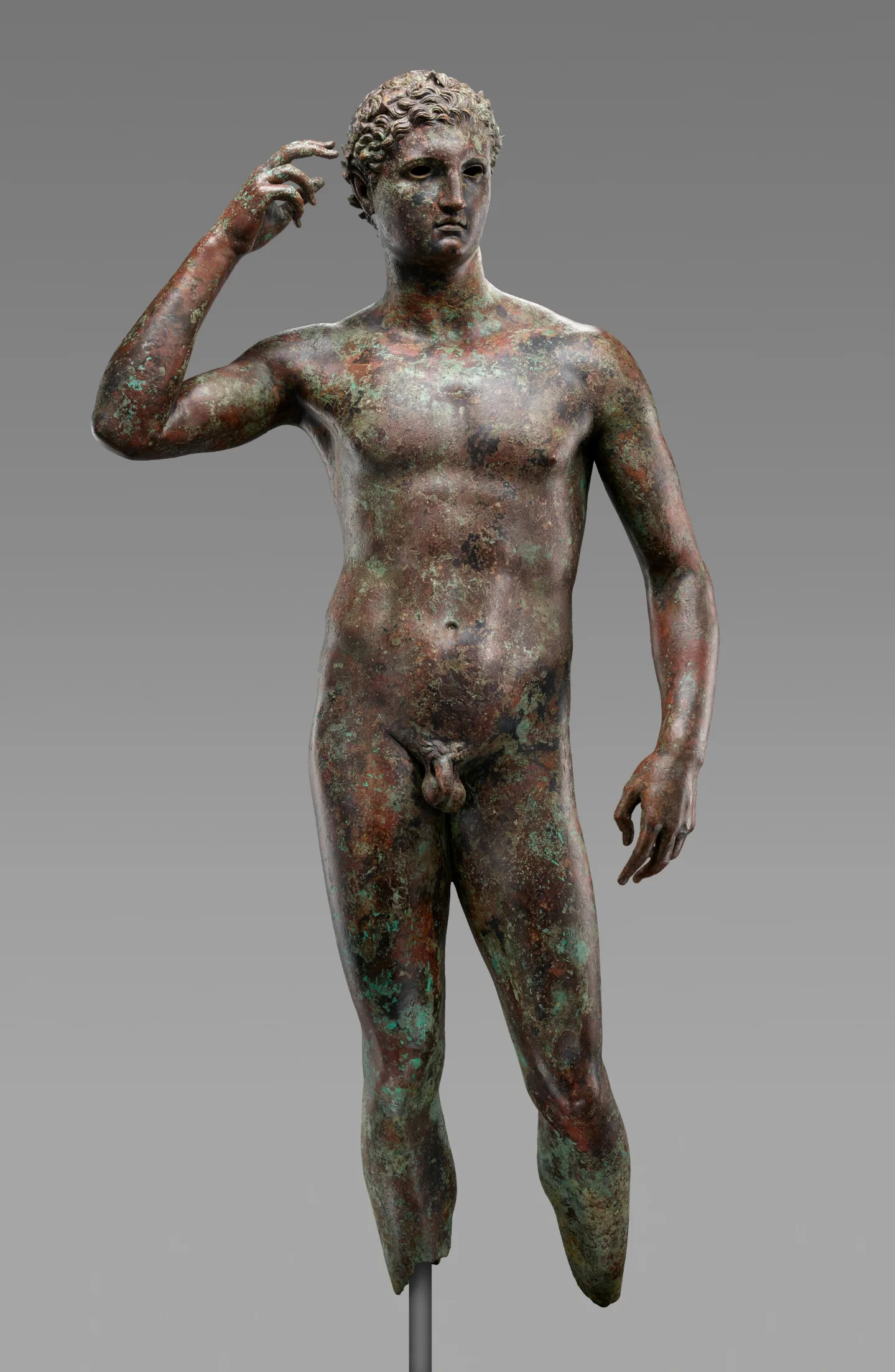
On a summer day in 1964, the crew of an Italian fishing trawler named Ferri Ferruccio was working the Adriatic off the coast of Fano when their nets snagged something heavy and unexpected. They hauled it up. What broke the surface was not a catch they could sell at market: it was a naked teenage boy made of bronze, his right arm raised as if touching the crown of his own head, blank sockets where eyes had once been.1
He had been underwater for roughly two thousand years. They had no way of knowing that. What they knew was that the figure was clearly old, clearly valuable, and clearly something the Italian state would want to take from them. They wrapped him up, took him ashore, and sold him to a local antiquities dealer named Giacomo Barbetti for approximately $5,600.1 The long argument over who owns the boy had begun.
A golden athlete, cast in one piece
The statue now known as the Victorious Youth — accession number 77.AB.30 at the J. Paul Getty Museum — was made somewhere between 300 and 100 BCE, during the Hellenistic period that followed Alexander the Great's conquests.2 It is 151.5 centimeters tall and weighs 64.4 kilograms.3 The medium is bronze with copper inlay at the lips and nipples, which in antiquity created a naturalistic flush of warm red against gold.
The casting technique is one of the statue's most remarkable attributes. The entire figure was produced in one pour using the lost-wax (cire perdue) method — a technical achievement of the first order for a life-size bronze.2 The youth stands in contrapposto, his weight carried on the right leg while the left knee relaxes slightly forward, the spine describing a gentle S-curve that conveys movement in stillness. His right arm is lifted, the fingers nearly grazing the olive wreath on his head. Only fragments of the wreath survive.3
The olive wreath is the key. In ancient Greece, olive wreaths were awarded exclusively at the Olympic Games, held every four years at the sanctuary of Zeus at Olympia in the western Peloponnese.4 This figure is an Olympic champion, frozen at the moment of crowning himself. The left hand — now empty — probably once held a palm branch, a secondary victor's attribute.2 The feet and lower legs are missing, torn away at some point, probably when the statue was wrenched from its original stone base.
Look closely at the face and the hollow eye sockets become unsettling: the eyes were originally inlaid with colored stone, bone, or glass paste, held in copper sheets curled to simulate lashes.4 Today the empty cavities make the figure look as though it is staring inward. In antiquity, those glass eyes would have glittered with something between alertness and arrogance. Kenneth Lapatin, curator of antiquities at the Getty, has noted what the ancient surface would have looked like: "He's a mottled greenish, brownish, reddish, orangish color, where in antiquity he was a golden, metallic yellow." 4
The sculptor who may or may not have made him
The name most frequently attached to this statue is Lysippos, the court sculptor of Alexander the Great. The attachment is reasonable, and contested, and probably permanent.
Lysippos worked in the late 4th century BCE and was reported to have produced over 1,500 bronzes in his career — a staggering output for a medium that required months of skilled labor per piece.4 None of his signed works survive. What scholars have pieced together is a stylistic profile: elongated proportions, smaller heads relative to the body than earlier classical sculpture, a preference for figures designed to be viewed from multiple angles rather than from a single frontal position.1 The Victorious Youth fits this description. The style of the head from the front reads as highly idealized, almost generic; from the side, it becomes more individual, more specific. Lapatin puts it with characteristic caution: "This statue conforms to Lysippian ideals and proportions as we know them, but to say that it is an original by Lysippos is a stretch. We don't even know his date. He might be from the late 4th century, the period of Lysippos, but he could be from the 3rd or the 2nd century."4
When the Getty's first curator of antiquities, Jiri Frel, published The Getty Bronze in 1978 (revised 1982), he went further than cautious attribution. Frel argued the statue was a specific portrait — a likeness of Demetrios Poliorketes (336–283 BCE), a Macedonian general and king, by Lysippos himself.1 That theory did not survive sustained peer review. The Getty's online collection entry now describes the maker as "unknown maker, perhaps by a pupil of Lysippos."2
Carol Mattusch, an art history professor at George Mason University who wrote the definitive 1997 monograph The Victorious Youth, placed the work in the "school of Lysippos" category — acknowledging the stylistic kinship while declining the direct attribution.1 Her analysis also pointed toward a workshop production context: Greek bronze statues of this quality were typically cast in large workshops using molds for individual body parts, assembled, and finished by master sculptors. The boundary between "original by Lysippos" and "work of his atelier" may be less meaningful than it sounds.
There are physical clues about where the statue came from, though they stop short of proof. Analysis of fibers found inside the bronze core identified them as flax.1 The 2nd-century CE travel writer Pausanias recorded that flax in Greece was grown in only one region — around Olympia. The olive wreath is the prize given at Olympia. The technical signature on the back of the neck — a rectangular plate used for vertical support during installation — appears on at least two other surviving bronzes, the Marathon Boy (National Archaeological Museum, Athens) and the Antikythera Youth (also Athens).1 The cumulative weight of these details points toward Olympia as the original site. But no ancient inscription has been found linking statue to sanctuary, because the stone base it once stood on is lost.
How a Roman ship may have saved him
The Olympic Games continued under Roman rule. Roman generals and emperors competed for the prestige of patronizing Greek culture, and they plundered it with equal enthusiasm. Beginning in the 2nd century BCE, thousands of Greek bronze statues were removed from temples, gymnasia, and public squares and shipped westward to Rome and its provinces to decorate private villas and imperial palaces.1
The Victorious Youth almost certainly left its original site on one of those ships. The vessel sank somewhere in the Adriatic, at a depth and location that has never been determined. The ship's cargo went down with it.
This is how the statue survived. The paradox of Greek bronzes is that the medium which made them so prized — the raw material value of the metal — also ensured their near-total annihilation. Bronze was melted down for weapons, for coins, for new statues of new patrons. Of the thousands of life-size bronzes known to have been cast in antiquity, a handful survive: the Riace Warriors (Reggio Calabria), the Antikythera Youth, the Marathon Boy, the Cape Artemision Zeus or Poseidon (Athens), the Apoxyomenos recovered from the Croatian coast in 1999.4 Lapatin has observed that "the ones that we have today, paradoxically, we have because of disaster, earthquake, landslide, shipwreck." Shipwrecks, unlike ransacking armies, do not melt things down. The sea preserved what the land destroyed.
Out of the net, into the black market
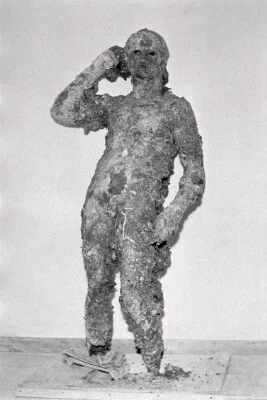
When the Ferri Ferruccio's crew pulled the statue up in 1964, it was encrusted in barnacles and marine growth so thick that the human form was barely visible.1 The encrustation indicated the statue had been on the seabed since antiquity — it had not been recently dumped or concealed.
From Barbetti the statue passed to Gianfranco Becchina, an antiquities dealer with extensive European connections, and then through a Munich dealer named Heinz Herzer to a consortium called the Artemis Group.1 The route was not quiet: in 1970, Italian authorities charged four individuals with smuggling the statue out of Italy. All four were ultimately acquitted.5 The bronze traveled onward.
In 1972, Herzer and a conservator named Rudolph Stapp undertook a three-month cleaning project, dissolving the marine growth and treating the underlying bronze disease that years of submersion had caused.1 What emerged, once the accretion came away, was the golden athlete. Radiocarbon dating of a wood fragment found inside the statue's core in 1974 confirmed the bronze was authentically ancient, not a modern forgery.1
The British archaeologist and art historian Bernard Ashmole was brought in to inspect the statue. His assessment was that the work was consistent with Lysippos. That opinion set a chain of events in motion.
$3.95 million and a photograph
In the summer of 1977, the J. Paul Getty Museum purchased the statue from Herzer for approximately $3.95 million — one of the largest sums paid for an ancient work of art at that date.2 The acquisition was driven largely by Jiri Frel, who believed he was bringing an original Lysippos into the Getty collection. The museum assigned it accession number 77.AB.30 and installed it at the Getty Villa in Malibu, California, in the gallery now designated as Gallery 111: The Hellenistic World.
The Getty did not ask, or chose not to ask, where exactly it had come from. This was not unusual for the era: the 1970 UNESCO Convention on the Means of Prohibiting and Preventing the Illicit Import, Export and Transfer of Ownership of Cultural Property had been adopted but was not yet widely enforced, and the market for unprovenanced antiquities operated largely without scrutiny.1 The Getty's acquisition practices in the Frel years would later become a source of sustained institutional embarrassment — a 1995 raid on a Geneva storage facility belonging to dealer Giacomo Medici exposed documents and photographs connecting multiple major American museums to the Italian black market.6 For the Victorious Youth specifically, the paper trail was already public knowledge: the 1970 smuggling charges had been reported in the Italian press.
The statue had a proper address in California. Italy had not forgotten that it had left.
Italy's long argument
Italy's formal legal claim on the Victorious Youth dates to 1989, when the Italian government first notified the Getty that the statue was considered illegally exported cultural property.1
The next two decades produced a slow procedural escalation. In 2005, Getty antiquities curator Marion True was indicted in Rome, alongside dealer Robert E. Hecht, for trafficking in looted antiquities — the Medici archive had been too damaging to ignore.6 In December 2006, Italy's minister of cultural heritage threatened a full cultural embargo against the Getty if 52 disputed objects were not returned.1 In August 2007 the two parties reached a partial agreement: the Getty would return 40 of the 52 pieces — including the Venus of Morgantina, a 5th-century BCE marble goddess that was repatriated in 2010 — but the Victorious Youth was explicitly excluded, its fate tied to pending criminal proceedings.1
The Getty's arguments were consistent and specific. Lisa Lapin, the museum's then-vice president of communications, stated that "the bronze has only a fleeting and incidental connection with Italy" — the statue was the work of a Greek artist, had been in the sea for millennia, and was recovered in international rather than Italian territorial waters.1 These were not frivolous objections. The question of whether an ancient Greek work becomes Italian cultural property by the accident of being found in Italian waters is genuinely unsettled in international law.
In 2010, the Pesaro public prosecutor formally ordered confiscation of the statue, and Italy's Constitutional Court became involved.1 On November 30, 2018, Italy's Supreme Court of Cassation — the country's highest court of appeal — rejected the Getty's challenge and confirmed Italy's right to reclaim the bronze.6 The Getty appealed to the European Court of Human Rights in Strasbourg.
On May 2, 2024, the ECHR's Section I ruled against the Getty Trust, upholding the Italian confiscation order and finding that Italy's action did not violate the European Convention on Human Rights.7 After 35 years of formal proceedings across four countries and two supranational judicial bodies, the boy in the net had a court order telling him to go home.
As of May 2026, he remains in Gallery 111 at the Getty Villa, pending further legal proceedings.2
The face that Fano named a travel agency after
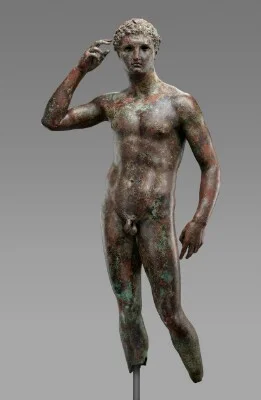
While the Getty and the Italian state traded lawyers, the citizens of Fano — the small Adriatic coastal town nearest to where the Ferri Ferruccio's nets came up — had their own relationship with the statue.
They call it il Lisippo. The town has a monthly cultural magazine called Lisippo and a travel agency called Lisippo. The name is not a scholarly assessment; it is a piece of civic identity.
In January 2025, Massimo Osanna, Italy's Director General of Museums, gave an interview to the London Times that landed in Fano like a stone. Osanna said that the attribution to Lysippos rested on "a vague stylistic similarity" and nothing more, and that "the name is not correct."8 He suggested the statue is more likely a copy of a Lysippos original than an original in its own right, and urged the art world to move "away from the obsession of searching for celebrated names."8 He also voiced support for building a dedicated museum in Fano to house the statue once it is returned.
Giampiero Patrignani, editor of Fano's Lisippo magazine, was direct in his response: "The statue is by Lysippos. Why would the Getty have bought it if it weren't? The name is part of our identity. They are taking something away from us."8 Marco Berardi, who runs the Lisippo travel agency, was more measured: "The statue has a special space in the hearts… it will always be the Lisippo for us."8
The Getty responded that "the question of authorship of Victorious Youth remains open" and that it had "seen no information that changes that position."8 That answer — carefully correct, deliberately uncommitted — is the same answer the museum has given for fifteen years. Osanna's scholarly position, it should be noted, is not far from what Lapatin had already stated in 2022: claiming a direct Lysippos original "is a stretch." The disagreement between the Italian state and the Getty on attribution is narrower than the politics suggests.
What the empty eye sockets actually tell us
The Victorious Youth sits at the intersection of several problems that go well beyond one statue.
The first problem is scarcity. The Riace Warriors, the Antikythera Youth, the Marathon Boy — each of the major surviving Greek bronzes owes its existence to a disaster: earthquake, landslide, shipwreck.4 The survivors are outside the reach of the recycling economy that consumed the rest. Attribution in ancient bronzes is almost always built from stylistic inference rather than inscription, because inscribed bases and the statues they once held have almost never survived together. "The ones that we have today, paradoxically, we have because of disaster," as Lapatin observed.4
The second problem is the antiquities market. The Getty Bronze's journey from the seabed to a Malibu gallery represents, in miniature, a trade that stripped the documentary context from thousands of ancient objects during the 20th century. A statue with an excavated provenance — with records showing where it was found, in what relationship to other objects, in what stratigraphic layer — carries historical information that can never be recovered once the object is separated from its site. The Victorious Youth came up in a fishing net. It will never have an excavation report.
The third problem is the law. The 2024 ECHR ruling is clear in outcome but leaves the underlying question — who owns an ancient Greek work found in international waters that washed up near an Italian beach — without a fully settled answer for future cases. The Getty's appeal rested on arguable grounds. Italy won, but the legal framework that produced the win is not airtight, and other contested bronzes currently displayed in other museums are watching.
The boy in the net still stands in Malibu. His right arm is still raised. The fingers still reach toward an olive wreath that is mostly gone. His eyes are still empty.
Whoever made him could not have imagined this outcome: that his athlete would outlast not just the games he won, but the civilization that staged them, the ships that carried him, the language in which his name would have been inscribed on a base — and would end up the subject of a European human rights ruling, two millennia later, in a language that did not exist when he was cast.
Cover image from: Statue of a Victorious Youth — Getty Museum Collection
참고 출처
- 1Victorious Youth — Wikipedia
- 2Statue of a Victorious Youth — Getty Museum Collection
- 3CONA Full Record: Statue of a Victorious Youth
- 4Statue of a Victorious Youth — Getty Conversations (Smarthistory)
- 5The 'Getty Bronze' at the European Court of Human Rights — IAL
- 6Getty museum must return 2,000-year-old statue, Italian court rules — The Guardian
- 7Case Review: Getty v. Italy (2024) — Center for Art Law
- 8Italian Cultural Chief Disputes Attribution of Famed Getty Bronze — Artnet News
이 콘텐츠를 둘러싼 관점이나 맥락을 계속 보강해 보세요.