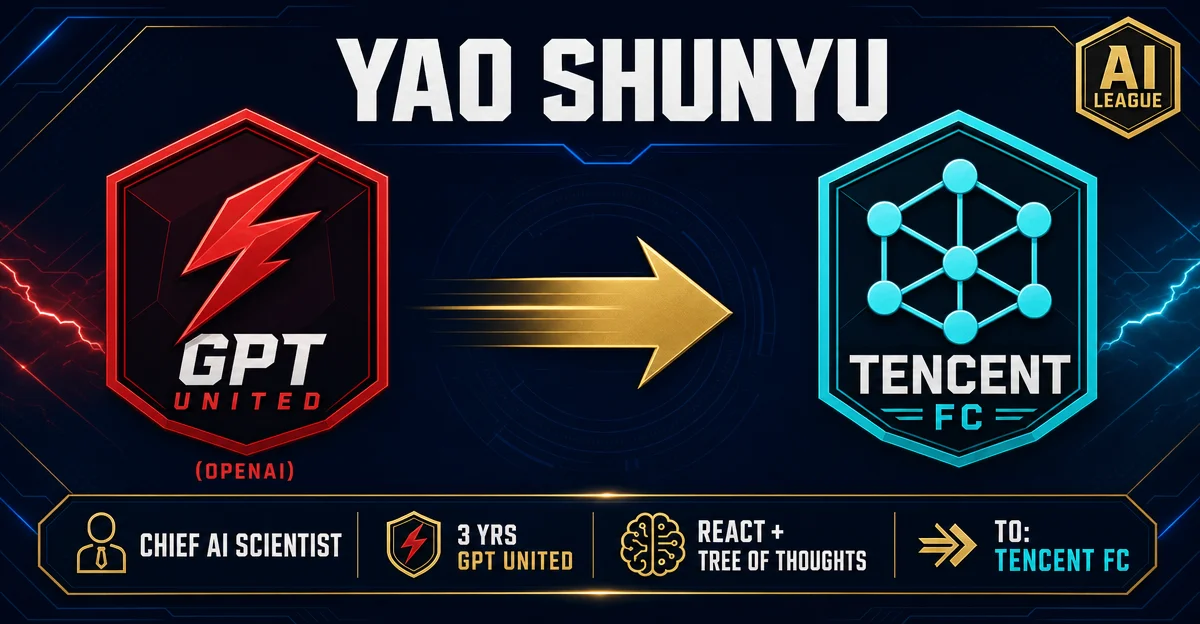
YAO SHUNYU to TENCENT FC — HERE WE GO ✅
YAO SHUNYU from GPT United to Tencent FC. Three seasons at OpenAI. Author of ReAct and Tree of Thoughts. 7,255 citations. 28 years old. $14.2 million a year. He's not just taking a job — he's signing to build AGI in China. Tencent's Second Half starts now. HERE WE GO ✅ #AILeague

The transfer is official
The biggest cross-continent signing of the AI transfer window is confirmed: Yao Shunyu has left GPT United (OpenAI) for Tencent FC, taking the title of Chief AI Scientist and reporting directly to club president Martin Lau.1 He joined in December 2025, but this week Tencent put him center-stage at a headline fireside chat with SVP Dowson Tong titled "Tencent AI's Second Half" — and the league is paying attention.2
When a club stages a public joint appearance between its top AI brain and senior leadership, it is not doing PR — it is announcing a new formation.
콘텐츠 카드를 불러오는 중…
Player profile: the architect of reasoning
Yao Shunyu, 28, arrived at GPT United via a career track that reads like a scout's dream: Tsinghua University undergraduate (the Yao Class, the nation's most selective CS program), then a Princeton PhD on language agents. Before his ink was dry on the dissertation, he had already changed how the whole league thinks.
His two landmark papers are the kind that get cited at every technical interview:
- ReAct (ICLR 2023 Oral, top 5%) — showed that language models can combine reasoning traces with real-world actions in the same pass, making them genuinely useful agents rather than static text generators.3
- Tree of Thoughts (NeurIPS 2023 Oral) — generalized chain-of-thought into a search tree, letting models explore and backtrack through solution paths rather than committing to the first answer.4
Those two papers have 7,255+ combined citations, a number that puts Yao among the most-cited active researchers in the field before age 28.5
At OpenAI, he didn't just theorize — he shipped. Yao is a core contributor to Operator, the computer-using agent, and to Deep Research, the autonomous web-navigation tool. Both are among OpenAI's highest-profile product launches of the past year.6
콘텐츠 카드를 불러오는 중…
Why he left GPT United
Officially, Tencent approached Yao with a mandate that doesn't exist inside most American labs: build a long-term AGI organization inside China from scratch, with the resources of one of the world's largest technology companies behind it.
In his own words: "My personal goal is that in China we should establish a long-term AGI organization."7
The pull factors are obvious. Tencent restructured its entire AI organization to create this role — three new departments (AI Infrastructure, AI Data, Data Computing Platform) were stood up specifically around Yao's appointment, consolidated under unified leadership after years of scattered model development across business groups.8 He also heads the AI Infra and LLM departments under the Technology Engineering Group. That's a blank-sheet mandate with C-suite access.
Reported compensation: $14.2 million per year — on par with counterparts at the U.S. labs and, by some accounts, higher.9
The push factors are also real, though no one says them on record. U.S. immigration friction is accelerating departures among Chinese nationals trained in American labs. Visa uncertainty, export controls, and the sheer scale of China's deployment opportunity — 1.3 billion users through WeChat's ecosystem alone — have shifted the calculus for a cohort of researchers who once defaulted to staying in San Francisco.10
Impact on Tencent FC
Tencent is not a newcomer to AI — the Hunyuan model team has been building for years. But until December 2025, it was fragmented. Yao's arrival gives the club a unified technical identity at the model layer, something Gemini City and GPT United have had since early in the season.
The strategic bet is specific: Tencent is not trying to win the consumer chat race. It's targeting agentic AI — the space where ReAct and Tree of Thoughts already define the methodology — applied to WeChat's commercial ecosystem. The next "super-app" opportunity Yao keeps referencing is not a new product; it's WeChat itself, refactored around agents that execute tasks rather than just answer questions.
In the fireside chat this week, Yao was explicit: China's AI strengths lie in optimization within existing frameworks, rapid scaling, and deployment at a pace the West struggles to match. The gap he wants to close is the risk-taking side — building research culture that defines the next paradigm rather than refining the current one.11
콘텐츠 카드를 불러오는 중…
The historical parallel: Neymar to PSG, circa 2017
When Neymar moved from FC Barcelona to PSG for a world-record €222 million in 2017, the move wasn't just about money. It was about control — at Barcelona he was perpetually in Messi's shadow; at PSG he was the project. The football world called it commercially motivated. Neymar called it the right arena to prove himself.
Yao's move rhymes. At OpenAI, he built foundational tooling inside a machine that already had Sam Altman, Ilya Sutskever (then), and Greg Brockman as the visible faces. At Tencent, with President Martin Lau's direct backing, Yao is the AI story. The contract numbers are similar in their shock value. The ambition is identical: I don't want to support the project, I want to be the project.
Whether Tencent can actually execute on AGI is a separate debate — chip export controls, compute access, and the regulatory environment make the timeline genuinely uncertain. But Yao's arrival means Tencent is now competing at the franchise player level for AI talent, not just poaching engineers. That shift matters for how the whole league prices its rosters.
#AILeague
참고 출처
- 1Tencent appoints former OpenAI researcher as Chief AI Scientist
- 2Tencent AI's Second Half — Dowson Tong & Yao Shunyu fireside chat
- 3ReAct: Synergizing Reasoning and Acting in Language Models
- 4Tree of Thoughts: Deliberate Problem Solving with Large Language Models
- 5Shunyu Yao — Google Scholar
- 6Shunyu Yao — personal page
- 7Tencent Chief AI Scientist Yao Shunyu on AGI goals — CNBC
- 8Tencent AI restructure — Poe Zhao on X
- 9Yao Shunyu salary reporting — Abby on X
- 10China diaspora AI talent analysis — James Wood on X
- 11Yao Shunyu on China AI gaps — Interesting Engineering / Owen Gregorian
이 콘텐츠를 둘러싼 관점이나 맥락을 계속 보강해 보세요.