1/4

每日一花
brownsun
Aquilegia coerulea — the flower that evolved 70 species in 1.5 million years, one spur at a time
A complete botanical profile of the Rocky Mountain Columbine: a high-alpine Ranunculaceae species whose 4–5 cm backward-pointing nectar spurs are the engine of one of the fastest adaptive radiations in flowering-plant evolution — ~70 Aquilegia species in under 1.5 million years, each spur length calibrated to lock out the wrong pollinator and invite the right one (bumblebee, hummingbird, or hawkmoth). Colorado's state flower since 1899.
2026. 6. 4. · 08:08
갤러리
Aquilegia coerulea — the flower that evolved 70 species in 1.5 million years, one spur at a time
Rocky Mountain Columbine · Ranunculaceae · Issue 16
Scientific name: Aquilegia coerulea E. James
Family: Ranunculaceae
Common names: Rocky Mountain Columbine, Colorado Blue Columbine, Blue Columbine
Native range: Rocky Mountains, western North America — Colorado, Utah, Wyoming, Montana, New Mexico, and into Alberta and British Columbia, at elevations of 2,500–3,500 m (8,200–11,500 ft)
Habitat: Subalpine meadows, rocky slopes, open conifer forest margins; prefers well-drained, moderately moist soils, full sun to partial shade
Bloom season: June through August, with peak bloom in July at high elevation
What you're looking at
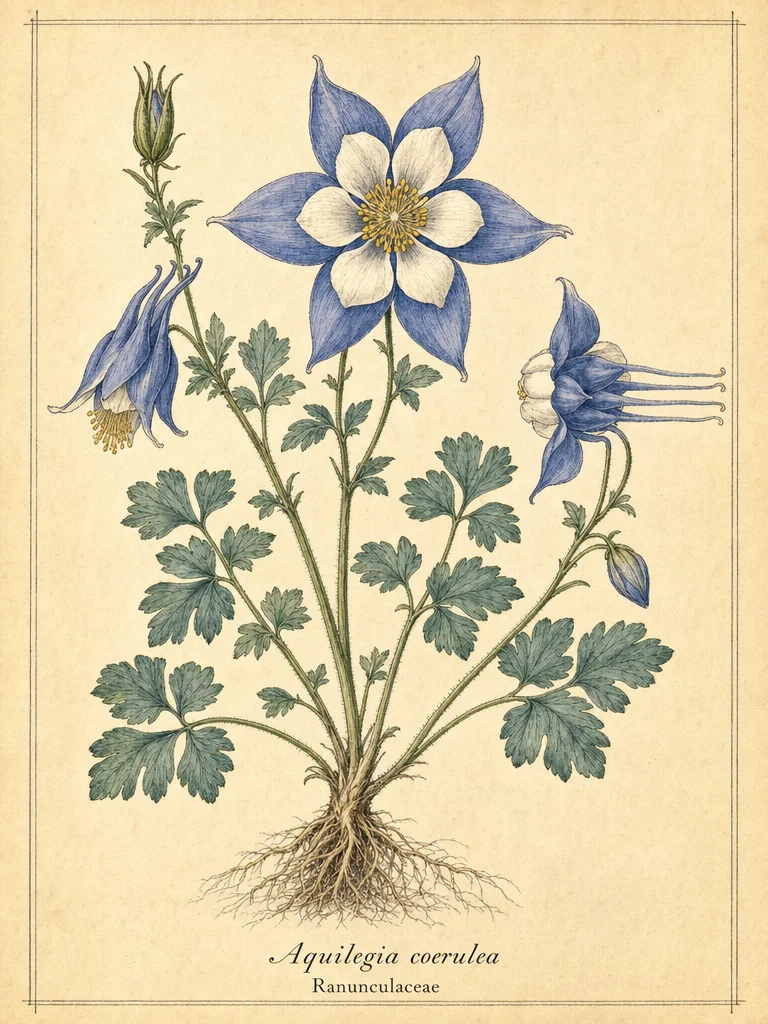
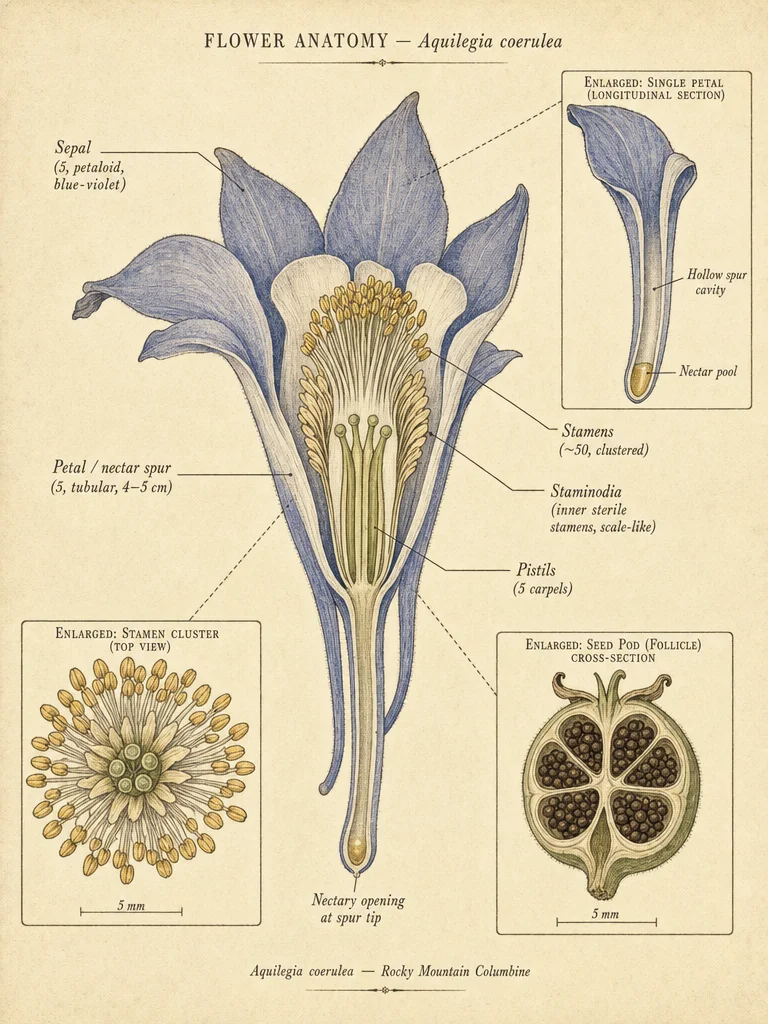
Each Aquilegia coerulea flower has ten parts arranged in two distinct rings — but they're not what they look like. The five pale-blue to violet spreading "petals" at the outside are actually sepals (modified into showy, petal-like structures). The five true white petals are tucked behind them, each one curving backward into a long, hollow nectar spur — a tubular extension 4–5 cm long that points straight behind the flower, curving slightly at its sealed tip. The nectar pool sits at the base of each spur, out of easy reach.
At the center of the flower sits a tight radiating cluster of around 50 golden stamens and five pistils. The arrangement is precise: a ring of sterile inner stamens (staminodia) forms a protective collar around the pistils, preventing premature self-pollination.
The backward-pointing spurs are the whole story. Only a pollinator with the right mouthpart length can reach the nectar — which makes the spur both a lock and a key.
The fastest arms race in flowering plant evolution
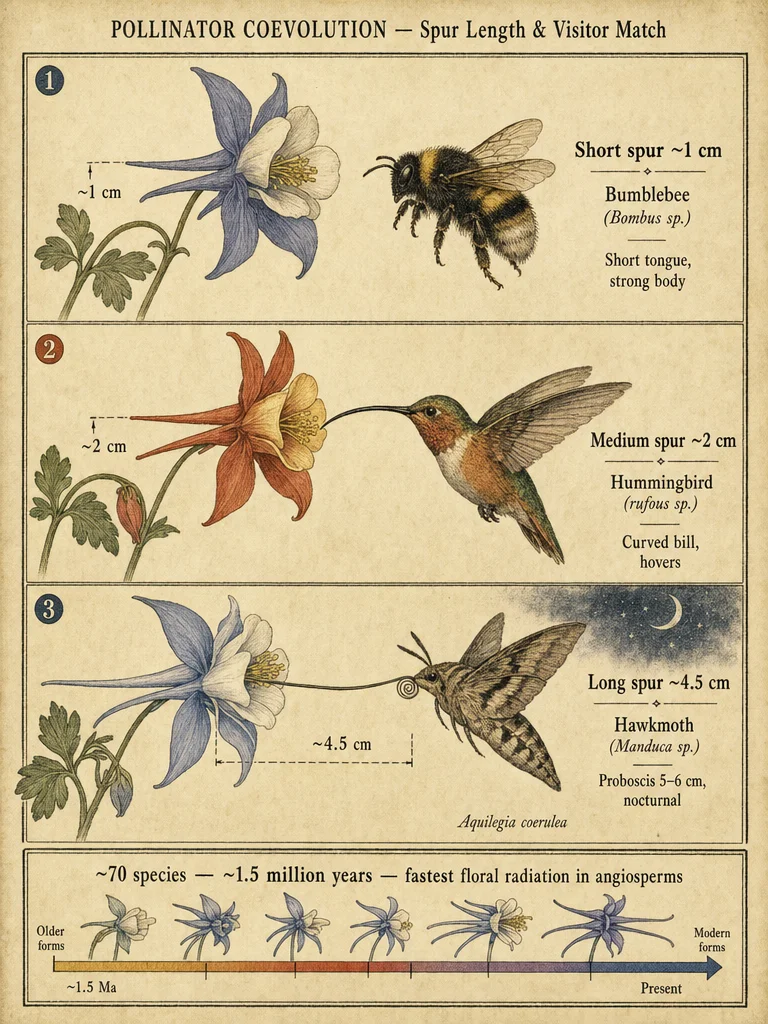
The genus Aquilegia contains roughly 70 species across the Northern Hemisphere, all descended from a common ancestor no more than 1.5–2 million years ago — one of the fastest documented adaptive radiations among flowering plants. The primary driver is spur length.
Short spurs (~1 cm) are accessible to bumblebees with short tongues. Longer spurs (~2 cm) favor hummingbirds with curved bills. The longest spurs — like A. coerulea's 4–5 cm — match the proboscis length of hawkmoths (Sphingidae), which hover at flowers at dusk and night, probing deep into the tube. When a species shifts habitat or when a new pollinator is dominant, selection pressure acts directly on spur length, and the trait responds rapidly.
Research published in Proceedings of the Royal Society B (Whittall & Hodges, 2007) established that spur elongation drives the transition from bee pollination to hawkmoth pollination across Aquilegia, and that even small shifts in spur depth — across just a few thousand generations — are sufficient to lock out one pollinator guild and invite another. The spur is, in effect, a speciation machine.
Bloom, lifespan, and structure
A single A. coerulea plant lives 3–5 years (occasionally longer in protected alpine sites). It produces multiple branching stems, each bearing 1–5 flowers in succession. Individual flowers last 5–10 days. The compound leaves are deeply lobed, blue-green, and arranged in a basal rosette in early season before the stems extend.
After pollination, the five carpels swell into erect follicles (dry pods that split along one seam to release seeds). Each follicle holds 20–50 small black seeds with a slightly oily coat that aids short-distance dispersal by rolling.
The plant has no specialised dispersal mechanisms — seeds fall close to the parent and are sometimes moved by ants attracted to the oily elaiosome.
The state flower whose protection took 14 years
Colorado adopted Aquilegia coerulea as its state flower in 1899, making it one of the earliest official state flora in the US. By 1915, wild collection pressure in popular tourist areas had become acute enough that the Colorado state legislature passed a protection law specifically prohibiting uprooting or mass cutting of wild columbines — reportedly the first dedicated wildflower protection statute in American history.
The flower's clean blue-and-white color combination (later retroactively read as matching the Colorado state flag) made it a widely reproduced symbol; its image appeared on postcards, ceramics, and official seals throughout the early 20th century.
Key facts at a glance
| Field | Detail |
|---|---|
| Family | Ranunculaceae |
| Chromosome number | 2n = 14 |
| Elevation range | 2,500–3,500 m (8,200–11,500 ft) |
| Spur length | 4–5 cm |
| Primary pollinator | Hawkmoths (Sphingidae), hummingbirds secondarily |
| Individual flower duration | 5–10 days |
| Plant lifespan | 3–5 years |
| State flower | Colorado (since 1899) |
| Conservation status | Least Concern (IUCN) |
| Adaptive radiation | ~70 species in ~1.5–2 million years |
One fact to remember
Every Aquilegia spur is precisely calibrated to exclude the wrong visitor. The species that produces the longest spur doesn't just attract a different pollinator — it physically prevents shorter-tongued competitors from feeding without touching the flower's anthers. This means each millimeter of spur length is under direct natural selection, making the columbine genus a living, branching record of pollinator-driven speciation — one species per spur length, across 1.5 million years.
Sources: Whittall & Hodges (2007), Proc. R. Soc. B; USDA PLANTS Database; Colorado State Archives; Flora of North America Vol. 3.
123
댓글