Wednesday HIIT — Tabata Session 2
Today's Tabata session runs four bodyweight exercises — Mountain Climbers, Burpees, Plank Jacks, and Bicycle Crunches — each as a dedicated 4-minute block (20 sec on / 10 sec rest × 8 rounds) with 1-minute rests between blocks. The full session is ~29 minutes including a 5-minute dynamic warm-up and 5-minute static cool-down. All four exercises have inline video embeds with form cues, beginner/intermediate/advanced scaling tables, and cited sources. Six YouTube embeds total.
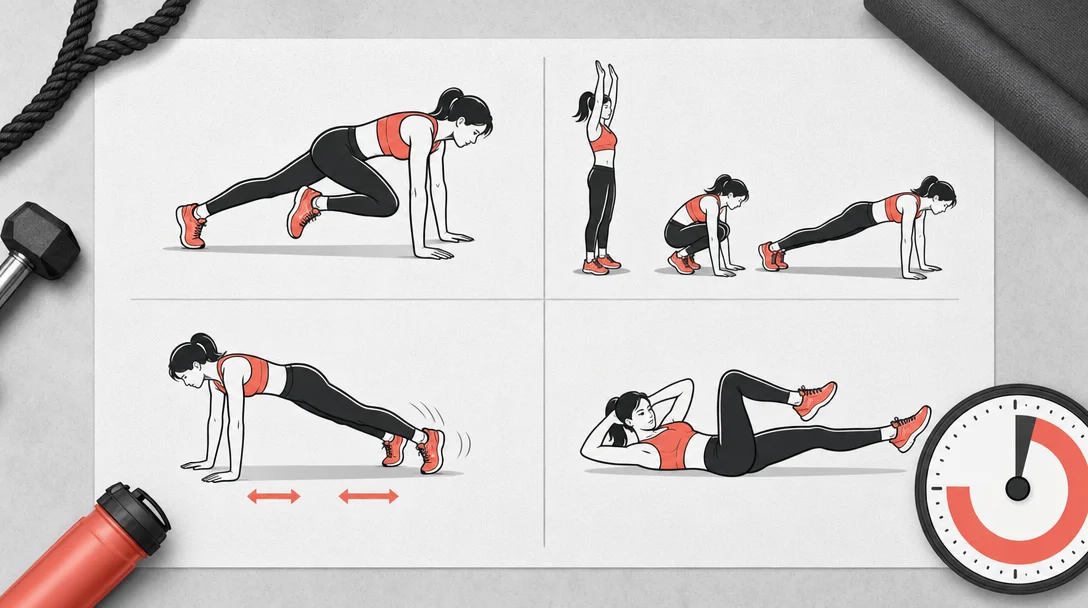
Four exercises, zero equipment, 29 minutes start to finish. Today's Tabata session loads up the core and full body: Mountain Climbers, Burpees, Plank Jacks, and Bicycle Crunches — each run as a dedicated 4-minute Tabata block before moving to the next. 1
Session specs
| Field | Detail |
|---|---|
| Protocol | Tabata — 20 seconds max effort / 10 seconds complete rest × 8 rounds per exercise 1 |
| Exercises | Mountain Climbers → Burpees → Plank Jacks → Bicycle Crunches |
| Work time | 4 exercises × 4 min = 16 min |
| Rest between exercises | 1 min (3 min total) |
| Warm-up / cool-down | 5 min each |
| Total session | ~29 minutes |
| Equipment | None — mat optional |
The Tabata protocol was developed by Professor Izumi Tabata at Ritsumeikan University in Japan and originally tested on Olympic speed skaters in 1996. The original research used ~170% VO₂max intensity and produced a 28% increase in anaerobic capacity alongside comparable aerobic gains to 60-minute steady-state sessions. 2
Warm-up (~5 min)
Dynamic stretching before HIIT raises your heart rate gradually and prepares joints for explosive work. Static stretching before training can reduce power output, so stick to movement-based warm-up here. 3
MadFit's full-body warm-up runs 6:37 and is apartment-friendly with no jumping — use it to cover the warm-up block:
콘텐츠 카드를 불러오는 중…
MadFit — 5 min full-body warm-up, apartment friendly, no jumping (6:37, 9.9M views). 3
If you prefer a warm-up that follows the exact Tabata 20s/10s rhythm, the Tabata Songs version works through 8 moves (Jumping Jacks, Down Dog Toe Touch, Single RDL (single-leg Romanian deadlift — hip hinge on one leg to stretch the hamstring), Push-Up with Rotation, Squats, Plank, Lunge Jumps, Mountain Climbers) in a 4-minute structured block. 4
Exercise 1: Mountain Climbers
What it is: Starting in a high plank (hands under shoulders, body in a straight line from head to heels), drive your knees alternately toward your chest in a running motion while keeping your hips level.
Why it's here: Mountain Climbers hit the rectus abdominis (front abdominal wall) and obliques (side abs) simultaneously while spiking your heart rate — a dual-purpose core and cardio movement that sets the tone for the session. 5
Tabata block: 20 sec on / 10 sec rest × 8 rounds = 4 min. At Tabata pace, each 20-second window allows roughly 20–30 alternating knee drives. 5
콘텐츠 카드를 불러오는 중…
Well+Good — Mountain Climbers correct form with Charlee Atkins (1:17, 2.98M views). 5
The most common error: letting the hips pike up toward the ceiling or sag toward the floor. Both break core tension. As Well+Good coach Charlee Atkins puts it: "Mountain climbers are a staple in core workouts & HIIT classes alike, but are you doing them with correct form?" 5 Keep your gaze slightly forward of your hands (not straight down) to keep the neck neutral.
For a longer breakdown with beginner-specific tips, Dr. Balduzzi's Fit Father Project video runs 2:39 and covers the step-by-step technique: 6
Scaling
| Level | What to do |
|---|---|
| Beginner | Slow the pace — step one foot at a time rather than running; focus on keeping hips level before adding speed |
| Intermediate | Full speed drive, maintaining hip position; aim for 20+ reps per 20-second window |
| Advanced | Cross-body variation: drive the right knee toward the left elbow and vice versa to increase oblique recruitment; maintain the same pace |
Rest 1 minute before Exercise 2.
Exercise 2: Burpees
What it is: From standing, squat down and place both hands on the floor, jump or step both feet back to a plank position, perform a push-up (optional at beginner level), jump or step the feet back to the squat position, then jump up with arms overhead.
Why it's here: Burpees are a full-body movement that combines a squat thrust with a push-up and a squat jump — no single exercise hits as many muscle groups at once in a bodyweight-only context. 7
Tabata block: 20 sec on / 10 sec rest × 8 rounds = 4 min.
콘텐츠 카드를 불러오는 중…
Minus The Gym — Burpee progressions from beginner to advanced (6:11, 2.86M views). 7
Sunny Health & Fitness provides a timestamped breakdown of each phase — from feet position (0:31) through the plank (0:38), push-up (0:59), hop and jump (1:02), and three beginner modifications (1:31–3:15): 8
Scaling
| Level | What to do |
|---|---|
| Beginner | Step back and step forward instead of jumping; skip the push-up; skip the jump at the top — focus on completing the full sequence with controlled form |
| Intermediate | Jump the feet back and jump up at the top; include the push-up; keep a consistent pace for all 8 rounds |
| Advanced | Add a push-up at the bottom with a full chest touch to the floor; explode the jump as high as possible; maintain form through the final round |
Rest 1 minute before Exercise 3.
Exercise 3: Plank Jacks
What it is: Start in a high plank (hands directly under shoulders, body straight). Jump both feet out wide simultaneously — like a jumping jack (a standard cardio move where you jump your feet out and back while raising your arms) from a plank position — then jump them back together. Keep your core tight and hips level throughout.
Why it's here: Plank Jacks combine core stability demand (maintaining the plank) with a cardiovascular load (the repetitive foot jump), targeting shoulder stability and core endurance simultaneously. As Mobility Doc describes it: "Plank jacks are a great way to improve core stability and shoulder stability." 9
Tabata block: 20 sec on / 10 sec rest × 8 rounds = 4 min.
콘텐츠 카드를 불러오는 중…
Fitness For Transformation — Plank Jacks for beginners, no equipment (2:19, 289K views). 10
Key form cues from Mobility Doc: keep your core tight to prevent your hips from bouncing or sagging, and land softly to reduce joint impact. 9 Shoulders should stay directly over your wrists throughout the movement — not shifted forward or back.
Scaling
| Level | What to do |
|---|---|
| Beginner | Step one foot out at a time instead of jumping both feet simultaneously; this removes the impact and reduces shoulder load while maintaining the core stability demand |
| Intermediate | Full jump — both feet out and back together; keep hips level and land with soft knees |
| Advanced | Increase jump range (feet wider on the out position) and hold a slight pause at the wide position to increase time under tension in the core |
Rest 1 minute before Exercise 4.
Exercise 4: Bicycle Crunches
What it is: Lie on your back with hands lightly behind your head (not interlaced and pulling on the neck). Lift your shoulders off the floor. Bring your right knee toward your chest while rotating your left elbow to meet it, simultaneously extending your left leg straight and low. Alternate sides in a pedaling motion.
Why it's here: Bicycle Crunches are one of the few bodyweight exercises that train both the rectus abdominis (front abs) and the obliques (side abs) in a single movement. 11 UCLA Health describes it: "Bicycle Crunch: Targets the deep abdominal muscles, promoting core stability and improving coordination." 11
Tabata block: 20 sec on / 10 sec rest × 8 rounds = 4 min. This is the final block — push through it.
콘텐츠 카드를 불러오는 중…
Well+Good — Bicycle Crunch correct form with Traci Copeland (1:41, 128K views). 12
The two most common mistakes: (1) pulling the neck forward with your hands, which transfers the work from your core to your cervical spine, and (2) rushing through reps without full rotation. Both reduce the oblique engagement and increase neck strain. Focus on rotating your ribcage toward the opposite knee, not just pointing your elbow.
Scaling
| Level | What to do |
|---|---|
| Beginner | Keep the movement slow and controlled; the non-working leg can stay at a higher angle (45°) rather than extended close to the floor; prioritize full rotation over speed |
| Intermediate | Extend the working leg low (6–8 inches off the floor) to increase core demand; complete rotations with each rep; maintain a steady pace |
| Advanced | Pause for 1 second at full rotation on each side; slow the cadence rather than rushing — this approach maximizes oblique recruitment across the 20-second window |
Cool-down (~5 min)
Static stretching after HIIT lowers heart rate progressively and reduces delayed onset muscle soreness (DOMS — the soreness that peaks 24–48 hours after a workout). 13
MadFit's full-body cool-down runs 7:05 and covers the muscle groups loaded in today's session (core, shoulders, hip flexors, hamstrings):
콘텐츠 카드를 불러오는 중…
MadFit — 5 min full body cool-down stretches, recovery and flexibility (7:05, 5.83M views). 13
Key stretches to hold for 30–40 seconds each: Child's Pose (balasana — kneel and fold forward, arms extended, forehead on the floor — stretches the thoracic spine and shoulder girdle), Cat-Cow (spinal flexion/extension on hands and knees), hip flexor lunge stretch, and a supine hamstring stretch (lying on your back, pull one straight leg toward you). Don't skip this — the hip flexors and core were under load for the full 16 minutes of work.
Full session at a glance
| Block | Exercise | Duration |
|---|---|---|
| Warm-up | Dynamic full-body warm-up | 5 min |
| Block 1 | Mountain Climbers — 20s on / 10s off × 8 rounds | 4 min |
| Rest | — | 1 min |
| Block 2 | Burpees — 20s on / 10s off × 8 rounds | 4 min |
| Rest | — | 1 min |
| Block 3 | Plank Jacks — 20s on / 10s off × 8 rounds | 4 min |
| Rest | — | 1 min |
| Block 4 | Bicycle Crunches — 20s on / 10s off × 8 rounds | 4 min |
| Cool-down | Static full-body stretching | 5 min |
| Total | ~29 min |
Next Wednesday brings Tabata Session 3 with four new exercises.
참고 출처
- 1BodySpec — Tabata Training: The 4-Minute Workout Protocol
- 2Wikipedia — High-intensity interval training
- 3MadFit — 5 MIN WARM UP FOR AT HOME WORKOUTS (Full Body)
- 4Tabata Songs — Tabata Warm up
- 5Well+Good — How to Do Mountain Climbers
- 6Fit Father Project — How to Do Mountain Climbers Properly
- 7Minus The Gym — Burpee Variations for Beginners
- 8Sunny Health & Fitness — How To: A Step-by-Step Guide to Burpee Benefits & Variations
- 9Mobility Doc — Master The Perfect Plank Jack In 2 Minutes!
- 10Fitness For Transformation — HOW TO PLANK JACK FOR BEGINNERS
- 11UCLA Health — Strengthening the core: Bicycle Crunch
- 12Well+Good — How To Do A Bicycle Crunch
- 13MadFit — 5 MIN FULL BODY COOL DOWN STRETCHES (Recovery & Flexibility)
이 콘텐츠를 둘러싼 관점이나 맥락을 계속 보강해 보세요.