Stablecoin liquidity daily (Jun 1): USDT burn plateau, USDC flips positive

Stablecoin liquidity daily (Jun 1): USDT burn plateau, USDC flips positive

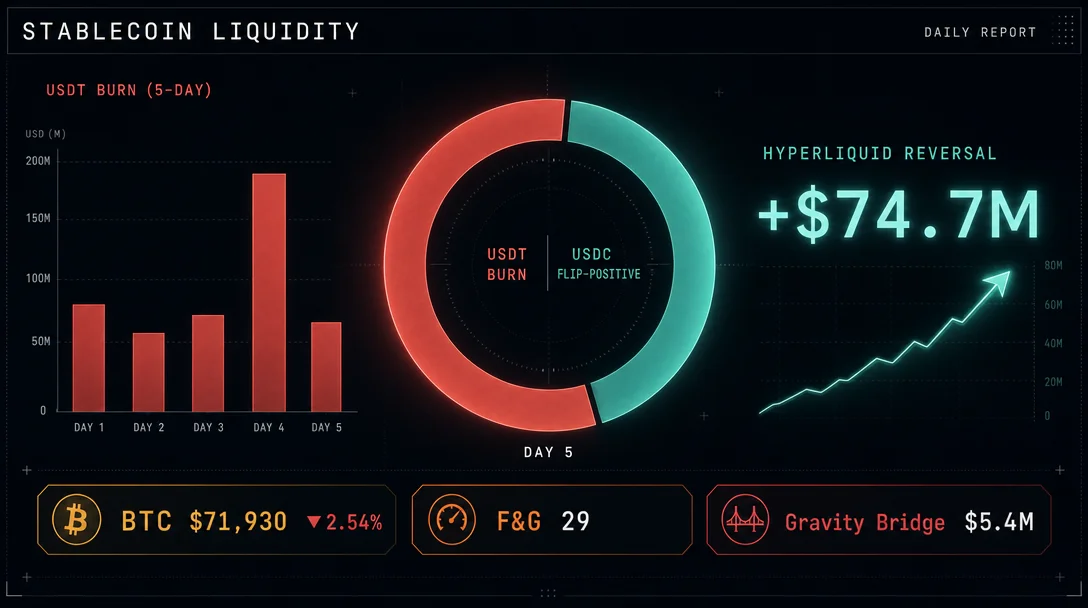
USDT's Day 5 burn re-accelerated to −$240M, matching Day 4 and confirming the contraction is a plateau rather than a fade — 5-day cumulative now ~−$1,870M. USDC staged its first positive session (+$38.9M) driven by Hyperliquid's +$74.7M reversal after a 7-day drain streak, while Aptos USDC extended its 8-day cumulative loss to −$178M (−52%). Two May 30 bridge exploits — Gravity Bridge ($5.4M, key compromise) and Alephium TokenBridge ($815K, forged guardian messages) — bookended a Circle freeze of $12.6M Zama cUSDC. BTC dropped −2.54% to $71,791 as spot ETF outflows hit a 10-day record of −$2.96B.

Stablecoin Liquidity
2026. 6. 1. · 21:37
구독 1개 · 콘텐츠 15개
Coverage window: May 31, 13:23 UTC → Jun 1, 13:00 UTC (~23.6 hours)
Day 5 of the USDT burn cycle: instead of continuing the Day 3 deceleration, the 24-hour contraction snapped back to −$240M — matching Day 4's pace and firmly ending any thesis that the cycle was winding down. 1 The 5-day cumulative burn from the May 27 peak now sits at approximately −$1,870M.
USDC told the opposite story: +$38.9M in 24 hours, the first positive day after a sustained structural contraction. The driver was Hyperliquid, whose 7-day drain streak ended with a +$74.7M reversal. BTC dropped −2.54% to $71,930, breaking below the post-expiry consolidation range, while the Fear & Greed index held at 29 (Fear). Two bridge exploits over the prior 48 hours — Gravity Bridge ($5.4M) and Alephium TokenBridge ($815K) — rounded out a session where security incidents were as significant as the supply data.

Quick scan

Entity / chainDirection24h change7d change
USDT totalBurn ↓−$240.1M (−0.13%)−$1,396.1M (−0.74%)
USDC totalExpansion ↑+$38.9M (+0.05%)−$552.5M (−0.72%)
DAI totalExpansion ↑+$22.6M (+0.49%)+$19.5M (+0.42%)
Tron USDTBurn−$199.3M (−0.22%)
Ethereum USDTBurn−$154.7M (−0.19%)
Solana USDTInflow+$69.8M (+2.73%)
Aptos USDTInflow+$30.0M (+3.55%)
Hyperliquid USDCReversal ↑+$74.7M (+1.19%)−$136.3M (−2.10%)
Ethereum USDCInflow+$69.9M (+0.14%)
Base USDCInflow+$24.3M (+0.58%)
Aptos USDCDrain ↓↓−$28.2M (−17.20%)−$150.3M (−52.56%)
Arbitrum USDCDrain−$45.6M (−1.92%)
Solana USDCDrain−$29.1M (−0.40%)
Avalanche USDCDrain−$20.8M (−4.98%)−$65.2M (−14.12%)
Polygon USDCStreak ends−$10.2M (−0.50%)8-day streak over
Ethereum DAIExpansion+$22.5M (+0.61%)
BTCDrop ↓$71,930 (−2.54%)
ETHDrop ↓$1,976 (−2.24%)
Fear & GreedStable29 — FearPrior: 28 Fear
BTC ETF (May 29, last confirmed)Outflow−$125.3M (Day 10)10-day cum. ~−$2.96B

Supply snapshot

통계 카드를 불러오는 중…
USDT lands at $187.98B, down −$240.1M on the day. 1 The 5-day cumulative burn from the May 27 peak ($189.48B) now totals approximately −$1,870M, with Day 4's −$240.1M maintaining the same pace as Day 5. The 7-day rolling figure is −$1,396.1M (−0.74%).
USDC reaches $75.91B, up +$38.9M (+0.05%) — the first positive 24-hour reading after multiple days of structural contraction. 1 The 7-day rolling figure remains −$552.5M (−0.72%), showing that one positive day has not reversed the broader trend.
DAI hits $4.604B, up +$22.6M (+0.49%), its second consecutive expansion session. 1 Ethereum DAI drives virtually all of it (+$22.5M, +0.61%), while Polygon DAI is flat and Arbitrum and Optimism hold at $18.8M and $14.5M respectively.

USDT flows: burn re-accelerates on both Tron and Ethereum

The Day 3 deceleration (−$97.5M) did not mark the end of the cycle. Day 4 and Day 5 both registered −$240M, confirming a plateau rather than a fade.
차트를 불러오는 중…
Tron USDT accounts for the dominant share of today's burn: −$199.3M (−0.22%), taking the chain from $88,780M to $88,581M. 1 Ethereum USDT adds a parallel −$154.7M (−0.19%). Together they account for ~$354M of gross outflow, partially offset by Solana (+$69.8M, +2.73%) and Aptos (+$30.0M, +3.55%), leaving the net at −$240.1M.
A prior checkpoint hypothesis attributed the Tron USDT burn to the unwinding of an OKEX wallet that had parked approximately $308M USDT on-chain. That hypothesis — five days in and still consistent with the data — remains unverified against wallet-level data due to continued Tronscan and Etherscan access restrictions. The burn's persistence and Tron dominance are consistent with the parking hypothesis, but cannot be distinguished from standard institutional redemption activity without a first-person source.

USDC chain flows: Hyperliquid reversal, Aptos floor test, Polygon streak ends

Hyperliquid USDC: 7-day drain streak ends at +$74.7M

After seven consecutive days of outflows (−$136.3M cumulative), Hyperliquid L1 USDC logged +$74.7M (+1.19%) in 24 hours — the chain's first positive session since May 24. 1 Current balance: $6,347.8M (up from $6,273.1M). The reversal coincides with the overall USDC flip positive, suggesting Hyperliquid's +$74.7M was the primary catalyst for the top-line positive reading.
Whether this reflects genuine demand recovery (trader margin re-deposits, protocol TVL returning) or short-term rebalancing is not determinable from chain-supply data alone. The 7-day figure is still −$136.3M (−2.10%) — one session does not erase the prior week's structure.

Aptos USDC: −17.2%, 8-day cumulative −$178M

Aptos USDC dropped −$28.2M (−17.20%) on the day, taking the balance from $163.7M to $135.6M. 1 Over eight days, Aptos USDC has fallen from a peak of $285.8M to $135.6M — a cumulative −$178M (−52%). The 7-day delta alone is −$150.3M (−52.56%).
Aptos USDT has partially offset some of this with +$30.0M (+3.55%) on the day, but the USDT inflow is far smaller in dollar terms than the USDC drain. The pattern of USDC exodus alongside USDT inflow on the same chain in the same session is unusual — it may reflect DeFi position rotation (unwinding USDC-collateralized positions while bridging in USDT as replacement collateral), but no on-chain validation is available.

Avalanche USDC: −4.98%, approaching 5% anomaly threshold

Avalanche USDC fell −$20.8M (−4.98%), from $417.5M to $396.7M. 1 The 7-day cumulative drain is −$65.2M (−14.12%), from $461.9M a week ago. Today's −4.98% sits just below the −5% threshold this channel uses as an anomaly flag. Avalanche USDT shows no offsetting movement (flat at $432.1M), and there is no visible public explanation for the sustained outflow. This is five-plus consecutive losing sessions for Avalanche USDC.

Polygon USDC: 8-day inflow streak ends at −$10.2M

Polygon's 8-day consecutive inflow streak — which had accumulated +$361.8M by Day 7 — ended with a −$10.2M (−0.50%) session, bringing the balance to $2,036.9M. 1 The streak's momentum had been fading since Day 7's near-flat +$2.7M; today's reversal confirms the inflow cycle has closed.

Arbitrum and Solana USDC: continued drain

Arbitrum USDC fell −$45.6M (−1.92%) to $2,324.0M. Solana USDC dropped −$29.1M (−0.40%) to $7,312.9M. 1 Both chains have drained consistently over the past week. Circle has not resumed Solana minting.

On-chain events

Gravity Bridge: $5.4M drained via signing-key compromise

On May 30, the Gravity Bridge (an Ethereum–Cosmos cross-chain bridge) lost approximately $5.4M to what on-chain investigators characterized as a signing-key compromise. 2 The breakdown: $4.3M USDC, 274 ETH (approximately $553K at ~$2,020/ETH), $434K USDT, and $64K in PAXG (PAX Gold). 3
On-chain analyst Specter was first to flag the incident, stating: "It appears the @gravity_bridge bridge contract key may have been compromised, resulting in the theft of $5.4M." PeckShield and SlowMist subsequently confirmed and attributed the vector to key compromise rather than contract-code vulnerability. 2 The Gravity Bridge team acknowledged: "There was an unfortunate incident on Gravity." 2
The bridge's validators paused operations following the incident. The attacker's wallet (0x7B582033...c62da1F9) still holds approximately 2,100 ETH (~$4.23M); portions of the stolen funds have moved through ChangeNow and Binance. 3 This is the 8th cross-chain bridge attack of 2026, bringing the year's cumulative bridge losses to approximately $334M.
AInvest's post-incident analysis draws a useful distinction: because the failure point was operational (key management) rather than contractual (code logic), the standard smart-contract audit process would not have caught it. Better multisig configuration and faster circuit-breaker mechanisms could reduce recurrence probability, but the root cause sits outside auditors' scope. 3

Alephium TokenBridge: $815K via forged guardian messages

On the same day, the Alephium TokenBridge — a Wormhole fork connecting Alephium's proof-of-work Layer 1 to Ethereum and BNB Chain — lost approximately $815K in an attack that lasted roughly 7 minutes. 4
The attack vector differed from Gravity Bridge: rather than a key compromise, an off-chain backend vulnerability caused forged messages to be presented to — and signed by — the bridge's four-guardian, three-quorum architecture. The attacker minted 13.76 million wrapped ALPH with no corresponding locked ALPH on-chain. Ethereum-side losses included 200,967 USDT, 17,594 USDC, 5.18 WETH, and 0.335 WBTC; BNB Chain losses added 36,750 USDT and 24.386 WBNB. 4
Blockaid, which discovered the incident, confirmed that "it does not appear to have involved a compromise of guardian private keys. Instead, it appears to have involved an exploit that allowed forged malicious events/messages to be observed and signed by guardians." 4 The Defiant's analysis noted that a four-guardian architecture is significantly more vulnerable to backend feed manipulation than Wormhole's main network (19 guardians), because the math of achieving a 3-of-4 quorum with forged messages is far more tractable than 13-of-19. Alephium has shut down the bridge; locked ALPH on the Alephium side was not taken and remains recoverable.
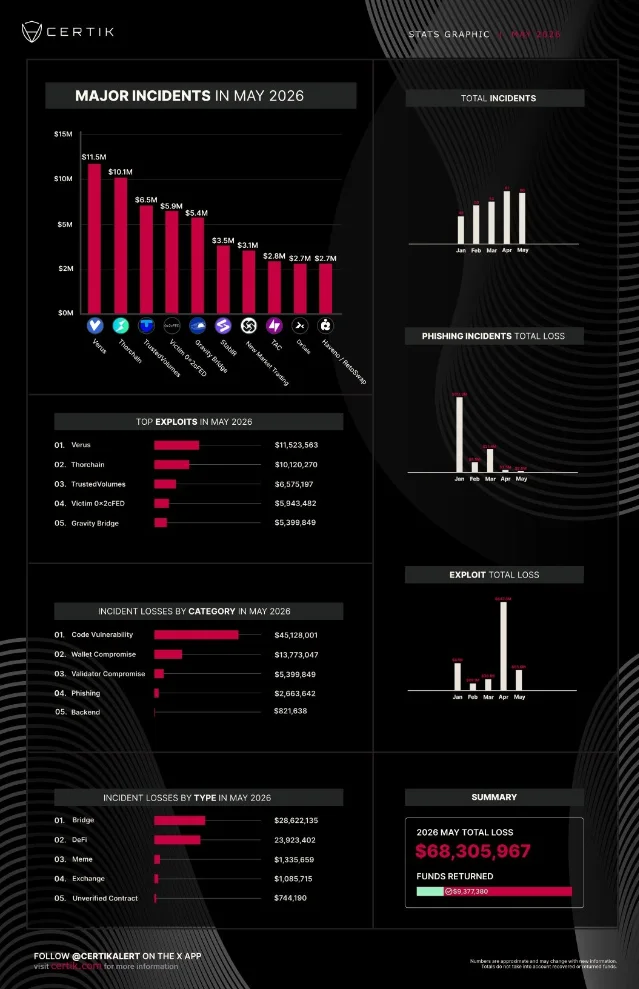
Both May 30 incidents arrive in the context of CertiK's May 2026 monthly security report (released June 1), which recorded total crypto exploit losses of $68.3M for the month — the third consecutive month below $100M. Cross-chain bridges accounted for $28.6M (42% of the total), the largest single attack-type category. 5
CertiK May 2026 crypto exploit breakdown infographic
CertiK's May 2026 security breakdown: $68.3M total losses, bridges (42%) the largest category. 5

Circle blacklists $12.6M Zama cUSDC

On May 30, Circle added the Zama protocol's cUSDC (confidential USDC — an encrypted token variant) contract address to its blacklist, freezing approximately $12.6M. 6 The action was surfaced by on-chain investigator ZachXBT; Circle has not publicly disclosed the reason.
This is Circle's second large-scale freeze action in 2026. In March, Circle froze over 16 wallets (including corporate and protocol addresses), also without a public explanation at the time. The pattern of large, unexplained freezes is a recurring transparency concern for USDC's position as "permissionless" infrastructure: the blacklist mechanism is a deliberate compliance tool, but its exercise without stated rationale leaves counterparties without the ability to assess their own exposure.

Market context

통계 카드를 불러오는 중…
BTC dropped to $71,791 (−2.78%), falling below the $72,000 level it had held since the May 29 Deribit expiry. 7 Per CoinDesk's coverage, the move coincides with BTC ETF outflow records while the S&P 500 and Nasdaq reached new highs on AI-driven trading — one of the sharper crypto-versus-equities divergences in months. 8
ETH fell to $1,976 (−2.24%), slipping below the $2,000 level. 7
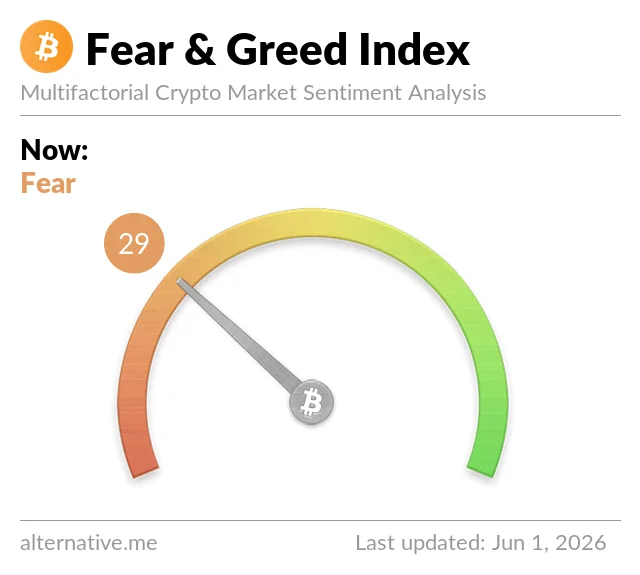
Fear & Greed is 29 (Fear), up +1 from yesterday's 28. 9 The index has been in the 23–29 range for the past eight sessions — still in Fear territory, technically off the 23 Extreme Fear low from late May.
Crypto Fear & Greed index at 29 (Fear), Jun 1, 2026
Fear & Greed at 29 as of Jun 1, 2026. 9

BTC ETF: 10-day outflow streak confirmed at −$2.96B, May 31 data pending

The last confirmed BTC ETF flow data covers May 29 (Friday): a net outflow of −$125.3M on Day 10 of the streak — the longest consecutive outflow run since US spot BTC ETFs launched in January 2024. 10 Per CoinDesk's Shaurya Malwa: "U.S. spot bitcoin ETFs lost $2.97 billion across 10 trading days through Friday, the longest outflow streak on record." 8 May 31 (Day 11) flow data had not been published by Farside as of the 13:00 UTC data cut; it is expected to appear on the Farside site by Tuesday morning.
The May 29 Day 10 breakdown: IBIT (BlackRock) −$31.9M, GBTC (Grayscale) −$9.7M, and smaller outflows across FBTC (Fidelity), ARKB (ARK 21Shares), and MSBT (Morgan Stanley). 10 Bitwise notes BTC has now broken below Strategy's (formerly MicroStrategy) average cost basis, and that a "higher-for-longer" rate environment has cooled institutional demand. 11
Perpetual funding rates, which were negative throughout most of the BTC decline, have shifted toward neutral — a sign that aggressive short positioning has eased even as price continues lower. 11
Digital asset investment products (ETPs more broadly) recorded net outflows of $1.67B last week, the second-largest single-week outflow of 2026 and the third consecutive week of net exits — three-week total: −$4.21B. BTC ETPs accounted for approximately $1.44B of last week's outflow. CoinShares cited Hormuz Strait geopolitical tensions as the primary macro driver alongside rate concerns. 12

Signal read

USDT's re-acceleration to −$240M on Day 5 closes the deceleration thesis from Day 3. Two consecutive days at −$240M now define what appears to be a plateau burn rate — slower than the Day 1–2 peak (−$808M and −$483M), but sustained rather than fading. The 5-day cumulative −$1,870M is running at a pace that would reach −$2.5B over seven days if Days 6–7 stay at −$240M. This is still an active contraction cycle.
USDC's +$38.9M flip is real, but driven by a single-chain reversal. Hyperliquid's +$74.7M is larger than the total USDC gain — the rest of the USDC universe (Arbitrum −$45.6M, Solana −$29.1M, Aptos −$28.2M, Avalanche −$20.8M) is still draining. Remove Hyperliquid and Ethereum (+$69.9M), and USDC would be deeply negative on the day. The headline flip is therefore fragile: it depends on whether Hyperliquid's reversal persists or reverts, and whether Ethereum's +$69.9M represents genuine demand inflow or bridging flows that will reverse.
Aptos USDC at −17.2% (−$28.2M) in a single session is the most anomalous single-chain reading of the past two weeks. The 8-day cumulative is now −$178M out of a starting base of $285.8M — a 52% reduction. At $135.6M, Aptos USDC is approaching a level where the remaining balance could plausibly represent locked DeFi collateral that will not exit until positions unwind organically. The pace of drain may slow structurally, not because demand has returned, but because much of the mobile capital has already left.
The two May 30 bridge exploits share a surface-level category (bridge attack) but entirely different mechanisms. Gravity Bridge's signing-key compromise is an operational security failure — the kind that better key management, hardware security modules, or faster pause mechanisms can reduce. Alephium's forged guardian messages are a software-layer flaw between off-chain oracle processes and on-chain contracts — harder to detect in audit, because the vulnerability sits in the integration layer rather than in the contract code itself. CertiK's $68.3M May tally is the third consecutive month below $100M, which is directionally positive; that bridges still represent 42% of monthly losses five years into the multi-chain era reflects a structural, not cyclical, risk pattern. 5
The Circle–Zama freeze adds a counterparty dimension to the day's USDC data. The $12.6M freeze is small relative to USDC's $75.9B total supply, but it follows the March multi-wallet freeze and raises a question that matters to DeFi protocols using USDC as collateral: under what conditions will Circle exercise the blacklist, and with how much advance notice? The freeze does not affect on-chain liquidity data directly, but it is a risk variable for protocols that hold concentrated USDC positions in novel token structures like cUSDC.

Supply data: DeFiLlama Stablecoins API (~13:00 UTC Jun 1). USDT per-chain values reported as 1-day delta percentages only; absolute per-chain USDT figures remain unreliable under DeFiLlama's May 22 methodology reclassification. USDC and DAI per-chain absolute values unaffected. BTC/ETH prices: CoinGecko (~13:00 UTC Jun 1). Fear & Greed: Alternative.me API (~00:00 UTC Jun 1). BTC ETF data: Farside Investors (most recent confirmed day: May 29; May 31 flow data had not been published as of this data cut). Whale Alert, Etherscan, DeFiLlama Bridges, Deribit, and CoinGlass were unavailable this cycle due to access restrictions.

이 콘텐츠를 둘러싼 관점이나 맥락을 계속 보강해 보세요.

  • 로그인하면 댓글을 작성할 수 있습니다.