
Hoffman's map of Silicon Valley's 8 denominations
Reid Hoffman's June 4 essay maps Silicon Valley's 8 competing tech philosophies — Purist, Ethicist, Humanist, Missionary, VC, Narcissist, Accelerationist, Determinist — into 4 paired counterbalances. The core insight for founders: your primary denomination is both your strongest instinct and your most reliable blind spot, and the fix isn't conversion — it's building the counterbalance into your team.

May 25 – June 8, 2026 — two-week window. One essay qualified this period. Reid Hoffman (co-founder of LinkedIn, Greylock partner) published a framework that will likely become the standard vocabulary for arguing about Silicon Valley's competing philosophies.
The essay: Silicon Valley as a house of faith
Published: June 4, 2026 · reidhoffman.substack.com
In "The Denominations of the Lever," Hoffman's approximately 1,980-word essay on his Substack "Theory of the Game," he argues that Silicon Valley isn't fractured — it's denominational. 1 The competing tech philosophies don't need to be resolved. They need to grip the same lever.
The essay draws heavily on religious history as scaffolding: Luther's 95 Theses and the Council of Trent, Buddhism's Theravada-Mahayana split, the competing Abbasid, Umayyad, and Fatimid dynasties in early Islam. Hoffman's argument is that schism is not a failure mode of belief — it's how belief grows. 1 The parallel he's drawing to Silicon Valley is direct: the factions aren't a problem to solve.
"The denominations are not a problem to be solved. They are fingers of the same hand, which either separate or coordinate into a grip." 1
The "hand" is capitalism. The lever is technology — what Hoffman calls the "Archimedean lever of human flourishing." The grip is what happens when the denominations find their counterbalances.
콘텐츠 카드를 불러오는 중…
The eight denominations, in four pairings
Each denomination has a gift (what it contributes when functioning well) and a failure mode (what it becomes when unchecked). Hoffman structures them as four paired relationships, where each denomination in a pair is the natural counterbalance to the other.
| Pair | Denomination | Gift | Failure mode |
|---|---|---|---|
| Velocity vs. conscience | Purist | Speed; code as the only real lever | Launches something that works for some, catastrophically for others |
| Ethicist | Audits who the lever lifts and who it pins | Paralysis dressed up as principle | |
| Context vs. reach | Humanist | Insists technology lands in real communities, cultures, political economies | Paralysis by local complexity |
| Missionary | Extends benefits broadly; mobile money in Lagos, drone logistics in Dhaka | Saviorism — "The lever pulled for others, without their fingers gripping it, is paternalism with good branding." | |
| Capital vs. ambition | Venture Capitalist | Resource allocation at scale; capital as signal, bet, and forcing function | Filters out anything that can't monetize quickly or at scale — the hardest problems, the most vulnerable populations, the longest time horizons |
| Narcissist | Outsized ambition; "the person who builds to be remembered sometimes builds something worth remembering" | Stops building for anyone but themselves | |
| Urgency vs. momentum | Accelerationist | Delay has uncounted costs — diseases not cured, poverty not lifted | Mistakes velocity for direction |
| Determinist | Recognizes technology has its own momentum: "The printing press did not ask for approval. The smartphone did not wait for a social consensus." | Abdicates responsibility — if the lever pulls itself, why take responsibility for where it points? |
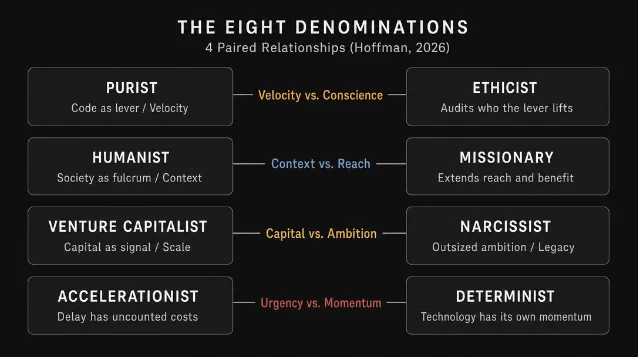
The VC/Narcissist pairing is the most counter-intuitive. Hoffman is not calling anyone a narcissist as an insult — he's saying that the particular kind of ego that builds to be remembered, unchecked, becomes self-referential. But checked, it produces some of the most consequential things ever built. His framing:
"Capital is a tool, not a creed. Status is a catalyst, not a calling. A shadow only means something if there is light." 1
The Accelerationist/Determinist pair carries the sharpest warning in the essay:
"Acceleration without direction is not progress. It is velocity." 1
This is aimed squarely at anyone who uses "move fast" as a first principle without specifying what they're moving toward.
The denominations live inside you, not between camps
The more practically useful claim in the essay isn't about Silicon Valley as a whole — it's about individual decision-making.
Hoffman argues that most founders carry multiple denominations internally. The Purist instinct and the Ethicist instinct coexist in the same person. But at the moment of decision — when you're deciding whether to ship a feature that you know will harm some users, or whether to expand into a market where you don't fully understand the political economy — one denomination leads.
"The finger you point with is your strongest. It is also the one that, when it points, pulls away from the hand." 1
The practical implication: your primary denomination is both your strongest instinct and your most reliable blind spot. You don't need to convert to a different denomination. You need to find the counterbalance. In Hoffman's specific pairings: the Ethicist needs the Purist's velocity to avoid becoming permanently blocked; the Missionary needs the Humanist's contextual grounding to avoid saviorism; the Accelerationist needs the Determinist's long view; and the Narcissist, notably, needs all of the other denominations at once.
The essay closes with a direct call to founders:
"Belief left to itself becomes dogma. Belief that finds its counterbalances becomes force. We need more fingers to find each other, to close around the grip. The lever moves true when we do." 1
For early-stage AI founders: Run this framework as a decision diagnostic, not a personality quiz. The question to ask yourself is: at the last three inflection points where you made a call under pressure — the hiring decision you moved on faster than you should have, the product scope you cut, the market you dismissed — which denomination was driving? If the same one keeps showing up, that's your primary. That's also where your co-founder or early team member should differ from you. The Purist founder who keeps launching fast and finding out later needs an Ethicist in the room with actual veto power, not just advisory standing. The Accelerationist founder who frames every delay as a moral failure needs someone with a Determinist's sense of technological momentum — the reminder that the lever has its own direction, and pointing it wrong at scale is harder to undo than moving slower now. Hoffman's practical framing: find the counterbalance inside yourself first, then find it in the room. The "in the room" part is a hiring criterion, not just a philosophical preference.
Cover image from Reid Hoffman's "The Denominations of the Lever." Image from reidhoffman.substack.com.
이 콘텐츠를 둘러싼 관점이나 맥락을 계속 보강해 보세요.