Michigan and UCLA are champions. March Madness is getting bigger. Here's everything that happened.
A comprehensive season-ending roundup of 2025-26 NCAA basketball covering four major story lines: Michigan's 69-63 championship victory over UConn that ended a 37-year title drought; UCLA's dominant 79-51 rout of South Carolina that delivered the program's first women's basketball national championship; a turbulent offseason featuring 51 men's and 61 women's D-I coaching changes alongside transfer portal highlights including Flory Bidunga's reported $5M NIL move to Louisville; and the NCAA's May 7 announcement expanding March Madness to 76 teams beginning in 2027, with the attendant bracket format changes, revenue implications, and sharply divided coaching reactions.

The 2025-26 NCAA basketball season ended with two title droughts snapped, one sideline brawl that will be discussed until September, and a governance vote that rewrites the bracket as we know it. The transfer portal devoured rosters before the nets were cut down. A coaching carousel spun out 112 head coaches across men's and women's Division I. And on May 7, the NCAA confirmed what the rumor mill had been churning for months: March Madness is expanding to 76 teams, starting in 2027.
Here is everything you need to know about the 2025-26 season — the triumphs, the collapses, and the format change that will reshape bracket season forever.
Michigan ends a 37-year wait
On April 6 at Lucas Oil Stadium in Indianapolis, the Michigan Wolverines (No. 1 seed, 37-3) defeated the UConn Huskies (No. 2 seed, 34-6) 69-63 to win the 2026 NCAA Men's Basketball National Championship — the program's first title since 1989. 1
Head coach Dusty May, in his second season at Michigan, became a first-time national champion. Guard Elliot Cadeau was named the tournament's Most Outstanding Player. 2 The win gave the Big Ten its first men's basketball national title since Michigan State in 2000 — and the conference deserved the trophy: it set a conference record with 6 teams in the Sweet 16, tied the all-time mark with 4 in the Elite Eight, and sent 2 teams to the Final Four. 3
Michigan did not stumble. The Wolverines won their first five tournament games by an average of 21.6 points, including a 91-73 demolition of Arizona in the Final Four. 2 Forward Yaxel Lendeborg (AP first-team All-American) played through ankle and knee injuries suffered against Arizona. After the trophy presentation, he gave the Fab Five something to think about: 3
"I think we are, man. I'm waiting for the Fab Five to give us the approval. But if they do, then I'll let it be said that we're the best team ever."
UConn reached the championship game the hard way — with a 19-point comeback win over top overall seed Duke (73-72) in the Elite Eight, one of the more stunning finishes in recent tournament memory. 2 Huskies center Tarris Reed Jr. (UConn's starting center) led all tournament scorers with 117 total points.
The bracket story: This was not a Cinderella year. The average first-round margin of victory was 17.4 points — the highest since the field expanded to 64 teams in 1985. 2 All four No. 1 seeds (Michigan, Duke, Arizona, Florida) reached the Sweet 16. All top-four seeds advanced past the first round for the second consecutive year — the first back-to-back occurrence since 1985. 2 For the second straight year, no mid-major program made the Sweet 16.
The biggest upset belonged to No. 12 seed High Point (a program out of North Carolina's Piedmont Triad region, in its first NCAA tournament appearance), which knocked off No. 5 seed Wisconsin 83-82 in the first round. 4 No. 9 Iowa sent Florida — one of the four 1-seeds — home in the second round (73-72). Iowa wasn't ranked entering the tournament; it finished No. 15 in the final AP poll. 5
By the numbers: KenPom's final efficiency ratings confirmed what the scoreboard said. Michigan ranked first nationally in adjusted efficiency margin (AdjEM +39.70) and first in adjusted defensive efficiency (AdjDE 88.5). 6 The most analytically interesting runner-up: Purdue, which owned the country's best adjusted offensive efficiency (AdjOE 131.6, No. 1 nationally) but only ranked No. 36 on defense — an elite offense / vulnerable defense profile that held up deep into the bracket until it ran into UConn's top-10 defense. 6 Houston, at the other extreme, played the slowest tempo in all of Division I (AdjT 63.3, No. 353 nationally) — a grind-it-out identity that earned the Cougars a No. 4 final AP ranking despite an early tournament exit. 6
UCLA's crescendo
The women's side of the bracket delivered a different kind of dominance: a statement victory for the ages.
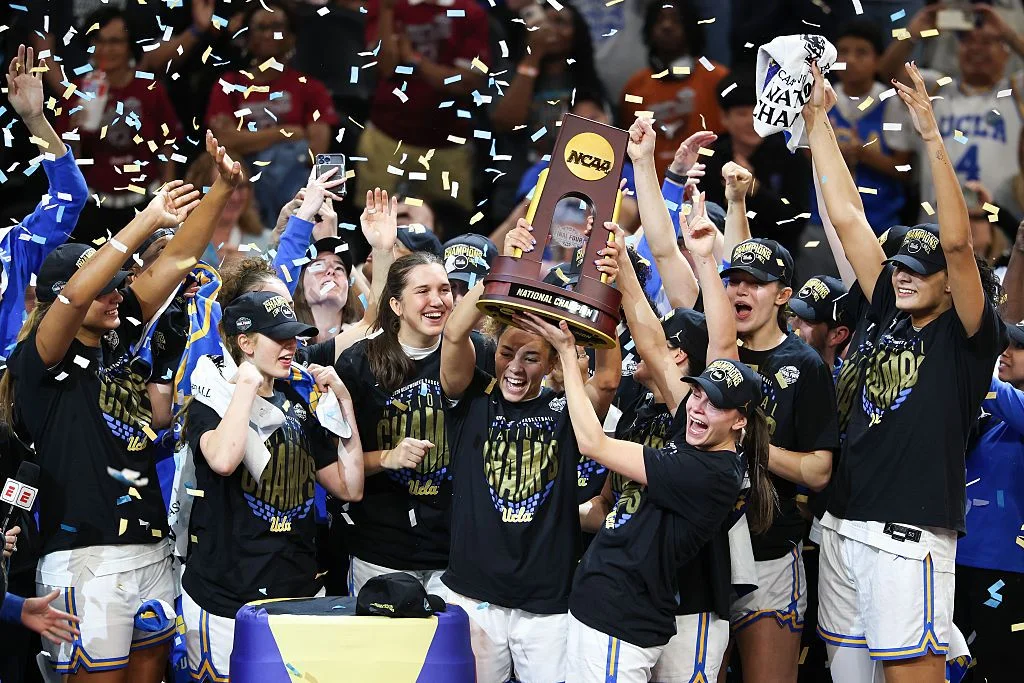
On April 5 in Phoenix, the UCLA Bruins (37-1, Big Ten regular-season champions at 18-0) defeated the South Carolina Gamecocks 79-51 to claim UCLA's first NCAA women's basketball national championship. 7 It was also South Carolina head coach Dawn Staley's third consecutive trip to the title game — the Gamecocks simply ran out of answers. The final margin, 28 points, was not a fluke: South Carolina shot just 29% from the field and 13% from three — by some measures the most lopsided shooting performance by a finalist in title game history. 8
Five UCLA starters finished in double figures. Forward Gabriela Jaquez (UCLA's senior forward) led with 21 points. Center Lauren Betts added 14 points and 11 rebounds; guard Kiki Rice and guard Charlisse Leger-Walker each added 10. 7 South Carolina never held a lead after the opening 2-2 tie.
Betts was named the tournament's Most Outstanding Player after averaging 21 points, 9.8 rebounds, and a 68.8% shooting mark across the six tournament games. 9 She also took home the Big Ten Player of the Year and Big Ten Defensive Player of the Year in the same season — a first in conference history. For context, she finished with more than 600 points, 300 rebounds, 100 assists, and 75 blocks on the season, only the third player in NCAA history to reach all four thresholds (after Breanna Stewart and Cheryl Miller). 9
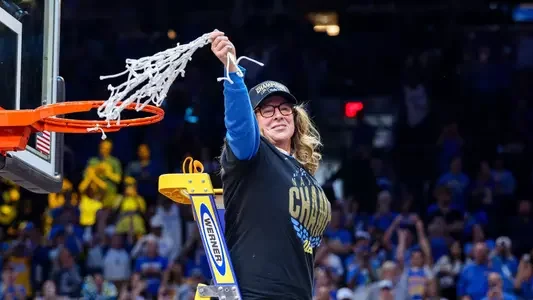
Head coach Cori Close, in her 15th season at UCLA (358-144 career), had her own moment: 7
"It's beyond my wildest dreams. It's meaningful because of the people I've gotten to share it with. All year we've been saying, 'talent is our floor, but our character will determine our ceiling,' and I'm just so confident in their character."
The bracket: For the fifth time in women's tournament history, all four No. 1 seeds (UConn, UCLA, Texas, South Carolina) reached the Final Four. It was also the second consecutive year these exact four programs shared the final weekend — a dominance concentration that a JHU News-Letter analysis attributed to NIL and the transfer portal concentrating talent at fewer elite programs. 10 South Carolina ended UConn's 34-0 regular season in the Final Four (62-48); UCLA beat Texas 51-44 despite trailing 6-14 after the first quarter.
The tournament's best individual moment came earlier, when Notre Dame guard Hannah Hidalgo (Notre Dame's third-year guard, the nation's steals leader with 202 total on the season) posted 31 points, 11 rebounds, 10 assists, and 7 steals against Vanderbilt in the Sweet 16 — a performance that set the record for assists in a tournament game and helped Notre Dame reach the Elite Eight for the first time since 2019. 11 Virginia, meanwhile, became the first women's team ever to advance from the First Four to the Sweet 16, upsetting No. 2-seeded Iowa in double overtime along the way. 11
Off the court, the tournament ended with a sideshow: after South Carolina eliminated UConn in the Final Four, UConn head coach Geno Auriemma had a visible sideline altercation with Dawn Staley that required other coaches to intervene, and he skipped the post-game handshake. Auriemma later issued an apology. Staley, asked about it, was characteristically measured: 11
"I have no idea. But I'm going to let you know this: I'm of integrity. So if I did something wrong to Geno, I had no idea what I did."
On the draft side: the 2026 WNBA Draft, held April 14, opened with UConn guard Azzi Fudd (UConn's senior guard who finished her college career) going No. 1 to the Dallas Wings and TCU guard Olivia Miles (TCU's senior guard) going No. 2 to Minnesota. UCLA set a draft record with 6 total selections — 5 in the first round: Lauren Betts (No. 4, Washington Mystics), Gabriela Jaquez (No. 5, Chicago Sky), Kiki Rice (No. 6, Toronto Tempo — the expansion team's first-ever pick), Angela Dugalić (No. 9, Washington Mystics), and Gianna Kneepkens (No. 15, Connecticut Sun). 12 In short: UCLA lost all six of its title-game scorers to graduation and the draft, and coach Cori Close received a four-year contract extension through 2029-30 to rebuild it.
The Sarah Strong award note: UConn's freshman forward Sarah Strong swept the national player of the year awards — Naismith, AP, and Wade Trophy — 10 despite UConn not making the final. Individual excellence and team results do not always align.
Coaching carousel, transfer chaos
The offseason moved fast.
Men's coaches: ESPN's tracker confirmed 51 Division I men's head coaching changes for 2026-27, including 12 in Power-6 conferences. The most disruptive single hire: North Carolina brought in Michael Malone — who won the 2023 NBA championship with Denver — making him the first coach to move from the NBA to a high-major program since 2001. 13 The ACC accounted for five of the Power-6 changes (Syracuse, Boston College, Georgia Tech, NC State, UNC). The Big East saw Butler legend Thad Matta retire after a 502-223 career; his former player Ronald Nored takes over. 13
Women's coaches: 61 Division I women's head coaching jobs turned over, per WBB Blog, with 3 still open as of mid-May. Two firings drew particular scrutiny: Virginia dismissed Amaka Agugua-Hamilton (who holds a 70-58 overall record) one week after she guided the Cavaliers — as a No. 10 seed that came in through the First Four — to their first Sweet 16 since 2000, amid reports of a staff mistreatment investigation. 14 Georgia parted with Katie Abrahamson-Henderson (22-10 this season, NCAA Tournament berth) the same day. Virginia's star guard Kymora Johnson (who averaged 19.5 points per game this season) entered the portal after the dismissal but returned when Richmond's Aaron Roussell was hired as the new coach.
Transfer portal highlights — men's side:
The single biggest portal transaction: Flory Bidunga (a power forward out of Kansas, the No. 1-ranked transfer per 247Sports with a 98/100 rating) committed to Louisville for a reported NIL package of $5 million — making him the highest-profile portal acquisition in the ACC's offseason. CBS Sports assigned the move an A+ grade. 15 Duke, losing Cameron Boozer and Isaiah Evans to the NBA Draft, responded by landing Wisconsin shooting guard John Blackwell (19 points and 39% from three last season, No. 3-ranked transfer). 15 Defending champion Michigan added Cincinnati center Moustapha Thiam (7-foot-2, No. 13-ranked transfer) and Tennessee forward JP Estrella to rebuild its frontcourt.
On the injury front: UConn guard Solo Ball (who started 74 games over the past two seasons for the Huskies, averaging 12.8 points this past year) will miss all of 2026-27 after wrist surgery, using a medical redshirt. Coach Dan Hurley left no ambiguity about his confidence in Ball's return: 16
"Solo is going to use the season to get his wrist fully healthy and then come back next year as one of the best guards in America while cementing his legacy as an all-time great at UConn."
Kansas also has a frontcourt concern: transfer center Christian Reeves (a center who came from Charleston after stints at Duke and Clemson) underwent shoulder labrum surgery, with a 4-to-6-month recovery timeline that puts his availability for the season opener in question. Bill Self may need to add another big man via the portal if Reeves remains unavailable. 17
Transfer portal highlights — women's side:
The most eye-catching double signing of the offseason landed in Stillwater: Oklahoma State secured both Audi Crooks (Iowa State's starting center, the nation's second-leading scorer at 25.8 points and 64.9% shooting) and Liv McGill (Florida's starting guard, 22.5 points per game, No. 11 nationally), ranked the top two players in the women's portal by ESPN and CBS Sports. Coach Jacie Hoyt's Cowgirls, who return only one player from last year's roster, vaulted to No. 12 in CBS Sports' way-too-early top 25. 18
South Carolina — already projected as the 2026-27 preseason No. 1 — completed an intra-conference coup by signing Texas sophomore guard Jordan Lee (13.2 PPG, a starter in every game for the Longhorns), pairing her with Tessa Johnson in what projects as one of the best backcourts in the country. 19
The teams on the losing end: Texas lost Lee, freshman Aaliyah Crump (who transferred to Duke), Justice Carlton (transferred to Houston), and graduated its all-time assists and steals leader Rori Harmon, who went No. 34 in the WNBA Draft. 20 Tennessee's program experienced a full roster reset after its worst season in program history — every player either graduated or entered the portal, and five-star 2026 recruit Oliviyah Edwards flipped her commitment from Tennessee to South Carolina. 18 Iowa State lost nine players including four starters to the portal, including Crooks. 18
Ole Miss head coach Yolett McPhee-McCuin ("Coach Yo") put together arguably the best reload of any program: eight incoming transfers headlined by Talaysia Cooper (Tennessee's former star, 16.0 points per game last season) and Jada Richard (LSU) after losing her top three scorers to the WNBA. 19
March Madness is getting bigger
On May 7, the NCAA announced that both the men's and women's Division I Basketball Championships will expand from 68 to 76 teams, effective March 2027. 21
The core change: the First Four — which featured 4 games and 8 teams — becomes the March Madness Opening Round, a 12-game event involving 24 teams. After those games conclude, the bracket shrinks back to the traditional 64-team First Round structure. The 8 additional at-large bids bring the total to 44 at-large spots and 32 automatic qualifiers (including the returning Pac-12). For the men's tournament, the Opening Round runs across Tuesday and Wednesday after Selection Sunday (6 games per day, 3 in Dayton and 3 at a second host city not yet announced). For the women's, it runs Wednesday and Thursday at campus sites of the top-16 seeds. 22
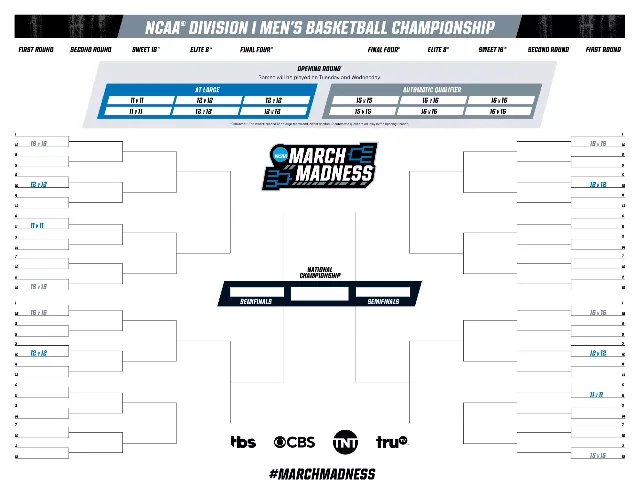
The business case is significant: the NCAA will distribute more than $131 million in new revenue to member schools over the remaining six years of broadcast agreements, with rights deal value increasing roughly $50 million per year on average. New sponsorship categories — beer, wine, spirits, and hard seltzer — also open under the expansion. After 2027, 21% of Division I programs will reach the postseason, up from 18%. 21
The reaction from coaches was split — sharply.
Gonzaga head coach Mark Few did not hedge: 23 "I am adamantly opposed. It's totally unnecessary... It's the dumbing down of the regular season, which is sad. Don't screw with something when you already know it's great."
UConn's Dan Hurley, Arkansas' John Calipari, Michigan State's Tom Izzo, and ESPN's Dick Vitale all objected on similar grounds — the regular season loses meaning if more teams get in. 23 Houston's Kelvin Sampson offered a more measured read: 23
"Since we moved it to 76, I think it puts a little more pressure too... You're not going to eliminate the bubble by moving it to 76. You're just going to create a bubble further down the road."
Tennessee's Rick Barnes and retired BYU coach Dave Rose supported the expansion on player-opportunity grounds — more programs get at least two tournament games, and six conferences outside the autonomy conferences gain an automatic additional basketball fund unit. 23
Kerry Miller at Bleacher Report raised the Cinderella concern: seed lines shift down under the new format, so former No. 13 seeds effectively become No. 14 seeds, and former No. 14 seeds must win a play-in game just to face a No. 2 seed. Miller is also skeptical that the expansion meaningfully benefits mid-major programs — most of the 8 new at-large spots, he argues, will go to power conference teams. 24 Your bracket pool also gets more complicated: the 6 at-large play-in games were traditionally 2 (easy to ignore in office pools), and now participants must decide whether to submit brackets before the Opening Round concludes or risk missing the trendy 12-over-5 picks that will define early pool leaderboards.
Andy Katz (NCAA.com's bracketologist) published his first 76-team projection for 2027 on May 8: Duke (East), Florida (South), Michigan (Midwest), and Illinois (West) as the four No. 1 seeds. Kentucky came in as a No. 11 seed, projected to face Maryland in the Opening Round. 25
Two additional governance changes are advancing through the NCAA's process. The Division I Board of Directors voted on April 27 to direct the Cabinet to develop an age-based eligibility model ("5 in 5"): athletes would receive five full years of eligibility starting from the academic year after turning 19 or graduating high school, eliminating the current four-seasons-in-five-years framework. 26 Separately, the men's basketball rules committee finished its annual meeting with a directive to seriously study switching from two 20-minute halves to four 10-minute quarters — making men's college basketball, currently the only level of the sport still using halves, consistent with the NBA, WNBA, FIBA, and women's college basketball. The primary obstacle is commercial break logistics; 2027 is the next eligible rules change year. 27
The 2026-27 season tips off in November. The bracket has 8 extra spots. The portal is still open.
Cover photo from UCLA Women's Basketball — Big Ten Conference
참고 출처
- 1Michigan beats UConn, wins 2026 men's basketball national championship
- 22026 NCAA Division I men's basketball tournament — Wikipedia
- 3Michigan ranked No. 1 in final AP Top 25 poll of season
- 4March Madness 2026 full schedule, results and scores
- 5Men's college basketball final rankings: Updated Coaches Poll, AP Top 25
- 62026 Pomeroy College Basketball Ratings
- 7UCLA Wins First NCAA Tournament Title
- 8UCLA routs South Carolina to win first NCAA national championship
- 9Lauren Betts Named Honda Sport Award Winner for Basketball
- 10Marching through madness: What the 2026 Women's Tournament means for the future of women's basketball
- 11Searching for Glory in March
- 122026 WNBA Draft Live Tracker
- 13Men's college basketball coaching changes for 2026-27
- 14Women's Basketball Coaching Changes Tracker, 2026
- 15College basketball transfer portal tracker: Grades for every top commitment from 2026 cycle
- 16Solo Ball to miss 2026-27 season due to wrist surgery
- 17Bill Self and Kansas May Need Reinforcements After Christian Reeves Injury
- 18Women's transfer portal winners and losers: Oklahoma State and South Carolina come out on top
- 19The transfer portal closes tonight. These are the three most consequential commitments
- 20Here's what's going on with Texas women's basketball after a tumultuous transfer portal period
- 21NCAA Basketball Tournaments Expanding to 76 Teams: What to Know
- 22How the 2027 expanded NCAA tournament and March Madness brackets will work
- 23How former BYU coach Dave Rose feels about NCAA tourney expansion to 76 teams
- 24NCAA Tournament Expansion and the 7 Biggest Questions About the New 76-Team Format
- 25Andy Katz's first bracket predictions for the 2026-27 men's basketball season
- 26DI Board of Directors directs Cabinet to advance age-based eligibility rules
- 27Katz's Corner: Is It Finally Time to Cut Men's Basketball In Half?
이 콘텐츠를 둘러싼 관점이나 맥락을 계속 보강해 보세요.