Doomscrolling is now official English
The OED's March 2026 update formally added *doomscrolling*, *doomscroll*, and *doomscroller* — no longer slang. Trace the word's 1,400-year etymology, its murky 2018 Twitter birth, its COVID explosion into mainstream English, and how to use all three forms correctly.
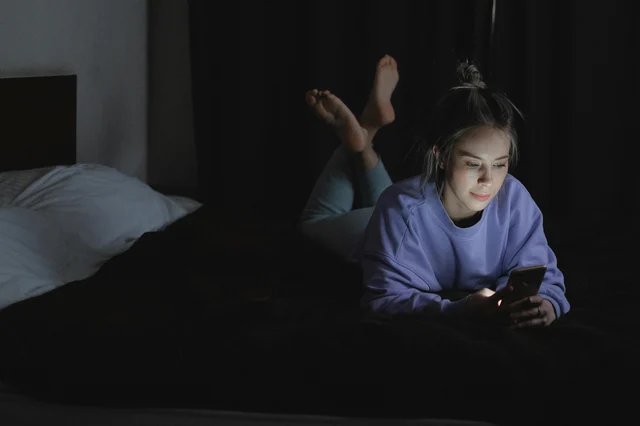
It starts, as so many modern habits do, with a phone in a dark room. You open a news app at 11 p.m. to check one headline, and ninety minutes later you're reading about a flood in a country you've never visited. You feel worse than when you started, yet you keep going. There's a word for this. As of March 2026, it's in the Oxford English Dictionary.
Doomscrolling entered the OED's March 2026 quarterly update 1 — one of more than 500 new words, phrases, and senses added in a single batch. The word arrived not alone but as a trio: the noun doomscrolling, the verb doomscroll, and the agent noun doomscroller. All three forms are now considered standard contemporary English.
What it means, and what the dictionaries disagree about
The OED defines doomscrolling (n.) as "the action of scrolling continuously and compulsively through large quantities of upsetting or worrying online news, or content on a social media platform." 2 The verb form, doomscroll, is the same action expressed as an intransitive act; a doomscroller is the person doing it.
One detail worth noting: the OED entry carries no register label. No "informal," no "slang," no "colloquial." That's a deliberate editorial call. When a word gets those tags stripped, it means lexicographers have decided it belongs to general educated usage, not to any particular social register or subculture.
The OED wasn't first. Merriam-Webster formally added doomscroll as a verb in September 2023 3 — two and a half years before Oxford got there. The two definitions differ in a telling way: Merriam-Webster's version says "spending excessive time scrolling through online content (especially news) that makes one feel sad, anxious, angry, etc." 4 The OED version sharpens this to "continuously and compulsively" and limits the object to "upsetting or worrying" content. Where M-W emphasizes excessive time, OED emphasizes the compulsive, looping quality of the act. Both are right, but they're naming different aspects of the same spiral.
Cambridge Dictionary defines it more simply as "the activity of spending a lot of time looking at your phone or computer and reading bad or negative news stories" — accessible, if less clinically precise.
A 1,400-year etymology squeezed into one portmanteau
The compound is a blend of doom and scrolling. Each half carries more history than the finished word might suggest.
Doom goes back to Old English dōm, meaning a law, statute, or decree — essentially, a judgment. 5 It derives from Proto-Germanic *domaz, itself from the Proto-Indo-European root *dhe- ("to set, place, put, do"). Cognates include Old Norse dómr, Old High German tuom (judgment, decree), and Sanskrit dhaman- (law). In Old English, a book of laws was called a dombec. The modern sense of doom as ruin, destruction, or inescapable fate only began to take hold in the early fourteenth century and became general after about 1600, shaped in large part by doomsday — the Christian day of final judgment. By the time Marvel named a supervillain Doctor Doom, or Tim Burton christened a villain Judge Doom, the original jurisprudential meaning was centuries buried.
Scroll takes a different route. The noun enters English around 1400 from Anglo-French escrowe and Old French escroe, meaning a strip or roll of parchment. 6 These trace back to Frankish *skroda ("a shred") and Proto-Germanic *skrauth-, from the PIE root *sker- ("to cut"). The computing sense — moving text across a screen line by line — wasn't recorded until 1981, just four decades ago.
Put the two together and you have something oddly apt: the Old English concept of inescapable judgment fused with the modern act of paging through a digital feed. The portmanteau word, coined on a social media platform in 2018, is carrying 1,400 years of linguistic freight.
A competing term, doomsurfing, emerged alongside it. 4 "Surfing" had been the dominant verb for browsing the early internet; as mobile devices made scrolling the primary motion of content consumption, doomscrolling outpaced its rival.
Born on Twitter, in October 2018
The OED dates the word's first use to 2018 — and notes that all three of its forms (noun, verb, agent noun) first appeared on Twitter. 2 Craig Leyland, the OED Executive Editor for the March 2026 update, said: "The verb doomscroll appeared one day after the noun, but it took until 2020 before a person was described as a doomscroller." 2
Wikipedia credits the original coinage to Ashik Siddique, now co-chair of the Democratic Socialists of America. 7 The origins are, as Wired acknowledged, "a bit murky" — the October 2018 tweet that multiple outlets point to as a possible first use hasn't been independently recovered in full, partly because Twitter's historical search API only covers the last seven days.
What's less murky is how the word escaped obscurity. Quartz reporter Karen K. Ho began posting nightly Twitter reminders in 2020 — "Hey, are you still doomscrolling?" — and gathered more than 20,000 followers from the practice alone. 8 Ho had first spotted the term in a post from October 2018 and later described the phenomenon's appeal with precision:
"It feels productive and like we're exercising our agency during a period where we can't do much and so much choice and variety has been taken away, even though it's often neither of those things." 8
The knowledge-is-power impulse — the sense that reading one more article keeps disaster at bay — is exactly what makes the loop so sticky.
How COVID turned a Twitter curiosity into a household word
When COVID-19 lockdowns began in March 2020, hundreds of millions of people found themselves stuck inside with nothing to do but track a fast-moving emergency. Traffic to news sites surged. The word doomscrolling surged with it. Dictionary.com named it the top monthly trend in August 2020. 7 The Macquarie Dictionary of Australian English named it its 2020 Committee's Choice Word of the Year. And in November 2020, the OED — in an unusual break from its tradition of naming a single Word of the Year — published a "Words of an Unprecedented Year" report that included doomscrolling in its list, acknowledging that 2020 simply refused to compress into one word. 9
The behavior the word names has real neurological weight. Clinical psychologist Amelia Aldao described the mechanism to Vox: "The more time we spend scrolling, the more we find those dangers, the more we get sucked into them, the more anxious we get. Now you look around yourself and everything feels gloomy, everything makes you anxious. So you go back to look for more information." 8 Researchers have linked heavy doomscrolling to changes in the inferior frontal gyrus, the brain region that filters out threatening information — chronic exposure can, over time, lower that filter's threshold.
The scale isn't trivial. A 2024 Morning Consult survey found that approximately 31% of American adults doomscroll on a regular basis. 7 Among millennials the figure rises to 46%; among Gen Z adults, 51%. Meanwhile, the 2024 Reuters Institute Digital News Report found that 39% of people worldwide now actively avoid the news — up from 29% in 2017. The two trends coexist: some people can't stop; others have stopped entirely.
Part of the design problem is infrastructural. Aza Raskin, who invented the infinite scroll mechanism in 2006, later described it as "one of the first products designed to not simply help a user, but to deliberately keep them online for as long as possible." 8 Without a natural end-of-page to prompt you to stop, stopping becomes a conscious act of will — which is exactly why most people don't.
The events that have since powered doomscrolling cycles read like a catalog of the decade's anxieties: the George Floyd protests, the 2020 U.S. presidential election, the January 6 Capitol storming, Russia's invasion of Ukraine, the Gaza war, the ongoing climate emergency.
How to use the word — and its built-in antidote
The three forms of the word work as follows:
- Doomscrolling (noun, pronounced doom-SKROH-ling): used to describe the behavior as an activity. "Hours of doomscrolling left her more anxious than informed."
- Doomscroll (verb, ˈdüm-ˌskrōl): both transitive and intransitive. "She doomscrolled until 2 a.m." or, less commonly, "He doomscrolled his way through the election night coverage."
- Doomscroller (noun): the person engaged in the behavior. "As a committed doomscroller, he knew every cable news anchor by their closing catchphrase."
The word sits comfortably in formal and informal writing alike — that missing register label matters. You can use it in a newspaper op-ed, a medical journal introduction, or a text message. Its near-synonym doomsurfing is understood but carries a dated internet-era feel; doomscrolling is the more current choice in any context.
One final detail worth keeping: the OED added doomscrolling and touch grass to its March 2026 update in the same batch. 2 The OED explicitly described "touch grass" — the directive to go outside and disengage from screens — as a "commonly-suggested cure for the inveterate doomscroller." That the dictionary formalized the problem and its folk remedy in a single update has a quiet logic to it: the language caught up to the habit, and the habit came with its own exit sign already attached.
참고 출처
- 110 highlights from the March 2026 Oxford English Dictionary update
- 2New words in the OED: March 2026 update
- 3Definition of DOOMSCROLLING — Merriam-Webster
- 4On "Doomsurfing" and "Doomscrolling" — Merriam-Webster
- 5doom — Etymology, Origin & Meaning — Etymonline
- 6scroll — Etymology, Origin & Meaning — Etymonline
- 7Doomscrolling — Wikipedia
- 8Doomscrolling, explained — Vox
- 9Doomscrolling On A Staycation? The OED's "Words of an Unprecedented Year" — NPR
이 콘텐츠를 둘러싼 관점이나 맥락을 계속 보강해 보세요.