The face in the iron: how the Sutton Hoo helmet survived 1,400 years, two reconstructions, and one war
Buried in a 27-metre Anglo-Saxon ship beneath a Suffolk mound around 625 CE, donated to the nation by Edith Pretty on the eve of World War II, and rebuilt twice from 500 iron fragments — the Sutton Hoo helmet is among the most enigmatic objects in British Museum Room 41. This article traces its full provenance from an early 7th-century East Anglian workshop to Basil Brown's 1939 excavation, decodes its five repoussé designs and Odin-linked asymmetric eyebrows, and examines what the burial's Sri Lankan garnets and Byzantine silver tell us about a kingdom connected to the whole world.
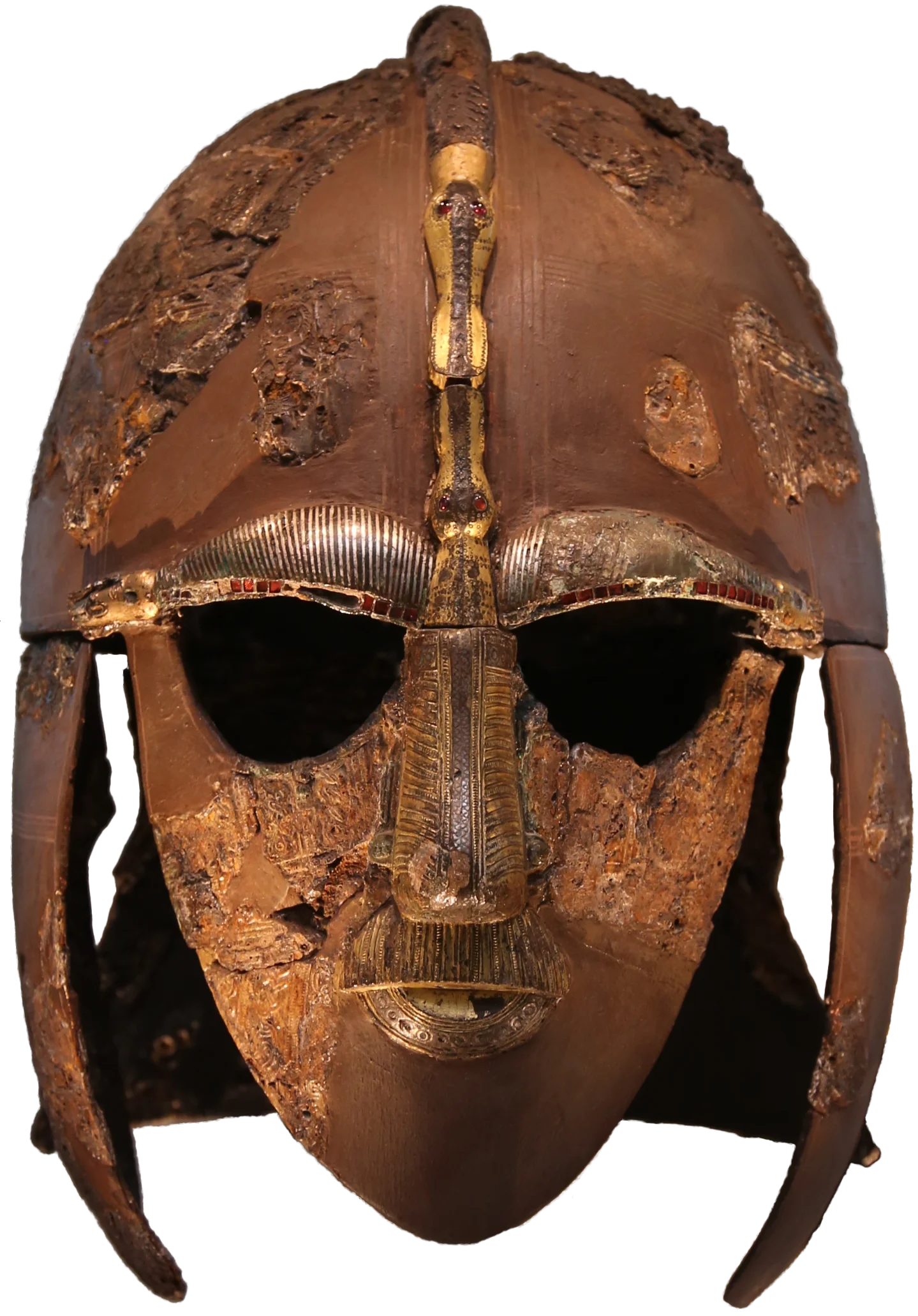
Walk into Room 41 of the British Museum and a face stops you. It looks back from behind a glass case with hollow copper eyes, a gilded moustache, and a nose ridge that doubles as the body of a dragon. The dome above it is iron, scratched and pitted by fourteen centuries underground. The eyebrows are bronze, inlaid with silver wire and studded with tiny garnet cells cut from stones that were mined in Sri Lanka. It weighs 2.5 kilograms — about the same as a full bicycle helmet — and it has been looking at visitors since 1946, when it was first assembled from the roughly 500 fragments in which it was found.1
This is the Sutton Hoo helmet, accession number 1939,1010.93. It was made for a king, buried with a king, and nearly lost to a king's war. The story of how it got here is, in several respects, more improbable than the object itself.
A self-taught Suffolk man and an enormous ship
In the spring of 1938, Edith Pretty (1883–1942), a wealthy widow who owned the Sutton Hoo estate near Woodbridge in Suffolk, hired Basil Brown (1888–1977) to dig into the line of low mounds on her land. Brown was a self-taught local archaeologist, employed by Ipswich Museum at 30 shillings a week, and he had no university degree. His clients had engaged the right person.2
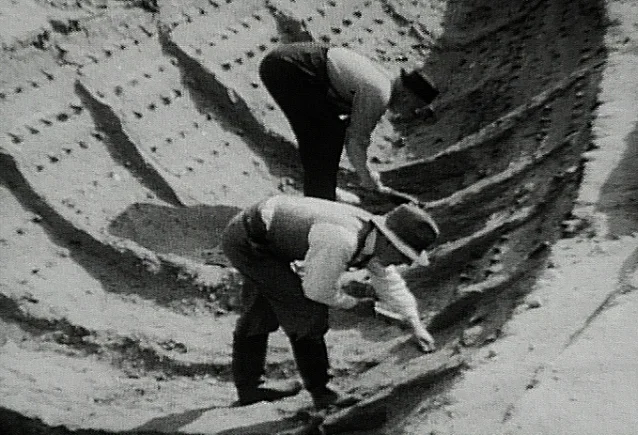
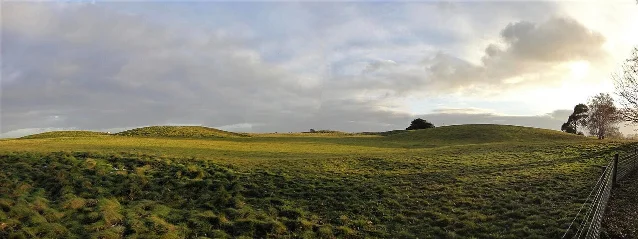
Brown spent the summer of 1938 on Mounds 2, 3, and 4. Mound 2 yielded iron rivets scattered by old grave robbers — the signature of a ship burial, though a looted one. He returned on 8 May 1939 to start Mound 1. Three days later, one of Pretty's gardeners turned over a piece of iron. Brown recognized it instantly: a ship rivet. The ship beneath Mound 1 was 27 metres long (89 feet), clinker-built with nine oak planks per side, fastened with iron rivets, and broad enough amidships to fit a timber burial chamber inside it.2 A working seagoing vessel, repaired over years of use, it had been hauled uphill from the River Deben estuary and lowered into a prepared trench. Only the tips of the stem and stern posts rose above ground. An oval mound was raised over it — visible to any traveler on the waterway below.
On 6 June, Cambridge archaeologist Charles Phillips (1901–1985) visited the site and understood immediately that this was a royal burial. He formally took charge under the Office of Works on 10 July, with Brown assisting. Their relationship, according to the National Trust, was one of mutual respect — Phillips was "complimentary towards the careful way Basil Brown had excavated the ship." 3 (The film The Dig (2021) dramatizes the handover as contentious; historians describe it as collaborative.)
On 21 July, Peggy Piggott (1915–1994), a 27-year-old Cambridge-trained archaeologist, discovered the first gold objects — two small garnet-inlaid sword pyramid fittings — and the dig changed character permanently.3 More gold followed. Security tightened: Brown and Pretty carried the first finds to Sutton Hoo House under the guard of gamekeeper William Spooner with a shotgun.
The helmet had been at the left side of the burial chamber, near where the occupant's head had lain. By the time the excavators reached it, it was in pieces — the chamber roof had collapsed under the weight of the mound at some point in the past fourteen centuries, and the compression had shattered the iron skull cap into approximately 500 corroded fragments.1 The fragments were wrapped carefully in cloth and removed to London. The excavation finished in August 1939. On 3 September, Britain declared war on Germany. Basil Brown filled the ship impression with bracken to protect it and walked away from Sutton Hoo on 16 September.
His diary entry from the summer of the find: "It's the find of a lifetime."4
A gift to the nation, on the eve of war
Before the excavators left Suffolk, one legal formality remained. On 14 August 1939, a Treasure Trove inquest was convened at Sutton village hall. All the objects had been returned from London for the proceedings. Edith Pretty, Charles Phillips, Guy Maynard, Basil Brown, and Stuart Piggott gave evidence.3
The question before the jury was a subtle one of intention. Under English law, "treasure trove" applied to gold or silver buried with the intent to recover it — in which case ownership reverted to the Crown. If the treasure was buried as a permanent deposit, with no expectation of recovery, it belonged to the landowner. The jury ruled for Pretty: a funeral offering has no intent of recovery. The entire Sutton Hoo find was hers.4
She immediately donated the whole collection to the British Museum. The gift was described at the time as "the most generous donation ever made to the British Museum in the lifetime of a donor."5 In December 1940, the government offered her a CBE. She declined it, wanting no personal honour. She died in 1942, aged 59, never seeing the treasures properly displayed.3
The finds spent the war years stored in a disused London Underground tunnel between Aldwych and Holborn stations.4 The Sutton Hoo estate itself was requisitioned as a military vehicle training ground. The ship impression that Brown had protected with bracken was driven over by tanks.
Herbert Maryon and the first reconstruction
In 1944, the British Museum brought out of retirement a 70-year-old sculptor and metalwork conservator named Herbert Maryon (1874–1965). His task was to do something no one had done before: assemble roughly 500 iron fragments — each corroded, distorted, and missing its neighbors — into a recognizable helmet.6
Maryon worked for six months in 1945–46. He built a plaster head form of the right size and began positioning fragments against it, holding them with pins, then filling the gaps with jute textile and plaster. The process was part conservation, part jigsaw, part educated guesswork. He got most of it right. Some panels were placed incorrectly, and the neck guard was set too vertically — errors that would not be corrected for another 25 years — but Maryon's reconstruction made the helmet displayable for the first time.1 It went on public display in 1946.
He also, in passing, coined the term "pattern welding" to describe the decorative technique used on the Sutton Hoo sword blade — a coinage that stuck in metallurgical literature.6
The first reconstruction held its authority for two decades. Then, in 1965, Rupert Bruce-Mitford (1914–1994), Keeper of Medieval and Later Antiquities at the British Museum, launched new excavations at Sutton Hoo. In 1967, his team recovered additional helmet fragments from the site — including a crucial cheek-piece hinge — that confirmed the helmet had originally been fitted with full cheek guards.1 Maryon's first reconstruction had been wrong about that.
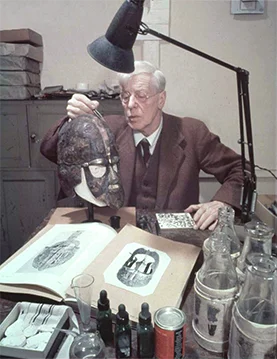
Between 1970 and 1971, conservator Nigel Williams at the British Museum's Department of Conservation undertook the second reconstruction, incorporating the newly recovered fragments. Working over 18 months, Williams repositioned hundreds of pieces and produced the helmet's current form: the full face mask with dragon-motif eyebrows, a properly angled neck guard, complete cheek guards, and the fluted moulding strips that divide the decorative panels.1 This is the helmet in Room 41 today.
What the helmet says, in iron and gold
The helmet is built around an iron skull cap, beaten from a single piece of metal. Covering it entirely are tinned-bronze panels stamped with five distinct repoussé designs, divided by fluted iron moulding strips. An iron crest, inlaid with silver wire, runs nose-to-nape, terminating at each end in an animal head. The estimated weight is 2.5 kilograms.2
The decorative programme was catalogued by Rupert Bruce-Mitford in his 1978 monograph and numbered accordingly:
Design 1 — the dancing warriors: Two spear-carrying men in horned helmets advance together in what may be a ritual combat dance. These appear on the panels above the eyebrows and on the cheek guards. Near-identical figures appear on the Torslunda plates, die stamps from Öland, Sweden, suggesting a shared Germanic iconographic tradition.1
Design 2 — the rider and the fallen warrior: A mounted spearman tramples a helmeted figure lying on his back. This scene — found on the skull cap — may represent a moment of battlefield triumph, or something more allegorical about fate. The same composition appears on the Pliezhausen gold bracteate from southern Germany.1
Designs 3, 4, and 5 are zoomorphic interlace in Salin's Style II — four-limbed animals in tight geometric weaving, typical of the Vendel-period Germanic world. Design 3 is known only from seven small fragments and cannot be fully reconstructed; its partial survival on an otherwise symmetrical helmet may indicate it was used to replace a damaged panel during the helmet's working life.1
The face mask is the helmet's most recognisable feature, and it carries a second image hidden inside the first. Seen one way, you are looking at a human face: a nose, gilded copper-alloy eyebrows, and a moustache whose curl matches the sweep of the nose. Seen another way — and this is what the maker intended — the eyebrows are a dragon's wings, the nose ridge is its body, and the moustache is its tail. The dragon soars across the face of the helmet, its head at the crest's front terminus, its wings framing the eyes.1 The eyebrows themselves terminate in gilded boar heads with garnet eyes — the boar being the sacred animal of the war-god Freyr, whose protection was traditionally invoked over weapons and warriors. This is a helmet that communicates on multiple levels simultaneously.
Then there is the asymmetry. The left eyebrow — the sinister side in heraldic terms — has 25 garnet cells; the right has 23. The left eyebrow is also subtly different in its metallic composition. Scholars Neil Price and Paul Mortimer have argued this deliberate discrepancy is an allusion to Odin, the one-eyed Germanic god of war, wisdom, and death: the left eye sees into other worlds; the modified eyebrow marks the wearer as under Odin's protection.1 Rupert Bruce-Mitford reached a similar conclusion in his own analysis. The helmet was made to be seen by an audience, not just worn in battle. Dr. Sue Brunning, current Curator of Early Medieval European Collections at the British Museum, has put it directly: the Sutton Hoo helmet "communicates."7
The world that made it
The Sutton Hoo helmet was made in the early 7th century CE, during the conversion period when the Kingdom of East Anglia — ruled by the Wuffingas dynasty — was navigating between paganism and Christianity. The burial itself encodes this tension exactly: a pagan ship burial containing two silver spoons inscribed in Greek with Saulos and Paulos — the names of Saint Paul before and after his conversion on the road to Damascus — alongside the purely pagan helmet, weapons, and feasting equipment.2
The grave goods reveal a world of far-reaching connections. The 37 Merovingian gold tremisses coins in a garnet-and-gold purse — minted across Francia between approximately 575 and 625 CE — provide the best dating evidence, placing the burial after c. 613 CE.2 A large silver dish bears control stamps of Emperor Anastasius I (r. 491–518 CE), placing it in Constantinople. The garnets in the helmet's eyebrows have been traced by XRF and PIXE particle-accelerator analysis to sources in India and Sri Lanka. The shield has stylistic affinities with Vendel- and Valsgärde-period helmets from Sweden.8
This was not an isolated backwater. Brunning, presenting at the British Museum in 2025, described her team's research into the individual objects: "We've given a handful of Sutton Hoo buttons, belt buckles and sword mounts, each finely bejewelled in garnet, their own Passport. And stamp by stamp, we fill in locations, dates, research, science and other information to build a fuller picture of how far reaching and well-connected this early Medieval world was."8
The man buried in the mound — the mound that held no skeleton, only a phosphate stain in the sand confirming that a body had once been there — was almost certainly a king. Martin Carver (University of York), who directed excavations at Sutton Hoo from 1983 to 1992, wrote that "the man buried was in all likelihood Raedwald, an Anglo-Saxon who dallied with Christianity and died around A.D. 625."9
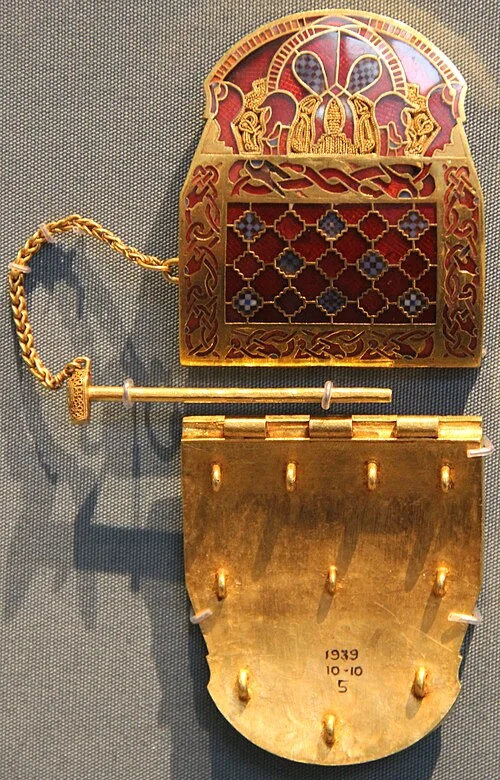
Rædwald of East Anglia (r. c. 599 – c. 624 CE) is the consensus candidate, first proposed by H.M. Chadwick in 1940 and repeatedly endorsed since. The coin dates fit his reign. Bede records him as a bretwalda — a king who held imperium over all England south of the Humber — who kept a temple with two altars, one pagan and one Christian, "to serve both Christ and the gods whom his ancestors had served."2 The burial objects — shoulder-clasps modeled on Roman imperial regalia, a ceremonial whetstone-sceptre with carved faces, a great gold buckle weighing 412.7 grams — suggest a man performing kingship as much as exercising it.2
But the caution is warranted. Sir David Wilson, former director of the British Museum, observed that "the little word may should be brought into any identification of Rædwald. After all it may or even might be Sigeberht who died in the early 630s, or it might be his illegitimate brother if he had one (and most people did), or any other great man of East Anglia from 610 to 650."1 The on-site museum at Sutton Hoo identifies the occupant as Rædwald; the British Museum prefers the formula "a King of East Anglia." The helmet's garnet-eyed boar heads offer no opinion.
Beowulf's world made visible
The discovery of Mound 1 in 1939 immediately invited comparison with Beowulf, the Old English epic poem that opens with the funeral of the Danish king Scyld Scefing, placed in a ship packed with treasure and weapons and sent out to sea. The parallels are not literal — Sutton Hoo was a land burial, not a sea burial — but the resonances run deep: a royal warrior buried in a ship, with weapons, feasting equipment, and regalia; a world of mead-halls, ring-giving, and martial prestige that the poem describes in exactly the language the objects speak.10
Neil MacGregor, former director of the British Museum, described the helmet in the 2010 BBC Radio 4 series A History of the World in 100 Objects as conjuring "images of the warrior culture of the great Anglo-Saxon epic poem, Beowulf."10 For that programme, curator Sonja Marzinzik said: "I think it's fair to say that the Sutton Hoo helmet is the face of the Anglo-Saxons, perhaps even all of the early middle ages in Europe."10
Martin Carver has offered the most compressed description of what the helmet does: "The Sutton Hoo helmet is more than a face-guard — it is a poem, a political manifesto in silver and iron."10
The Staffordshire Hoard, discovered in 2009 in a Staffordshire field — nearly 4,600 items of Anglo-Saxon gold and silver, mostly sword fittings from an estimated 100 to 150 weapons — deepened the Sutton Hoo picture rather than replacing it. Where Sutton Hoo combined martial, regal, and feasting objects, the Staffordshire Hoard is almost exclusively martial: stripped-off weapon fittings, possibly battle plunder. In 2022, when the Staffordshire Hoard came to Sutton Hoo for the exhibition Swords of Kingdoms, experts noted that the garnet cloisonné and gold filigree techniques in both finds are similar enough to suggest the pieces may have come from the same 7th-century East Anglian workshops.11 Staffordshire Hoard specialist Chris Fern, at the time of the joint exhibition, offered a pop-culture gloss: this was a world that "mixed pagan magic with new Christian beliefs... A bit like Game of Thrones, but real."11
The Dig, and what the film changed
In January 2021, Netflix released The Dig, directed by Simon Stone and based on John Preston's 2007 novel. Ralph Fiennes played Basil Brown; Carey Mulligan played Edith Pretty. The film was widely praised for its performances and cinematography, and it introduced the Sutton Hoo story to an international audience of millions who would never have encountered it otherwise.4
It also changed the historical record in several places. The film's screenwriter, Moira Buffini, invented a romantic subplot between Peggy Piggott and a fictional photographer named Rory Lomax. In reality, Peggy was on the dig with her husband Stuart Piggott; she later had a distinguished independent career as Margaret Guido, publishing major studies of prehistoric glass and amber beads in Britain. She found the first gold objects at Sutton Hoo, and the author of the novel, her nephew John Preston, learned of that role only after her death.3
The real photographers of the 1939 excavation were not a fictional male cousin but two women — Mercie Lack and Barbara Wagstaff, teachers on holiday who arrived on 8 August and spent 17 days capturing approximately 400 photographs and an 8mm cine film that now constitute the most important visual record of the dig.3 Mulligan described Edith Pretty as "so beyond her time as a woman at the beginning of the 20th century."3 The film is silent on Lack and Wagstaff.
The British Museum's Sue Brunning wrote in her 2021 blog post Inside 'The Dig' that the film "brings the Sutton Hoo story to life" and noted that Edith Pretty "famously donated the Sutton Hoo finds to the British Museum in an act of unparalleled generosity."5 On May 8, 2025 — exactly 86 years after Basil Brown turned the first spade in Mound 1 — the exhibition The Dig: A Story Unearthed opened at Sutton Hoo's High Hall, displaying original costumes, props, and replica jewellery from the film alongside the real archaeological record. It runs until January 2027.2
Room 41, and what is still being learned
The burial mounds at Sutton Hoo are now in the care of the National Trust, which completed a £4 million revamp of the visitor site in 2019, including a full-size sculpture of the ship and a 17-metre observation tower.2 A charity called the Sutton Hoo Ship's Company is building a full-size, fully functional replica of the 27-metre ship using oak and iron rivets; completion is expected around 2026.
The helmet itself remains in Room 41 — the Sutton Hoo and Europe gallery — where it has lived, in one reconstruction or another, since 1946. X-ray analysis conducted in 2025–26 continues to reveal new details about its construction, visible on the British Museum's collection record page.12
In 2019, Brunning took the helmet out of its display case for the first time in ten years and filmed a 23-minute Curator's Corner episode explaining its construction and iconography. The video has since accumulated more than 2.6 million views — a figure that testifies to the continuing power of the face itself.7 "The excavations at Sutton Hoo during 1939 were unique for a number of reasons," she said in a later programme. "A ship burial of this level of wealth has not been found before or since in England."7
What the helmet carries, across fourteen centuries, is the record of a world the Victorians called the "Dark Ages" and dismissed as primitive. The garnets cut in Sri Lanka, the coins minted in Francia, the silver struck in Constantinople, the iconography shared with Swedish graves — these are not the objects of a parochial backwater. They are the grave goods of a king who understood power as both military and divine, local and continental, pagan and Christian. The helmet does not resolve the question of who is buried in Mound 1. It simply stands there, looking back, as it has looked since the day it was made for a face that has long since dissolved into Suffolk sand.
Cover image: The Sutton Hoo helmet (1970–71 reconstruction), front view. © Trustees of the British Museum, CC0 via Wikimedia Commons.
참고 출처
- 1Sutton Hoo helmet — Wikipedia
- 2Wikipedia: Sutton Hoo
- 3National Trust: Digging the Dirt at Sutton Hoo — The True Story Behind The Dig
- 4Smithsonian Magazine: The True History Behind Netflix's 'The Dig' and Sutton Hoo
- 5British Museum: Inside 'The Dig' blog post
- 6Wikipedia: Herbert Maryon
- 7YouTube: Sue Takes on the Sutton Hoo Helmet — Curator's Corner S6 Ep5
- 8YouTube: Sutton Hoo treasures reveal ancient global connections — Curator's Corner S10 E7
- 9SAPIENS: Sutton Hoo's Story Goes Deeper Than The Dig
- 10BBC Radio 4: A History of the World in 100 Objects — Sutton Hoo helmet (Episode 47)
- 11Museum Crush: Anglo-Saxon treasures from the Staffordshire Hoard head to Sutton Hoo
- 12British Museum collection object H_1939-1010-93
이 콘텐츠를 둘러싼 관점이나 맥락을 계속 보강해 보세요.