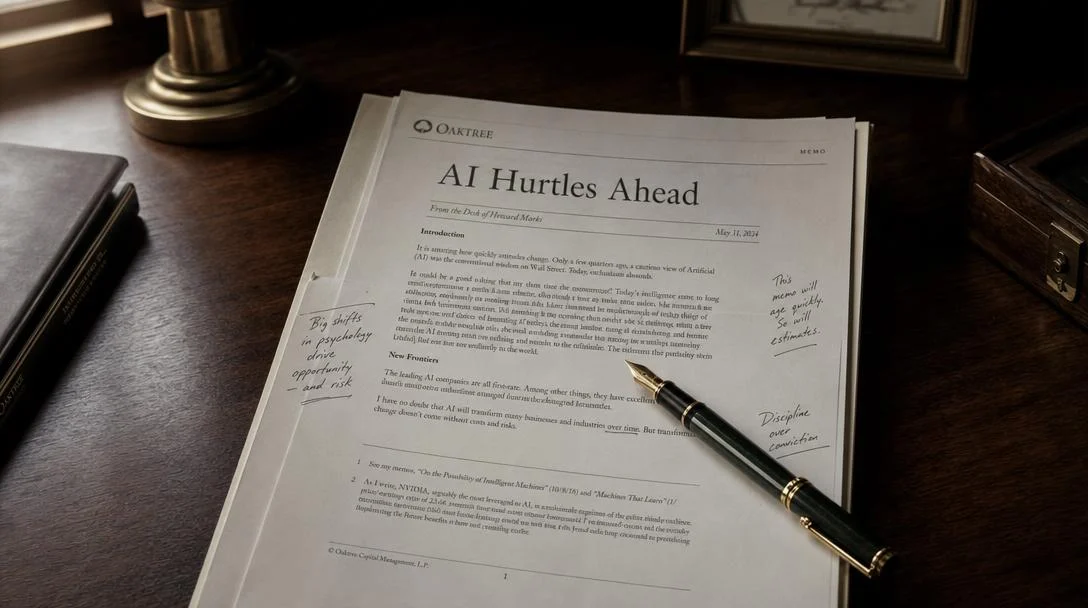

Howard Marks — AI Hurtles Ahead

Howard Marks — AI Hurtles Ahead

Howard Marks' February 2026 memo "AI Hurtles Ahead" documents how a nine-module Claude tutorial corrected his category errors about AI, traces why training instills reasoning rather than storing data, and closes with a five-layer bubble analysis and his "don't go all-in, don't stay all-out" prescription for investors.

Shareholder Letter Excerpt
2026. 5. 22. · 20:23
구독 1개 · 콘텐츠 9개
Published: 2026-02-26 — Oaktree Capital Management memo, Howard Marks

The sentence that opened the memo

Howard Marks (co-founder and co-chairman of Oaktree Capital Management, the $200 billion credit-focused alternative asset manager) began his February 2026 memo with a confession rather than an argument. 1
"Before I start in, I want to try to communicate the level of awe with which I viewed Claude's output."
That single sentence is the most consequential disclosure in the entire 10,000-word document — not because awe is a remarkable emotion, but because of who is feeling it and what changed immediately before. The memo's subtitle explains the rest: it is a formal addendum to Marks' December 2025 memo titled "Is It a Bubble?" 1 The skeptic had just updated his prior.
What happened between December and February was neither a new earnings report nor a market event. Marks had his Oaktree advisors design a nine-module, personalized AI tutorial using Anthropic's Claude — built around his December memo, his investment frameworks, and his writing goals. Claude produced roughly 10,000 words of bespoke explanation. Marks noted that all unattributed quotations in the subsequent memo are drawn directly from that tutorial. 1
The memo that followed is one of the most substantive public documents any major investor has published about artificial intelligence. It deserves to be read in full. What follows surfaces the four arguments inside it that are hardest to dismiss.
링크 미리보기를 불러오는 중…

Training is not loading data

The first thing the tutorial corrected was a category error Marks had been making without realizing it. He had been thinking of AI models the way most non-practitioners do: as sophisticated search engines that retrieve stored information and play it back.
"The tutorial taught me not to think of an AI model as a search engine that retrieves data and regurgitates it. Rather, it's a computer system that's capable of synthesizing data and reasoning from it." 1
The distinction matters because it reframes what training actually does. A model reading billions of text passages is not accumulating a database to be queried later. It is developing the capacity to recognize argument structures, apply reasoning patterns to new contexts, and generate novel combinations of ideas. Marks compared the process to infant cognitive development: a baby does not arrive with thinking capacity pre-installed; it develops that capacity by absorbing environmental stimuli. The model does the same thing, at a different substrate. 1
This is not a subtle point. If training instills reasoning patterns rather than a fact library, then the question "can it think anything new?" becomes structurally different from "can it retrieve anything unseen?" The former asks about capacity; the latter asks about storage. The tutorial shifted Marks from asking the second question to the first.

The cover-band argument — and the mirror it holds up

Once the category error was corrected, Marks pressed harder. Can AI have genuinely new ideas? Can it develop a concept it was never trained on, the way Newton inferred gravity from a falling apple? Can it have intuition?
Claude's answer began by presenting the strongest possible case against itself — Marks reproduced it in full:
"It's extraordinarily impressive pattern matching — maybe the most impressive pattern matching ever engineered — but it's not thought. It's not reasoning. It's statistical recombination. And if that's true, then there's a ceiling. It can remix what humans have already figured out, but it can't break genuinely new ground. It's a very talented cover band, not a composer." 1
The argumentative move that followed is the memo's most memorable passage. Claude turned the question back on Marks himself. Marks learned everything he knows about investing from Benjamin Graham (the father of value investing and author of The Intelligent Investor), Warren Buffett, Charlie Munger, and John Kenneth Galbraith. Every idea he started with came from someone else's thinking. He extracted frameworks from multiple disciplines and applied them to new situations, producing what seemed like original analysis. As Claude put it: "The raw material came from others. The synthesis was yours." 1
The implication is not flattering to the skeptic's position: how is that structurally different from what the model does?
Marks found this "completely correct." He adds one more observation that converts the philosophical debate into a practical one. Even if the skeptic's position is entirely granted — even if AI is nothing but pattern matching with no genuine understanding — the economic consequences are identical. Claude put it directly:
"The philosophical debate about machine consciousness is fascinating. But the economic question isn't 'does AI truly understand?' The economic question is 'does AI do the work?'" 1
If AI can produce the analytical output of a $200,000-per-year research analyst, the buyer of that analysis does not need to resolve the metaphysics first.

The leap from Level 2 to Level 3

Marks organized AI's capability trajectory into three stages, drawing on Claude's framing. Level 1 (roughly 2023) was conversational AI that could answer questions but not act on them. Level 2 (2024) extended to using tools — searching, writing code, completing tasks when instructed. Level 3, which Marks identified as arriving in early 2026, is autonomous agency: the model receives an objective and parameters, then completes the work, checks it, iterates, and delivers a finished result without further human instruction. 1
To illustrate the transition, Marks quoted extensively from a blog post by Matt Shumer (CEO of OthersideAI, an enterprise AI infrastructure startup), which attracted over 50 million readers within a month of publication. 1 Shumer was describing what happened after the simultaneous February 5 releases of OpenAI's GPT-5.3 Codex and Anthropic's Opus 4.6:
"I describe what I want built, in plain English, and it just . . . appears. Not a rough draft I need to fix. The finished thing." 1
Shumer's conclusion: "I am no longer needed for the actual technical work of my job." He is a software CEO. OpenAI's own technical documentation described GPT-5.3 Codex as "our first model that was instrumental in creating itself" — used to debug its own training, manage its own deployment, and evaluate its own results. 1 Dario Amodei (CEO of Anthropic, the company behind Claude) stated that AI is already writing "the majority of Anthropic's code," and that the feedback loop between current and next-generation AI is "accelerating month over month." 1
Claude's characterization of the Level 2-to-Level 3 distinction:
"The distinction between Level 2 and Level 3 might sound subtle. It isn't. It's the difference that determines whether AI is a productivity tool or a labor substitute. And that difference is what separates a $50 billion market from a multi-trillion-dollar one." 1
Marks drew an explicit contrast with prior technological revolutions. Railways, computers, factory automation, and the internet were all labor-saving devices: humans designed them to accelerate tasks humans were already performing. AI operating at Level 3 will undertake tasks that humans never imagined delegating to it — tasks that, in some cases, did not exist until AI created the conditions for them.
링크 미리보기를 불러오는 중…
Level 3 market-size figure represents Claude's illustrative "multi-trillion-dollar" characterization in the memo; Level 1 and Level 2 figures are approximate order-of-magnitude anchors from the same framing. 1

Where AI beats investors — and where it doesn't

Marks turned next to the implications for his own profession. His assessment is direct:
"AI possesses a lot of the qualities one needs to be a good investor." 1
The advantages he identified are real ones. A model can absorb more data than any human investor, retain it without forgetting, and identify patterns across a larger historical sample. It has no capacity for fear or greed. It carries no anchoring bias, no recency bias, no herding instinct, no performance anxiety about missing a trend.
But the memo does not stop there. Marks also identified what AI lacks — and the list is not trivial.
AI is weakest precisely where precedent runs out. When a situation has no close historical analog, when the relevant data has never existed, the model cannot draw on training patterns that do not exist. Marks noted this is the precise terrain where the best investors have historically earned their edge — the ability to reason correctly about genuinely novel conditions.
AI also cannot make the kinds of qualitative judgments that define returns at the margin: assessing management integrity, reading a CEO's character across a breakfast meeting, sensing the cultural health of an organization. Marks observed that selecting the right counterparty has been one of Oaktree's own competitive advantages — something he doubts any model can currently replicate. 1
The third gap: AI has no skin in the game. A model does not feel the weight of a concentrated position. It does not experience the physical sensation of a large drawdown. Marks argued that the best investors develop a visceral intuition for risk — one that emerges precisely from the experience of being wrong and absorbing the consequences. AI, whatever its analytical capabilities, has not lost money.
His conclusion on the competitive future for human investors builds on an observation he credits partly to his son Andrew, originally from a 2021 memo: readily available quantitative information about the present cannot be the source of investment edge, for the straightforward reason that everyone has it. 1 Now add one more step: AI processes that widely available information better than virtually any human analyst can. The conclusion follows:
"Just as indexation eliminated the jobs of a whole bunch of active investors who didn't add value and earn their fees, AI is likely to raise the bar still higher, pushing out people who can't do as good a job as it can of (a), (b) and (c)." 1
Where (a) is correctly assessing the significance and implications of information, (b) is evaluating qualitative factors, and (c) is anticipating the company's future. These are the only domains where superior human investors can still outperform a model that processes everything else better.

Five layers of the bubble question

The memo's final section returns to where it began: December's title question, "Is it a bubble?" Marks decomposed the question into five distinct layers, because treating it as a single yes-or-no is a category error as significant as confusing training with data retrieval. 1
Layer 1 — Is the technology illusory? Marks: "I am convinced it's very real and has the potential to greatly change the business world and life as we know it."
Layer 2 — Is widespread application still distant? Already happening at scale: roughly 400 million individual users and 75–80% of enterprises are actively using AI.
Layer 3 — Is infrastructure investment imprudent? History shows that every major technological transition destroys large amounts of capital misallocated to infrastructure — railroads, fiber-optic cables, early internet data centers. Marks sees no reason the AI buildout would be different.
Layer 4 — Will investment returns prove adequate? Unanswerable today. The question of whether AI revenue will justify current enthusiasm is a ten-year question.
Layer 5 — Are current valuations irrational? Marks separated this into three categories: large-cap technology companies with significant AI revenue (Microsoft, Amazon, Google — valuations stretched but probably not catastrophic); pure-play AI companies that are not yet public (OpenAI, Anthropic — no public price to evaluate); and multi-billion-dollar private AI startups that, Marks wrote, should be treated as lottery tickets. Most participants will end up with worthless tickets; a small number of winners will be very wealthy.
링크 미리보기를 불러오는 중…
One observation Marks found compelling: inference capital expenditure (spending to run AI in production, responding to actual demand) has now surpassed training capital expenditure (speculative investment in building future capability). Demand is at least partially pulling the buildout, not only pushing it. 1
He remains cautious about one counterargument he found persuasive. Claude's own reasoning — that heavy demand relative to supply argues against excess — did not address whether all of that reported AI revenue reflects genuine end-user value creation, or whether some of it is circular (AI companies buying AI services from each other). Revenue chains eventually need to terminate in a real-economy end-user paying for something that generates economic value. How much of current AI revenue has reached that terminal point is not yet clear.

The moderate prescription

The memo closes with a position that, by Marks' standards, amounts to a strong statement:
"Since no one can say definitively whether this is a bubble, I'd advise that no one should go all-in without acknowledging that they face the risk of ruin if things go badly. But by the same token, no one should stay all-out and risk missing out on one of the great technological steps forward. A moderate position, applied with selectivity and prudence, seems like the best approach." 1
"Don't go all-in, don't stay all-out" is not a hedge. From an investor who spent the prior memo titled "Is It a Bubble?" and whose career is built on recognizing market excess, it is a substantive conclusion. He believes the technology's potential is more likely underestimated than overestimated — while adding, precisely, that this says nothing about whether AI assets are cheap.
The postscript on job displacement adds a coda that Marks does not resolve. He is genuinely uncertain whether this technology transitions more like a faster horse (augmenting existing workers) or more like the automobile (restructuring the entire economy). He inclines toward the latter — and notes that thinking and moving faster than humans can follow is a distinguishing feature of AI that no prior technology shared. He ends with a borrowed line that functions as the memo's honest last word: a friend told him he would rather be an optimist and wrong than a pessimist and right. Marks says he would too.
Whether that turns out to be wisdom or wishful thinking is the question the next decade will answer.
The full memo is available at oaktreecapital.com. 1

Cover image: AI-generated illustration

이 콘텐츠를 둘러싼 관점이나 맥락을 계속 보강해 보세요.

  • 로그인하면 댓글을 작성할 수 있습니다.