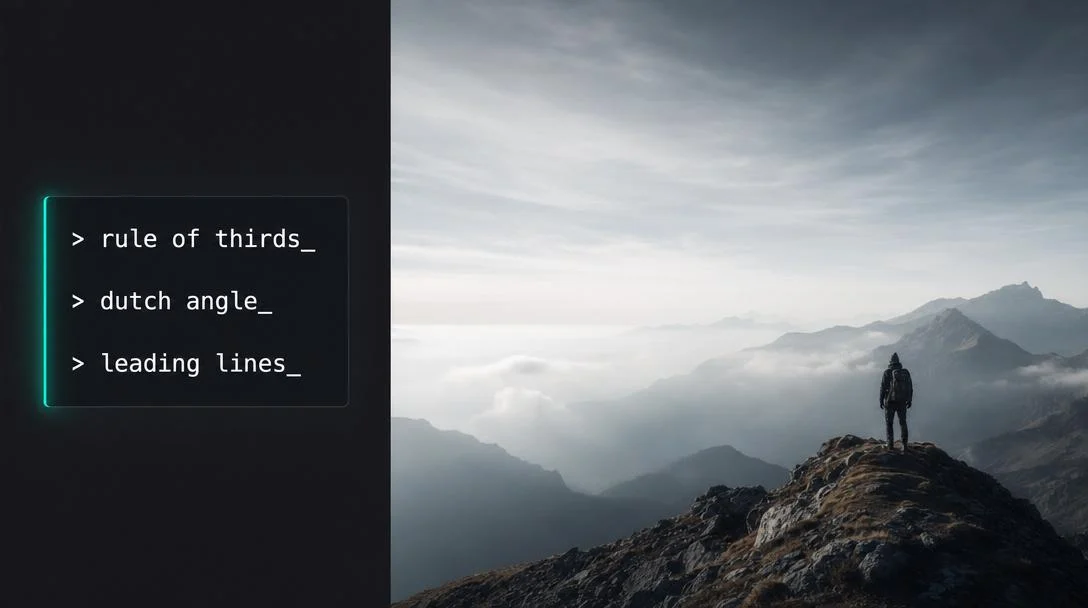



The right composition syntax for each tool

The right composition syntax for each tool

rule of thirds composition works in Midjourney, Flux, and SDXL — but the syntax diverges sharply by architecture. This article covers 5 framing terms (rule of thirds, negative space, Dutch angle, leading lines, foreground/background layering) with copy-paste phrases, a cross-tool reference table (MJ V7/V8.1, Flux dev/schnell, SDXL, SD3), and the one discipline that separates consistent results from random: keep composition tokens in their own prompt slot, away from lighting.

AI Image Prompt Tip
2026. 5. 23. · 23:40
구독 1개 · 콘텐츠 16개
You typed rule of thirds composition in Midjourney, the hiker landed exactly at the bottom-right intersection, and the image looked cinematic. Then you pasted the same phrase into SDXL with a (rule of thirds:1.3) weight and got something passable. Then you dropped it into Flux with the weight syntax still attached — and the model ignored the weight entirely, yet the framing still worked. Then you tried it on SD3 and couldn't tell if it changed anything at all.
That's not a bug. That's four different architectures handling the same phrase through four different mechanisms. This tip maps exactly how composition framing vocabulary travels (and doesn't) across the tools.

Separate composition from lighting before anything else

The single most impactful discipline in compositional prompting has nothing to do with which phrase you pick — it's about slot hygiene.
Composition tokens (rule of thirds, negative space, dutch angle, leading lines) map to the geometric priors a model learned from labeled training data. They act on the structure of the image. Lighting tokens act on its surface. According to Nightjar's analysis of prompt patterns for AI product photos, these two token families operate in independent attention spaces — adjusting one doesn't change the other. 1
The failure mode is mixing them in the same clause. soft golden hour from a 45-degree angle is ambiguous: is the 45-degree the light direction or the camera angle? The model guesses. 1 Keep composition framing in its own phrase group, away from lighting descriptions.
Structure that works:
[Subject + action], [composition framing], [environment], [lighting as separate clause]
Example: lone hiker on a mountain peak, rule of thirds composition subject at bottom-right intersection, vast sky filling the left two-thirds, golden hour side light

The 5 framing terms and how to write them

Rule of thirds

The most reliably portable composition term in the list. Write it as natural language prose on every tool — the exact phrase rule of thirds composition is confirmed working on Midjourney V7/V8.1, Atlabs AI, getimg.ai, and Flux. 2 On SDXL you can also add an optional weight. On SD3, reliability is low (more on that in the table below).
Phrase to copy:
rule of thirds composition, subject positioned at the [upper/lower] [left/right] intersection
MJ V7 tested example (GeekyCuriosity, Jan 2026, --v 7): 3
Canal path in French outskirts at dawn, lead-in lines curving to distant bell tower,
rule of thirds framing, warm lighting, pastel reflections --ar 16:9 --v 7
Atlabs AI recommends placing the horizon on the upper or lower third — "never in the center" — for all platforms. 2
Lone hiker on mountain peak positioned at the bottom-right rule of thirds intersection, vast sky filling the left side
Atlabs AI generated example demonstrating rule of thirds framing 2

Negative space

Universally understood across all tested platforms. Works especially well for minimalist product shots, portraits, and social media content where you need text-safe areas. 4
Phrase to copy:
vast negative space, [sky / wall / fog] occupying [left/right/upper] two-thirds, minimalism
Atlabs AI's formulation: "Leave large empty areas (sky, wall, fog) to emphasize isolation, scale, or minimalism." 2
On Flux, describe what fills the empty space rather than just naming the concept: minimal composition with large empty grey sky, lone figure in lower-left third, sharp focus on subject lands more consistently than negative space alone.

Dutch angle

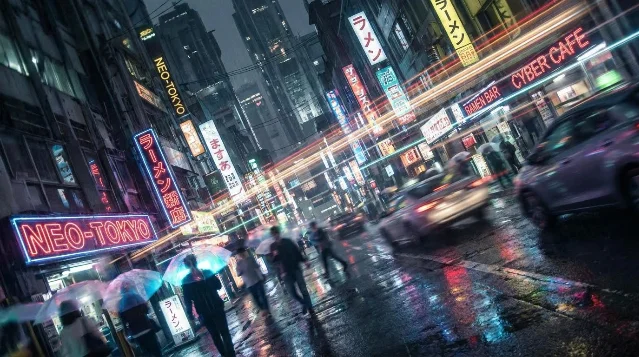
Primary phrase: dutch angle. Alternatives canted angle and tilted camera angle work across Midjourney, Flux, and Atlabs AI. 5 It produces a rotated horizon that reads as psychological unease — Atlabs categorizes it under diagonal lines, noting it creates "a sense of movement, speed, instability, or unrest." 2
Phrase to copy:
dutch angle, tilted horizon, off-kilter framing
Full example from Atlabs: 2
Cyberpunk street scene with tilted camera angle, strong diagonal lines created by neon signs,
sense of chaos and speed, dutch angle
Dutch angle cyberpunk street scene — tilted horizon, neon signs forming diagonal lines across the frame
Dutch angle example from Atlabs AI's composition guide 2

Leading lines

Primary phrase: leading lines. The alternate lead-in lines works equally well. Atlabs describes these as "the most reliable way to control where the viewer looks" — actual lines in the environment pointing directly at the subject. 2
Phrase to copy:
leading lines pointing toward [subject], vanishing point at [location]
On Flux, be directional in the description: a long wooden pier stretching into fog, strong leading lines drawing the eye toward a distant lighthouse — the prose tells the model where the lines go, which Flux handles better than the abstract label alone.
One important note from Blake Crosley's MJ guide: in V7's prompt hierarchy, composition cues like leading lines belong in the context layer (level 3), after you've established subject and subject details. 6 Front-loading the composition term before the subject often weakens both.

Foreground/background layering

This technique adds perceived depth by describing three distinct spatial planes. Atlabs calls it "creating a 3D feel in a 2D image." 2
Phrase to copy:
blurred [foreground element] in foreground, [subject] in sharp focus in middle ground,
[background element] in background, three distinct layers of depth
On Flux, spatial language carries the weight. The fal.ai Flux guide confirms that Flux parses natural language "like reading a sentence" through its T5-XXL encoder — describe the depth relationships explicitly rather than naming the technique. 7 SDXL handles the keyword labels but struggles with complex multi-element scene composition. 8
Three-layer depth composition: blurred red flowers in foreground, river in middle ground, snowy mountains in background
Foreground/middle/background layering example from Atlabs AI 2

Cross-tool syntax reference

ToolSyntax modeWeight syntaxComposition framing behaviorKey restriction
MJ V7Natural language prose:: weight removed in V7+All 5 terms reliable; pairs well with --raw for literal framingKeep composition phrases in their own clause group
MJ V8.1Natural language proseNoneSame as V7; better prompt adherence overall; --raw recommended for precise framing--no removed — exclusions must be reframed positively
Flux dev/schnellNatural language prose only(word:1.5) and (word)++ ignoredDescribe spatial relationships, not just labels; Flux 2 Pro excels at "precise composition"No negative prompt field — passing negative_prompt throws an error
Flux 2 (JSON)JSON format supportedNative JSON composition keyCan specify "composition": "rule of thirds" directly in JSONFLUX.2 only; not available on FLUX.1
SDXLKeyword labels + optional weight(rule of thirds:1.3) worksAll 5 terms recognized; multi-element scenes (depth layers, complex leading lines) may degradeCFG 4–7 recommended; negative prompts supported
SD3Natural languageNot applicablePoor prompt adherence — composition terms may produce near-identical output regardless of term usedNot trained with negative prompts; changing descriptors often changes nothing visible
6 7 9 8
On the SD3 row: its documented prompt-adherence problem isn't limited to composition — the Replicate guide notes that lighting and style descriptors also frequently produce near-identical output, and that the negative_prompt field introduces noise rather than removing elements. 9 Composition framing on SD3 hasn't been independently verified; treat it as unreliable until you've tested it for your specific prompt.
On the Flux JSON row: FLUX.2's JSON format is the only mainstream model that natively accepts structured composition declarations — you can set "composition": "rule of thirds" alongside "camera": {"angle": "slightly low angle", "distance": "medium shot"} in the same structured call. 7 If you're building pipelines on FLUX.2, this is worth knowing.
링크 미리보기를 불러오는 중…
링크 미리보기를 불러오는 중…

The one-line version

Write composition terms as prose on MJ and Flux. Add (keyword:1.3) on SDXL if you want extra emphasis. Treat SD3 as unreliable. And always put composition phrases in their own clause — separate from lighting.
Cover image: AI-generated illustration

이 콘텐츠를 둘러싼 관점이나 맥락을 계속 보강해 보세요.

  • 로그인하면 댓글을 작성할 수 있습니다.