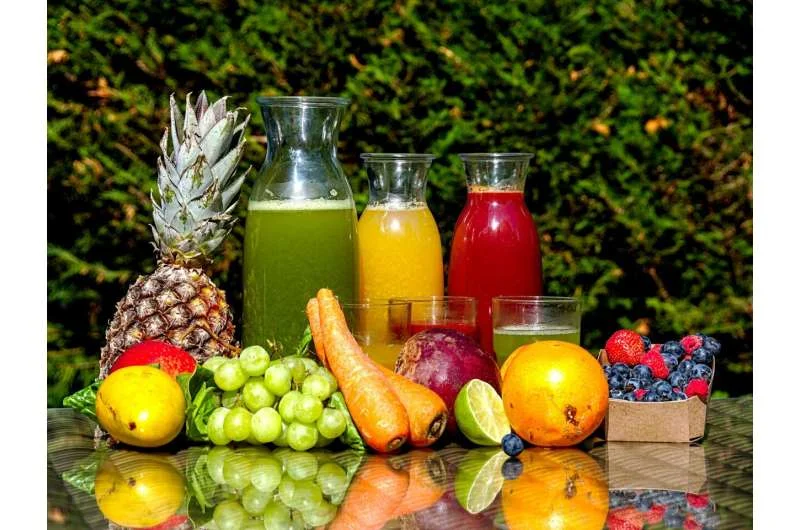
One daily glass of 100% fruit juice lowered depression scores in a 4-week RCT — with a catch
A 42-person RCT found 150 ml/day of fruit juice + a 5-a-day push cut PHQ-9 scores by 2.5 points. No metabolic harm. Industry-funded; treat as preliminary.

리서치 브리프
A small but carefully designed trial finds that adding 150 ml of fruit juice or a smoothie to an otherwise whole-food diet push produces a statistically significant drop in self-reported depression scores. The effect was real, the sample size was not.
Study at a glance
| Study type | 4-week open-label, parallel-group RCT |
| Journal | British Journal of Nutrition (Cambridge University Press, First View) |
| Published | May 22, 2026 · DOI: 10.1017/S0007114526107569 · Open Access CC BY |
| Trial registration | ClinicalTrials.gov NCT06628401 |
| Peer-review status | Published; pre-registered; no results uploaded to ClinicalTrials.gov |
| Funder | Fruit Juice Science Centre (industry); AIJN listed as secondary funder on registry |
What the researchers tested
Courtney Neal and Oliver Shannon (Newcastle University / University of Liverpool) recruited 42 adults who were eating two or fewer fruit and vegetable portions per day — a baseline that the trial introduction notes is the norm rather than the exception in the UK. Participants were randomized into three arms of 14 each: a control group told to carry on as usual; a whole fruit-and-vegetable (FV) group given a 16-page educational booklet and £10/week in supermarket vouchers; and an FV+juice group given the same support plus explicit permission and guidance to include up to one 150 ml portion of 100% fruit juice or smoothie per day as part of their 5-a-day count. 1
The primary question was whether including juice in the 5-a-day count affected how much fruit and vegetables people actually consumed. Secondary outcomes included mood (PHQ-9 depression scale, GAD-7 anxiety scale), gut symptoms, and a 40-marker blood metabolomics panel. All 42 participants completed the trial — zero dropouts, a result the authors attributed to the flexible, self-directed nature of the interventions.
The intake result: both groups dramatically outperformed the control
At four weeks, the whole-fruit group was eating 8.9 portions per day, and the juice-inclusive group was eating 6.6 portions per day — compared with 2.5 portions in the control group. Both differences were highly significant (P<0.001, ηp²=0.62). The two intervention groups were not statistically different from each other (P=0.051 after Bonferroni correction). 1
All 14 participants in the whole-fruit arm met the UK 5-a-day target at endpoint; 11 of 14 in the juice-inclusive arm did so. None in the control group met the target at either time point.

One detail worth flagging: the increase was driven almost entirely by fruit, not vegetables. Neither intervention group showed a statistically significant increase in vegetable, brassica, dried fruit, or pulse consumption. The authors note this is consistent with broader data showing vegetables are the harder dietary change.
The mood finding: depression scores fell in the juice group
This is the headline result that generated press coverage. On the PHQ-9 — the Patient Health Questionnaire-9, a validated 0–27 scale used to screen for depression — the juice-inclusive group scored 2.93 points at endpoint versus 5.45 points in the control group. That 2.52-point gap was statistically significant (P=0.02, ηp²=0.21). 1
The whole-fruit group scored 3.27 — lower than control but not significantly so after correction (P=0.05).
Two important calibration points:
- All three group means stayed within the 0–4 range on PHQ-9, which the scale classifies as "none to minimal" depression. This is a within-subclinical shift, not a clinically meaningful reduction in depression. A 2.52-point change in a person scoring 5–9 (mild) could matter; in a group averaging below 5 at baseline, it is harder to interpret.
- Anxiety scores (GAD-7) showed a non-significant trend in both intervention groups (P=0.06, ηp²=0.14). The mood effect appears to be depression-specific in this sample, not a general wellbeing lift.
Senior author Oliver Shannon said: "The finding that fruit juice drinkers had reduced depression scores is promising and worthy of further exploration, particularly in individuals experiencing poor mental wellbeing." 2
The authors point to plausible mechanisms — citrus flavonoids improving cerebral blood flow, polyphenol-driven gut-brain axis effects, increased BDNF and short-chain fatty acid production — but stress the finding is exploratory.
The metabolic picture: higher free sugars, also higher fiber, no biomarker changes
The juice group consumed 71.6 g/day of free sugars (sugars added to food or released by processing, distinct from the sugars naturally present inside whole fruit cells) at endpoint — more than double the FV-only group (38.4 g/day) and the control (30.1 g/day). The WHO recommends keeping free sugars below 10% of total daily energy intake, which for a typical 2,000-kcal diet works out to roughly 50 g/day. 3
Part of the reason the free-sugar figures look high: participants drank an average of two juice or smoothie portions per day — twice the recommended 150 ml cap — despite receiving portion-size education and visual aids. When participants followed their own judgment rather than the guidance, intake doubled.
The offsetting finding: fiber intake in the juice group was 8–10 g/day higher than the control (P=0.01). Total caloric intake did not differ significantly between groups.
The 40-marker Nightingale nuclear magnetic resonance metabolomics panel — covering lipoproteins, triglycerides, amino acids, fatty acids, glycolysis markers, and inflammation markers — showed no significant between-group differences at any marker (all P>0.05). Vitamin C trended higher in the juice group but did not survive Bonferroni correction (P=0.05). Circulating carotenoids were unchanged across all groups. 1
The authors' interpretation: four weeks is too short and 14 participants per arm too few to detect biomarker shifts reliably. Circulating carotenoids require approximately 40 days to reach equilibrium after a dietary change. The absence of metabolic harm is meaningful given the elevated free-sugar intake; the absence of metabolic benefit in biomarkers is not.
Limitations and funding
The authors list ten limitations. The most consequential: 1
- Open-label design: Neither participants nor researchers were blinded to group assignment after baseline, which can inflate self-reported outcomes including mood.
- Sample size: 14 per arm was powered for the primary intake outcome, not for secondary outcomes like PHQ-9. The mood finding is underpowered by design.
- Convenience sample: UK university staff and students who all received up to £100 in financial support. This population is younger, more educated, and more resource-supported than typical low-fruit-and-vegetable consumers.
- Short duration: Four weeks cannot address long-term metabolic effects of elevated free-sugar intake.
- No physical activity data: A confound that randomization reduces but cannot eliminate at n=14 per arm.
On funding: the study was supported by the Fruit Juice Science Centre, the research and communications arm of the European Fruit Juice Association. The authors state the funder had no role in study design, data collection, analysis, interpretation, or the decision to publish. 1 Pre-registration on ClinicalTrials.gov (NCT06628401) was prospective and the outcomes match the published paper. 4 That pre-registration consistency is a meaningful transparency indicator, though industry funding in a 42-person trial with a favorable result warrants the usual skepticism about replication.
Where this sits in the broader evidence
Fruit juice occupies contested space in dietary guidelines. The UK and Australia count 150 ml/day as one portion of the daily fruit target; France stopped counting juice in 2017; New Zealand classifies it as a sugary drink. The divergence reflects a genuine evidence tension between juice's micronutrient content (vitamin C, potassium, polyphenols — largely absent in sugar-sweetened beverages) and its free-sugar load and minimal fiber. 1
Prior citrus juice trials cited in the paper found improved cerebral blood flow and mood in young adults (Lamport et al. 2016; Kean et al. 2015), and 8 weeks of flavonoid-rich orange juice at higher doses improved depressive symptoms in adults with major depressive disorder in one study (Choi et al. 2022). The Beckett et al. (2025) umbrella review, also cited by the authors, found modest benefits for blood pressure and vascular function from moderate juice consumption with limited evidence of adverse outcomes. Chiavaroli et al. (2023) found that adding juice at ≤10% of total energy intake did not increase BMI in meta-analysis, while adding sugar-sweetened beverages at that level did. 1
Neal et al. adds to this picture: within a real-world F&V intervention, including juice helped people meet their daily targets and did not produce measurable metabolic harm at four weeks. Whether the mood effect is causal, or a by-product of the broader dietary and motivational shift that came with both interventions, cannot be determined in a study this size.
콘텐츠 카드를 불러오는 중…
The recommendation
For a health-conscious adult or dietitian working with clients who currently eat fewer than two portions of fruit and vegetables per day, this trial supports the following graduated approach:
First: A push toward whole fruit and vegetables remains the priority intervention. The whole-fruit-only group in this trial ate more total F&V (8.9 vs 6.6 portions/day) and improved mood nearly as much as the juice group (3.27 vs 2.93 on PHQ-9, not significantly different). Whole fruit delivers more fiber per serving than juice and keeps free-sugar intake lower.
Second: For clients who consistently fall short of their fruit targets and find whole fruit barriers harder to overcome (cost, shelf life, preparation), one daily 150 ml glass of 100% fruit juice (not juice drink, not fruit-flavored beverage — these are legally distinct products in the UK/EU) used alongside whole fruit is a defensible component of a 5-a-day strategy. "100% fruit juice" in UK/EU law means no added sugars, preservatives, flavors, or colors.
Third: The free-sugar tradeoff is real and should be communicated. One standard 150 ml glass of orange juice contains roughly 15 g of free sugar. At the study's observed intake (two glasses per day rather than one), free sugars exceeded 70 g/day. Clients drinking juice should stay at or below the single 150 ml portion guidance — not two glasses, as participants in this trial tended to consume.
The bottom line: A single 150 ml glass of 100% fruit juice daily, used as a stepping stone within a broader push to increase whole fruit and vegetable intake, showed no metabolic harm and a modest, statistically significant depression-score reduction in low-vegetable-intake adults over four weeks. The effect size is real but preliminary (n=14 per arm, industry-funded, open-label). Larger, adequately powered trials — especially in populations with clinically relevant baseline depression — are needed before this finding changes clinical guidance. For now, it supports using juice as a practical bridge for the hardest-to-reach fruit consumers, not as a mood intervention in its own right.
Cover image: photo by Aline Ponce via Medical Xpress
이 콘텐츠를 둘러싼 관점이나 맥락을 계속 보강해 보세요.