www.frontiersin.org
Beta-alanine works for women — with a major caveat
A May 2026 systematic review and meta-analysis in Frontiers in Nutrition (Gu et al.) — the first restricted entirely to female participants — pooled 11 RCTs (312 women) and found beta-alanine significantly extends time to exhaustion (SMD = 0.49, I² = 0%). GRADE certainty is very low for all outcomes. The article covers the carnosine-buffering mechanism, why the benefit is specific to 60–240-second high-intensity efforts, and closes with a concrete four-week loading protocol (3.2–6.4 g/day, doses ≤1.6 g) for immediate clinical application.

리서치 브리프
For two decades, the case for beta-alanine rested almost entirely on studies whose subjects were overwhelmingly male. A meta-analysis published May 26, 2026 in Frontiers in Nutrition changes that picture — but it does so with a meaningful asterisk attached. 1
Gu et al. (2026) is the first systematic review and meta-analysis restricted entirely to female participants. Across 11 randomized controlled trials (312 women), it finds that beta-alanine extends time to exhaustion with a statistically significant pooled effect. The same analysis then hands that finding back with a caveat: GRADE certainty is very low for every outcome examined, meaning the actual effect size in a larger, better-designed evidence base could look quite different.
What the paper offers health-conscious women and their dietitians is not a definitive green light, but something more specific: the first women-focused evidence that the direction of effect is real, paired with a clear map of where the evidence is thin and what practical parameters the existing trials do support.
The study
Gu et al. searched five databases — PubMed, Web of Science, Scopus, Cochrane Library, and Embase — through April 30, 2026, following PRISMA 2020 guidelines. 1 The review was pre-registered on PROSPERO (CRD420261362733). After screening, 11 independent RCTs (reported across 12 publications) met inclusion criteria, enrolling a combined 312 women.
The primary outcome was time to exhaustion (TTE) — an open-loop exercise capacity test in which participants push to voluntary failure rather than completing a fixed distance or time. Eight of the 11 trials contributed TTE data, yielding n = 187 for the main meta-analysis. All analyses used a random-effects model and reported results as standardized mean differences (SMD) with 95% confidence intervals. Bias risk was assessed with the RoB 2 tool; evidence certainty was evaluated with GRADE.
링크 미리보기를 불러오는 중…
What the meta-analysis found
The TTE result is the headline: SMD = 0.49 (95% CI 0.20–0.79, p = 0.001, I² = 0%). 1 An SMD of 0.49 falls in the moderate-effect range by conventional thresholds.
The I² of 0% is worth pausing on. Heterogeneity of zero means that across all eight contributing studies, the direction and magnitude of TTE improvement were consistent — no single trial was pulling the pooled estimate in an unexpected direction. In a field where mixed-sex meta-analyses routinely show substantial heterogeneity, uniformity of effect across female-only trials is a methodologically useful signal.
As the authors summarize: "Beta-alanine supplementation showed a pooled effect in favor of TTE (8 studies, N = 187; SMD = 0.49, 95% CI 0.20 to 0.79; p = 0.001; I² = 0%)." 1
For the other outcomes measured — VO₂max/VO₂peak, peak power, anaerobic performance, and body fat percentage — the pooled confidence intervals were wide, overlapping zero, and not statistically significant. The conclusion the authors draw is appropriately bounded: "current evidence does not support clear pooled effects on peak power, anaerobic performance, VO₂max and VO₂peak, or body fat percentage." 1
The GRADE caveat: very low certainty across the board
GRADE certainty for all outcomes — including TTE — was rated very low, downgraded for risk of bias, imprecision, and publication bias. Peak power and anaerobic performance received an additional downgrade for indirectness. 1
Very low certainty does not mean the finding is wrong. It means that the current evidence base — 11 RCTs, 312 women — is insufficient to be confident the true effect size resembles what the pooled estimate shows. Future well-designed trials could shift the estimate upward, downward, or confirm it. That distinction matters for how this evidence should be presented to clients: not "beta-alanine works for women," but "the available data point in a positive direction for TTE, with important uncertainty remaining."
The I² = 0% provides some reassurance — consistent direction across studies is a better sign than a large effect driven by one outlier trial. But with 312 total participants across eight TTE studies, the absolute sample is small enough that a few underpowered RCTs could still produce misleading consistency.
How this fits the larger evidence base
Prior meta-analyses on beta-alanine covered predominantly male or mixed-sex samples. Hobson et al. (2012) — the first large beta-alanine meta-analysis — analyzed 360 participants across 15 studies, of whom only 20.3% were women. Its overall finding: a median 2.85% improvement in exercise performance measures when a median total dose of 179 g was supplemented. 2 Critically, Hobson et al. found the benefit was specific to exercise lasting 60–240 seconds (P = 0.001), with no significant benefit below 60 seconds (P = 0.312).
Saunders et al. (2017) updated that analysis across 40 RCTs and 1,461 participants, reporting an overall effect size of 0.18 (95% CI 0.08–0.28). 3 Exercise duration again moderated effect size significantly (p = 0.004): for bouts of 0.5–10 minutes, the effect size on exercise capacity tests was 0.50 — numerically identical to Gu et al.'s women-only TTE estimate.
That consistency across populations is meaningful context. It suggests beta-alanine's TTE benefit in women (SMD = 0.49) is not a women-specific outlier but falls squarely within the range seen in the broader literature, concentrated in the same 1–4-minute effort window where the physiology predicts it should work.
링크 미리보기를 불러오는 중…
Why exercise duration is the right filter
The mechanism explains the specificity. Beta-alanine is the rate-limiting precursor for carnosine synthesis in muscle tissue. Carnosine (β-alanyl-L-histidine) acts as an intracellular H⁺ buffer — its imidazole ring has a pKa of 6.83, positioning it to absorb the hydrogen ions that accumulate rapidly during high-intensity anaerobic glycolysis. 2
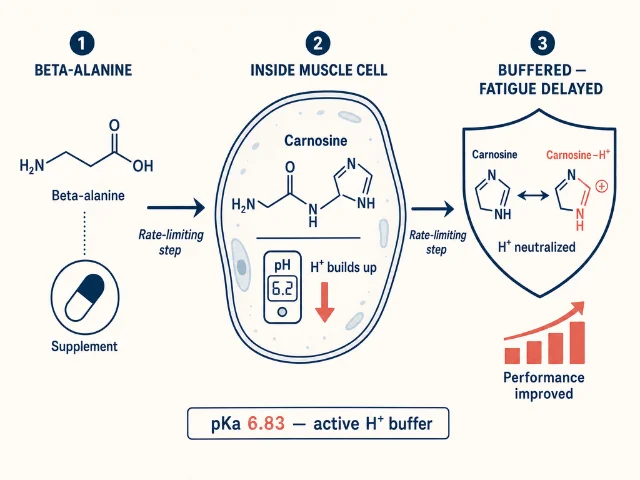
This buffering capacity matters most when H⁺ accumulation is both rapid and sustained — which happens in efforts lasting roughly 60–240 seconds. A 100-meter sprint is over before systemic H⁺ rises to performance-limiting levels. A marathon distributes the metabolic load across aerobic pathways. The 400-meter run, 800-meter swim, a 90-second rowing piece, a 2-minute cycling time trial: these are the events where carnosine availability becomes a limiting factor.
Women typically have lower baseline muscle carnosine concentrations than men — a gap attributed partly to hormonal differences, including the possible influence of estrogen on carnosine metabolism. 1 That lower starting point may also mean more room for supplementation to make a measurable difference — though this remains speculative in the absence of direct comparative data.
링크 미리보기를 불러오는 중…
Dosing: what the evidence supports
Standard protocols from the research literature converge on a clear loading approach. 4
Loading raises muscle carnosine levels by 20%–30% after two weeks and 40%–60% after four weeks at standard doses. 4 The research-validated range is 3.2–6.4 g/day, divided into doses of ≤1.6 g taken every 3–4 hours. Timing relative to training does not affect outcomes — beta-alanine works through cumulative carnosine accumulation, not acute pre-workout pharmacokinetics. Taking it with a carbohydrate- and protein-containing meal may modestly enhance carnosine synthesis. 4
No women-specific dosing studies exist yet. The protocols above are derived from mixed-sex research and should be treated as provisional for female athletes until dedicated trials are published.
Paresthesia — a tingling or flushing sensation on the skin — is the most commonly reported side effect. It is benign and transient, but some people find it uncomfortable. Keeping single doses at or below 1.6 g, or using sustained-release formulations, largely eliminates it. Beta-alanine is not on the 2026 World Anti-Doping Agency prohibited list.
| Parameter | Research-supported range |
|---|---|
| Daily dose | 3.2–6.4 g |
| Single dose (to avoid paresthesia) | ≤ 1.6 g every 3–4 hours |
| Loading period | Minimum 2 weeks; 4 weeks for full effect |
| Carnosine increase at 4 weeks | 40%–60% |
| Timing relative to training | No effect on outcome |
| Best-evidence exercise duration | 60–240 seconds |
Limitations worth knowing before you recommend it
The evidence quality issues in Gu et al. are not minor. All outcomes earned a GRADE rating of very low — the lowest possible level, indicating that estimates of effect should be held with substantial uncertainty. 1 The 312-participant sample is small for a meta-analysis, and publication bias — more positive results getting published than null results — cannot be ruled out.
The full formatted text of Gu et al. had not yet been released as of May 26, 2026 (the study was accepted that day and is awaiting final production). Individual-study data on participant characteristics, precise dosing protocols across the 11 trials, and the complete GRADE evidence profile are not yet publicly available. The forest plot and PRISMA flow diagram will add important detail when published.
Women-specific considerations that remain unanswered include: whether menstrual cycle phase affects response, whether oral contraceptive use modifies carnosine synthesis, and whether dosing needs adjustment for different reproductive stages. None of the included RCTs appear to have stratified by these variables.
The evidence is best described as: directionally positive for TTE in high-intensity exercise, mechanistically coherent, and consistent with mixed-sex literature — but not yet robust enough to make confident quantitative predictions for an individual client.
The recommendation
Beta-alanine is a reasonable addition for women whose primary athletic goals center on sustained high-intensity efforts of 60–240 seconds — think 400-to-1,500-meter track events, 100-to-200-meter pool swims, rowing ergometer pieces, repeated sprint sports, or CrossFit-style interval work.
The concrete step a reader can take today: if that effort window describes your training or your client's training, start a four-week loading protocol at 4–6 g/day, split into doses of ≤1.6 g with meals. Assess whether time-to-exhaustion performance — not peak power or VO₂max, which the current evidence does not support — improves by week four. If no meaningful change is apparent after four weeks of consistent loading, the evidence does not warrant continuing at the same investment.
If the relevant efforts are shorter than 60 seconds or longer than four minutes, available data do not support a benefit — and the supplement cost and attention would be better spent on variables with stronger evidence (diet quality, sleep, periodized training load).
Cover image: AI-generated illustration.
참고 출처
- 1Gu et al. 2026 — Beta-alanine supplementation and exercise performance in women: SR/MA, Frontiers in Nutrition
- 2Hobson et al. 2012 — Effects of β-alanine supplementation on exercise performance: a meta-analysis, Amino Acids
- 3Saunders et al. 2017 — β-alanine supplementation to improve exercise capacity and performance: SR/MA, BJSM
- 4Examine.com — Beta-alanine benefits, dosage, and side effects
이 콘텐츠를 둘러싼 관점이나 맥락을 계속 보강해 보세요.