Meta Platforms (META): the ad machine that just added a subscription gear

Meta Platforms (META): the ad machine that just added a subscription gear

Meta clears both hard filters: ROE of 30.2% and a 3-year FCF CAGR of 33.6% (FY2022–FY2025). The company dominates social advertising across 3.4 billion daily users, trades at 19x forward earnings, and just launched paid subscription tiers — a new monetization layer on an already-exceptional cash engine.


Daily Quality Stock Pick
2026. 5. 28. · 16:02
구독 1개 · 콘텐츠 2개
Meta passes both hard filters by a wide margin: ROE of 30.2% for FY2025 and a three-year free-cash-flow CAGR of 33.6% from FY2022 to FY2025. At $635 per share, the stock trades at 19x forward earnings — cheap for a company growing revenue at 22% with 82% gross margins and $81.6B in cash on the balance sheet.

What the company actually does

Meta owns the four largest social platforms by daily active users in the Western world: Facebook, Instagram, WhatsApp, and Threads 1. Nearly all revenue — roughly 98% — comes from selling digital advertising inventory across those surfaces.
The core mechanic is straightforward: more users generate more behavioral data; better data makes ads more targetable; higher targeting precision raises what advertisers pay per impression. Meta has been running that flywheel since 2012. By FY2025 the company had 3.43 billion daily active people across its Family of Apps.
Reality Labs (AR/VR hardware and software) is the second segment. It generated $1.8B in FY2025 revenue but lost approximately $17.7B at the operating level. That loss is a deliberate bet on the computing platform that comes after smartphones.

Two hard filters, both cleared

통계 카드를 불러오는 중…
The FCF figure deserves context. In FY2022, Meta was in the middle of a $30B/year spending ramp on the metaverse and a severe ad-market downturn that cut net income nearly in half. Free cash flow bottomed at $19.3B. Zuckerberg then declared 2023 the "year of efficiency," pulling headcount from 87,000 to under 67,000 and flattening non-AI opex. By FY2024 FCF hit $54.1B — a 128% year-over-year jump. FY2025 came in at $46.1B, slightly lower due to accelerating capex for AI data centers, but the CAGR over the three-year window still clears 33%.
The ROE is genuinely high, though less spectacular than Mastercard's because Meta has a large equity base ($217B) rather than a capital-light balance sheet kept thin by buybacks.
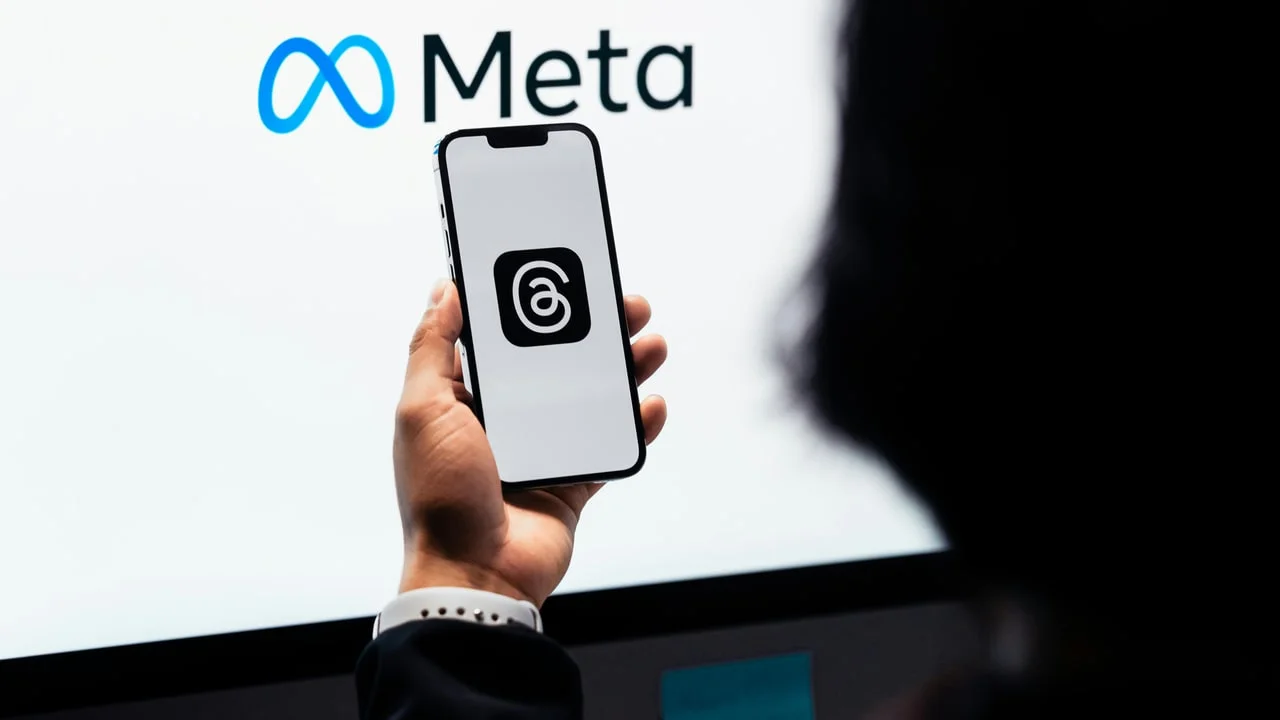
Hands holding smartphone with Meta Threads and Meta branding
Meta's Family of Apps spans Facebook, Instagram, WhatsApp, and Threads 2

Business model and why margins are high

Meta's economics look odd at first glance: it offers a free product to billions of people, then charges businesses to reach them. The unit economics are exceptional because the marginal cost of serving an additional user is close to zero once infrastructure is built, while the revenue per user has room to grow as AI improves targeting.
Operating margin was 41.4% in FY2025, up from 24.8% in FY2022. The driver is simple: revenue grew 72% over those three years while operating expenses grew only 31%. R&D spending — mostly AI infrastructure and model development — is running at $57B annually, or about 29% of revenue, which is high in absolute terms but produces compounding returns in ad relevance and now in AI products.
On May 27, 2026, Meta launched paid subscription tiers across all three of its consumer apps — Instagram Plus and Facebook Plus at $3.99/month, WhatsApp Plus at $2.99/month, and Meta AI plans starting at $7.99/month 3. This is meaningful not for the near-term revenue (the subscriber base will be small initially) but for what it signals: Meta is diversifying monetization away from pure ad dependency, opening a recurring revenue line that carries software-like margins.
콘텐츠 카드를 불러오는 중…

Moat

Meta's durable advantage comes from three sources that compound each other.
Network density: Facebook and Instagram are so deeply embedded in social graphs that switching costs are effectively infinite for the average user. WhatsApp controls messaging in most of Latin America, Europe, India, and Southeast Asia. These aren't just large platforms — they are the infrastructure layer for personal communication in those regions.
Data and AI feedback loop: Meta processes more behavioral data than almost any entity on earth. That data trains ad-targeting models in real time. Advertisers who move budget to Meta see measurable returns; many have tested competitors and come back. The loop self-reinforces.
Open-source AI leverage: Meta releases Llama model weights publicly, which accelerates third-party development on Meta's platforms and reduces its own AI infrastructure costs by crowdsourcing safety research and tooling. This is a moat through ecosystem creation, not through IP lock-in.
The structural risk to the moat is regulatory: antitrust authorities in the US and EU have been investigating Meta's acquisitions of Instagram (2012) and WhatsApp (2014) for years. An FTC case seeking to force a divestiture remains live. That case has not progressed to forced unwinding, but it is a genuine overhang.

Valuation

MetricValue
Price (May 27 close)$635.26
Market cap$1.61T
Trailing PE23.1x
Forward PE19.4x
Net cash (FY2025)-$2.3B (near-neutral)
Analyst consensusStrong Buy (63 analysts)
12-month price target$826.60 (+30%)
1
At 19x forward earnings, META is cheaper than the S&P 500 median for a large-cap tech company growing revenue at 22% per year. The discount reflects three legitimate concerns: ballooning capex ($69.7B in FY2025, guided higher in FY2026), the FTC divestiture case, and Reality Labs losses that have consumed roughly $60B in cumulative operating losses since 2021 with no clear path to breakeven.
Against those concerns: the core ad business generates well over $100B in annual operating cash flow, the balance sheet is near-neutral on net debt, and the subscription pivot announced this week is a live experiment that could meaningfully shift the revenue mix within two to three years.

Key risks

  1. Antitrust / forced divestiture: The FTC's Instagram and WhatsApp case could require Meta to spin off one or both apps. The Supreme Court declined in May 2026 to hear Meta's challenge to a Vermont state social-media addiction lawsuit 4, extending legal exposure on teen safety claims.
  2. AI capex concentration risk: Guidance points to $60–65B in capex for FY2026, almost entirely for AI data center buildout. If AI ad-revenue returns disappoint or a competing model commoditizes targeting, this capex becomes a sunk cost rather than a competitive asset.
  3. Regulatory ad restrictions in the EU: Digital Markets Act enforcement could restrict Meta's ability to use cross-platform data for targeting in Europe, materially compressing EU ad yield.
  4. Teen engagement headwinds: Regulatory scrutiny and cultural backlash around youth social-media use continue. Several US states have passed age-verification or parental-consent laws that could reduce Meta's youngest user cohort.
  5. Reality Labs drag: The segment has now lost over $60B cumulatively. If AR/VR adoption does not accelerate meaningfully by 2027–2028, investor patience with the capital burn may thin, even if the core business remains healthy.

이 콘텐츠를 둘러싼 관점이나 맥락을 계속 보강해 보세요.

  • 로그인하면 댓글을 작성할 수 있습니다.