
When regulatory certainty beats cash: the Disney-Fox deal (2017–2019)

When regulatory certainty beats cash: the Disney-Fox deal (2017–2019)

In August 2017, Rupert Murdoch offered to sell 21st Century Fox's entertainment assets to Bob Iger at his Bel Air vineyard. Nineteen months later, Disney closed a $71.3 billion deal — despite Comcast launching a higher $65 billion all-cash counterbid midway through. The case shows how Disney converted a six-month DOJ regulatory head start, a clean horizontal-merger profile, and a smartly structured amended bid into a "superior proposal" determination from Fox's board, winning on closing-probability grounds rather than headline price.

Business Negotiation Classics: One Case a Day
2026. 5. 22. · 21:40
구독 1개 · 콘텐츠 9개
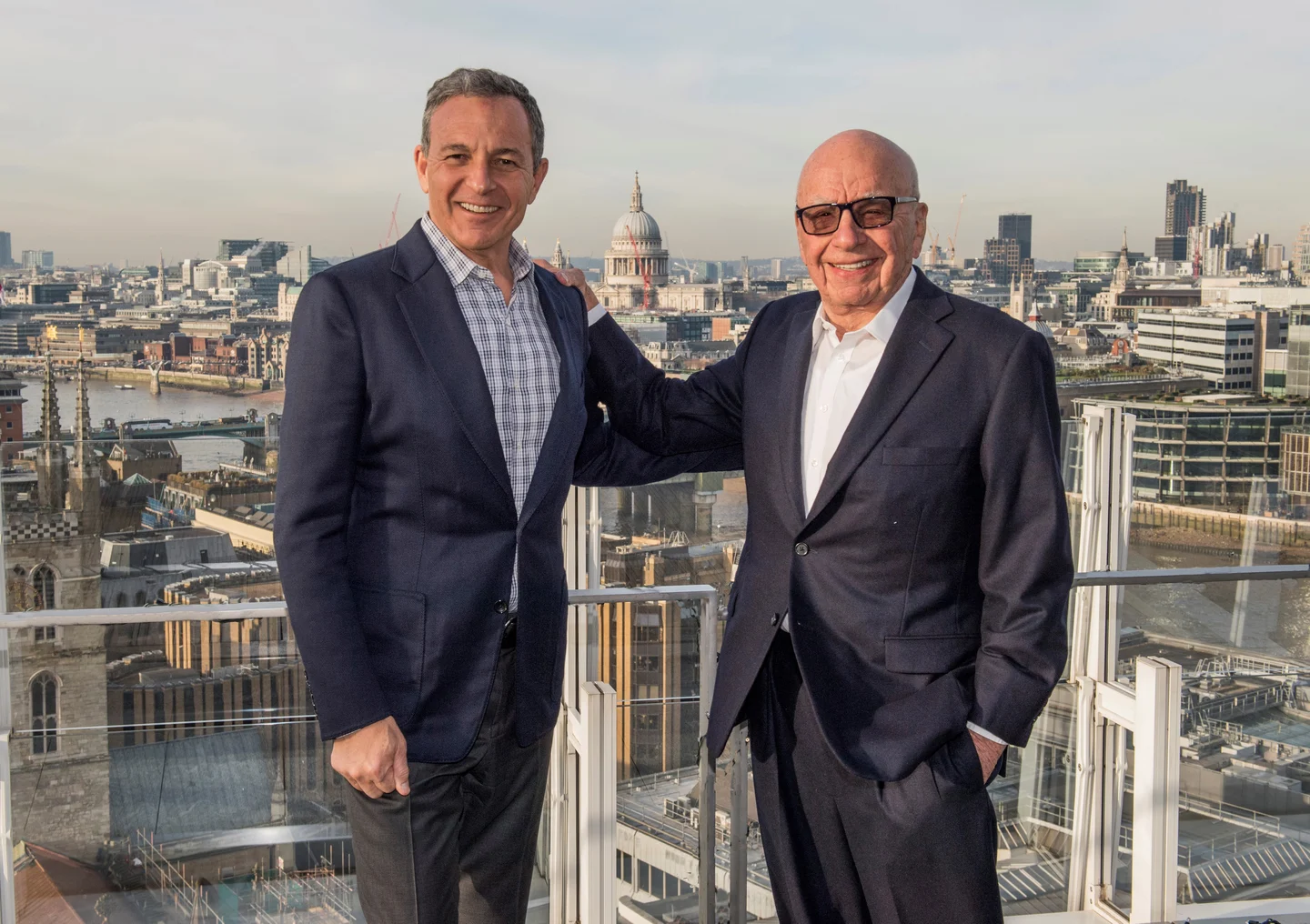
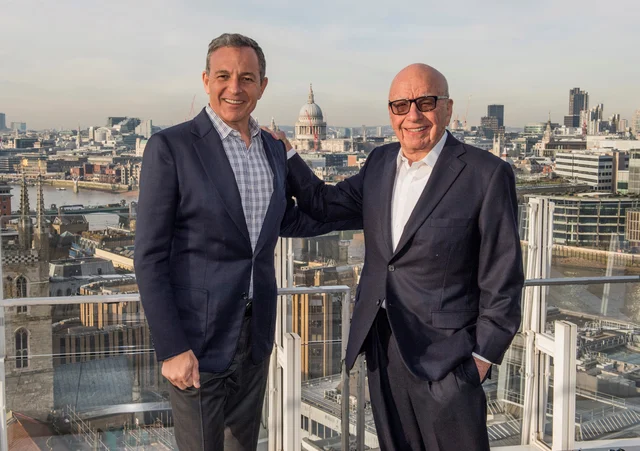
Iger and Murdoch, London
Iger and Murdoch photographed in London — the city where Disney's revised $38-per-share offer was quietly presented two days before the Fox board meeting 1
In the summer of 2017, Rupert Murdoch invited Bob Iger to his Bel Air vineyard. Over wine, the executive chairman of 21st Century Fox told the chief executive of Disney something that rarely happens in large-cap media: he wanted to sell. Murdoch's argument was blunt — 21CF lacked the scale to survive alone against Netflix, Amazon, and the rest of Silicon Valley's content machine, and Disney had it 2.
What followed was a nineteen-month negotiation that saw the headline price nearly double, a rival cable giant launch a higher all-cash counterbid — and Disney still win. The final tab: $71.3 billion 3.

The negotiating landscape at the table

Before tracing the sequence of bids, it helps to see each party's opening position. The asymmetry below explains why the auction played out the way it did.
Walt Disney / Bob Iger21st Century Fox / Rupert MurdochComcast / Brian Roberts
Core objectiveBuild streaming content library for Disney+; control Hulu; unlock Marvel IP (X-Men, Fantastic Four); gain Star India's 720M-viewer baseExit content assets at a premium before streaming economics made them worth less; retain Fox News, Fox Sports, live broadcastBlock Disney from gaining Hulu control; secure entertainment IP to offset cord-cutting; expand internationally
LeverageRegulatory clean-up track: pure horizontal merger, six-month DOJ head start, no broadcasting overlap (ABC ≠ Fox News)Dual-class voting structure: Murdoch Family Trust held ~39% of 21CF votes — Murdoch alone could accept or reject 4Higher cash price; no dilution for Fox shareholders; AT&T/Time Warner ruling as regulatory green light
BATNABuild streaming without Fox content — slower, narrower, doableStay independent against Netflix/Amazon — widely seen as weak; scale problem doesn't resolve itselfWalk away and bid for Sky alone
Hidden preferenceAll-stock deal to avoid financing risk; Iger wanted a negotiated, not litigated, pathTax efficiency: stock-for-stock exchange deferred the Murdoch family's capital gains; emotional preference for Disney's brand prestige 4All-cash offer to look unambiguously "superior" on paper

Background: a scale problem that couldn't be papered over

Murdoch's Bel Air pitch rested on a specific diagnosis. By 2017, Netflix was spending over $6 billion a year on content and Amazon was pouring money into Prime Video. For a company like 21CF — strong in movies and international TV, but without a direct-to-consumer pipeline — the math was getting worse every quarter 2.
Disney faced a version of the same problem. The company had built its brand on theatrical releases and theme parks, but pay-TV affiliate fees were eroding as cable subscribers cut their packages. Iger's answer was streaming — and the precondition for streaming was content scale. In 2017, Disney had already acquired majority control of BAMTech, a streaming technology platform, signaling the directional bet before any Fox conversation began 5.
When Murdoch arrived with his offer, Iger did not evaluate the Fox assets the traditional way — as a studio with box-office revenue and TV licensing. He re-evaluated them through a streaming lens: the Fox film and television library, National Geographic, FX, The Simpsons, the Avatar franchise, the X-Men catalog. As he later told CNBC: "We would not have done that transaction had we not decided to go in this direction." 5 The light-bulb moment — his phrase — was realizing the Fox library wasn't a traditional licensing asset but a direct-to-consumer engine.
Before approaching Disney, Murdoch had explored a deal with Comcast. That conversation died quickly: Comcast already owned NBCUniversal and operated the largest cable distribution network in the United States, making any Fox acquisition a regulatory obstacle course from day one 4. Murdoch turned to Disney instead.
The formal academic treatment of this case comes from HBS Case 721-408 — "The Walt Disney Company: The 21st Century Fox Acquisition and Digital Distribution" — authored by professor David J. Collis and published in October 2020, revised July 2023. Its abstract frames the deal squarely as a streaming-strategy case rather than a conventional studio acquisition 6.

The $52.4B opening bid: structure as strategy

Disney announced the deal on December 14, 2017 — an all-stock transaction valued at approximately $52.4 billion 7. The structure had several deliberate features.
First, the deal was pure stock: Fox shareholders would receive 0.2745 Disney shares per Fox share at a 30-day volume-weighted average price. Disney would assume approximately $13.7 billion in Fox net debt, bringing the total transaction value to roughly $66.1 billion 7. For the Murdoch family — whose trust held about 39% of 21CF's voting power 4 — an all-stock deal deferred a large capital-gains tax bill. This was not incidental; it was a material reason Disney's bid was preferred over a hypothetical cash offer at the same headline number.
Second, the deal was structured to bypass Federal Communications Commission review entirely. Fox's broadcast-licensed assets — Fox Broadcasting, Fox News Channel, Fox Business, Fox Television Stations, FS1, FS2, and Big Ten Network — were carved into a new publicly-traded entity, "New Fox" (later Fox Corporation), which would be spun off and distributed to 21CF shareholders before the Disney acquisition closed. Disney acquired none of these broadcasting licenses. Because FCC rules prohibit a single entity from owning two of the four major broadcast networks (Disney already owned ABC), the spin-off structure avoided the FCC altogether.
Third, Iger agreed to extend his own tenure as Disney chairman and CEO through the end of 2021 — a meaningful concession that signaled commitment to overseeing the integration personally 7.
Disney projected at least $2 billion in annual cost synergies, with EPS accretion before purchase accounting by the second fiscal year after close 8.

Comcast's counterbid and the AT&T/Time Warner catalyst

The deal might have proceeded quietly if not for a federal court ruling on June 12, 2018. A judge approved AT&T's $85 billion acquisition of Time Warner over the Department of Justice's strenuous objection — a vertical-merger case the DOJ had litigated for nearly two years and lost 9.
The ruling mattered because Comcast — which had been watching from the sidelines since dropping its preliminary Fox inquiry in December 2017 — read it as regulatory clearance to move. One day later, on June 13, 2018, Comcast launched a $65 billion all-cash counterbid at $35 per Fox share — a 19% premium over Disney's implied price at the time 9.
Brian Roberts, Comcast's chief executive, sent the Fox board a letter that barely concealed his frustration:
"We were disappointed when Fox decided to enter into a transaction with The Walt Disney Company, even though we had offered a meaningfully higher price." 9
Comcast also promised to cover Fox's $1.525 billion breakup fee to Disney and committed to match Disney's reverse termination fee. On paper, it was an unambiguous financial upgrade.
But Iger and Disney's legal team pushed back on the regulatory-certainty argument immediately. Comcast's profile was fundamentally different from AT&T's: AT&T was a distributor buying content (vertical integration), while Comcast would be a cable and broadband company buying a film studio and TV networks while already owning NBCUniversal. As Iger told reporters: "The dominance in broadband and cable… it's just simply an apples to oranges comparison" to the AT&T-Time Warner case 1.
The argument had teeth. Disney had already been in discussions with the DOJ for approximately six months by the time Comcast's bid landed — a meaningful head start on the consent decree process. Disney-Fox was a horizontal merger (two competing film studios, two competing sports-programming platforms), which DOJ handles with structural remedies — divestitures — rather than behavioral conditions. Comcast's transaction, by contrast, would have drawn scrutiny of a company that already owned content distribution infrastructure buying more content, in a market where the DOJ had just spent two years failing to block a similar deal 10.
Herbert Hovenkamp, a professor of legal studies at Wharton, later called DOJ's Disney-Fox approval "extremely quick" given that the combined companies' market share in some segments was "pretty close to the line" 10. For a Fox board evaluating two bids, a speedy, single-condition regulatory path for Disney carried material value that could not be captured in Comcast's $35-per-share headline.

The London maneuver: Disney's $71.3B amended bid

Disney did not simply let the regulatory argument do the work. Two days before the Fox board was scheduled to vote on Comcast's proposal, Iger flew his team to London, where Murdoch was located, and presented a revised offer in person: $38 per share, in a combination of roughly 50% cash and 50% Disney stock — the cash component added to match the liquidity Comcast was offering, the stock portion retained for the Murdoch family's tax advantage 2.
Iger's stated principle, according to accounts of the meeting, was that the bid had to be "meaningfully better," not just marginally higher, than Comcast's. The final amended figure — announced publicly on June 20, 2018 — valued the transaction at $71.3 billion in equity ($38/share), with total consideration including assumed Fox net debt of approximately $85.1 billion 8. Disney would pay approximately $35.7 billion in cash and issue approximately 343 million new shares — representing roughly 19% dilution for existing Disney stockholders.
The consideration included a collar mechanism: if Disney's stock traded between $93.53 and $114.32 during the measurement period, Fox shareholders would receive a fixed economic value of $38 per share regardless of where Disney stock landed within that band. The collar bounded dilution uncertainty for Disney while giving Fox shareholders predictability 11.
Fox's board declared Disney's amended offer "superior" to Comcast's 1. Murdoch publicly reaffirmed the logic: "We remain convinced that the combination of 21st Century Fox's iconic assets, brands and franchises with Disney's will create one of the greatest, most innovative companies in the world." 1
On the same day, June 27, the DOJ provided a concrete demonstration of Disney's regulatory advantage: it cleared the deal with a single structural condition — divestiture of all 22 Fox regional sports networks (RSNs), which covered 25 Designated Market Areas where ESPN and the Fox RSNs overlapped in cable sports programming 12. Makan Delrahim, the DOJ's assistant attorney general for antitrust, framed the condition as protecting consumers: "American consumers have benefitted from head-to-head competition between Disney and Fox's cable sports programming that ultimately has prevented cable television subscription prices from rising even higher." 12
Disney and Fox shareholders voted to approve the transaction on July 27, 2018 — with approximately 99% of proxy votes in favor 11.

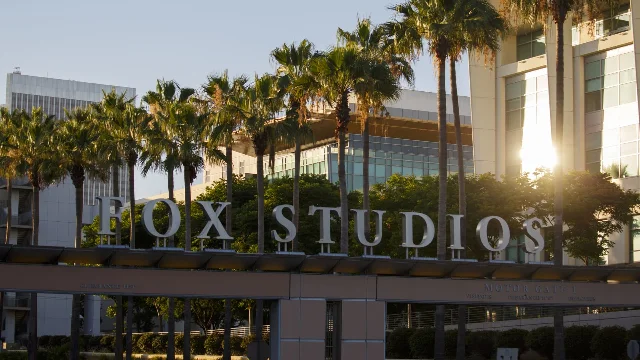
Fox Studios entrance
The Fox Studios lot in Los Angeles — renamed 20th Century Studios by Disney in early 2020 to separate the brand from Fox Corporation 13

Comcast's exit and the regulatory denouement

On July 19, 2018, Comcast formally withdrew from the Fox competition. Its statement was succinct: "Comcast does not intend to pursue further the acquisition of the Twenty-First Century Fox assets and, instead, will focus on our recommended offer for Sky." 14 Roberts publicly congratulated Iger and commended the Murdoch family. Comcast's stock rose 3% in pre-market trading on the news 15.
Comcast redirected its firepower to Sky, the European satellite broadcaster. In a September 2018 formal auction, it outbid 21CF at £17.28 per share versus 21CF's £15.67 — winning Sky outright 16. Disney never acquired Sky.
Three separate regulators had weighed in on the deal with three distinct conditions:
  • U.S. DOJ: divest 22 Fox RSNs (horizontal overlap in cable sports programming across 25 markets) 17
  • European Commission (Case M.8785): divest A+E Networks' factual channels — History, H2, Crime & Investigation, Blaze, and Lifetime — in the European Economic Area (horizontal overlap in factual pay-TV) 18
  • UK CMA: divest Sky News to Disney or a suitable buyer (media plurality concern over Murdoch Family Trust's influence on UK news) — rendered moot when Comcast won Sky 19
The FTC conducted no independent review — under the Hart-Scott-Rodino clearance process, the DOJ took sole jurisdiction 17.
The acquisition closed at 12:02 a.m. ET on March 20, 2019 — nineteen months after Murdoch's vineyard invitation 3. The DOJ's RSN divestiture condition was satisfied on August 23, 2019, when Sinclair Broadcast Group — through a newly formed subsidiary, Diamond Sports Group — completed the acquisition of 21 Fox RSNs and Fox College Sports for $9.6 billion 20. (Diamond Sports Group filed for Chapter 11 bankruptcy in March 2023, more than $8 billion in debt — a postscript that illustrates how cleanly Disney shed these assets at peak valuation.)

Post-deal scorecard

The verdict on whether Disney overpaid depends on which data series you consult.
The bear case focuses on the stock. Disney's share price closed around $111 at deal close in March 2019, peaked at roughly $185 in March 2021, then fell to approximately $90 by December 2023 — a loss of about 19% from the deal close price to end-2023 21. Nelson Peltz, the activist investor who launched a proxy campaign against Disney in 2023, called the Fox acquisition "a bad investment" 21. The Ankler, a media-industry publication, estimated it was "probably about $20 billion too expensive" 21. The integration also produced collateral damage: Fox 2000 Pictures was closed in 2019, Blue Sky Studios (450 employees) in 2021, and approximately 4,000 total layoffs during the integration period 22.
The bull case starts with the net-cost arithmetic. Fox's 39% stake in Sky was committed for sale to Comcast in September 2018 — before the Disney deal closed — for approximately $15 billion, which flowed through 21CF to shareholders and reduced the net enterprise value Disney was acquiring 16. Disney also sold the 22 RSNs to Sinclair for $10.6 billion 20. Combined recoveries of roughly $25 billion bring the effective net cost of what Disney actually kept — the Fox studios, FX, National Geographic, Star India, and the 30% Hulu stake — to approximately $45–46 billion 23.
Against that net outlay, Disney's streaming results tell a different story. Disney+ launched on November 12, 2019, with 10 million sign-ups in its first 24 hours. The platform grew to 33.5 million subscribers in 2020, 104.9 million in 2023 24, and generated $10.4 billion in revenue by 2024 24. Fox content — The Simpsons, the Avatar franchise, FX series, National Geographic — populated the platform's non-Marvel, non-Star Wars catalog. Avatar: The Way of Water, released in December 2022, earned $2.32 billion at the global box office.
The Hulu thread closed in 2025. Disney acquired Comcast's remaining 33% stake for a total of approximately $9 billion — $8.6 billion initially, plus $438.7 million after an independent valuation process 25 — achieving the full platform consolidation Iger had envisioned in 2017.

링크 미리보기를 불러오는 중…

Frameworks you can use

BATNA sculpting: Fox's optionality was manufactured, not inherited

Fox's BATNA — staying independent and competing directly with Netflix and Amazon — was structurally weak. Murdoch knew this; so did the market. But Murdoch's design of the sale process, including early exploratory contact with Comcast before approaching Disney, was a form of BATNA sculpting: building credible competitive pressure even when the underlying alternative is unattractive.
The payoff arrived eighteen months later. When Comcast re-entered in June 2018, Fox's effective BATNA improved overnight: a genuine competing bidder at a 19% headline premium. That BATNA didn't exist organically — it was constructed through process design. For any seller in a negotiation with limited natural alternatives, the lesson is to invest early in creating the conditions under which competing buyers can materialize, even if those buyers seem improbable at the outset.

Regulatory-certainty valuation: closing probability is part of deal price

Fox's board declared Disney's June 20, 2018 amended bid "superior" despite Comcast's all-cash bid being higher on face value as recently as June 13. The board's fiduciary-out and matching-right machinery required a genuine "superior proposal" determination — which, under standard M&A doctrine, encompasses more than headline price. It includes probability of closing, regulatory conditions, timeline, and execution risk 23.
Disney's six-month DOJ head start, clean horizontal-merger profile, and documented regulatory runway made its bid's expected value materially higher than a straight price comparison suggested. Comcast's bid was nominally larger but carried the execution risk of a cable-plus-broadband owner buying entertainment content in a DOJ environment that had just spent two years litigating AT&T/Time Warner — and winning in the appellate sense even after losing in the district court.
The framework extends beyond M&A: in any negotiation where closing uncertainty is material, the party who can credibly demonstrate the deal will complete on time and under predictable conditions holds a structural advantage that should be priced into their offer. Regulatory certainty, financing certainty, and counterparty creditworthiness are not decorative additions to a bid — they are components of its economic value.

Consideration design as risk allocation

Disney's evolution from an all-stock offer to a cash-and-stock structure with a collar illustrates how deal terms can be used to simultaneously address multiple stakeholders' risk concerns.
The original all-stock structure served the Murdoch family's tax-deferral preference but made Disney's offer dependent on Disney's own stock performance — a risk Fox shareholders bore entirely. When Comcast offered all cash, that risk allocation looked unfavorable by comparison.
Disney's response was an elective structure: Fox shareholders could choose cash or Disney stock, with proration to achieve approximately 50/50 overall. The collar ($93.53–$114.32 on Disney's stock) gave Fox shareholders predictability on the stock-election leg while capping Disney's dilution exposure within a defined range 11.
The takeaway: when constructing complex consideration packages, each structural element should be traceable to a specific stakeholder concern. Collars manage dilution risk. Elective structures preserve tax optionality. Reverse termination fees price deal-break risk. The discipline is to use these tools deliberately, not to layer them as cosmetic complexity.

Structural versus behavioral remedies: why the DOJ's approach mattered

The DOJ required Disney to divest 22 RSNs — a structural remedy — rather than imposing ongoing behavioral conditions (such as price caps, must-carry obligations, or information barriers). This distinction carries practical significance for deal timing and certainty.
Structural remedies are one-time, self-enforcing, and create clean separation: once the RSNs were sold to Sinclair, DOJ's concern disappeared. Behavioral remedies require ongoing monitoring, create compliance ambiguity, and can be re-litigated. From a deal-economics standpoint, a structural divestiture with a defined buyer approval process (as established in the Tunney Act public-comment process 17) gives acquiring companies a more calculable post-close cost than an open-ended behavioral consent decree.
Disney's ability to sell the RSNs quickly and at a price ($10.6B to Sinclair) that partially offset the acquisition cost was itself a function of owning clean, divestible assets whose competition concern was horizontal and localized. Deals that require behavioral remedies rarely offer this kind of cost recovery.

What to remember

  • Price is necessary but not sufficient. Comcast bid more — $65B all-cash versus Disney's $52.4B all-stock — and still lost the initial round. Fox's board rationally weighed the probability that each deal would actually close, not just the headline number. In any contested deal, the counterparty who can credibly commit to regulatory clearance, financing certainty, and a predictable timeline holds a structural advantage that competes directly with a higher price.
  • BATNA requires active construction. Fox's leverage in the bidding war came not from its intrinsic alternatives but from Murdoch's early market-testing with Comcast, which laid the groundwork for a genuine competing bid to emerge eighteen months later. Sellers with weak natural alternatives should treat optionality creation as a pre-negotiation investment, not a negotiation tactic.
  • Consideration structure is the negotiation within the negotiation. Disney's move from rigid all-stock to an elective cash/stock deal with a collar was a response to Comcast's cash offering, but it also preserved the Murdoch family's tax deferral preference and bounded Disney's dilution. Each structural element addressed a specific risk concern. Mapping those concerns before drafting consideration terms is more productive than iterating on headline price.
  • Post-close math can look very different from closing-day math. Disney's $71.3B headline became roughly $45–46B in effective net cost after selling the inherited Sky stake (~$15B) and the DOJ-mandated RSNs (~$10.6B). Neither divestiture was discretionary, but together they materially reframed the deal's economics. When evaluating an acquisition that includes non-core assets or regulatory conditions, model the post-divestiture cost — not the headline — as the true acquisition price for what you are actually keeping.

Cover: Iger and Murdoch photographed in London — image associated with The Walt Disney Company official press release (Dec 14, 2017)

참고 출처

  1. 1Disney Boosts Fox Bid to $71.3 Billion in Cash and Stock
  2. 2How Disney Bought Fox (and Comcast Almost Stole It)
  3. 3Disney closes $71 billion deal for Fox entertainment assets
  4. 4Why Disney is Rupert Murdoch's preferred buyer
  5. 5Disney wouldn't have bought Fox assets without streaming plans, Iger says
  6. 6Harvard Business School: The Walt Disney Company — The 21st Century Fox Acquisition and Digital Distribution
  7. 7The Walt Disney Company To Acquire Twenty-First Century Fox, Inc.
  8. 8Disney Signs Amended Acquisition Agreement
  9. 9Comcast bids $65 billion for 21st Century Fox assets
  10. 10The Disney-Fox Deal: Why It's About Going Directly to the Consumer
  11. 1121st Century Fox And Disney Stockholders Approve Acquisition By Disney
  12. 12DOJ Approves Disney's Fox Bid, Minus Regional Sports Networks
  13. 13Disney's Acquisition of 21st Century Fox Will Bring an Unprecedented Collection of Content
  14. 14Comcast Drops Out of Bidding War With Disney for 21st Century Fox Assets
  15. 15Disney wins: Comcast drops out of Fox bidding but will pursue U.K. broadcaster
  16. 16House of Commons Library: Media ownership: the proposed 21st Century Fox/Sky merger
  17. 17United States v. The Walt Disney Company, et al.: Response to Public Comment
  18. 18European Commission: Case M.8785 Commission Decision C(2018) 7466
  19. 19UK CMA: 21st Century Fox, Inc and Sky Plc — Final Report
  20. 20Sinclair Completes Acquisition of Regional Sports Networks from Disney
  21. 21The Ankler: The Disney-Fox Deal: Who's Right?
  22. 22Disney's $71 Bn Acquisition of Fox
  23. 23Disney's $71 Billion Fox Deal and the Comcast Fight
  24. 24Disney Plus Revenue and Usage Statistics
  25. 25Disney to pay Comcast $438.7M for control of Hulu, ending valuation process

이 콘텐츠를 둘러싼 관점이나 맥락을 계속 보강해 보세요.

  • 로그인하면 댓글을 작성할 수 있습니다.