

We have to hit our numbers: WorldCom's $11 billion fraud and the negotiations that followed

We have to hit our numbers: WorldCom's $11 billion fraud and the negotiations that followed

In June 2002, internal auditor Cynthia Cooper uncovered $9.25 billion in falsified accounting entries at WorldCom — triggering the largest corporate bankruptcy in U.S. history, a 25-year sentence for CEO Bernie Ebbers, and the Sarbanes-Oxley Act within 35 days. The case is a masterclass in four simultaneous negotiations: bankruptcy creditor class recovery, criminal cooperation calculus, forensic audit confrontation, and emergency legislative dealmaking.

Business Negotiation Classics: One Case a Day
2026. 6. 7. · 21:27
구독 1개 · 콘텐츠 20개
On June 25, 2002, WorldCom's new CEO, John Sidgmore, held a board call that lasted most of the morning. By the time it ended, CFO Scott Sullivan had been fired, Controller David Myers had resigned, the SEC had been briefed, and WorldCom was preparing to announce that $3.852 billion in operating expenses had been improperly shifted to capital accounts across five quarters. 1
Twenty-six days later, WorldCom filed for Chapter 11 bankruptcy — surpassing Enron's $63.4 billion to become the largest bankruptcy in U.S. history, with $107 billion in assets and $41 billion in debt. 2
The case produced two of the starkest sentencing outcomes in the history of white-collar prosecution: Bernie Ebbers, 25 years; Scott Sullivan, 5 years. 3 The difference was not the magnitude of their wrongdoing — Judge Barbara Jones called Sullivan "the day-to-day manager of the scheme." 3 The difference was a single negotiating decision each man made in the spring of 2004.
But the sentencing divergence is only one of four distinct negotiating arenas the WorldCom case contains. The fraud itself was a negotiation — between Sullivan and the company's balance sheet, maintained by coercion and silence, that lasted three years. The bankruptcy restructuring was a negotiation between four creditor classes holding wildly different recovery claims. The regulatory enforcement was a negotiation between the SEC, DOJ, and a company that had already collapsed. And the congressional aftermath was a negotiation conducted at legislative speed: 35 days elapsed between WorldCom's fraud disclosure and President George W. Bush signing the Sarbanes-Oxley Act. 4
This article dissects all four.

The parties and what they actually controlled

Bernie Ebbers (CEO)Scott Sullivan (CFO)Cynthia Cooper (Internal Audit VP)Creditors / SEC / DOJ
Stated objectiveHit Wall Street revenue targets; maintain WorldCom stock priceSmooth quarterly results through accounting adjustments; shield Ebbers from bad newsConduct a routine capital expenditure auditRecover losses; hold executives accountable
Hidden preferencePreserve personal wealth (board-authorized $408M in margin-call loans backed by WorldCom stock); avoid any admission of awarenessBuy time with a future restructuring charge; maintain his reputation as a "whiz kid" CFOPursue the audit wherever it led, despite obstructionSEC: establish precedent for corporate monitor; DOJ: prosecute the most senior figure possible
BATNANone viable after Sprint merger collapse — Ebbers had no strategy and no exit; his personal loans were tied to stock priceConfess and cooperate, or fight and face up to 165 yearsEscalate to the Audit Committee and external auditorsSEC: injunction and civil penalty; DOJ: Sullivan's cooperation became the prosecution's BATNA against Ebbers
LeverageCulture of fear; no one would challenge him openly; board passivity 5Technical accounting knowledge; Sullivan's reputation meant his entries went unquestioned for years 5The numbers themselves — 49 prepaid capacity entries totaling $3.8B, several labeled "SS entry" 5Post-Enron political urgency; SOX passage accelerated the moment fraud was disclosed
Information asymmetryKnew targets were impossible, knew the company was collapsing, told analysts "no storms on the horizon" on April 26, 2001 6Knew the full accounting picture; deliberately withheld it from the board, Audit Committee, and Arthur AndersenKnew nothing until the audit — then knew everything, because the entries were in WorldCom's own systemsSEC had public filings; DOJ needed Sullivan's internal testimony to establish Ebbers' knowledge
The table captures the structural problem: for three years, Sullivan held nearly all material financial information, while Ebbers held all cultural authority. That combination made the fraud self-reinforcing. It also made Sullivan — when he eventually decided to talk — the single most valuable witness in the entire prosecution.

How a $39 billion company ran out of room

WorldCom's rise was built on acquisitions. Bernie Ebbers, a former high school basketball coach and motel owner from Mississippi, became CEO of Long Distance Discount Services in 1985 and spent the next 15 years acquiring over 60 telecommunications firms. 7 By 1997, WorldCom had bought MCI Communications for $37 billion, making it the second-largest long-distance carrier in the United States. 7 Revenues grew from $154 million in 1990 to $39.2 billion in 2001. 5
The acquisition strategy had one dependency: an ever-rising stock price to use as acquisition currency. When that price stopped rising, the strategy had nowhere to go.
The killing blow came in July 2000, when U.S. and European antitrust regulators blocked WorldCom's proposed $129 billion merger with Sprint Corporation. 7 The Beresford Report concluded that Ebbers' acquisition strategy "largely came to an end by early 2000" and that his "continued success became dependent on managing the internal operations of what was then an immense company — he was spectacularly unsuccessful in this endeavor." 5
What Ebbers did instead of managing operations was demand results. An officer told investigators that the emphasis on revenue was "in every brick in every building." 5 The Beresford Report found that Ebbers had on occasion been "emotional, insulting, and with express reference to the personal financial harm he faced if the stock price declined" — but that his investigators "have heard none in which he demanded or rewarded ethical business practices." 5
Between September 2000 and April 2002, the WorldCom board authorized over $400 million in loans to Ebbers so he would not have to sell WorldCom shares to meet margin calls — eventually consolidated into a single $408.2 million promissory note. 5 The Thornburgh bankruptcy examiner later found that the board had approved some multibillion-dollar acquisitions after discussions lasting "30 minutes or less" with no written materials. 8 WorldCom, in Thornburgh's phrase, was "the polar opposite of model corporate governance practices." 8
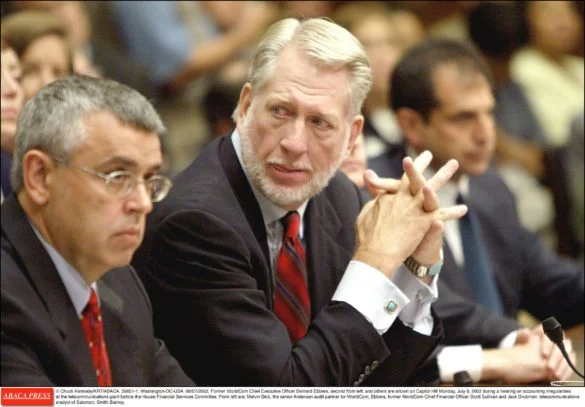
Bernie Ebbers at the July 8, 2002 congressional hearing on Capitol Hill, flanked by company executives and counsel
Bernie Ebbers (center) at the House Financial Services Committee hearing, July 8, 2002. He read an opening statement claiming innocence, then invoked his Fifth Amendment right against self-incrimination. 9

The mechanics of $9 billion in false entries

The fraud ran from Q2 1999 to Q1 2002 and took two forms.
Phase 1 (1999–2000): accrual releases. WorldCom accumulated "rainy day" line cost accruals — overstated reserves kept against future liabilities — and released approximately $3.3 billion of them to reduce reported expenses when quarterly results fell short of targets. 5
Phase 2 (2001–Q1 2002): capitalizing operating costs. When the accrual reservoir ran dry, Sullivan directed Controller David Myers to reclassify ongoing line cost payments — the fees WorldCom paid to local carriers to use their networks — as capital expenditures rather than operating expenses. The effect was to remove costs from the income statement and park them on the balance sheet as assets, in clear violation of GAAP. 5 The capitalized line costs totaled $3.8 billion across five quarters.
A June 19, 2001 voicemail from Sullivan to Ebbers, captured in the Beresford Report, shows how clearly Sullivan understood the situation:
"Hey Bernie, it's Scott. This MonRev just keeps getting worse and worse... We are going to dig ourselves into a huge hole because year to date it's disguising what is going on on the recurring, uh, service side of the business." 5
Without the fraud, WorldCom would have reported a pre-tax loss of $401 million in Q2 2001 (instead of the reported $159 million profit), a $440 million loss in Q4 2001 (instead of $401 million profit), and a $578 million loss in Q1 2002 (instead of $240 million profit). 5 In total, $9.25 billion in pre-tax income was overstated by the time the Beresford Committee completed its analysis. 5 A subsequent August 2002 admission that WorldCom had also manipulated reserve accounts pushed the final restatement figure to approximately $11 billion. 2
The fraud was not sophisticated in structure. The Beresford Committee's summary: "More than $9 billion in false or unsupported accounting entries were made in WorldCom's financial systems in order to achieve desired reported financial results." 5 Arthur Andersen, WorldCom's external auditor throughout the fraud period, failed to detect any of it — the Committee found Andersen had allowed its audits to be "limited and shaped by Mr. Sullivan in ways that served to conceal and perpetuate the company's accounting fraud." 8

Five days that ended the fraud

Cynthia Cooper, VP of Internal Audit at WorldCom, launched her capital expenditure review earlier than scheduled in late May 2002 — her manager Glyn Smith had read a Fort Worth Weekly article quoting an IT consultant who had flagged suspicious accounting entries. 7
What Cooper found were 49 entries labeled "prepaid capacity," totaling $3.8 billion, transferring line costs to the balance sheet. Several were labeled "SS entry" — Sullivan's initials, indicating his direct instructions. 5 When Cooper asked Sullivan to explain the entries, he requested she postpone the audit until Q3, arguing he planned to address it through a restructuring charge. Controller Myers sent emails to her team calling the audit "wasteful and tied up needed employees." Cooper's team worked at night to avoid detection. 7
Cooper contacted Audit Committee Chairman Max Bobbitt directly. Bobbitt brought in KPMG — WorldCom had replaced Arthur Andersen as external auditor on May 16, just weeks earlier. KPMG's conclusion was unambiguous: the entries made sense "from a business perspective, but not an accounting perspective." 7
The next five days unfolded in sequence:
  • June 20: Audit Committee confronts Sullivan. Sullivan presents a white paper defending the entries under the matching principle. The Committee gives him the weekend to produce further documentation.
  • June 24: Sullivan's documentation fails to satisfy the Committee. KPMG confirms the entries were "made solely to meet Wall Street targets." Arthur Andersen withdraws its 2001 audit opinion.
  • June 25: The board accepts Myers' resignation. It demands Sullivan resign. Sullivan refuses. The board fires him. WorldCom briefs the SEC. CEO John Sidgmore announces to the public that WorldCom has overstated income by over $3.8 billion across five quarters. 5
Twenty-six days after the disclosure, on July 21, 2002, WorldCom filed for Chapter 11 with $41 billion in debt — at the time the largest bankruptcy in U.S. history. 2 Cooper later reflected on her decision to press ahead despite Sullivan's obstruction: "I really found myself at a crossroads where there was only one right path to take." 10
링크 미리보기를 불러오는 중…

The bankruptcy: four creditor classes, four very different outcomes

WorldCom's Plan of Reorganization, filed May 23, 2003, proposed recoveries that mapped almost perfectly to the security of each creditor's claim — a textbook illustration of how collateral priority determines bankruptcy leverage. 11
Creditor classClaim typeProposed recovery
Class 5: WorldCom bondholders$26B in unsecured WorldCom notes36 cents on the dollar
Class 6: General unsecured creditorsTrade claims against parent35.7 cents on the dollar
Class 9: MCI bondholders$3B in notes backed by MCI assets~80 cents on the dollar
Class 12: Intermedia creditors~$1B in notes backed by Intermedia assets~94 cents on the dollar
Class 8: WorldCom stockholdersEquityZero
The gap between 36 cents (WorldCom bonds) and 94 cents (Intermedia bonds) reflected the structural difference in asset backing. MCI and Intermedia creditors were effectively secured against operating businesses that had real value — the WorldCom parent was the entity that held the fraud liability.
Two dissident groups challenged this structure. MCI Quips holders — owners of $750 million face value in cumulative quarterly income preferred securities — had been assigned zero recovery on the grounds that their instruments were equity-like. They argued the plan's substantive consolidation of WorldCom and Intermedia was unfair because MCI was far more profitable than the parent. MCI trade claims holders similarly argued their 36-cent recovery understated MCI's standalone value.
On the night of September 8–9, 2003, WorldCom CEO Michael Capellas flew back from Washington and personally brokered an all-night negotiation. The settlement gave MCI Quips holders approximately 47 cents on the dollar — $353 million total, up from zero — and trade claims holders 50 cents ($118 million, up from $85 million). 12 Attorney Edward Weisfelner said of Capellas: "The leadership of Michael Capellas early in the morning really helped break the logjam." 12
After the settlement, 97% of voting creditors approved the revised plan. Judge Arthur J. Gonzalez confirmed it on October 31, 2003. WorldCom emerged from bankruptcy as MCI, Inc. on April 20, 2004, shedding approximately $36 billion in debt and holding $4.6 billion in cash. 13 Verizon Communications acquired MCI in January 2006 for approximately $8.5 billion. 7

The cooperation calculus: 5 years versus 25

On March 2, 2004, two things happened simultaneously in a Manhattan federal courthouse. A superseding indictment against Bernie Ebbers was unsealed, charging him with conspiracy and securities fraud for directing WorldCom's false reporting from September 2000 through June 2002. 6 And Scott Sullivan, in a separate proceeding before Judge Barbara Jones, entered guilty pleas to conspiracy, securities fraud, and filing false documents — and agreed to cooperate fully with prosecutors. 14
The divergence from that moment forward was total.
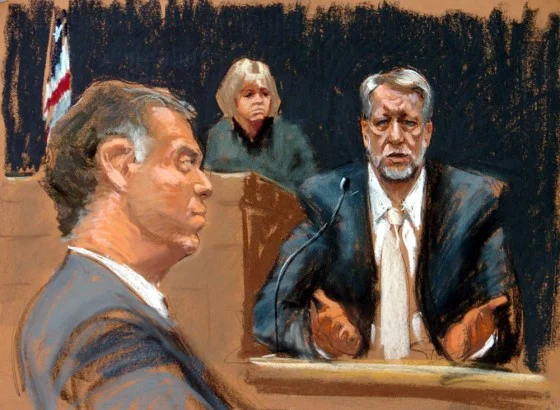
Courtroom sketch of Bernie Ebbers on the witness stand, February 28, 2005, with defense counsel Reid Weingarten in the foreground
Bernie Ebbers testifying in his own defense, February 28, 2005. Courtroom sketch by Bill Robles. 9
Ebbers' strategy: total denial. He had refused to be interviewed by the Beresford Committee. At the July 2002 congressional hearing, he read an opening statement declaring "I do not believe I have anything to hide," then immediately invoked the Fifth Amendment — claiming innocence while refusing cross-examination. 7 At trial on February 28, 2005, he took the witness stand and testified: "I wasn't advised by Scott Sullivan of anything ever being wrong. He's never told me he made an entry that wasn't right. If he had, we wouldn't be here today." 9 His defense rested on the assertion that he, as CEO, knew nothing of technology or accounting: "I know what I don't know. To this day, I don't know technology and I don't know finance and accounting." 9
Sullivan's strategy: total disclosure. Sullivan testified that Ebbers had pressured him with the phrase "We have to hit our numbers" and described Ebbers as a detail-oriented manager far more familiar with financial performance than his trial testimony suggested. 6 Prosecutors praised Sullivan's "cool demeanor in the face of tough cross-examination," his exhaustive preparation, and his willingness to volunteer information beyond what he was directly asked. 15
On March 15, 2005, a jury convicted Ebbers on all nine counts — one count of conspiracy, one count of securities fraud, and seven counts of filing false statements. 16 On July 13, 2005, Judge Jones sentenced him to 25 years in federal prison — the longest sentence for white-collar crime in U.S. history at that time. 16
Sullivan was sentenced on August 11, 2005, to 5 years in prison. Judge Jones was explicit about why: "Mr. Sullivan's cooperation was the key factor in the case of Mr. Ebbers, without which Mr. Ebbers likely could not have been indicted, much less convicted." 3 At sentencing, Sullivan said: "I made horrible decisions. It was a misguided effort to save the company. I ask for leniency so I can get back to my family as soon as possible." 3
Sullivan had originally faced up to 165 years of potential exposure. 15 The cooperation reduced his effective sentence by 97%.
The SEC settlement imposed a $2.25 billion civil penalty on WorldCom — the largest in SEC history at the time — satisfied by $500 million in cash and 10 million shares of reorganized MCI common stock, distributed to investors through the Sarbanes-Oxley Section 308 Fair Funds mechanism. 17 Over $6.1 billion in total was distributed to more than 830,000 individual and institutional investors in the class-action settlement. 7 Ebbers surrendered nearly all his assets; his wife was left with an estimated $50,000. He was released on compassionate grounds in December 2019 due to declining health and died on February 2, 2020, at age 78. 7
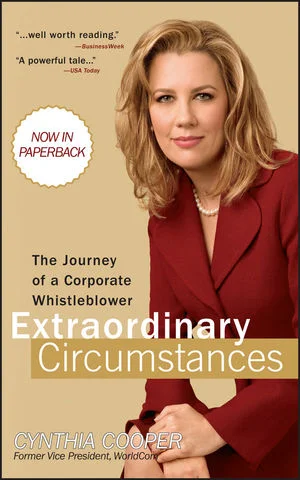
*Extraordinary Circumstances: The Journey of a Corporate Whistleblower* by Cynthia Cooper, published by Wiley (2008 paperback edition)
Cynthia Cooper's account of the audit process and its aftermath. She was named TIME Person of the Year in 2002 alongside Enron's Sherron Watkins and FBI agent Coleen Rowley. 18

Frameworks you can use

The first-mover cooperation advantage in criminal prosecutions

The 25-versus-5 sentencing gap is the sharpest illustration in modern white-collar history of what prosecutors call the "first mover advantage" in cooperation negotiations. The calculus is straightforward in structure: the prosecution needs an insider who can establish knowledge and intent at the senior level; the first person to provide that testimony receives the largest sentencing discount; every subsequent cooperator provides diminishing marginal value.
Sullivan understood this. His defense counsel later noted that it was "the experience of others in a similar position that moved him to cooperate in the hope of a minimal sentence." 15 He had watched Michael Milken, Ivan Boesky, and others work through the cooperation calculus before him. His potential 165-year exposure made a 5-year outcome look transformational.
Ebbers' refusal to cooperate reflected a different — and ultimately incorrect — theory of his case: that he could convince a jury that a CEO could build a company to $39 billion in revenues while being genuinely unaware of how the financials were constructed. The jury took four days to reject that theory. 16
For mid-level managers: when a potential fraud investigation materializes, the critical negotiating window is the first 48–72 hours. At that point, cooperation agreements can still be structured around information the prosecution genuinely lacks. After the first cooperator has testified, the information advantage disappears — and so does the leverage. The Ebbers-Sullivan divergence is a precise illustration of what happens at both ends of that decision.

The "tone at the top" as a coercion mechanism

The Beresford Report identified something more specific than "culture" as the driver of WorldCom's fraud: individual coercion. Ebbers created "a culture, as well as much of the pressure, that gave birth to this fraud." 5 Investigators collected "numerous accounts of Ebbers' demand for results — on occasion emotional, insulting, and with express reference to the personal financial harm he faced if the stock price declined." 5
The Darden case WorldCom: Keeping Planes in the Air focuses on Betty Vinson, a senior manager in corporate accounting who falsified entries at Sullivan's direction after being assured — repeatedly — that "this accounting manipulation would only occur one time." 19 Vinson ultimately received a lighter sentence, but her trajectory is the case study in what psychologists following Stanley Milgram would call obedience to authority under institutional pressure.
The framework maps onto the Fraud Triangle — pressure, opportunity, rationalization — with the important addition that at WorldCom, the "pressure" component was actively manufactured by the CEO and not simply ambient financial distress. Ebbers' $408 million in personal loans, approved by the board's Compensation Committee without full board disclosure, meant that he had a direct personal financial interest in every fraudulent entry Sullivan made. 8
For anyone managing a finance or accounting function: when someone above you ties their personal financial survival to the numbers you produce, you are no longer in an ordinary reporting relationship — you are in a coercion structure. The relevant question is not whether the person is asking you to do something explicitly illegal. It is whether the pressure to hit numbers has severed the connection between reported results and actual results.

Collateral priority as bankruptcy leverage

The four-class recovery spread in WorldCom's restructuring — from 94 cents for Intermedia creditors to zero for stockholders — was not primarily the product of negotiation skill in the bankruptcy proceeding. It was the product of structural decisions made years earlier, when MCI and Intermedia were acquired as subsidiaries with their own debt tranches, distinct from the parent's unsecured bond obligations.
The dissident creditors who extracted additional value (MCI Quips holders going from zero to 47 cents, MCI trade claims going from 36 cents to 50 cents) succeeded because they had a specific legal theory: substantive consolidation — combining MCI into the WorldCom parent estate — was procedurally unfair given how much more profitable MCI was as a standalone business. The overnight settlement was a recognition by WorldCom's restructuring team that litigating consolidation would delay emergence and cost more than the settlement itself. 12 Analyst Pat Comack described the $400 million payment as "a small price to pay to emerge from bankruptcy as soon as possible." 12
The lesson for M&A structurers: the debt architecture you create at acquisition determines the recovery hierarchy if the deal goes wrong. WorldCom's acquisition of MCI and Intermedia left those subsidiaries with their own senior debt, which turned out to be a windfall for MCI and Intermedia bondholders in bankruptcy. The parent's bondholders, who bought WorldCom paper at par, were sitting on the liability side of the fraud. Structural protection is not a bankruptcy concept — it is a deal design concept.

The 35-day legislative clock: negotiating reform under crisis pressure

WorldCom's fraud disclosure on June 25, 2002 did not merely trigger a regulatory response — it compressed years of pending corporate governance reform into five weeks. Senator Paul Sarbanes introduced his reform bill (S. 2673) on the same day as WorldCom's disclosure. 4 The Senate passed it 97-0 on July 15. The final bill passed the House 423-3 and the Senate 99-0 on July 25. President Bush signed it on July 30 — 35 days after the WorldCom announcement. 4
Sarbanes-Oxley's core provisions map directly to WorldCom's specific failure modes: Section 302 (CEO/CFO personal certification of financial reports) was aimed at the Ebbers defense — the claim that a CEO can disclaim knowledge of his own filings. Section 404 (management assessment of internal controls) was aimed at WorldCom's 11 accounts-receivable systems and the control fragmentation that let Sullivan operate without detection. The whistleblower protections in Title VIII were aimed at the environment Cooper described when she had to work at night to avoid detection. 4
The legislative speed was possible because the Enron collapse six months earlier had primed the political environment — but the WorldCom disclosure sealed it. Crises create legislative windows that close quickly. The negotiating leverage belongs to whoever can define the problem clearly enough to move consensus before the window closes. In this case, WorldCom handed reformers a problem so clearly defined — $9 billion, 5 quarters, two perpetrators, a board that knew nothing — that the path to legislation had no credible opposition.

What to remember

  • In criminal investigations, the first cooperator captures the largest sentencing discount. Sullivan faced up to 165 years of potential exposure; his cooperation and testimony produced a 5-year sentence. Ebbers rejected cooperation and received 25 years — the longest white-collar sentence in U.S. history at the time. The information advantage of early cooperation disappears once the prosecution's primary witness has testified. The window is narrow and it closes in days, not weeks.
  • Personal financial entanglement between a CEO and stock price is a structural governance warning. WorldCom's board authorized $408 million in loans to Ebbers backed by WorldCom shares — making his personal solvency directly dependent on the company's reported performance. The Beresford Committee found this arrangement "may have played a role in motivating the misconduct." 5 When a CEO's personal wealth is this tightly coupled to the stock price, the board has created a direct incentive to misreport — and an obstacle to any governance mechanism designed to catch it.
  • The debt architecture you build at acquisition determines the recovery map in bankruptcy. WorldCom's MCI and Intermedia bondholders recovered 80 and 94 cents on the dollar, respectively, while WorldCom's own bondholders recovered 36 cents. The difference was collateral priority established years before the fraud, not anything that happened during the bankruptcy proceeding. Deal structure is crisis architecture.
  • Crisis windows compress legislative timelines. The Sarbanes-Oxley Act passed in 35 days because WorldCom's fraud arrived in a post-Enron environment where the political consensus for reform already existed but lacked a final catalyst. Section 302 certification requirements and Section 404 internal control mandates — each a direct response to a specific WorldCom failure — became law faster than most corporate governance reforms pass in a decade. The speed was not accidental; it reflected how clearly the problem was defined and how little credible opposition remained.
Cover image: AI-generated editorial illustration combining fiber optic cable fracture with corporate ledger imagery. AI-generated composite image.

이 콘텐츠를 둘러싼 관점이나 맥락을 계속 보강해 보세요.

  • 로그인하면 댓글을 작성할 수 있습니다.