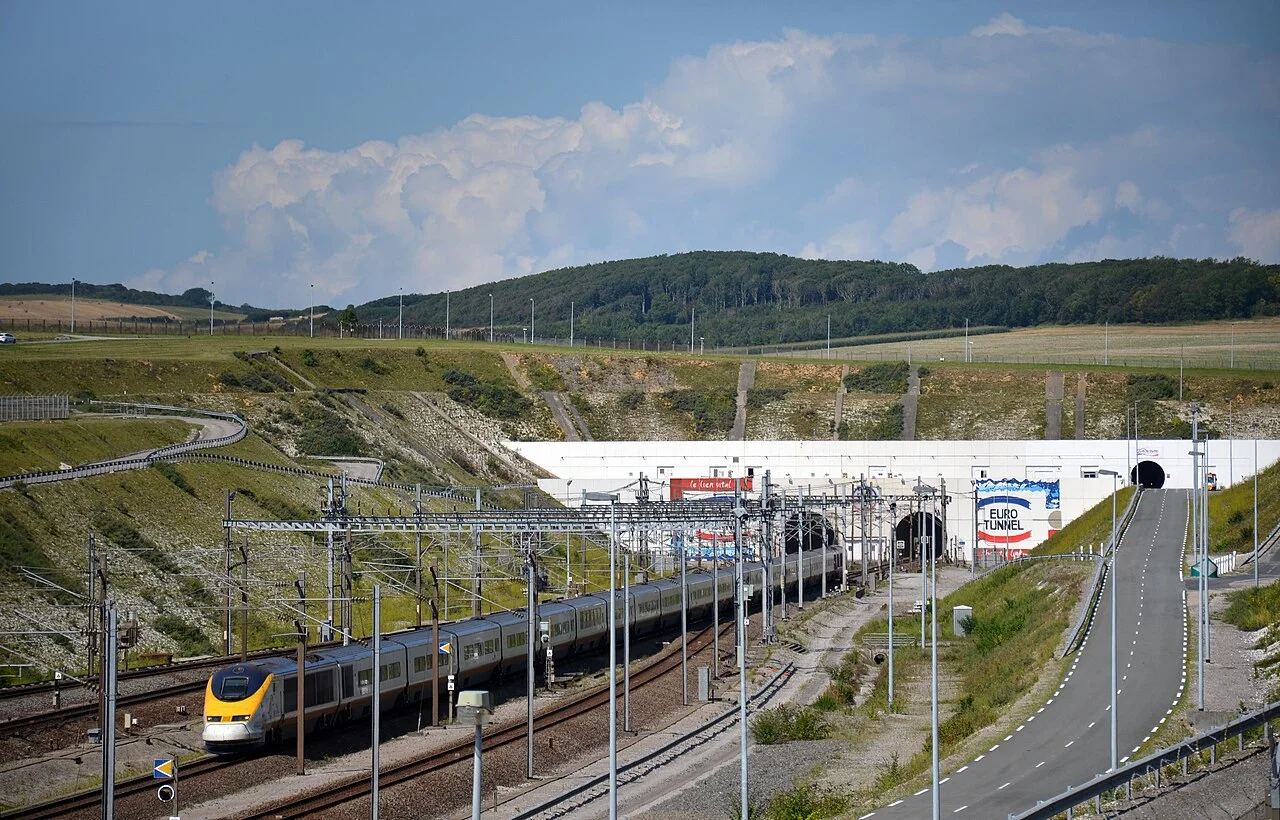
Channel Tunnel — engineering the 38 km hole under the English Channel
A 5,500-word engineering case study tracing the Channel Tunnel from the 1882 first attempt through the 1994 opening to 2026 operations. The article follows the chain of forced decisions: chalk marl geology selection (28-year site investigation, 166 marine boreholes) drove the asymmetric TBM fleet (6 UK open-face vs. 5 French EPB machines that ran closed mode for the first 5 km); the three-bore configuration with a positive-pressure service tunnel bored 1 km ahead as a geological pilot is shown as a dual-purpose safety and surveying solution; the 50°C cooling problem required Europe's largest chilling system (480 km of pipes, now upgraded to Trane CenTraVac units saving 33% energy); and the 1996/2008 fires validated the cross-passage evacuation philosophy while driving the SAFE station fibre-optic detection programme and the current Siemens replacement (≈£90M). Legacy section covers EPB general-purpose validation, Crossrail service gallery inheritance, ElecLink 1 GW interconnector, Getlink's record €859M 2025 EBITDA, and the March 2025 St Pancras Highspeed MoU targeting Cologne/Frankfurt/Geneva routes.
Profile, prehistory, and the financing gamble
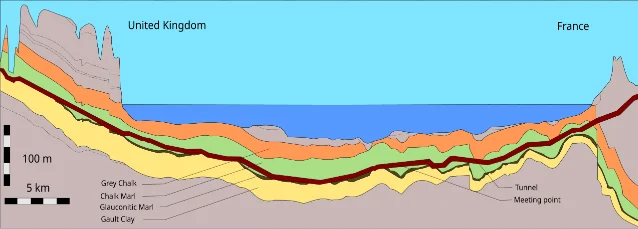
The geology decision — finding the right stratum
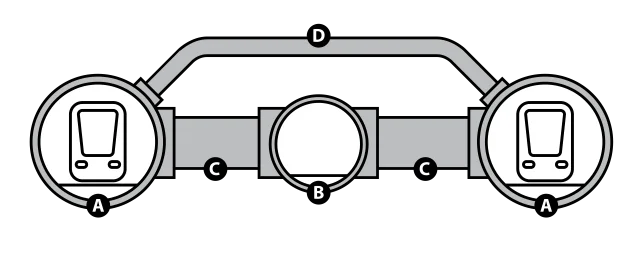
Three-bore architecture — the service tunnel as an engineering keystone
The TBM fleet — 11 machines, two different problems
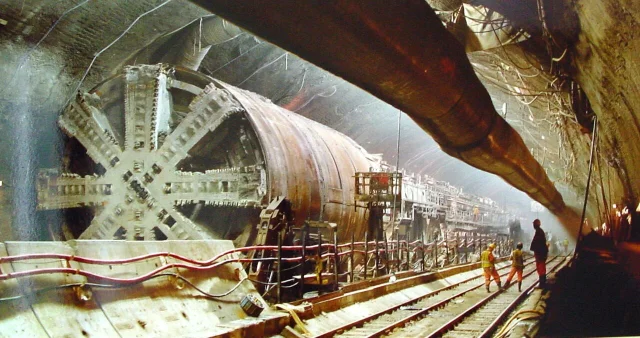
Construction logistics — moving a mountain under the sea
Technical specifications — railway systems and the 50°C cooling problem
Electrification and signalling
Track system
Cooling
Specifications summary
| Parameter | Value |
|---|---|
| Total tunnel length | 50.46 km (31.35 mi) |
| Undersea section | 37.9 km (23.5 mi) |
| Running tunnel internal diameter | 7.6 m (25 ft) |
| Service tunnel internal diameter | 4.8 m (16 ft) |
| Running tunnel spacing (centres) | 30 m (98 ft) |
| Cross-passage diameter / spacing | 3.3 m / 375 m |
| Piston relief duct diameter / spacing | 2 m / 250 m |
| Crossover cavern dimensions | 150 m × 10 m × 18 m |
| TBM bore diameter (running) | 8.72 m outer |
| TBM bore diameter (service) | 5.76 m outer |
| Electrification | 25 kV 50 Hz AC overhead |
| Signalling | TVM-430 cab signalling + ATP |
| Operating speed | 160 km/h |
| Design speed | 200 km/h |
| Track system | Sonneville LVT, UIC60 rail, 60 cm spacing |
| Cooling pipe length | 480 km |
| Cooling pipe diameter | 61 cm |
| Cooling water volume | 84 million litres |
| Tunnel depth below sea level (max) | 75 m |
| Tunnel depth below seabed (average) | 45 m |
| Construction start | 1 December 1987 |
| Opening (official) | 6 May 1994 |
| Initial cost estimate (1985 prices) | £2.6 billion |
| Final cost (1985 prices) | £4.65 billion (80% overrun) |
| Concession expiry | 2052 |
Fire safety — a philosophy tested by real fires
Legacy and the tunnel's second act
참고 출처
- 1Wikipedia: Channel Tunnel
- 2Eastern Engineering Group: Eurotunnel and the Channel Tunnel
- 3Springer: Rock Mass Classification of Chalk, a UK Perspective
- 4Practical Engineering: How The Channel Tunnel Works
- 5FOSA/AP Sensing: Eurotunnel Chooses AP Sensing for Fire Detection
- 6Railway Technology: The future is now for the Channel Tunnel
- 7CTSA: Work Plan 2026
- 8Getlink SE: Annual Results 2025
- 9Getlink: Eurotunnel and London St. Pancras Highspeed accelerate HSR
- 10European Commission: Plan to accelerate high-speed rail across Europe
이 콘텐츠를 둘러싼 관점이나 맥락을 계속 보강해 보세요.