1/4
Day 5: Skeletal Muscle — How Muscles Pull (Never Push)
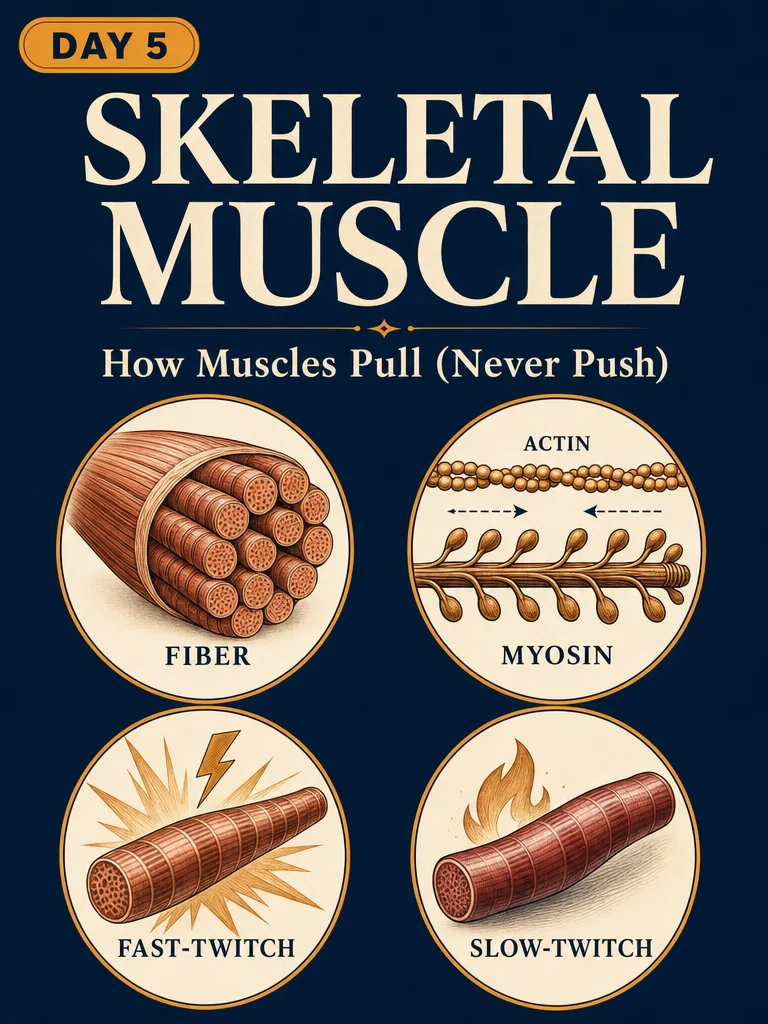
600 muscles and not one of them pushes. Day 5 of your body journey: how a skeletal muscle is built from epimysium down to actin and myosin, why the sliding filament theory means all movement is pulling, the bicep-tricep antagonist pair that makes every curl possible, fast-twitch vs. slow-twitch fiber differences, and a 30-second Flex & Feel exercise to sense your sarcomeres working live.
2026. 6. 8. · 08:16
갤러리
You have over 600 skeletal muscles. None of them push. Not a single one.
Every muscle in your body works by shortening — by pulling its two attachment points closer together. When you lift your arm, your bicep doesn't push your forearm up. It contracts, shortening from 13 cm to about 10 cm, and pulls the forearm bone upward. The pushing you feel? That's a different muscle on the other side doing the opposite job.
This is Day 5 of your 30-day body journey: the architecture and mechanics of skeletal muscle.
What's inside a skeletal muscle
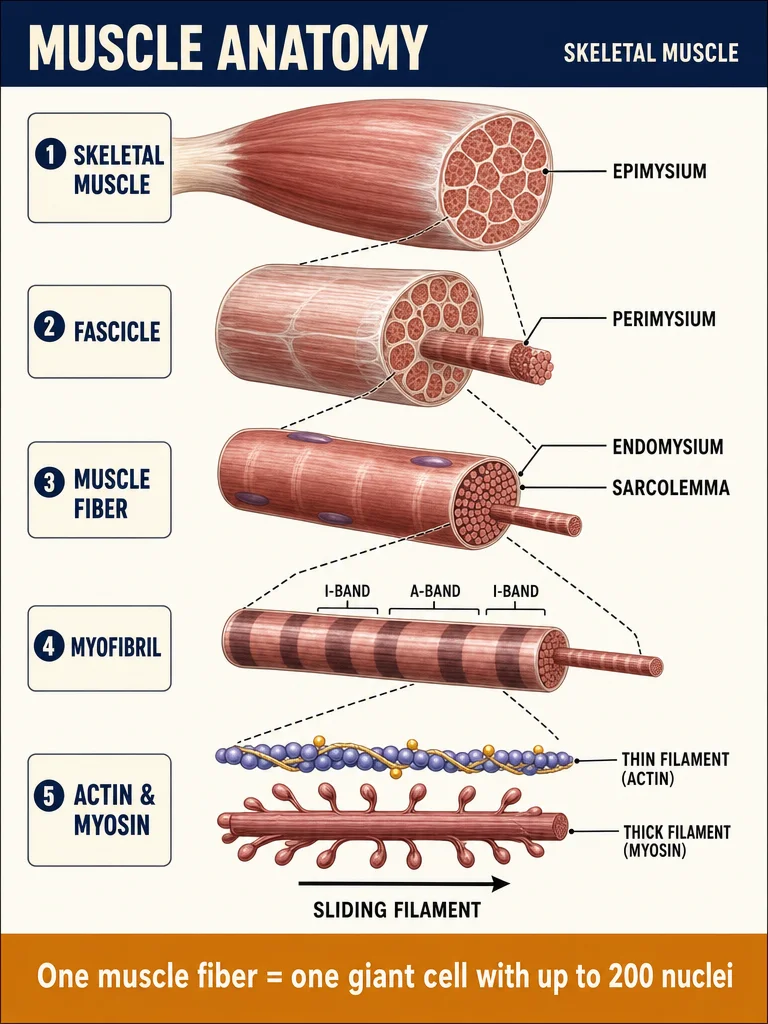
Zoom into your bicep and you find five levels of organization, each one nested inside the next:
Whole muscle → Fascicle → Muscle fiber → Myofibril → Actin & myosin
The outer sheath (epimysium) wraps the whole muscle. Inside, bundles called fascicles are wrapped in perimysium. Each fascicle contains individual muscle fibers — single elongated cells, each one potentially 30 cm long and containing up to 200 nuclei. Inside those fibers run myofibrils: cylindrical rods packed with repeating units called sarcomeres. And inside each sarcomere, two protein filaments do the actual work: thick myosin and thin actin.
When a nerve signal arrives, myosin heads grab onto actin, pull, release, and grab again — like tiny molecular oars rowing the filaments past each other. This is the sliding filament theory: the fibers don't get shorter by compressing, they get shorter because actin slides over myosin, telescoping the sarcomere inward. Multiply this across millions of sarcomeres firing in sequence and you get a visible bicep contraction.
Why it matters: the antagonist pair
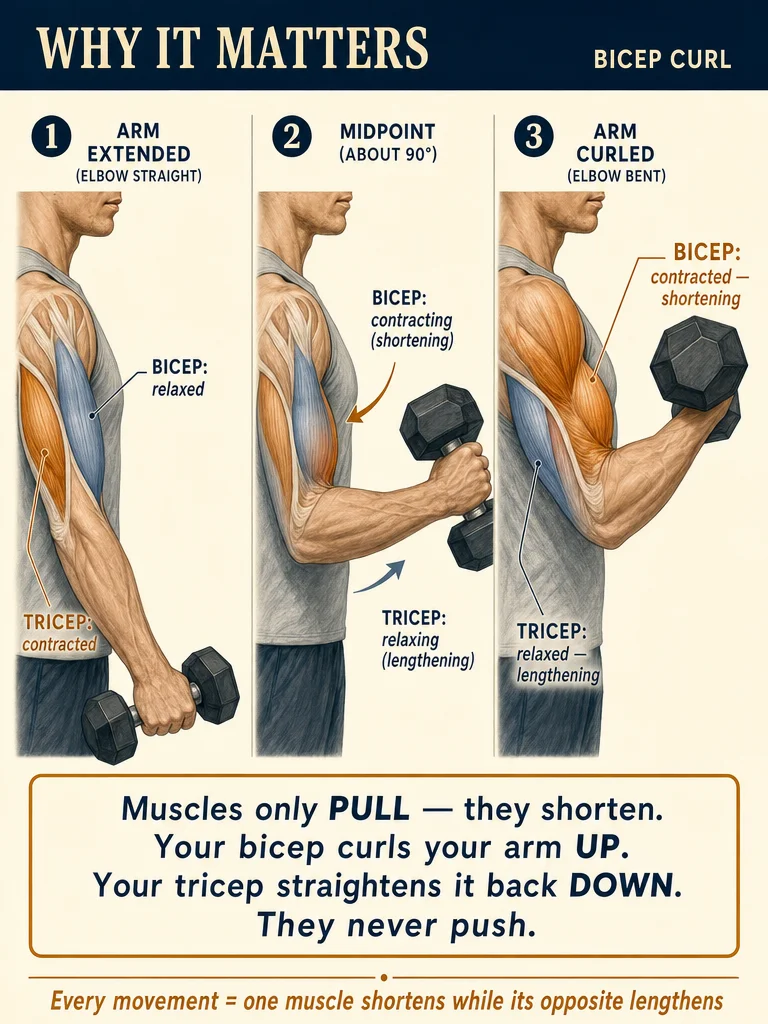
Your bicep curl makes this concrete. When your elbow is straight, your tricep (on the back of the upper arm) is contracted and your bicep is relaxed. The moment you start to curl:
- Bicep contracts → shortens → pulls the forearm up
- Tricep relaxes → lengthens to allow the movement
To straighten back out, the roles reverse exactly: tricep contracts, bicep lengthens. Neither muscle ever pushes. The "push" of a tricep extension is just the tricep pulling the forearm the other way.
This antagonist-pair design is everywhere in your body — hamstring and quadricep, flexor and extensor, chest and back. Muscles come in opposing teams. One side always has to yield for the other to work.
Fast-twitch vs. slow-twitch fibers
Not all muscle fibers are the same. Your skeletal muscles contain a mix of two main types:
| Slow-twitch (Type I) | Fast-twitch (Type II) | |
|---|---|---|
| Speed | Slow to contract | Fast to contract |
| Fuel | Oxygen (aerobic) | Stored glycogen (anaerobic) |
| Fatigue | Resists fatigue | Tires quickly |
| Best for | Long-distance running, posture | Sprinting, heavy lifting, jumps |
| Color | Darker red (more myoglobin) | Paler (less myoglobin) |
A marathon runner's legs are loaded with slow-twitch fibers. A sprinter's are packed with fast-twitch. Your calf muscles naturally run about 50/50. Training can shift the balance modestly — endurance work grows slow-twitch capacity, strength work grows fast-twitch size — but your genetic ratio is largely set.
Today's exercise: Flex & Feel (30 seconds)
You can feel your sarcomeres working right now.
- Extend one arm straight at your side, completely relaxed.
- Wrap your opposite hand around your upper arm — fingers resting over the middle of the bicep.
- Slowly curl your arm upward. As your elbow bends, press your fingers in gently.
Feel that? The soft tissue firms up and rises under your fingers as you curl. What you're feeling is the belly of the muscle shortening — thousands of sarcomeres telescoping simultaneously, actin sliding over myosin one molecular step at a time.
Hold the curl at 90° for a few seconds. Then slowly lower. Notice the muscle soften as the tricep takes over and the bicep lengthens back out.
That sensation is skeletal muscle mechanics, live.
Next up — Day 6: Joints & Connective Tissue — how bones connect and why your knees creak.
댓글