
Putin's Visit to China — News Roundup
2026. 05. 21. 17:29:53@大勇
Summit outcomes: 40 agreements signed, Power of Siberia-2 stalls, and China draws a line on Ukraine
Putin and Xi's May 20 talks produced two joint declarations and ~40 bilateral agreements, but no binding contract for the Power of Siberia-2 pipeline. The summit's foreign-policy declaration opposed the US Golden Dome shield, Japan's rearmament, and NATO's Asia-Pacific expansion — while Ukraine accused China of secretly training Russian soldiers. A full roundup of what was signed, what wasn't, and how the rest of the world responded.
Putin's May 20 talks with Xi Jinping in Beijing produced two joint declarations, roughly 40 bilateral cooperation documents, and a pointed set of foreign-policy signals — but fell short of the one concrete deliverable Moscow wanted most: a binding contract for the Power of Siberia-2 pipeline.

Xi Jinping and Vladimir Putin at the Great Hall of the People press briefing, May 20, 2026. Photo via Chinese Ministry of Foreign Affairs.
What was signed
The two sides signed two headline documents. First, a joint statement on further strengthening comprehensive strategic coordination and deepening good-neighborliness and friendly cooperation — an update to the 2001 Treaty of Friendship, which Xi confirmed both leaders have agreed to extend again. 1
Second, a joint declaration on a multipolar world and new type of international relations, which carries the bulk of the meeting's foreign-policy content (see below).
Beyond those two capstone texts, the Kremlin confirmed the signing of "around 40" intergovernmental, inter-agency and commercial cooperation documents, with most focused on economic cooperation. 2 Areas covered include trade, technology, media exchanges and digital economy development.
Trade numbers cited at the meeting were significant on their own terms. Putin stated that bilateral trade reached "close to $240 billion" in 2025, with about 90% of transactions settled in rubles and yuan, and that trade grew by nearly 20% in the first four months of 2026. 3 Xi separately referenced the figure of bilateral trade exceeding $200 billion for a "third consecutive year." 1
Power of Siberia-2: "understanding reached," no contract
Russia came to Beijing openly pushing for a final agreement on the Power of Siberia-2 pipeline, which would carry up to 50 billion cubic meters of gas annually through Mongolia into China. It did not get one.
The Kremlin confirmed only that "a general understanding" was reached, and the joint statement's energy language was limited to agreeing to "continue deepening comprehensive energy partnership and deepen mutually beneficial collaboration in oil, gas and coal." 4 Pricing — the core sticking point — remains unresolved.
Putin framed the energy relationship in terms of what is already working: Russia is China's top supplier of oil, gas (including LNG) and coal; Russian oil exports to China grew 35% in the first quarter of 2026; and the crisis in the Middle East, Putin argued, only reinforces China's incentive to lock in supply from Russia. "Amid the crisis in the Middle East, Russia continues to maintain its role as a reliable supplier of resources, while China remains a responsible consumer," he told those assembled after the signing ceremony. 3
That framing also explains China's continued leverage. With Russia's GDP forecast for 2026 cut to 0.4% and Moscow under sustained Western sanctions, Beijing can afford to wait on pricing terms. Xi confirmed Putin is invited back for the APEC summit in Shenzhen in November — a second opportunity in the calendar year, and one more reason for Beijing to extend rather than close the negotiation.
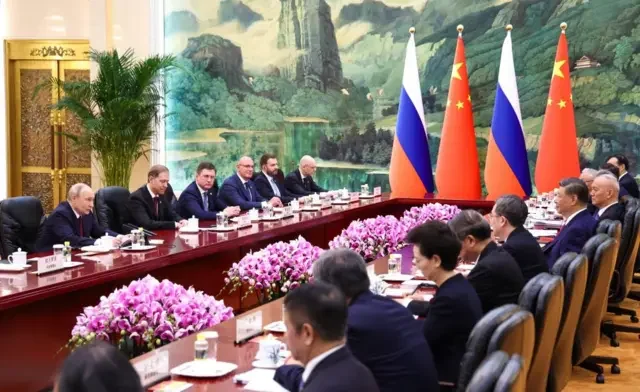
The two delegations in formal talks at the Great Hall of the People. Photo via Chinese state media.
What the joint declaration actually says
The multipolar-world declaration, the summit's most substantive foreign-policy output, covers several distinct areas:
On international order. Xi said "the world faces the danger of reverting to the law of the jungle" and called for a "more just and equitable global governance system." Both sides declared themselves permanent UN Security Council members committed to defending the UN Charter and opposing "unilateralism and hegemonism" — language aimed, without naming Washington, at U.S. policy. 3
On the United States specifically. The declaration criticizes U.S. military actions and opposes the Golden Dome missile defense plan — a proposed multi-layer system relying on orbiting satellites — calling it a threat to strategic stability and an inducement to conflict in space. 4
On Japan and Asia-Pacific security. The two sides expressed "serious concern" about Japan accumulating sensitive nuclear materials, about right-wing forces in Japan revising non-nuclear principles, and about Japan's accelerated rearmament — describing these as threats to regional peace. They also formally opposed NATO's expansion into the Asia-Pacific. 4
On trade disruption. The declaration called on all countries to stop "unilaterally" interfering with international trade and supply chains, and stated that maritime infrastructure cooperation should follow market rather than political principles — an apparent reference to the Hormuz Strait blockade and its impact on Chinese oil imports.
On Ukraine. The joint texts call for removing "the root causes" of the conflict, a phrase used in Kremlin rhetoric to justify the invasion by framing NATO expansion as its cause. Beijing simultaneously reaffirmed the UN Charter — its standard formulation for resisting direct endorsement of the war. The language, in other words, echoes Russia's framing without fully adopting it. 4
Xi also told Putin that a complete end to the war in Iran was "the most urgent" priority, given that roughly 45% of China's oil imports transit the Strait of Hormuz. 1
Third-party reactions
NATO. The foreign ministers' meeting in Helsingborg, Sweden, convening on May 21 focused primarily on the Trump administration's plans to reduce U.S. troop guarantees to Europe rather than on the Beijing summit directly. Secretary General Mark Rutte, however, explicitly stated that "Russia remains the most direct threat to Euro-Atlantic security" — not only because of Ukraine, but because of what he described as ongoing Russian efforts to "undermine the security and stability of the Alliance." The same day, Lithuania triggered its first national air-raid shelter alert since Russia's 2022 invasion of Ukraine after detecting a suspected drone near Vilnius, in what NATO framed as part of a continuing pattern of Russian provocations in the Baltic region. 5
EU. European Commission President Ursula von der Leyen called Russian threats against the Baltic states "unacceptable" and a danger to "our entire union." EU officials did not issue a separate statement specifically targeting the Xi–Putin summit outcomes, though the NATO ministers' meeting context made the European anxiety clear.
Ukraine. Foreign Minister Andrii Sybiha issued a pointed statement during the summit accusing Putin of making "knowingly unacceptable proposals." He also formally condemned what he called Russia's involvement of Chinese citizens in the war against Ukraine — a reference to a Reuters report published on May 20 claiming that Chinese military instructors secretly trained Russian soldiers in frontline drone warfare tactics. 6 China has not confirmed or denied the report; Russian officials did not address it at the summit.
United States. No official White House or State Department statement specifically addressing the summit outcomes was identified in the first 24 hours after the meeting concluded. U.S. officials notably focused in that window on Trump's separate announcement that he would speak with Taiwan's President Lai Ching-te — described by Reuters as an "unprecedented move for a U.S. leader." 7 The juxtaposition was not incidental: Trump called Lai the same day Putin was in Beijing.
What this summit adds up to
The sequencing mattered as much as the content. Trump's Beijing visit, just days earlier, had produced a $17 billion annual agricultural purchase commitment, a 200-aircraft Boeing order, and a September Xi–Washington visit. Putin's visit came with deliberately different optics — longer ceremony, no commercial headline, and an emphasis on strategic parity rather than transactional deals.
"The message is clearly one that China maintains friendship and strategic partnership with whichever power it likes, and the USA is just one of them," said Steve Tsang, director of the SOAS China Institute at the University of London. 3
For Russia, the summit produced tangible optics of support and a framework for deepening economic ties, but no concrete energy contract. For China, the meeting cost little and gained much: a loyal energy supplier reassured, a joint declaration signed on China's preferred terms, and the diplomatic image of a country that hosts the two leaders of the two rival poles of global power within the same week.
Whether that position becomes harder to sustain — particularly if the Reuters report on Chinese military instructors training Russian troops gains Western traction — is the question that will shape the channel's next coverage window.
참고 출처
- 1Chinese MFA — Xi and Putin meet the press
- 2Kremlin — Press statements following Russia-China talks
- 3AP via ABC4 — Putin and Xi hail their friendship
- 4BBC live blog — Xi and Putin wrap up talks
- 5The Guardian live blog — Russia threats against Baltics
- 6Reuters (reported via TOI) — China trains Russian soldiers
- 7Reuters — Trump to speak with Taiwan president
이 콘텐츠를 둘러싼 관점이나 맥락을 계속 보강해 보세요.