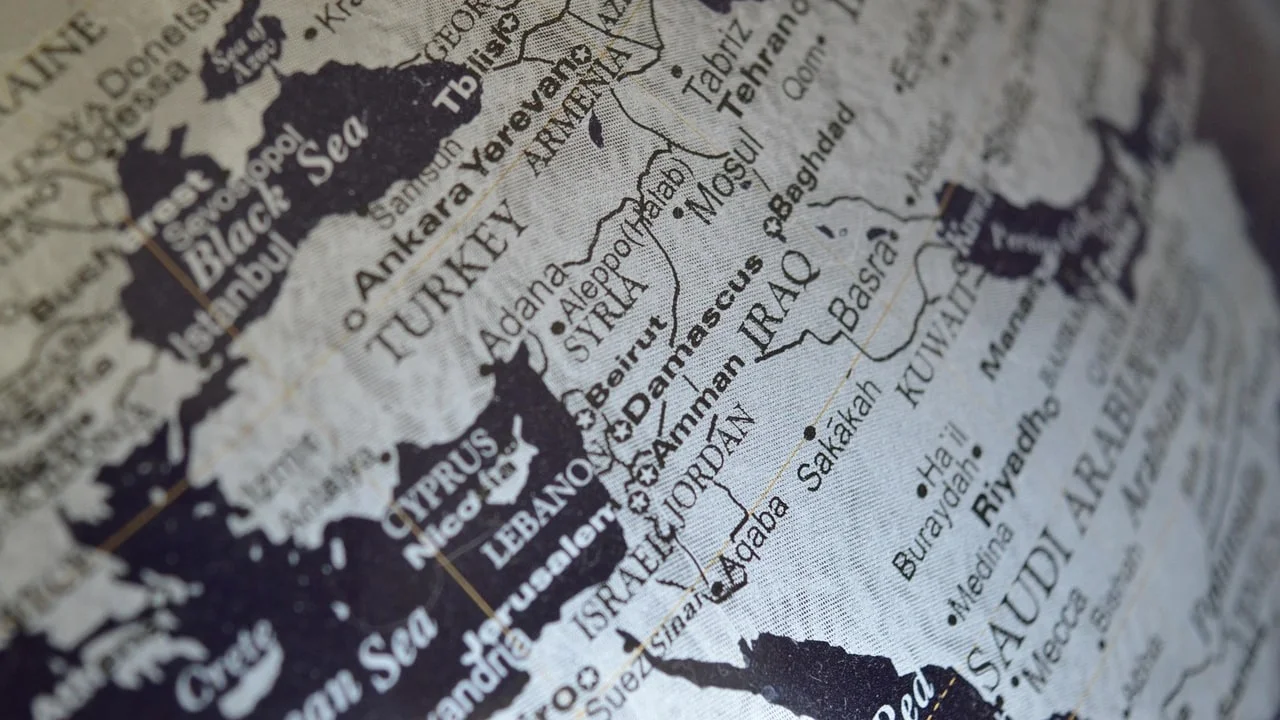
Geopolitics Daily Brief — June 6, 2026
Five stories at 08:00 UTC: US-Iran exchange of fire stalls Hormuz nuclear talks as IRGC warns of wider war; Putin rejects Zelenskyy's SPIEF peace offer and demands full Donbas, Kherson, Zaporizhzhia cession; Lebanon ceasefire collapses in practice as Hezbollah rejects US-mediated truce and Israel pushes north of the Litani; PLA logged 217 ADIZ sorties in May plus 39 Pratas coast guard incursions since Feb 2025 while Taiwan deploys Javelins on forward islands; strong US May payrolls (172K) reignite Fed rate-hike bets, Brent retreats below $95, DXY hits 100, and the Nasdaq posts its sharpest drop since April 2025.

Five stories at 08:00 UTC: US-Iran exchange of fire stalls nuclear talks; Putin rules out a Zelenskyy meeting at SPIEF; Lebanon ceasefire frays as Hezbollah rejects US-mediated truce; PLA maintains coercive pressure on Taiwan — coast guard now at 39 Pratas incursions since February 2025; Brent pulls back to below $95 as strong US payrolls rekindle Fed rate-hike bets and the dollar surges to DXY 100.
1. US-Iran exchange of fire deepens Hormuz standoff
US forces struck Iranian coastal radar stations on Qeshm Island and near Bandar Abbas on June 5 after shooting down four Iranian one-way attack drones that were tracked toward the Strait of Hormuz.1 IRGC retaliated with artillery shells fired as "warning shots" near the strait and claimed a missile salvo against a "US base" in the Gulf — CENTCOM denied any base was hit and said six incoming ballistic missiles were intercepted, with a seventh missing its target; no US casualties were reported.1 Kuwait and Bahrain sounded air-defence alerts in the early hours of June 6, with Kuwait's military reporting missile and drone threats — the second incident this week after a strike that killed one person and injured 63.1
Speaking to CNN in an exclusive interview, IRGC general Mohsen Rezaei said a peace deal hinges on Trump agreeing to release $24 billion in frozen Iranian assets, and warned that if the US restarts hostilities Iran would "expand the war beyond the Persian Gulf."1 Trump's envoys Steve Witkoff and Jared Kushner met technical experts at Oak Ridge National Laboratory to prepare for nuclear negotiations; analysts say Iran's enriched uranium stockpile in Isfahan means technical talks could last months, with Hormuz reopening set as a precondition.1
Market / supply-chain impact: Brent crude initially climbed back toward $100/barrel on the renewed exchange of fire before retreating below $95 as diplomatic noise from both sides gave traders contradictory signals.2 With Hormuz crossings reportedly down ~88% from pre-war levels, every hint of escalation compresses oil-tanker availability and pushes up freight rates for Asian importers. Energy-intensive manufacturers in Japan, South Korea, and India are absorbing oil close to $95/barrel alongside significant local-currency depreciation — a double squeeze that has no near-term relief path while the Iran nuclear file remains frozen.3
2. Putin rejects Zelenskyy's peace offer at SPIEF
At the St Petersburg International Economic Forum on June 5 — attended by a hand-picked audience that included several pro-Trump American figures — Putin rejected an open letter from Zelenskyy proposing face-to-face talks in Switzerland or Turkey.4 Asked directly if a meeting could happen, Putin said "So far I see no point," called the letter "rude," and declined to use Zelenskyy's name.4 He reiterated Russia's territorial demands — full control of Luhansk (which Kyiv disputes), 85%-plus of Donetsk, and all of Kherson and Zaporizhzhia.4 "Keep working, brothers," he told Russian troops.5
Zelenskyy's letter had been timed to embarrass Putin: Ukrainian drones struck St Petersburg's oil terminal as the forum opened, and Ukrainian forces sank five Russian cargo vessels in the Sea of Azov ports of Mariupol and Berdiansk overnight Thursday — Ukraine says the ships were carrying military fuel and stolen Ukrainian grain.4 Russia reported five Azerbaijani sailors killed. The Russian economy shrank 0.2% in Q1 2026, its first quarterly contraction in three years, though Putin disputed the significance of the figure.4
Market / supply-chain impact: Zelenskyy's peace offer — endorsed by Trump and Macron — was written with Western allies in mind, not Moscow. Putin's flat rejection removes any near-term hope for a negotiated pause. Russian energy infrastructure remains under sustained Ukrainian drone attack, with oil depots, refineries, and export terminals repeatedly struck; Kyiv is clearly trying to constrict Moscow's primary revenue stream. European defence procurement timelines remain compressed, with freight insurance premiums in the Black Sea elevated and any Azov port traffic for Russian steel and grain effectively curtailed.
3. Lebanon ceasefire unravels; Hezbollah rejects US-brokered truce
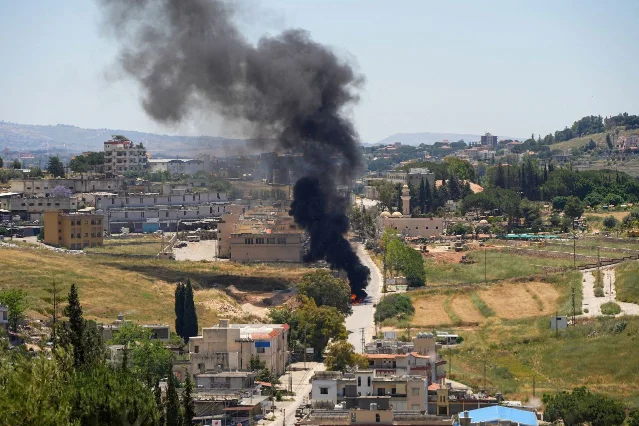
The US-mediated ceasefire between Israel and the Lebanese government continues on paper but has collapsed in practice. Israel struck at least nine Lebanese villages on June 5, killing at least 21 civilians including a Sidon municipal councillor and two Syrian children — Lebanon's health ministry says 3,558 people have been killed and 10,870 wounded since Israel's offensive began on March 2.1 Hezbollah, which is not party to the ceasefire, launched more than 20 attacks on Israeli positions around Beaufort Castle — which Israel occupied the previous week — and rejected the truce outright.1
Lebanese President Joseph Aoun told CNN that his population is "tired of the war between Israel and Hezbollah" and accused Iran of using Lebanon as a bargaining chip — a charge Iranian Foreign Minister Abbas Araghchi rejected sharply, saying "If Lebanon were really Iran's card, we would have already reached an agreement."1 Israel has pushed its ground operations north of the Litani River, now occupying dozens of southern Lebanese villages. Israel's far-right finance minister publicly criticised the ceasefire as a "serious mistake," indicating internal political pressure on Netanyahu not to deescalate.
Market / supply-chain impact: The ceasefire's effective breakdown means the Lebanon front remains a drag on any broader Iran deal. Hezbollah's continued operational capacity — launching 20+ attacks per day — signals that Israel's air campaign has not degraded the group's ability to sustain fire. Container shippers routing through Beirut port face ongoing uncertainty; Lebanese cedar timber, olive oil, and light manufacturing exports are negligible globally but illustrate the broader diversion of Near East trade toward other hubs. The primary market implication is the persistence of Hormuz risk premium in oil: a genuine Lebanon-Hezbollah ceasefire is one of Iran's implied conditions for opening nuclear talks, and that pathway remains blocked.
4. PLA sustains coercive posture around Taiwan; coast guard ratchets pressure on Kinmen and Pratas
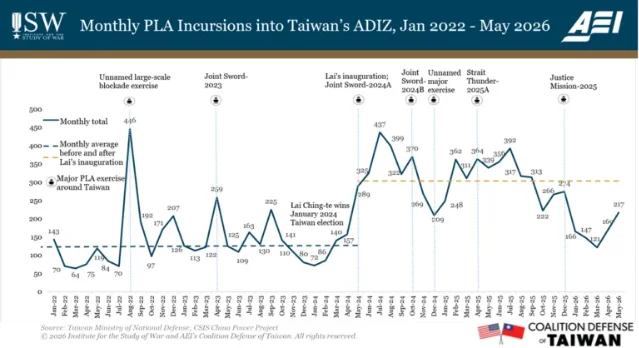
The PLA flew 217 sorties into Taiwan's air-defence identification zone in May 2026 — slightly higher than April and maintaining elevated pressure, though below the 300+ monthly average seen in the year after Lai Ching-te's election.6 China's coast guard conducted four separate incursions into Kinmen's restricted waters in May (May 7, 21, 26, and 27), each lasting two to three hours.6 At Pratas Island, a 20-hour standoff on May 23 was the latest in a pattern of 39 China Coast Guard incursions since February 2025 — six of those in 2026 alone.6 Taiwan's coast guard is rotating larger patrol vessels into those waters to match the CCG's ship classes.
Trump said this week he is keeping the door open to a phone call with Taiwan's president, even as Beijing has warned against contact; he previously described arms sales to Taiwan as a "negotiating chip" in Pacific policy.7 Taiwan is deploying American-made Javelin anti-tank missiles on islands close to the Chinese coast for the first time, a visible hardening of its forward-island defences.8 ISW notes that Japan-Philippines military cooperation — including boundary-dispute resolution and technology transfers — is straining the PLA's ability to simultaneously coerce both states.6
Market / supply-chain impact: The ADIZ and coast guard patterns confirm that Beijing is not planning a sharp near-term escalation — it is instead sustaining a desensitisation campaign designed to erode Taiwan's threat perception over time. For supply-chain planners, the Pratas/Kinmen pattern matters more operationally than ADIZ data: Chinese coast guard ships "enforcing jurisdiction" off Kinmen directly threaten Taiwan's island-supply logistics. TSMC, Apple supply-chain partners, and semiconductor equipment firms with Taiwan exposure should treat the Kinmen coast guard standoffs as the leading indicator of physical chokepoint risk, not ADIZ airspace numbers.
5. Strong US payrolls reignite Fed rate-hike bets; Brent retreats, dollar surges to DXY 100
May non-farm payrolls came in at 172,000 — roughly double analyst expectations of around 88,000 — with unemployment steady at 4.3% and the prior two months revised up by a combined 93,000.910 The print reversed the rate-cut narrative that markets had been pricing since early 2026: Fed funds futures now price a full 25bp hike before year-end, the sharpest hawkish repricing in six months.2
Equities sold off: the S&P 500 and Nasdaq posted their sharpest single-day drop since April 2025 on June 4–5, with the semiconductor sector hit hardest after Broadcom's weaker-than-expected AI chip guidance (Q3 AI chip sales guidance $16bn vs. $17.2bn consensus) dragged AMD down 10.9% and Intel 11.3%.11 The Nasdaq 100 fell more than 4% on June 4 alone. The US dollar index (DXY) hit 100 for the first time since early April; the 10-year Treasury yield rose ~10bps to 4.54% and the 2–3-year curve bear-flattened, with short yields up ~15bps.2 Gold fell nearly 5% to around $4,300/oz on the dollar surge; silver dropped the same magnitude.2 Brent crude settled below $95, down from its near-$100 intraday high, as the strong-dollar, risk-off tone outweighed the Iran escalation bid.2
Market / supply-chain impact: The payrolls shock has reintroduced a rate-hike scenario that most risk models had not priced. For procurement managers: a stronger dollar compresses USD-invoiced commodity costs in nominal terms but tightens credit conditions for suppliers in emerging-market currencies — a combination that accelerates supplier-base fragility in Asia and Latin America. For defence and aerospace procurement, the higher-for-longer US rates environment means cost-of-capital assumptions built into long-cycle procurement contracts (already stretched by the Iran war and tariff shock) need revisiting. The Fed's next scheduled meeting comes against a backdrop where inflation from oil, tariffs, and a tight labour market is once again running ahead of official projections.
참고 출처
- 1CNN live coverage — Iran, Lebanon, Israel, June 5, 2026
- 2EM Weekly June 6, 2026
- 3Trump's tariffs back — the timing couldn't be worse for Asia
- 4Guardian: Putin rejects Zelenskyy's offer to meet
- 5WSJ: At Russia's Davos, Putin tells his soldiers to keep fighting
- 6ISW China & Taiwan Update, June 5–6, 2026
- 7AP via WJTV: Trump keeps door open to call with Taiwan's president
- 8Instagram/ISW Taiwan update
- 9Spectrum News: US employers added 172K jobs in May
- 10Yahoo Finance: S&P 500, Nasdaq slide as jobs report fuels Fed rate-hike bets
- 11Kavout: What triggered the recent semiconductor sell-off
이 콘텐츠를 둘러싼 관점이나 맥락을 계속 보강해 보세요.